Showing posts sorted by relevance for query itaxon. Sort by date Show all posts

Wednesday, February 04, 2009

Wiki demo


Reading a recent TAXACOM thread (Species Pages - purpose) my sense is that some people are arguing that "species pages" would be time consuming to create, aren't much good for taxonomists (to quote Mike Dallwitz "In brief, to make simplified and attractive information about taxa easily available to casual users?"), and nobody gets credit for making them. In short, "they're not for me, I don't get credit for making them, so why bother?"

Others (e.g., Doug Yanega) see species pages -- properly constructed -- to be a research tool. If we extend this to its logical conclusion, we could envisage these pages being the primary source of information on taxa. Indeed, new taxa could be described in this way. In short, "this is the future of taxonomic publication".

One obvious way to realise species pages sensu Doug Yanega is using a wiki, but then there are those that horrified by the prospect of just "anyone" being able to edit that content. In short, "wikis are not for serious people, the ignorant might mess up my stuff". Others have had a more positive experience.

I realise this doesn't do justice to these positions, but this make things a little concrete, I've put together a demo based on a wiki I'm constructing. The aim of this wiki is to link together taxonomic names, specimens, images, classifications, publications, phylogeny, people in one place. It's a bit like a wiki version of my Elsevier Challenge entry.

This is some way off being ready for prime time, but I thought it might be useful to show the sort of thing that can be done.

As a starting point, http://itaxon.org/wikidev/Chromis_circumaurea is a page about Chromis circumaurea, one of the fish Rich Pyle et al recently described in Zootaxa. This page contains a map and some specimen images, and an abbreviated description copied from the Zootaxa article. The images and the map are generated automaticaly by the wiki, based on the links it has to the specimens, e.g.:

http://itaxon.org/wikidev/BMNH_2007.10.31.3
http://itaxon.org/wikidev/USNM_391138_%28Fishes%29

The USNM specimen is linked to a GenBank sequence http://itaxon.org/wikidev/EU358583 . Specimens themselves are linked to Museum collections (using data from Biodiversity Collections Index ).

The name itself is linked to a publication:

http://itaxon.org/wikidev/Jacc:1175-5326:1671%403

which is also linked to the authors. The wiki supports GUIDs, so that you can link to the page about Chromis circumaurea using it's ZooBank LSID, for example: http://itaxon.org/wikidev/Urn:lsid:zoobank.org:act:8ADC4817-8F1C-4C88-8B8A-5372A84CAEC9

What I hope this crude example demonstrates is a framework where we can support all the kinds of objects we care about, and easily create links between them that can generate useful information. For example, the page for Chromis circumaurea doesn't explicitly list the images shown, they are there because of the links between Chromis circumaurea, the specimens, and the images of those specimens. The same applies to the map. What this means is that very little information needs be entered, it's mostly a matter of joining the dots.

Note that these wiki pages already have more information than either iSpecies or EOL.

This example has been assembled by hand, but much of the data required can be entered automatically (e.g., for sequences, specimens, publications, etc.), and tools such as text mining or XML markup (e.g., TaxonX) could be easily exploited. I also realise that as it stands the demo has very limited information about the organism itself, but I don't this this as intractable.

If we could build things like this (and I believe we can, with a lot less effort than might be thought), the question becomes this the kind of "species page" that would be useful?

Monday, December 05, 2011

These are my species - finding the taxonomic names I published using Mendeley

The latest addition to my mapping of taxonomic names to the literature (http://iphylo.org/~rpage/itaxon/) is the ability for authors with Mendeley accounts to find the names they've published. This is an extension of the "I wrote that" tool I developed earlier.

Let's say I want to show the names that a given author has published. I could search by that author's name, but that raises all sorts of issues (see my earlier posts ReaderMeter: what's in a name? and Equivalent author names), especially for this database where I have incomplete citations and in many cases lack author names beyond surname.

Another way to tackle the problem is if I have a list of publications for an author, then all I need to do is match that list to the publications in my taxonomic database. If both lists have identifiers for the publications, such as DOIs, then the task is trivial. But, where do I get these lists?

An obvious source is Mendeley, where people are building lists of their own publications (as well as other publications that they are interested in). For example, my publications are listed at http://www.mendeley.com/profiles/roderic-page/.

But I don't want to have to get these lists myself, I'd much rather that a Mendeley user could go to my taxonomic database, say "I have this Mendeley account, show me the names I've published". One reason I'd like to do this is that if I want people to engage with this project it would be nice to be able to offer an immediate reward, in this case, a place where you can show your contribution to the task of cataloguing life on this planet.

Finding my taxonomic names

If you have a Mendeley account here's what you do:

Go to http://iphylo.org/~rpage/itaxon/. At the top right you will see a "Sign in using Mendeley" link.

M1
Click this and you will be taken to Mendeley where you will be asked if you'd like to allow http://iphylo.org/~rpage/itaxon/ to connect to your account (if you're already logged in to Mendeley then you'll see an Accept button, otherwise Mendeley will ask you to log in).

M2
If you click on Accept then you will be taken back to my site and you should now see your profile name and picture on the top right:

M3

If you click on the Profile link then my site will talk to Mendeley and get a list of your papers and look for them in my database. If it find a paper it outputs the taxonomic names published in that paper. For example, here is my profile:

M4

Listed are the species of bird lice in the genus Dennyus described in a paper on which I was a coauthor (http://dx.doi.org/10.1046/j.1365-3113.1996.d01-13.x).

This list is incomplete as earlier papers of mine on crab and isopod taxonomy aren't listed because these lack identifiers. This is something I need to work on, but for now this seems like a simple way to enable someone to go to the http://iphylo.org/~rpage/itaxon/ mapping between taxonomic names and literature and find the names they've authored.

If you have a Mendeley account, and your list of publications in Mendeley includes papers describing new animal species, go to http://iphylo.org/~rpage/itaxon/ and try it out.


Monday, November 09, 2009

iTaxon screencast

Sadly I won't be at TDWG 2009, at least not in person. However, there is a session on wikis, which may contain this brief screencast of my iTaxon experiments. The screencast was made in haste, but tries to convey some of the ideas behind these experiments, especially the idea that by linking data together we can generate more interesting and rich views of objects such as scientific publications. The screencast starts with the The amphibian tree of life page.


Monday, December 12, 2011

Exporting data from Australian Faunal Directory on CouchDB

Quick note to self about exporting data from my Australian Faunal Directory on CouchDB project. To export data from a CouchDB view you can use a list function (see Formatting with Show and List). Following the example on the Kanapes IDE blog, I created the following list function:

{
"_id": "_design/publication",
"_rev": "14-467dee8248e97d874f1141411f536848",
"language": "javascript",
"lists": {
"tsv": "function(head,req) {
var row;
start({
'headers': {
'Content-Type': 'text/tsv'
}
});
while(row = getRow()) {
send(row.value + '\\t' + row.key + '\\n');
}}"
},
"views": {
.
.
.
}
}


I can use this function with the view below, which lists Australian Faunal Directory publications by UUID ("value"), indexed by DOI ("key").

Couch

I can get the tab-delimited dump from http://localhost:5984/afd/_design/publication/_list/tsv/doi. Note that instead of, say, /afd/_design/publication/_view/doi to get the view, we use /afd/_design/publication/_list/tsv/doi to get the tab-delimited dump.

I've created files listing DOIs and BioStor ids for publications in the Australian Faunal Directory. I'll play with lists a bit more, specially as I would like to extract the mapping from the Australian Faunal Directory on CouchDB project and add it to the iTaxon project.

Thursday, June 25, 2009

EOL, Wikipedia, TDWG, LinkedData, and the Vision Thing

Time for more half-baked ideas. There's been a lot of discussion on Twitter about EOL, Linked Data (sometimes abbreviated LOD), and Wikipedia. Pete DeVries (@pjd) is keen on LOD, and has been asking why TDWG isn't playing in this space. I've been muttering dark thoughts about EOL, and singing the praises of Wikipedia. On so it goes on. So, here's one vision of where we could (?should) be going with this.

Let's imagine that we do indeed want to play in the Linked Data space. The concern that tends to raised the most is that biodiversity informatics uses LSIDs as the standard GUID, and this doesn't play nice with Linked Data. This is true, but not life threatening. There are various hacks (like this and this that deal with this).

But, the real concern (I think) is that we need a way to link our stuff to the rest of the Linked Data cloud. That is, wherever possible we need to reuse existing identifiers. In the LOD diagram below (for the latest version see here) DBpedia.org is key to linking much of this together, and major players (such as the BBC) are now using DBpedia.org to make connections.


DBpedia.org is based on Wikipedia, so I think you can see where this is going. There are some 120,000+ taxon pages in Wikipedia, so that's some 120,000+ identifiers in DBpedia.org that others interested in organisms can (and will) use to refer to taxa. Given the centrality of Wikipedia and DBpedia to LOD, why don't we adopt DBpedia.org URIs as the default GUID for our taxa? At present we have numerous, competing identifiers (e.g., NCBI tax ids, ITIS tsn's, Catalogue of Life LSIDs, uBio NameBankID's, plus LSIDs from various nomenclators). For users this is a mess -- which one do I use? Deciding requires dealing with issues (such as the difference between nomenclatural codes, and between taxonomic names and concepts, etc., that frankly, nobody outside our community cares about.

So, if we want to play with LOD, we need to make our identifiers play nice (straightforward), and we should think seriously about adopting DBpedia.org URIs as the default GUID for taxa.

Now, where does this leave EOL? Well, frankly, it should get out of the business of making web pages for taxa, because Wikipedia owns that space already. Their pages are fewer, but often much more detailed than the corresponding EOL page, and Wikipedia reacts faster to new discoveries. Wikipedia supports community editing, versioning, and quite sophisticated tools for handling biblographic references.

There's plenty of scope for userful tools and services for EOL to develop, but I think the real game is elsewhere. Now, Wikipedia is far from perfect. It's basically semi-structured text with a God-awful template language, and it would benefit greatly from more structure (e.g., as could be provided by Semantic Mediawiki), but I think we should think about building upon it. We could build our own (and my experiments over at itaxon.org explore this), but the big challenge is getting a community around a project, and if David Shorthouse's pronouncement that The Community is Dead is correct, then maybe we should get on board with the community that already exists. Perhaps what EOL should be doing is talking to Wikipedia, improving the existing templates for taxon pages, and creating bots to automatically populate Wikipedia with more taxon pages.

Thursday, October 27, 2011

Linking taxonomic names to literature: beyond digitised 5×3 index cards

Pubs
Tomorrow is the Anchoring Biodiversity Information: From Sherborn to the 21st century and beyond meeting. It should be an interesting gathering, albeit overshadowed by the sudden death of Frank Bisby.

I'm giving a talk entitled "Open Taxonomy", in which I argue that most taxonomic databases are little more than digitised collections of 5×3 index cards, where literature is treated as dumb citation strings rather than as resources with digital identifiers. To make the discussion concrete I've created a mapping between the Index to Organism Names (ION) database and a range of bibliographic sources, such as CrossRef (for DOIs), BioStor, JSTOR, etc.

This mapping is online at http://iphylo.org/~rpage/itaxon/.

So far I've managed to link some 200,000 animal names to a literature identifier, and a good fraction of these articles are freely available, either as images in BioStor and Gallica (for I've created a simple viewer) or as PDFs (which are displayed using Google Docs.

Some examples are:


The site is obviously a work in progress, and there's a lot to be done to the interface, but I hope it conveys the key point: a significant fraction of the primary taxonomic literature is online, and we should be linking to this. The days of digitised 5×3 index cards are past.


Tuesday, November 29, 2011

Mapping names to literature: closing in on 250,000 names

Following on from my earlier post Linking taxonomic names to literature: beyond digitised 5×3 index cards I've been slowly updating my latest toy:

http://iphylo.org/~rpage/itaxonAlpheus

This site displays a database mapping over 200,000 animal names to the primary literature, using a mix of identifiers (DOIs, Handles, PubMed, URLs) as well as links to freely available PDFs where they are available. Lots still to do as about a third of the 1.5 million names in the database have citations that my code hasn't been able to parse. There are also lots of gaps that need to be filled in, for example missing DOIs or PubMed identifiers, and a lot of the earlier names are linked by "microcitations" to names, and I'll need to handle those (using code from my earlier project Nomenclator Zoologicus meets Biodiversity Heritage Library: linking names directly to literature).

The mapping itself is stored in a database that I'm constantly editing, so this is far from production quality, but I've found it eye-opening just how much literature is available. There is a lot of scope for generating customised lists of papers, for example, primary taxonomic sources for taxa currently on the IUCN Red List, or those taxa which have sequences in GenBank (building on the mapping of NCBI taxa onto Wikipedia). Given that a lot of the relevant literature is in BHL, or available as PDFs, we could do some data mining, such as extracting geographical coordinates, taxonomic names, and citations. And if linked data is your thing, the 110,000 DOIs and nearly 9,000 CiNiii URLs all serve RDF (albeit not without a few problems).

I've set a "goal" of having 250,000 names mapped to the primary literature, at which point the database interface will get some much-needed attention, but for now have a look for your favourite animal and see if it's original description has been digitised.

Tuesday, January 10, 2012

Journals I'd like BHL to scan

I've recently updated my database of links between animal taxonomic names and literature identifiers, which now has over 280,000 names linked to some form of identifier (127,000 of these being DOIs). You can see the current version here:

http://iphylo.org/~rpage/itaxon/

As an experiment I've added a feature to list the number of names for each journal. Based on this list (limited to journals that I've found an ISSN for) here are some journals I'd like to see digitised by the Biodiversity Heritage Library (BHL). Note that by digitised I mean beyond the 1923 cutoff applied to many journals. This will mean negotiating with the journal publishers, but in a number of cases these are scientific societies or institutions, some associated with BHL. Given that major partners in BHL have made post-1923 content available, it would nice to extend this to other key taxonomic journals.

Revue Suisse de Zoologie

Revue Suisse de Zoologie has published nearly 10,000 taxonomic names but has essentially zero digital presence, which is extraordinary. Another Swiss journal, Entomologica Basiliensia is also an obvious candidate.

Revue de Zoologie et de Botanique Africaines

Revue de Zoologie et de Botanique Africaines has published over 5,000 names, and given the interest in providing information resources for Africa (e.g., http://www.mendeley.com/groups/1681811/bhl-africa/) this seems an obvious journal to scan completely.

Bulletin of the British Museum (Natural History) journals and books

The Natural History Museum [formerly British Museum (Natural History)] is a member of BHL so I'd expect it to have better coverage of it's own publications in BHL. There are gaps in journals such as Bulletin of the British Museum (Natural History) Entomology, which means there is a significant chunk of research published by Museum staff that simply doesn't exist digitally. At one point The Natural History Museum renamed the journals and moved them to Cambridge University Press, resulting in further gaps in digitisation. It's interesting that museums that haven't changed the title of their publications (such as the American Museum of Natural History and the Australian Museum) have better digital coverage than the NHM, which has flirted with various title changes in the last few decades. The Museum also published a series of monographs in the 20th century, many of these aren't in BHL.

Memoirs of the Queensland Museum

The Memoirs of the Queensland Museum is an important journal (> 3,000 names) but has only early issues scanned in BHL and recent issues as PDFs on the Museum web site (vulnerable to link rot when the site gets redesigned, as I've discovered to my cost).

Russian journals

Russian journals contain large numbers of taxonomic descriptions, but their digital presence is patchy. Springer has started to publish translations online (e.g., http://dx.doi.org/10.1134/S0013873810050155 in Entomological Review, which is a translation of an article in Zoologicheskii Zhurnal), but much of the Russian literature seems unavailable in digital form. BHL has spread from it's US-UK origins to BHL-Europe, BHL_China, and BHL_Australia, maybe it's time for BHL-Russia?

Summary

There are huge holes in the availability of taxonomic literature (where I equate "availability" with being digitised and online, free or otherwise). But on the other hand I've been pleasantly surprised by just how much taxonomic literature is online. It looks quite feasible to link at least 300,000 animal names to digital publications.

The journals I've highlighted are just a few obvious candidate for scanning. I suspect that as one goes down the list of taxonomic journals the rate of return will decline, to the point where scanning entire journals will be less efficient than scanning targeted articles.


Tuesday, August 18, 2009

To wiki or not to wiki?

What follows are some random thoughts as I try and sort out what things I want to focus on in the coming days/weeks. If you don't want to see some wallowing and general procrastination, look away now.

I see four main strands in what I've been up to in the last year or so:
  1. services
  2. mashups
  3. wikis
  4. phyloinformatics
Let's take these in turns.

Services
Not glamourous, but necessary. This is basically bioGUID (see also hdl:10101/npre.2009.3079.1). bioGUID provides OpenURL services for resolving articles (it has nearly 84,000 articles in it's cache), looking up journal names, resolving LSIDs, and RSS feeds.

Mashups
iSpecies is my now aging tool for mashing up data from diverse sources, such as Wikipedia, NCBI, GBIF, Yahoo, and Google Scholar. I tweak it every so often (mainly to deal with Google Scholar forever mucking around with their HTML). The big limitation of iSpecies is that it doesn't make it's results reusable (i.e., you can't write a script to call iSpecies and return data). However, it's still the place I go to to quickly find out about a taxon.

The other mashups I've been playing with focus on taking standardised RSS feeds (provided by bioGUID, see above) and mashing them up, sometimes with a nice front end (e.g., my e-Biosphere 09 challenge entry).

Wiki
I've invested a huge amount of effort in learning how wikis (especially Mediawiki and its semantic extensions) work, documented in earlier posts. I created a wiki of taxonomic names as a sandbox to explore some of these ideas.

I've come to the conclusion that for basic taxonomic and biological information, the only sensible strategy for our community is to use (and contribute to) Wikipedia. I'm struggling to see any justification for continuing with a proliferation of taxonomic databases. After e-Biosphere 09 the game's up, people have started to notice that we've an excess of databases (see Claire Thomas in Science, "Biodiversity Databases Spread, Prompting Unification Call", doi:10.1126/science.324_1632).

Phyloinformatics
In truth I've not been doing much on this, apart from releasing tvwidget (code available from Google Code), and playing with a mapping of TreeBASE studies to bibliographic identifiers (available as a featured download from here). I've played with tvwidget in Mediawiki, and it seems to work quite well.

Where now?
So, where now? Here are some thoughts:
  1. I will continue to hack bioGUID (it's now consuming RSS feeds from journals, as well as Zotero). Everything I do pretty much depends on the services bioGUID provides

  2. iSpecies really needs a big overhaul to serve data in a form that can be built upon. But this requires decisions on what that format should be, so this isn't likely to happen soon. But I think the future of mashup work is to use RDF and triple stores (providing that some degree of editing is possible). I think a tool linking together different data sources (along the lines of my ill-fated Elsevier Challenge entry) has enormous potential.

  3. I'm exploring Wikipedia and Wikispecies. I'm tempted to do a quantitative analysis of Wikipedia's classification. I think there needs to be some serious analysis of Wikipedia if people are going to use it as a major taxonomic resource.

  4. If I focus on Wikipedia (i.e., using an existing wiki rather than try to create my own), then that leaves me wondering what all the playing with iTaxon was for. Well, actually I think the original goal of this blog (way back in December 2005) is ideally suited to a wiki. Pretty much all the elements are in place to dump a copy of TreeBASE into a wiki and open up the editing of links to literature and taxonomic names. I think this is going to handily beat my previous efforts (TbMap, doi:10.1186/1471-2105-8-158), especially as errors will be easy to fix.

So, food for thought. Now, I just need to focus a little and get down to actually doing the work.

Thursday, September 17, 2009

Towards a wiki of phylogenies

At the start of this week I took part in a biodiversity informatics workshop at the Naturhistoriska riksmuseets, organised by Kevin Holston. It was a fun experience, and Kevin was a great host, going out of his way to make sure myself and other contributors were looked after. I gave my usual pitch along the lines of "if you're not online you don't exist", and talked about iSpecies, identifiers, and wikis.

I also ran a short, not terribly successful exercise using iTaxon to demo what semantic wikis can do. As is often the case with something that hasn't been polished yet, the students found the mechanics of doing things less than intuitive. I need to do a lot of work making data input easier (to date I've focussed on automated adding of data, and forms to edit existing data). Adding data is easy if you know how, but the user needs to know more than they really should have to.

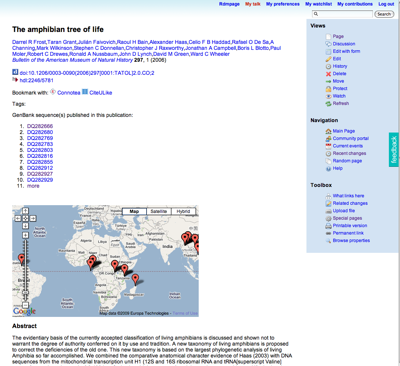
The exercise was to take some frog taxa from the Frost et al. amphibian tree (doi:10.1206/0003-0090(2006)297[0001:TATOL]2.0.CO;2) and link them to GenBank sequences and museum specimens. The hope was that by making these links new information would emerge. You could think of it as an editable version of this. With a bit of post-exercise tidying, we got someway there. The wiki page for the Frost et al.
paper
now shows a list of sequences from that paper (not all, I hasten to add), and a map for those sequences that the students added to the wiki:

frost.png


Although much remains to be done, I can't help thinking that this approach would work well for a database like TreeBASE, where one really needs to add a lot of annotation to make it useful (for example, mapping OTUs to taxon names, linking data to sequences and specimens). So, one of the things I'm going to look at is dumping a copy of TreeBASE (complete with trees) into the wiki and seeing what can be done with it. Oh, and I need to make it much, much easier for people to add data.

Friday, May 31, 2013

BioNames now live - Report on project

Bionames3
BioNames (http://bionames.org) is live. Getting to this point was supported by funding from EOL as part of their Computable Data Challenge. The award from EOL is paying for Ryan Schenk to work on the interface and overall design of the web site, and over the last few weeks we've been working increasingly frantically to get things ready. "Ready" is a relative concept. The project is far from finished from my perspective, there is a mound of data (millions of names, hundreds of thousands of publications) that is being cleaned, cross-linked, and ultimately visualised. But the EOL funding came with a deadline and adult supervision (aka Cyndy Parr), so it was a great incentive to get something function out the door.

What is BioNames?

Elsewhere I've argued that biodiversity informatics is fundamentally about linking stuff together, and BioNames tackles the link between a name and its publication. Ultimately I want each taxon name to be linked to its original description, and that description has a digital identifier (such as a DOI). It's a small step, but building those links, coupled with (where possible) bringing those publications together in one place provides a platform to potentially do some cool stuff (more on this later). Since about 2009 I've been working on building a database of these links, and have been documenting progress (or it's lack) along the way (e.g., search iPhylo for "itaxon").

Here are some screen shots (and links so you can see for your self). It's a very early stage release, but you'll get the idea.

GBIF classiifcation of Rousettus with Ryan's awesome taxon name timeline.
Bionames1

Viewing a paper A Tarzan yell for conservation: a new chameleon, Calumma tarzan sp. n., proposed as a flagship species for the creation of new nature reserves in MadagascarBionames4

Coverage of articles in a journal (Proceedings of the Entomological Society of Washington).
Bionames2What got built?

There is a bunch of code and documentation online:


There is also a Darwin Core Archive format dump, which *cough* fun to create.

There have been progress reports on this blog (search for BioNames). You can also see what we got up to in the github logs.

What didn't happen

The original proposal (http://dx.doi.org/10.6084/m9.figshare.92091) was, of course, a tad ambitious, and a number of things haven't made it into this release. Phylogenies are the biggest casualty, but they are close (see Viewing phylogenies on the web: Javascript conversion of Newick tree to SVG for experiments on visualisation). It just wasn't possible to get them ready in time for the May 31 deadline. But this is on the to do list.

What's next

Now that there is a functioning web site there are several directions to explore. There is a lot of data cleaning to do, many missing references to add, taxon names to map to GBIF and NCBI, and more. I've completely glossed over the issue of reconciling author names, it's clear that the same author can appear multiple times because of variations in how their name has been recorded in various databases. There are various ways to tackle this, the most interesting is to use tools like Mendeley or ORCID to enable people to "claim" their identity.

Now that there is a mapping between the NCBI taxonomy and taxon names linked to literature, it would be great to add phylogenetic data to BioNames (which was part of the original plan). One way is by importing PhyLoTA, another is by adding support for BLAST searches that generate trees. For example, for a given taxon we could create a list of suitable sequences (e.g., DNA barcodes) and enable users to generate BLAST trees to get a sense of what the taxon is related to (and, in many cases, how much genetic differentiation there is within that taxon).

Given that BioNames has a lot of full text (from BioStor as well as numerous sources of PDFs and scans) there is huge scope for data mining. Obvious things to do are extract taxon names, geographic localities, and specimen codes (using tools I already have for BioStor). Then there is the challenge of extracting lists of literature cited and building citation networks. A small proportion of the taxonomic literature exists in XML (e.g., articles in PLoS, Zookeys, and various SciElo journals), which makes this task a lot easier. Given that many of the cited papers will already be in BioNames, we could build a taxonomic literature reader that enabled you to treat the literature in BioNames as one big interlinked, browesable archive. I'm posting a list of ideas on Trello.

Tuesday, January 17, 2012

Mendeley as CiteBank: some ideas

Here are some quick notes on how BHL could use Mendeley as a "CiteBank".

As a repository of bibliographic data

If the goal is to assemble a "bibliography of life" then there are various ways this could be done.

Taxon-specific bibliographies

Create groups that are taxon-specific (or find existing groups in Mendeley. For example, I've created groups for amphibias (Amphibian Species of the World) and reptiles (TIGR/JCVI Reptile Database) based on the Amphibian Species of the World and TIGR/JCVI Reptile Database, respectively. Taxon-specific groups are probably going to be attractive to users, but the quality of bibliographic metadata can be variable. However, a bibliography for a specific taxonomic group that is populated with links to BHL content would be very useful.

Journal-specific bibliographies

This is where I've spent most of my efforts. I've created around 300 groups for various journals (see list below, or go directly to http://dl.dropbox.com/u/639486/groups.html). In some cases I've managed to populate these with the complete set of articles published in that journal, typically harvested from the journal's own web site. Typically the metadata from journal sites is high quality, although one has to be wary of Orwellian metadata.


I use these groups in two ways. The first is as a source of metadata for extracting articles from BHL using BioStor. If you have article-level metadata finding articles in BHL becomes easier, and can be automated so that 1000's can be added in a few minutes.

The second is for the taxon-literature mapping project, where one strategy is to use approximate string mapping to find equivalent citations in Mendeley and the ION database. Ultimately I'd like to link to the Mendeley citations as they tend to be higher quality than those in the original ION database.

BHL could create Mendeley groups for journals it has scanned, and populate those.

As an article-level index to BHL

This is perhaps the most direct way BHL could use Mendeley is as follows:

  1. Create a BHL account.
  2. For each BHL title create a Mendeley group (the name would be the BHL TitleID).
  3. For each item in that title create a folder in the corresponding group (the folder name would be the ItemID).
  4. Within each folder list the articles, book chapters or other component parts. If these aren't available yet, encourage people to add them. Some of these could be pre-populated with content from BioStor.
  5. Harvest the contents of these groups to provide an article-level index to BHL (which for me is the single biggest impediment to using BHL). Previously I've suggested a way to easily add article data to BHL, Mendeley title/item groups and folders might be way to facilitate this process.
PDF storage

Although Mendeley offers PDF storage, this is one feature I'd be less inclined to use. Mendeley's rule for sharing PDFs and making them publicly available are too restrictive (they often don't know whether a PDF can, in fact, be shared). Plus you want tools to visualise, index, and archive PDFs. In effect a big file store with added features. I have some ideas on how this can be implemented (and have a rough working version to support http://iphylo.org/~rpage/itaxon). Alternatively, one could use Internet Archive services.

Summary

As I've often argued, given the success of tools like Mendeley it seems pointless for anyone to try and build yet another online bibliographic database. The trick is to figure out how to leverage what Mendeley provides to support what the taxonomic (and broader biodiversity) community needs.

Wednesday, February 29, 2012

Making biodiversity data sticky: it's all about links

Who invented velcro?

Sometimes I need to remind myself just why I'm spending so much time trying to make sense of other people's data, and why I go on (and on) about identifiers. One reason for my obsession is I want data to be "sticky", like the burrs shown in the photo above (Who invented velcro? by A-dep). Shared identifiers are like the hooks on the burrs, if two pieces of data have the same identifier they will stick together. Given enough identifiers and enough data, then we could rapidly assemble a "ball" of interconnected data. A published the diagram below as part of my Elsevier Challenge entry (preprint, published version) summarises some of the links between diverse kinds of biological data:
Model
While in principle many of these links should be trivial to create, in practice they aren't. One major obstacle is the lack of globally unique identifiers, or if such identifiers exist they aren't being used. As a result, our data is anything but sticky. In the absence of identifiers, creating links between different data sets can a significant undertaking. One way to tackle this is focus on just one kind of link at a time and create a database of those links. The diagram below shows some of the links I've been working on:
Links
For example, the iPhylo Linkout project creates links between taxon concepts in NCBI and Wikipedia. The iTaxon project is a mapping between taxonomic names and publications. I've briefly explored mapping host-parasite relationships using GenBank, and I'm currently exploring the links between publications and specimens. This list certainly doesn't exhaust the set of possible links, but it's a start. The challenge is to create sufficient links for biodiversity data to finally coalesce and for us to be able to ask questions that span multiple sources and types of data.

Wednesday, March 03, 2010

Setting up a local Wikisource

A little while ago I came across Wikisource, and it dawned on me that this is a model for BHL. To quote from the Wikisource web site:
Wikisource is an online library of free content publications, collected and maintained by our community. We now have 140,596 texts in the English language library. See our inclusion policy and help pages for information on getting started, and the community portal for ways you can contribute. Feel free to ask questions on the community discussion page, and to experiment in the sandbox.

Much of their content comes from the Internet Archive (as does BHL's), and Wikisource have developed extensions for Mediaiwki to do some cool things, such as extract text and images from DjVu files. If you haven't come across DjVu before, it's a format designed to store scanned documents, and comes with some powerful open source tools for extracting images and OCR text. Wikisource can take a DjVu file, extract images, thumbnails and text, creating side-by-side displays where users can edit and correct OCR text:

wikisource.png


So, like a fool, I decided to try and install some of these tools locally and see if I could do the same for some BHL content. That's when the "fun" started. Normally Mediawiki is pretty easy to set up. There are a few wrinkles because my servers live behind an institutional HTTP proxy, so I often need to tweak some code (such as the OpenID extension, which also needs a fix for PHP 5.3), but installing the extensions that underlie Wikisource wasn't quite so straightforward.

DjVu
djvu.png
The first step is supporting DjVu files in Mediawiki. This seems straightforward (see How to use DjVu with MediaWiki). First off you need the DjVu tools. I use Mac OS X, so I get these automatically if I install DjView. The tools reside in Applications/DjView.app/Contents/bin (you can see this folder if you Control+click on the DjView icon and choose "Show Package Contents"), so adding this path to the name of each tool DjVu tool Mediaiwiki needs takes care of that.

But I also need NetPbm, and now the pain starts. NetPbm won't build on Mac OS X, at least not out of the box on Snow Leopard. It makes assumptions about Unix that Mac OS X doesn't satisfy. After some compiler error messages concerning missing variables that I eventually traced to signal.h I gave up and installed MacPorts, which has a working version of NetPbm. MacPorts installed fine, but it's a pain having multiple copies of the same tools, one in /usr/local, and one in /opt/local.

OK, now we can display DjVu files in Mediawiki. It's small victories like this which leads to over confidence...

Proofread Page
Next comes the Proofread Page extension, which provides the editing functionality. This seemed fairly straightforward, although the documentation referred to a SQL file (ProofreadPage.sql) that doesn't seem to exist. More worringly, the documentation also says:
If you want to install it on your own wiki, you will need to install a 404 handler for generating thumbnails, such as WebStore.

This seems fine, except the page for WebStore states:
The WebStore extension is needed by the ProofreadPage extension. Unfortunately, documentation seems to be missing completely. Please add anything you know about this extension here.

Then there are the numerous statements "doesn't work" scattered through the page. So, I installed the extension and hoped for the best. It didn't work. As in, really, really didn't work. It took an hour or so of potentially fatal levels of blood pressure-inducing frustration to get to the bottom of this.

WebStore
Now, Webstore is a clever idea. Basically, the Proofread Page extension will need thumbnails of images in potentially varying sizes, and creates a link to the image it wants. Since that image doesn't exist on the web site the web server returns 404 Not Found, which normally results in a page like this. Instead, we tell the web server (Apache) that WebStore will handle 404's. If the request is for an image, Webstore creates the image file, streams it to the web browser, then deletes the file from disk. Essentially WebStore creates a web server for images (Webdot uses much the same trick, but without the 404 handler). Debugging a web server called by another web server is tricky (at least for a clumsy programmer like me), but by hacking the Webstore code (and switching on Mediawiki debug logging) I managed to figure out that Webstore seemed to be fetching and streaming the images fine, but they simply didn't appear in the wiki page (I got the little broken image icon instead). I tried alternative ways of dumping the image file to output, adding HTTP headers, all manner of things. Eventually (by accident, no idea how it happened) I managed to get an image URL to display in the Chrome web browser, but it wasn't an image(!) -- instead I got a PHP warning about two methods in the class DjVuHandler (mustRender and isMultiPage) not being consistent with the class they inherit from. WTF?! Eventually I found the relevant file (DjVu.php in includes/media in the Mediawiki folder), added the parameter $file to both methods, and suddenly everything works. At this point I didn't know whether to laugh or cry.

OCR text
There are some issues with OCR text from Internet Archive DjVu files. There are some extraneous characters (new lines, etc.) that I need to filter, and I'll probably have to deal with hyphenation. It looks fairly straightforward to edit the proofing extension code to handle these situations.

Semantic Mediawiki
Having got the proofing extension working, I then wanted to install the Semantic Mediawiki extensions so that I could support basic inference on the wiki. I approached this with some trepidation as there are issues with Mediawiki namespaces, but everything played nice and so far things seem to be working. Now I can explore whether I can combine the proofing tools from Wikisource with the code I've developed for iTaxon.

BioStor
So, having got something working, the plan is to integrate this with BioStor. One model I like is the video site Metacafe. For each video Metacafe has a custom web page(e.g., http://www.metacafe.com/watch/4137093) with an Edit Video Details link that takes you to a Semantic Mediawiki page where you can edit metadata for the video. I envisage doing something similar for BioStor, where my existing code provides a simple view of an article (perhaps with some nice visualisations), with a link to the corresponding wiki page where you can edit the metadata, and correct the OCR text.

Lessons
In the end I got there, although it was a struggle. Mediawiki is a huge, complicated bit of software, and is also part of a larger ecosystem of extensions, so it has enormous power. But there are lots of times when I think it would be easier if I wrote something to replicate the bit of functionality that I want. For example, side-by-side display of text and images would be straightforward to do. But once you start to think about supporting mark-up, user authentication, recording edit history, etc., the idea of using tools others have developed becomes more attractive. And the code is open source, which means if it doesn't work there's a fighting chance I can figure out why, and maybe fix it. It often feels harder than it should be, but I'll find out in the next few days whether yesterday's exertions were worth it.