Showing posts with label GrandChallenge. Show all posts

Tuesday, August 31, 2010

Viewing scientific articles on the iPad: iBooks

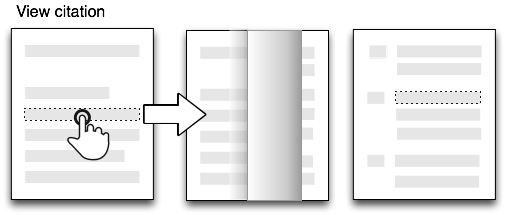
Apple's iBooks app is an ePub and PDF reader, and one could write a lengthy article about its interface. However, in the context of these posts on visualising the scientific article there's one feature that has particularly struck me. When reading a book that cited other literature the citations are hyper-links: click on one and iBooks forwards you (via the page turning effect) to the reference in the book's bibliography. This can be a little jarring (one minute you're reading the page, next you're in the bibliography), but to help maintain context the reference is preceded by the snippet of text in which it is cited:

touch7.jpg

To make this concrete, here's an example from Clarky Shirky's "Cognitive Surplus."

ibooks.jpg

In the body of the text (left) the text "notes in his book The Success of Open Source" (which I've highlighted in blue) is a hyper-link. Click on it, and we see the source of the citation (right), together with the text that formed the hyper-link. This context helps remind you why you wanted to follow up the citation, and also provides the way back to the text: click on the context snippet and you're taken back to the original page.

Providing context for a citation is a nice feature, and there are various ways to do this. For example, the Elsevier Life Sciences Challenge entry by Wan et al. ("Supporting browsing-specific information needs: Introducing the Citation-Sensitive In-Browser Summariser", doi:10.1016/j.websem.2010.03.002, see also an earlier version on CiteSeer) takes a different approach. Rather than provide local context for a citation in an article (a la iBooks), Wan et al. provide context-sensitive summaries of the reference cited to help the the reader judge whether it's worth her time to fetch the reference and read it.

Both of these approaches suggest that we could be a lot more creative about how we display and interact with citations when viewing an article.

Wednesday, September 03, 2008

Hell is other people's data

Starting to get serious about the Grand Challenge. First step is to parse the XML data Elsevier made available. Sadly this is only for Molecular Phylogenetics and Evolution for 2007, I would have liked the whole journal in XML to avoid hassles with parsing PDF. However, XML is not without it's own problems. I'm slowly getting my head around Elsevier's XML (which is, it has to be said, documented in depth). Two tools I find invaluable are the oXygen XML editor, and Marc Liyanage's TextXSLT application.


As a first attempt, I'm converting Elsevier XML into JSON (being a much simpler format to handle). I'm just after what I regard as the core data, namely the bibliography, and the tables (rich with GenBank accession numbers, specimen codes, and geocoordinates). There are a few "gotchas", such as misisng namespaves to add, and HTML entities that need to be added. Then there's the fact that the XML describes both the document content and it's presentation. Tables can get complicated (cells can span more than one row or column), which makes tasks such as identifying cell contents by using the heading of the corresponding column a bit harder. I hope to put a XSLT style sheet online once I'm happy that it can handle most, if not all the tables I've come across. Then the fun of trying to extract the information can begin.