Showing posts with label TaxPub. Show all posts

Wednesday, December 04, 2013

Towards BioStor articles marked up using Journal Archiving Tag Set

A while ago I posted BHL to PDF workflow which was a sketch of a work flow to generate clean, searchable PDFs from Biodiversity Heritage Library (BHL) content:

Workflow
I've made some progress on putting this together, as well as expanded the goal somewhat. In fact, there are several goals:
  1. BioStor articles need to be archived somewhere. At the moment they live on my server, and metadata is also served by BHL (as the "parts" you see in a scanned volume). Long term maybe PubMed Central is a possibility (BHL essentially becomes a publisher). Imagine PubMed Central becoming the primary archival repository for biodiversity literature.
  2. BioStor articles could be more useful if the OCR text was cleaned up and marked up (e.g., highlighting taxon names, localities, extracting citations, etc.).
  3. If BioStor articles were marked up to same extent as ZooKeys then we could use tools developed for ZooKeys (see Towards an interactive taxonomic article: displaying an article from ZooKeys) for a richer reading experience.
  4. Cleaned OCR text could also be used to generate searchable PDFs, which are still the most popular way for people to read articles (see Why do scientists tend to prefer PDF documents over HTML when reading scientific journals?). BioStor already generates PDFs, but these are simply made by wrapping page images in a PDF. Searchable PDFs would be much friendlier.

For BioStor articles to be archived in PubMed Central they would need to be marked up using the Journal Archiving and Interchange Tag Suite (formerly the NLM DTDs). This is the markup used by many publishers, and also the tag suite that TaxPub build upon.

The idea of having BioStor marked up in JATS is appealing, but on the face of it impossible because the all we have is page scans and some pretty ropey OCR. But because the NLM has also been heavily involed in scanning the historical literature they are used to dealing with scanned literature, and JATS can accommodate articles ranging from scans to fully marked up text. For example, take a look at the article "Microsporidian encephalitis of farmed Atlantic salmon (Salmo salar) in British Columbia" which is in PubMed Central (PMC1687123). PMC has basic metadata for the article, scans of the pages, and two images extracted from those pages. This is pretty much what BioStor already has (minus the extracted images).

With this in mind, I dusted off some old code, put it together and created an example of the first baby steps towards BioStor and JATS. The code is in github, and there is a live example here.

Jats
The example takes BioStor article 65706, converts the metadata to JATS, links in the page scans, and also extracts images from the page scans based on data in the ABBYY OCR files. I've also generated HTML from the DjVu files, and this HTML includes hOCR tags that embed information about the OCR text. This format can be edited by tools such as (see Jim Garrison's moz-hocr-edit discussed in Correcting OCR using hOCR in Firefox). This HTML can be processed to output a PDF that includes the page scans but also has the OCR text as "hidden text" so the reader can search for phrases, or copy and paste the text (try the PDF for article 65706).

I've put the HTML (and all the XML and images) in github, so one obvious model for working on an article is to put it into a github repository, push any edits made to the repository, then push that to a web server that displays the articles.

There are still a lot of rough edges, and I think we can buld nicer interfaces than moz-hocr-edit (e.g., using the "contenteditable" attribute in the HTML), althogh moz-hocr-edit has the nice feature of being able to save the edits straight back to the HTML file (saving edited HTML to disk is a non-trivial task in most web browsers). I also need to add the code for building the initial JATS file (currently this is hidden on the BioStor server). There are also issues about PDF quality. At the moment I output black and white PNGs, which look nice and clean but can mangle plates and photos. I need to tweak that aspect of the process.

One application of these tools would be to take a single journal and convert all the BioStor articles into JATS, then make it available for people to further clean and markup as needed. There is an extraordinary amount of information locked away in this literature, it would be nice if we made better use of that treasure trove.

Tuesday, July 06, 2010

ZooKeys publishes articles of the future

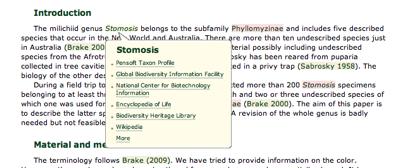
The open access taxonomic journal ZooKeys has published a special issue with four papers, each available in HTML, PDF, and XML, the later being extensively marked up. Penev et al. ("Semantic tagging of and semantic enhancements to systematics papers: ZooKeys working examples", doi:10.3897/zookeys.50.538) describes the process involved in creating these XML files. Two papers (doi:10.3897/zookeys.50.506 and doi:10.3897/zookeys.50.505) were created using authoring tools available in Scratchpads, as outlined by Blagoderov et al. ("Streamlining taxonomic publication: a working example with Scratchpads and ZooKeys", doi:10.3897/zookeys.50.539). When you view the HTMl for these articles you can toggle on or off the highlighting citations, taxonomic names, and geographic co-ordinates. Mousing over a taxonomic name, for example, a popup appears with links to GBIF, NCBI, EOL, BHL, Wikipedia, etc.):

brake.png

I think these papers represent one view of the future of scientific publishing ("article 2.0"), and I'm flattered that Penev et al. cite my Elsevier challenge work (doi:10.1016/j.websem.2010.03.004, preprint at hdl:10101/npre.2009.3173.1) as one of the sources of inspiration (along with the landmark Shotton et al. "Adventures in Semantic Publishing: Exemplar Semantic Enhancements of a Research Article" doi:10.1371/journal.pcbi.1000361, which I've discussed previously). It is also good to see the TaxPub XML schema used by a publisher, and Scratchpads being a part of the process of publishing taxonomic information.

Deep linking

My initial impression is that there is huge of potential here, although I think there is still lots to do. I'm not totally convinced that popups are they way to go (although I've dabbled with them as well), and we need to move beyond simply linking to other sites to a deeper form of integration. For example, a Zookeys article might link to BHL via a taxonomic name, but how about deeper linking? For example, the paper by Brake and von Tschirnhaus (doi:10.3897/zookeys.50.505) contains the following citations:

Biró L (1899) Commensalismus bei Fliegen. Természetrajzi füzetek 22: 198–204.

Kertész K (1899) Verzeichnis einiger, von L. Biró in Neu-Guinea und am Malayischen Archipel gesammelten Dipteren. Természetrajzi füzetek 22: 173–19

Neither reference has any links in the HTML, so the user is under the impression that they aren't available online, but both references have been scanned by BHL. You can see full text for these articles in BioStor (references 52005 and 52004, respectively -- note that the pagination for Biró 1899 is given incorrectly in the paper). This is one area where BHL has a lot to offer publishers, and it would be great to see BHL provide the services publishers need to add these links to their articles.

This integration should go both ways. It's odd that the paper by Brake and von Tschirnhaus contains LSID used by the ZooBank for this paper (urn:lsid:zoobank.org:pub:DABB03F4-A128-43BB-990C-02F25D656B00, see the <self-uri> tag in the XML), but ZooBank doesn't know about the DOI for the paper, hence the ZooBank page for this article has no link to the article itself. It's time to join this stuff together.

What's next?

What I'd really like to see is article XML repurposed as, say, RDF, and used to populate a database so that we can query it. In this way we can start to atomise the article into useful parts, and recombine them in new and interesting ways. Might be something to play with over the summer.

On a practical level, I'm somewhat bemused by the variety of XML formats being used by open access publishers. PLoS use version 2.0 of the NLM Journal Archiving and Interchange Tag Suite, and I wrote a XSLT style sheet to transform PLoS articles for viewing on an iPad. TaxPub is based on version 3.0 of the NLM DTD, which breaks quite a bit of my code relating to citations, so I'll have to tweak this to get it to display Zookeys articles correctly. Handling TaxPub itself will also require some additional work. Then there are the BMC journals, which have their own flavour of XML (based on something called the "KETON DTD"). It's all a bit messy. But I guess it'd be no fun if it was too easy...