Showing posts with label NCBI. Show all posts

Wednesday, May 11, 2016

Scott Federhen

ImagesAwoke this morning to the sad news (via Scott Miller) that Scott Federhen of the NCBI had died. Anyone using the NCBI taxonomy is a beneficiary of Scott's work on bring together taxonomy and genomic data.

Scott contributed both directly and indirectly to this blog. I reported on some of his work linking taxa in NCBI to sequences from type material (NCBI taxonomy database now shows type material), Scott commented on "dark taxa" and DNA barcoding (e.g., Dark taxa even darker: NCBI pulls (some) DNA barcodes from GenBank (updated)), and was an author on a guest post on "Putting GenBank Data on the Map" (in response to http://dx.doi.org/10.1126/science.341.6152.1341-a). He was also very helpful when I wanted to make links between the NCBI taxonomy and Wikipedia in my iPhylo Linkout project (see http://dx.doi.org/10.1371/currents.RRN1228).

I didn't know Scott well, but always enjoyed chatting to him at meetings (most recently the 6th International Barcode of Life Conference at Guelph). He wasn't shy about putting forth his views, or sharing his enthusiasm for ideas. Indeed, last time we met he was handing out paper copies of his preprint "Replication is Recursion; or, Lambda: the Biological Imperative" (available on bioR·iv http://dx.doi.org/10.1101/018804). He then followed up by sending me a t-shirt with the "replication is recursion" logo printed on one side and some penguins on the other (if I remember correctly this was designed by a member of his family). I delight in baffling students by wearing it sometimes when I lecture.

A number of people in the bioinformatics and biodiversity informatics communities are in shock this morning, this is obviously as nothing compared to what his family must be going through.

Wednesday, February 03, 2016

Bootstrapping the biodiversity knowledge graph with JSON-LD

In a recent Twitter conversation including David Shorthous and myself (and other poor souls who got dragged in) we discussed how to demonstrate that adopting JSON-LD as a simple linked-data friendly format might help bootstrap the long awaited "biodiversity knowledge graph" (see below for some suggestions for keeping JSON-LD simple). David suggests partnering with "Three small, early adopting projects". I disagree.

I think we need to approach this problem, not from the perspective of who would like to try this approach, but what would it take to really be useful? I think if we look at the structure of the biodiversity knowledge graph and look at who has what identifiers, we can gain some insight into what the next steps are.

Sinks

A fundamental problem is that many data providers are essentially dead ends in terms of building a network. They have data, but no connections, and so they are "sinks". A data browser goes there and can't go any further, it has to retrace its steps and go somewhere else. For example, your typical museum might serve up its collection data like this: Museum The museum has its own identifiers (e.g., a URL) and that's the only identifier in the data. Nomenclators are much the same: Nomen You get a nomenclator-specific identifier such as an LSID, but no other identifiers. Once again, if you are a data-crawler traversing the web of data, this is a dead end. (This is why I've become obsessed with linking nomenclators to the primary literature, I want to stop them being dead ends).

Connected sources

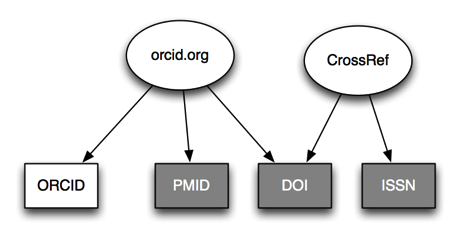
Then there are sources which have at least one external identifier, that is, an identifier that they themselves don't control. For example, CrossRef manages DOIs for articles, but if you get metadata for a DOI you also get an ISSN (identifying a journal): Crossref Now we have a connection to an external source of data, and some we can traverse the data graph further, which means we can start asking questions (such as how many articles in this journal have DOIs?).

Another connected source is ORCID: Orcid This gives us identifiers for authors (the ORCID) linked to article identifiers such as DOIs and PubMed ids (PMID). Follow the DOI to CrossRef and we can link people to articles to journals. Oc

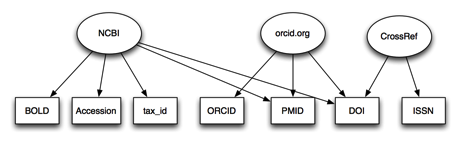
Another connected source is the NCBI: Ncbi NCBI has several internal identifiers (PMIDs, GenBank accession numbers, tax_ids) all of which lead to rich resources, and it's possible to get a lot of information by staying within NCBI's own silo, but there are external links such as DOIs (usually found attached to PubMed articles or to GenBank accessions) and links to external records such as DNA barcodes in BOLD.

Lets join CrossRef, ORCID, and NCBI together: All Now we have a bipartite graph linking sources with identifiers. We can imagine playing a game where we try and connect different entities by moving through the graph. For example, we could take an author identified by an ORCID, follow a DOI to a PMID, a PMID to a set of accessions numbers, and then be able to list all the sequences that an author has published. We could also step back and ask questions about which identifiers are the most useful in terms of making connections between different sources, and which sources provide the most cross links.

Filling in the gaps

Now, the graph above is obviously incomplete. I've restricted it to a few of the key services that I'm familiar with, and make use of external identifiers. One of the big obstacles to fleshing out the biodiversity knowledge graph is the frequent lack of reuse of identifiers. It's not enough to pump out data in linked-data form, you need to build the links. And not just "same as" style links connecting multiple identifiers for the same thing, you need to connect identifiers for different things. Until we tackle that, linked data approaches will not deliver much in the way of value. Hence we need sources that provide genuinely linked data by reusing exiting, external identifiers. If we have name in a nomenclator with a citation string, it needs to link that dumb literature string to a DOI. If we have a taxon concept, it needs to link the name of that taxon to a name in a nomenclator. If we have a specimen that has been sequenced, it needs to give the accession number of that sequence.

From this perspective, choosing which kinds of data with which to explore JSON-LD and a linked data graph should be driven by how connected those sources are: the more connected the more interesting the questions that we can ask. Sadly the vast majority of biodiversity data providers don't provide the kind of connected data we need, which means we continually pay lip service to linked data without feeding it the kind of data it needs in order to grow.

* Notes on JSON-LD

It is relatively easy to write horrible JSON-LD, so I think it would be useful to strive to make it as simple and as human-readable as possible (ignoring the @context block which is always going to be awful, this is the price we pay for simplicity elsewhere). To this end I think we should do at least the following:

  1. No URLs as identifiers URLs are ugly, and they are not reliable as identifiers. Providers can change URLs, even for persistent identifiers. The DOI prefix has changed from http://dx.doi.org/ to the preferred http://doi.org/, and the rise of HTTPS (prompted by concerns about security, among other issues, see Google's motives, part 2) is going to break a lot of older URLs (see Web Security - "HTTPS Everywhere" harmful). These changes keep happening, so lets try and shield ourselves from these by using standard prefixes for identifiers (such as 'DOI') for a DOI. Put all the alternative URL resolver prefixes in the @context block and use prefixes such as those standardised by http://identifiers.org (which basically formalises what many people in bioinformatics have been doing for a while).
  2. No prefixes for keys In other words, no CURIEs. Don't write "dwc:CatalogueNumber", just write "CatalogueNumber". I don't want to be told where the term comes from (that's what @context is for). If you have a namespace clash (i.e., two terms that are the same unless you include the namespace) then IMHO you're doing it wrong. Either you're using more than one vocabulary for the same thing (why?), or you've not modelling the data at the appropriate level of granularity. Either way, let's avoid clutter and keep things simple and readable.

Friday, August 15, 2014

Some design notes on modelling links between specimens and other kinds of data

If we view biodiversity data as part of the "biodiversity knowledge graph" then specimens are a fairly central feature of that graph. I'm looking at ways to link specimens to sequences, taxa, publications, etc., and doing this across multiple data providers. Here are some rough notes on trying to model this in a simple way.

For simplicity let's suppose that we have this basic model:

Core

A specimen comes from a locality (ideally we have the latitude and longitude of that locality), it is assigned to a taxon, we have data derived from that specimen (e.g., one or more DNA sequences), and we have one or more publications about that specimen (e.g., a paper that publishes a taxon name for which the specimen is a type, or a paper that publishes a sequence for which the specimen is a voucher).

Ncbi

NCBI


In GenBank we have sequences that have accession numbers, and these are linked to taxa (identified by NCBI tax ids). A nice feature of sequence databases is that taxa are explicitly defined by extension, that is, a taxon is the set of sequences assigned to a given taxon. Most (but not all, see Miller et al. doi:10.1186/1756-0500-2-101) sequences are also linked to a publication, which will usually have a PubMed id (PMID), and sometimes a DOI. Many sequences are also georeferenced (see Guest post: response to "Putting GenBank Data on the Map"). Most sequences aren't linked to a voucher specimen, but there is the implict notion of a source (in RDF-speak, many specimens are "blank nodes" Blank nodes for specimens without URI). Some sequences are associated with a specimen that has a museum code, and some are explicitly linked to the specimen by a URL.

Barcodes

DNA barcodes


Barcodes, as represented in BOLD are similar to sequences in GenBank. We have explicit taxa ("BINs") each of which has a URL, some also having DOIs. Most barcodes are georeferenced. There's some ambiguity about whether the URL for a barcode record identifies the barcode sequence, the specimen, or both. There may be a voucher code for the specimen. Some barcodes are linked to publications, but not (as far as I can see) in the data obtained from the API. Some barcodes are linked to the corresponding record in GenBank (which may or may not be supressed, see Dark taxa even darker: NCBI pulls (some) DNA barcodes from GenBank (updated)).

Gbif

GBIF


At it's core GBIF has occurrence records (many of these are specimen-based, but the majority of data in GBIF is actually observation-based), each of which has a unique id, and which is linked to a taxon, also with a unique id. As with the sequence databases, a taxon is a set of occurrences that have been assigned to that taxon. Many records in GBIF are georeferenced. There are limited cross links to other database - some occurrences list associated GenBank sequences. Some GBIF occurrences actually are sequences (e.g., the European Molecular Biology Laboratory Australian Mirror and the soon to be indexed Geographically tagged INSDC sequences), and barcodes are also making their way into GBIF (e.g., Zoologische Staatssammlung Muenchen - International Barcode of Life (iBOL) - Barcode of Life Project Specimen Data). Links to publications are limited.

Museum

Museums and herbaria


Some individual natural history collections which are online provide specimen-level web pages and URLs (some even have DOIs, see DOIs for specimens are here, but we're not quite there yet), and some museums list associated GenBank sequences. In the diagram I've not linked the specimens to a taxon, because most specimens are tagged by a name, not an explicit taxon concept (unlike NCBI, BOLD, or GBIF).

Literature

Literature


Literature databases (represented here by BioStor, but could be other sources such as ZooKeys, for example) may contain articles that mention specimen codes. These articles may also mention taxon names, and geographic localities (including coordinates) (see, for example, Linking GBIF and the Biodiversity Heritage Library. Mining text for names, specimens, and localities is fairly easy, but linking these together is harder (i.e., this specimen is of this taxon, and was found at this locality).

Linking together


If we have these separate sources and this trivial model, then we can imagine trying to tie information about the same specimen together across the different databases. Why might we want to do this. Here are three reasons:

  1. Augmentation Combining information can enhance our understanding of a specimen. Perhaps a specimen in GBIF is a geographic outlier. A publication that mentions the specimen includes it in a new taxon, perhaps discovered by sequencing DNA extarcted from that specimen. Linking this information together resolves the problematic distribution.
  2. Provenance What is the evidence that a particular specimen belongs to a particualr taxon, or was collected at a particular locality? If we connect specimens to the literature we we can review the evidence for ourselves. If we have sequences we can run BLAST, build a tree, and see if we should rethink our classification of that sequence. Imagine being able to browse GBIF and see the evidence for each dot on the map?
  3. Citation Mentions in the literature, use as vouchers for DNA barcoding or other forms of sequencing can be thought of a "citation" of that specimen. Museums hosting that material could use metrics base don this to demonstrate the value of their collection (see also The impact of museum collections: one collection ≈ one Nobel Prize).
Model

Making the links


All this is well and good, the trick is to actually make the links. Here things get horribly messy very quickly. Museum specimens are cited in inconsistent ways, we don't have widely used unique, resolvable specimen identifiers, and even if we did have these identifiers we don't have a global discovery mechanism for matching voucher codes to identifiers. GBIF would be an obvious part of a "global discovery mechanism" (bit like CrossRef but for specimens), GBIF can have multiple records for the same specimen. Sometimes this is because GBIF not only aggregates data from primary sources (such as museums) but also other aggregations which may themselves already include specimens harvested from primary sources. GBIF can also have multiple records because museums keep messing with their databases, try new variants of the Darwin Core triple, etc., resulting in records that look "new" to GBIF. Whole collections can be duplicate din this way.

One way to tackle this multiplicity of specimen records is to think in terms of "clusters" of specimens that are, in some sense, the same thing across multiple databases. For example, clustering a set of duplicated GBIF records together with the sequences derived from those specimens, perhaps including a DNA barcode, and a list of papers that mention that specimen. This is represented by the yellow bar through the diagram, it connects all the different pieces of information about a specimen into a single cluster. More *cough* later.

Friday, January 24, 2014

NCBI taxonomy database now shows type material

26243 367877492480 367794192480 4194340 6124010 nScott Federhen told me about a nice new feature in GenBank that he's described in a piece for NCBI News. The NCBI taxonomy database now shows a its of type material (where known), and the GenBank sequence database "knows: about types. Here's the summary:

The naming, classification and identification of organisms traditionally relies on the concept of type material, which defines the representative examples ("name-bearing") of a species. For larger organisms, the type material is often a preserved specimen in a museum drawer, but the type concept also extends to type bacterial strains as cultures deposited in a culture collection. Of course, modern taxonomy also relies on molecular sequence information to define species. In many cases, sequence information is available for type specimens and strains. Accordingly, the NCBI has started to curate type material from the Taxonomy database, and are using this data to label sequences from type specimens or strains in the sequence databases. The figure below shows type material as it appears in the NCBI taxonomy entry and a sequence record for the recently described African monkey species, Cercopithecus lomamiensis.
Cercopithecus

You can query for sequences from type using the query "sequence from type"[filter]. This could lead to some nice automated tools. If you had a bunch of distinct clusters of sequences that were all labelled with the same species name, and one cluster includes a sequence form the type specimen, then the other clusters are candidates for being described as new names.

Saturday, June 02, 2012

Linking NCBI taxonomy to GBIF


In response to Rutger Vos's question I've started to add GBIF taxon ids to the iPhylo Linkout website. If you've not come across iPhylo Linkout, it's a Semantic Mediawiki-based site were I maintain links between the NCBI taxonomy and other resources, such as Wikipedia and the BBC Nature Wildlife finder. For more background see

Page, R. D. M. (2011). Linking NCBI to Wikipedia: a wiki-based approach. PLoS Currents, 3, RRN1228. doi:10.1371/currents.RRN1228

I'm now starting to add GBIF ids to this site. This is potentially fraught with difficulties. There's no guarantee that the GBIF taxonomy ids are stable, unlike NCBI tax_ids which are fairly persistent (NCBI publish deletion/merge lists when they make changes). Then there are the obvious problems with the GBIF taxonomy itself. But, if you want a way to generate a distribution map for a taxon in the NCBI taxonomy, the quickest way is going to be via GBIF.

The mapping is being made automatically, with some crude checks to try and avoid too many erroneous links (e.g., due to homonyms). It will probably take a few days to complete (the mapping is quick, uploading to the wiki is a bit slower). Using a wiki to manage the mapping makes it easy to correct any spurious matches.

As an example, the page http://iphylo.org/linkout/Ncbi:109175 is for the frog Hyla japonica (NCBI tax_id 109175) and shows links to Wikipedia (http://en.wikipedia.org/wiki/Japanese_Tree_Frog, and to GBIF (http://data.gbif.org/species/2427601/). There's even a link to TreeBASE. I display a GBIF map so you can see what data GBIF currently has for that taxon.

Hyla

So, we have a wiki page, how do we answer Rutger's original question: how to get GBIF occurrence records via web service?

To do this we can use the RDF output by the Semantic Mediawiki software that underpins the Wiki. You can gte this by clicking on the RDF icon near the bottom of the page, or go to http://iphylo.org/linkout/Special:ExportRDF/Ncbi:109175. The RDF this produces is really, really ugly (and people wonder why the Semantic Web has been slow to take off...). In this RDF you will see the statement:

<rdfs:seeAlso rdf:resource="http://data.gbif.org/species/2427601/"/>

So, arm yourself with XPath, a regular expression, or if you are a serious RDF geek break out the SPARQL, and you can extract the GBIF taxon id for a NCBI taxon. Given that id you can query the GBIF web services. One service that I like is the occurrence density service, which you can use to recreate the 1°×1° density maps shown by GBIF. For example, http://data.gbif.org/ws/rest/density/list?taxonconceptkey=2427601 will get you the squares shown in the screen shot above.

Of course, I have glossed over several issues, such as the errors and redundancy in the GBIF classification, the mismatch between NCBI and GBIF classifications (NCBI has many more ranks than GBIF), and whether the taxon concepts used by the two databases are equivalent (this is likely to be more of an issue for higher taxa). But it's a start.

Tuesday, April 24, 2012

Dark taxa even darker: NCBI pulls (some) DNA barcodes from GenBank (updated)

Dark taxa have become even darker. NCBI has pulled the plug on large numbers of DNA barcode sequences that lack scientific names. For example, taxon Cyclopoida sp. BOLD:AAG9771 (tax_id 818059) now has a sparse page that has no associated sequences. From an earlier download of EMBL I know that this taxon is associated with at least 5 sequences, such as GU679674. But if you go to that sequence you get this:

Obsolete

So the the sequence is hidden. You can retrieve it by clicking on the obsolete version link, but by default it is hidden.

It's an extraordinary state of affairs that a huge slice of fundamental biodiversity data has been effectively "pulled" from view.

UpdateSujeevan Ratnasingham from iBOL has pointed out that the sequence I'd used above (GU679674) was not one of the ones hidden by NCBI, rather it was suppressed at the request of the investigator (which I'd have realised if I'd paid more attention to the screenshot). HQ918317 is an example of a BOLD record that was suppressed:

Hq

Tuesday, February 21, 2012

Linking GBIF and Genbank

As part of my mantra that it's not about the data, it's all about the links between the data, I've started exploring matching GenBank sequences to GBIF occurrences using the specimen_voucher codes recorded in GenBank sequences. It's quickly becoming apparent that this is not going to be easy. Specimen codes are not unique, are written in all sorts of ways, there are multiple codes for the same specimen (GenBank sequences may be associated with museum catalogue entries, or which field or collector numbers).

So why undertake what is fast looking like a hopeless task? There are several reasons:
  1. GBIF occurrences have a unique URL which we could potentially use as a unique, resolvable identifier for the corresponding specimen.
  2. Linking GenBank to GBIF would make it possible for GBIF to list sequences associated with a specimen, as well as the associated publication, which means we could demonstrate the "impact" of a specimen. In the simplest terms this could be the number of sequences and publications that use data from the specimen, more sophisticated approaches could use PageRank-like measures, see hdl:10101/npre.2008.1760.1.
  3. Having a unique identifier that is shared across different databases makes it easier to combine data from different sources. For example, if a sequence in GenBank lacks geographic coordinates but the voucher specimen in GBIF is georeferenced, we can use that information to locate the sequence in geographic space (and hence build geophylogenies or add spatial indexes to databases such as TreeBASE). Conversely, if the GenBank sequence is georeferenced but the GBIF record isn't we can update the GBIF record and possibly expand the range of the corresponding taxon (this was part of the motivation behind hdl:10101/npre.2009.3173.1.

As an example, below is the GBIF 1° density map for the frog Pristimantis ridens from GBIF, with the phylogeny from Wang et al.Phylogeography of the Pygmy Rain Frog (Pristimantis ridens) across the lowland wet forests of isthmian Central Americahttp://dx.doi.org/10.1016/j.ympev.2008.02.021 layered over it. I created the KML tree from the corresponding tree in TreeBASE using the tool I described earlier. You can grab the KML for the tree here.

Density

As we'd expect, there is a lot of overlap in the two sources of data. If we investigate further, there are records that are in fact based on the same specimen. For example, if we download the GBIF KML file with individual placemarks we see that in the northern part of the range their are 15 GBIF occurrences that map onto the same point as one of the terminal taxa in the tree.

Gbif

One of these 15 GBIF records (http://data.gbif.org/occurrences/244335848) is for specimen USNM 514547, which is the voucher specimen for EU443175. This gives us a link between the record in GBIF and the record in GenBank. It also gives us a URI we can use for the specimen http://data.gbif.org/occurrences/244335848 instead of the unresolvable and potentially ambiguous USNM 514547.

If we view the geophylogeny from a different vantage point we see numerous localities that don't have occurrences in GBIF.

Nogbif

Close inspection reveals that some of the specimens listed in the Wang et al. paper are actually in GBIF, but lack geographic coordinates. For example the OTU "Pristimantis ridens Nusagandi AJC 0211" has the voucher specimen FMNH 257697. This specimen is in GBIF as http://data.gbif.org/occurrences/57919777/, but without coordinates, so it doesn't appear on the GBIF map. However, both the Wang et al. paper and the GenBank record for the sequence from this specimen EU443164 give the latitude and longitude. In this example, GBIF gives us a unique identifier for the specimen, and GenBank provides data on location that GBIF lacks.

Part of GBIFs success is due to the relative ease of integrating data by taxonomic names (despite the problems caused by synonyms, homonyms, misspellings, etc.) or using spatial coordinates (which immediately enables integration with environmental data. But if we want to integrate at deeper levels then specimen records are the glue that connects GBIF (and its contributing data sources) to sequence databases, phylogenies, and the taxonomic literature (via lists of material exampled). This will not be easy, certainly for legacy data that cites ambiguous specimen codes, but I would argue that the potential rewards are great.

Wednesday, October 19, 2011

TDWG Challenge - what is RDF good for?

Last month, feeling particularly grumpy, I fired off an email to the TDWG-TAG mailing list with the subject Lobbing grenades: a challenge. Here's the email:
It's morning and the coffee hasn't quite kicked in yet, but reading through recent TDWG TAG posts, and mindful of the upcoming meeting in New Orleans (which sadly I won't be attending) I'm seeing a mismatch between the amount of effort being expended on discussions of vocabularies, ontologies, etc. and the concrete results we can point to.

Hence, a challenge:

"What new things have we learnt about biodiversity by converting biodiversity data into RDF?"

I'm not saying we can't learn new things, I'm simply asking what have we learnt so far?

Since around 2006 we have had literally millions of triples in the wild (uBio, ION, Index Fungorum, IPNI, Catalogue of Life, more recently Biodiversity Collections Index, Atlas of Living Australia, World Register of Marine Species, etc.), most of these using the same vocabulary. What new inferences have we made?

Let's make the challenge more concrete. Load all these data sources into a triple store (subchallenge - is this actually possible?). Perhaps add other RDF sources (DBpedia, Bio2RDF, CrossRef). What novel inferences can we make?

I may, of course, simply be in "grumpy old arse" mode, but we have millions of triples in the wild and nothing to show for it. I hope I'm not alone in wondering why...

In the context of the TDWG meeting (happening as we speak and which I'm following via Twitter, hashtag #tdwg) Joel Sachs asked me whether I had any specific data in mind that could form the basis of a discussion. So, here goes. I've assembled some small RDF data sets that it might be fun to play with. Each data set is for frogs, and I've divided them into two sets.

Primary data
These data sets are essentially unmodified RDF fetched from data providers:
  • uniprot.rdf Uniprot RDF for frogs in GenBank
  • ion.rdf Index of Organism Names (ION) RDF for taxonomic names for frogs (filtered to just those names that are also in GenBank, the RDF comes from ION LSIDs)
  • crossref.rdf CrossRef RDF for DOIs for publications that published new frog names (obtaining using CrossRef's support for Linked Data for DOIs)
  • dbpedia.rdf Dbpedia RDF for frogs in GenBank (Update 2011-10-20: the dbpedia.rdf file is a bit big, so here is subset.rdf which has just the conservation status and thumbnail image)


These sources give us information on genomics (at least, they tell us which taxa have been sequenced), where and when the original taxonomic description was published, and by whom, as well as some information on conservation status and what the frog looks like (via Dbpedia). Ideally we just load these files into a triple store and then ask a bunch of questions, such as what is the conservation status of frogs sequenced in Genbank?, is there correlation between the conservation status of a frog and the date it was discovered?, who has described the most frog species?, etc.

My contention is that actually we can't do any of this because the data is siloed due to the lack of shared identifiers and vocabularies (I suspect that there is not a single identifier any of these files share). The only way we can currently link these data sets together is by shared string literals (e.g., taxonomic names), in which case why bother with RDF? So my first challenge is to see whether any of the questions I've just listed can actually be tackled using this data.

Glue
In a slightly more constructive mode, to see if we can make progress I'm providing some additional RDF files, based on projects I'm working on to link data together. These files may help provide some of the missing "glue" to connect these data sets.

  • linkout.rdf The list of links between NCBI and Dbpedia (based on mapping in iPhylo LinkOut)
  • ion_doi.rdf A subset of publications listed in ION have DOIs, this file links the corresponding ION LSIDs to those DOIs (this file is from an ongoing project mapping names to primary literature)


The first file links the ION and CrossRef RDF, so we could start to ask questions about dates of discovery, who described what species, etc.. The second file links NCBI taxon ids (in this case in the form of UniProt URIs) to Wikipedia (in the form of Dbpedia URIs). Dbpedia has information on conservation status, and some frogs will also have pictures, so we can start to join genomics to conservation, as well as make some visualisations.

Update
I've now added another RDF file for 1000 georeferenced GenBank sequences for frogs. The file is genbank.rdf. This file is generated from a local, processed version of EMBL, and uses a mixture of Dublin Core and TDWG vocabularies. Here's an example of a single record:

<?xml version="1.0"?>
<rdf:RDF xmlns:dcterms="http://purl.org/dc/terms/"
xmlns:geo="http://www.w3.org/2003/01/geo/wgs84_pos#"
xmlns:owl="http://www.w3.org/2002/07/owl#"
xmlns:rdf="http://www.w3.org/1999/02/22-rdf-syntax-ns#"
xmlns:rdfs="http://www.w3.org/2000/01/rdf-schema#"
xmlns:tcommon="http://rs.tdwg.org/ontology/voc/Common#"
xmlns:toccurrence="http://rs.tdwg.org/ontology/voc/TaxonOccurrence#"
xmlns:uniprot="http://purl.uniprot.org/core/">
<uniprot:Molecule rdf:about="http://bio2rdf.org/genbank:EU566842">
<dcterms:created>2008-07-06</dcterms:created>
<dcterms:modified>2010-12-23</dcterms:modified>
<dcterms:title>EU566842</dcterms:title>
<dcterms:description>Xenopus borealis voucher MHNG:Herp:2644.64
cytochrome oxidase subunit I (COI) gene, partial cds; mitochondrial.</dcterms:description>
<dcterms:subject rdf:resource="http://purl.uniprot.org/taxonomy/8354"/>
<dcterms:relation rdf:parseType="Resource">
<rdf:type rdf:resource="http://rs.tdwg.org/ontology/voc/TaxonOccurrence#TaxonOccurrence"/>
<toccurrence:identifiedToString>Xenopus borealis</toccurrence:identifiedToString>
<toccurrence:decimalLatitude>0.66</toccurrence:decimalLatitude>
<geo:lat>0.66</geo:lat>
<toccurrence:decimalLongitude>37.5</toccurrence:decimalLongitude>
<geo:long>37.5</geo:long>
<toccurrence:verbatimCoordinates>0.66 N 37.5 E</toccurrence:verbatimCoordinates>
<toccurrence:country>Kenya</toccurrence:country>
<dcterms:identifier>MHNG:Herp:2644.64</dcterms:identifier>
</dcterms:relation>
</uniprot:Molecule>
</rdf:RDF>

I've added this simply so one could do some geographical queries.

Missing links
There are still lots of missing links here (for example, there's no explicit link between NCBI and ION, so we'd need to create this using taxonomic names), and we could add further links to the literature via sequences for taxa. Then there's the lack of geographic data. We could get some of this via georeferenced sequences in GenBank, but there's no RDF for this (Bio2RDF does have RDF for sequences but it ignores the bulk of the organismal metadata such as voucher specimens and latitude and longitude).

In many ways it's this lack of links that was point of my original email. The reality is that "linked data" isn't linked to anything like the extent that makes it useful. Simply pumping out RDF won't get us very far until we tackle this problem (see also my earlier post Linked data that isn't: the failings of RDF).

So, if you think RDF is the way to go, please tell me what you can learn from these data files.


Sunday, August 28, 2011

Tree of Life 0.1 - annotating the NCBI taxonomy

Last week I was at the NSF "Assembling, Visualising and Analysing the Tree of Life" Ideas Lab, run by KnowInnovation.com/. It was an interesting experience, essentially a structured week of brainstorming ideas.

One thing I came away with is the feeling that our notions of the "tree of life" are fuzzy, contradictory, and often probably unobtainable. It's tempting to imagine all sorts of wonderful visualisations, and loose sight of building something that is useful. Perhaps it's time instead to think of "Tree of Life version 0.1".

Imagine taking the NCBI taxonomy as a starting point. Yes it's incomplete, and has almost no fossils, but it's freely available and linked to a lot of data. Let's use a Google Maps-like viewer along the lines I explored earlier this year.

Then add annotation "tracks" to the tips. As a first pass these could be taken from the NCBI LinkOut service, such as the NCBI-Wikipedia mapping http://iphylo.org/linkout.

Ncbi 1

The NCBI tree is a classification rather than a phylogeny, so we could add greater phylogenetic content by linking to phylogenetic databases, such as TreeBASE and PhyLoTA. Imagine clicking on a node in the NCBI taxonomy and seeing a display of all the phylogenies centred on that node:

Ncbi 02

Now we have a way to navigate a large tree, view annotations, and display phylogenetic trees. All of this could be done fairly easily. The key is to have services keyed by the NCBI tax_id used to identify nodes on the tree.

Among the next steps would be to add additional "tracks", perhaps based on curated links analogous to the wiki-based NCBI-Wikipedia mapping. For example, very basic habitat data (marine or terrestrial) could be added, or geography, or host relationships (could be based in part on the data already in GenBank).

Given that the NCBI tree continues to grow, subsequent versions could be released as the tree changes. Or we could "fork" the NCBI tree and start to refine it based on phylogenetic information, and add taxa that aren't in the genome databases (these taxa will need consistent identifiers so we can map annotations on to them as well). Perhaps we could use something like Git to manage this tree, and to handle the necessary merging of updated versions of the NCBI tree. People could edit the tree, or indeed fork it and come up with their own.

Logo tmp reasonably smallThere are lots of ways to visualise trees (see TreeVis.net for some great examples), but what I'm after is a tool that is useful, that gives us a sense of what we know and what we don't. I suspect that one of the reasons we've struggled with visualising the tree of life is that there are lots of different notions about what it's for. In this case, I want a tool to navigate data about organisms, one that we can easily add annotations too.


Tuesday, April 12, 2011

Dark taxa: GenBank in a post-taxonomic world

How to cite: Page, R. (2011). Dark taxa: GenBank in a post-taxonomic world. https://doi.org/10.59350/xhvv2-xjt24
In an earlier post (Are names really the key to the big new biology?, I questioned Patterson et al.'s assertion in a recent TREE article (doi:10.1016/j.tree.2010.09.004) that names are key to the new biology.

In this post I'm going to revisit this idea by doing a quick analysis of how many species in GenBank have "proper" scientific names, and whether the number of named species has changed over time. My definition of "proper" name is a little loose: anything that had two words, second one starting with a lower case letter, was treated as a proper name. hence, a name like Eptesicus sp. A JLE-2010" is not a proper name, but Eptesicus andersoni is.

Mammals

Since GenBank started, every year has seen some 100-200 mammal species added to the database.


Until around 2003 almost all of these species had proper binomial names, but since then an increasing percentage of species-level taxa haven't been identified to species. In 2010 three-quarters of new tax_ids for mammals weren't identified.

Invertebrates

For "invertebrates" 2010 saw an explosive growth in the number of new taxa sequenced, with nearly 71,000 new taxa added to GenBank.


This coincides with a spectacular drop in the number of properly-named taxa, but even before 2010 the proportion of named invertebrate species in GenBank was in decline: in 2009 just over a half of the species added had binomials.

Bacteria

To put this in perspective, here are the equivalent graphs for bacteria.
Although at the outset most of the bacteria in GenBank had binomial names, pretty quickly the bulk of sequenced bacteria had informal names. In 2010 less than 1% of newly sequenced bacteria had been formerly described.

Dark taxa

For bacteria the graphs are hardly surprising. To get a proper name a bacterium must be cultured, and the vast majority of bacteria haven't been (or can't be) cultured. Hence, microbiologists can gloat at the nomenclatural mess plant and animal taxonomists have to deal with only because microbiologists have a tiny number of names to deal with.

For mammals and invertebrates there's clear a decline in the use of proper names.It would be tempting to suggest that this reflects a decline in the number of taxonomists - there might simply not be enough of them in enough groups to be able to identify and/or describe the taxa being sequenced.

However, if we look at the recent peaks of unnamed animal species, we discover that many have names like Lepidoptera sp. BOLD:AAD7075, indicating that they are DNA Barcodes from the Barcode of Life Data Systems. Of the 62,365 unnamed invertebrates added last year, 54,546 are BOLD sequences that haven't been assigned to a known species. Of the 277 unnamed mammals, 218 are BOLD taxa. Hence, DNA bnacording is flooding Genbank with taxa that lack proper names (and typically are represented by a single DNA bnacode sequence).

There are various ways to interpret these graphs, but for me the message is clear. The bulk of newly added taxa in GenBank are what we might term "dark taxa", that is, taxa that aren't identified to a known species. This doesn't necessarily mean that they are species new to science, we may already have encountered these species before, they may be sitting in museum collections, and have descriptions already published. We simply don't know. As the output from DNA barcoding grows, the number of dark taxa will only increase, and macroscopic biology starts to look a lot like microbiology.


A post-taxonomic world
If we look at the graphs for bacteria, we see that taxonomic names are virtually irrelevant, and yet microbiology seems to be doing fine as a discipline. So, perhaps it's time to think about a post-taxonomic world where taxonomic names, contra Patterson et al., are not that important. We can discover a good deal about organismal biology from GenBank alone (see my post Visualising the symbiome: hosts, parasites, and the Tree of Life for some examples, as well as Rougerie et al. 2010 doi:10.1111/j.1365-294X.2010.04918.x).

This leaves us with two questions:
  1. How much biology can we do without taxonomic names?
  2. If the lack of taxonomic names limits what we can do (and, playing devil's advocate, this is an open question) how can we speed up linking GenBank sequences to names?


I suspect that the answer to (1) is "quite a lot" (especially if we think like microbiologists). Question (2) is ultimately a question about how fast we can link literature, museum collections, sequences, and phylogenies. If progress to date is any indication, we need to rethink how we do this, and in a hurry, because dark taxa are accumulating at an accelerating rate.

How the analyses were done

Although the NCBI makes a dump of its taxonomic database available via FTP (at ftp://ftp.ncbi.nih.gov/pub/taxonomy/), this dump doesn't have dates for when the taxa were added to the database. However, using the Entrez EUtilities we can get the tax_ids that were published within a given date range. For example, to retrieve all the tax_ids added to the database in December 2010, we set the URL parameters &mindate=2010/12/01 and &maxdate=2010-12-31 to form this URL:

http://eutils.ncbi.nlm.nih.gov/entrez/eutils/esearch.fcgi?db=taxonomy&mindate=2010/12/01&maxdate=2010/12/31&retmax=1000000.

I've set &retmax to a big number to ensure I get all the tax_ids for that month (in this case 23511). I then made a local copy of the NCBI database in MySQL ( instructions here) and queried for all species-level taxa in GenBank. I used a rather crude regular expression REGEXP '^[A-Z][a-z]+ [a-z][a-z]+$' to find just those species names that were likely to be proper scientific names (i.e., no "sp.", "aff.", museum or voucher codes, etc.). To group the species into major taxonomic groups I used the division_id.

Results are available in a Google Spreadsheet.

Thursday, March 31, 2011

Paper on NCBI and Wikipedia published in PLoS Currents: Tree of Life

__logo__1.jpg
My paper describing the mapping between NCBI and Wikipedia has been published in PLoS Currents: Tree of Life. You can see the paper here. It's only just gone live, so it's yet to get a PubMed Central number (one of the nice features of PLoS Currents is that the articles get archived in PMC).

Publishing in PLoS Currents: Tree of Life was a pleasant experience. The Google Knol editing environment was easy to use, and the reviewing process quick. It's obviously a new and rather experimental journal, and there are a few things that could be improved. Automatically looking up articles by PubMed identifier is nice, but it would also be great to do this for DOIs as well. Furthermore, the PubMed identifiers aren't displayed as clickable links, which rather defeats the point of having references on the web (I've added DOI links to the articles wherever possible). But, minor grumbles aside, as a way to get an Open Access article published for free, and have it archived in PubMed Central, PLoS Currents is hard to beat. What will be interesting is whether the article receives any comments. This seems to be one area online journals haven't really cracked — providing an environment where people want to engage in discussion.

Thursday, March 24, 2011

TreeBASE meets NCBI, again

DÊjà vu is a scary thing. Four years ago I released a mapping between names in TreeBASE and other databases called TBMap (described here: doi:10.1186/1471-2105-8-158). Today I find myself releasing yet another mapping, as part of my NCBI to Wikipedia project. By embedding the mapping in a wiki, it can be edited, so the kinds of problems I encountered with TbMap, recounted here, here, and here. The mapping in and of itself isn't terribly exciting, but it's the starting point for some things I want to do regarding how to visualise the data in TreeBASE.

Because TreeBASE 2 has issued new identifiers for its taxa (see TreeBASE II makes me pull my hair out), and now contains its own mapping to the NCBI taxonomy, as a first pass I've taken their mapping and added it to http://iphylo.org/linkout. I've also added some obvious mappings that TreeBASE has missed. There are a lot more taxa which could be added, but this is a start.

The TreeBASE taxa that have a mapping each get their own page with a URL of the form http://iphylo.org/linkout/<TreeBase taxon identifier>, e.g. http://iphylo.org/linkout/TB2:Tl257333. This page simply gives the name of the taxon in TreeBASE and the corresponding NCBI taxon id. It uses a Semantic Mediawiki template to generate a statement that the TreeBASE and and NCBI taxa are a "close match". If you go to the corresponding page in the wiki for the NCBI taxon (e.g., http://iphylo.org/linkout/Ncbi:448631) you will see any corresponding TreeBASE taxa listed there. If a mapping is erroneous, we simply need to edit the TreeBASE taxon page in the wiki to fix it. Nice and simple.

At the time of writing the initial mapping is still being loaded (this can take a while). I'll update this post when the uploading has finished.

Wednesday, December 15, 2010

TreeBASE, again

My views on TreeBASE are pretty well known. Lately I've been thinking a lot about how to "fix" TreeBASE, or indeed, move beyond it. I've made a couple of baby steps in this direction.

The first step is that I've created a group for TreeBASE papers on Mendeley. I've uploaded all the studies in TreeBASE as of December 13 (2010). Having these in Mendeley makes it easier to tidy up the bibliographic metadata, add missing identifiers (such as DOIs and PubMed ids), and correct citations to non-existent papers (which can occur if at the time the authors uploaded their data the planned to submit their paper to one journal, but it ending up being accepted in another). If you've a Mendeley account, feel free to join the group. If you've contributed to TreeBASE, you should find your papers already there.

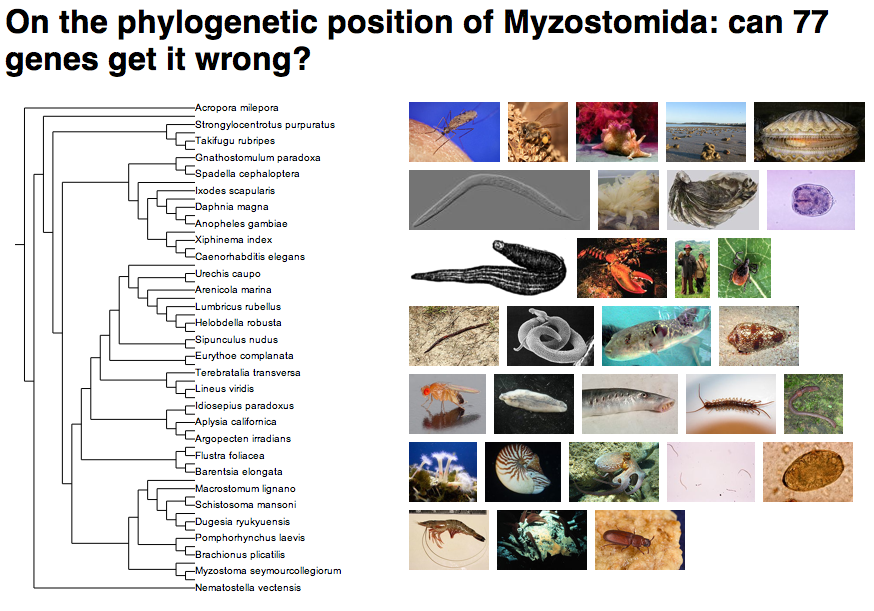
The second step is playing with CouchDB (this years new hotness), exploring ways to build a database of phylogenies that has nothing much to do with either a relational database or a triple store. CouchDB is a document store, and I'm playing with taking NeXML files from TreeBASE, converting them to something vaguely usable (i.e., JSON), and adding them to CouchDB. For fun, I'm using my NCBI to Wikipedia mapping to get images for taxa, so if TreeBASE has mapped a taxon to the NCBI taxonomy, and that taxon has a page in Wikipedia with an image, we get an image for that taxon. The reason for this is I'd really like a phylogeny database that was visually interesting. To give you some examples, here are trees from TreeBASE (displayed using SVG), together with thumbnails of images from Wikipedia:

myzo.png


troidini.png


protea.png


Snapshot 2010-12-15 10-38-02.png


Everything (tree and images) is stored within a single document in CouchDB, making the display pretty trivial to construct. Obviously this isn't a proper interface, and there's things I'd need to do, such as order the images in such a way that they matched the placement of the taxa on the tree, but at a glance you can see what the tree is about. We could then envisage making the images clickable so you could find out more about that taxon (e.g., text from Wikipedia, lists of other trees in the database, etc.).

We could expand this further by extracting geographical information (say, from the sequences included in the study) and make a map, or eventually a phylogeny on Google Earth) (see David Kidd's recent "Geophylogenies and the Map of Life" for a manifesto doi:10.1093/sysbio/syq043).

One of the big things missing from databases like TreeBASE is a sense of "fun", or serendipity. It's hard to find stuff, hard to discover new things, make new connections, or put things in context. And that's tragic. Try a Google image search for treebase+phylogeny:

treebasephylogeny.png

Call me crazy, but I looked at that and thought "Wow! This phylogeny stuff is cool!" Wouldn't it be great if that's the reaction people had when they looked at a database of evolutionary trees?

Tuesday, June 22, 2010

Mashing up NCBI and Wikipedia using treemaps

Having made a first stab at mapping NCBI taxa to Wikipedia, I thought it might be fun to see what could be done with it. I've always wanted to get quantum treemaps working (quantum treemaps ensure that the cells in the treemap are all the same size, see my 2006[!] blog post for further description and links). After some fussing I have some code that seems to do the trick. As an example, here is a quantum treemap for Laurasiatheria.

qt.png
The diagram shows the NCBI taxonomy subtree rooted on Laurasiatheria, with images (where available) from Wikipedia for the children of the the children of that node. In other words, the images correspond to the tips of the tree below:

laurasiatheria.png

There's a lot to be done to tidy this up, but there is potential to create a nice, visual way to navigate through the NCBI taxonomy (it might work well on the iPhone or iPad, for example).

Thursday, June 17, 2010

NCBI to Wikipedia links are now live...

The 52,956 links from NCBI to Wikipedia that I've been busy creating are now "live." If you go to a NCBI taxon such as Sphaerius you'll see something like this:

linkout.png

Clicking the "Wikipedia" link takes you to the Wikipedia page for this taxon. You can see all the links to Wikipedia using the query loproviphylo[filter]. Here are some additional links to try:

NCBIWikipedia
8353Xenopus
83698Banksia
9766 Balaenoptera

Thanks to Scott Federhen and Kathy Kwan at NCBI for all their assistance in getting this into NCBI Linkout.

Fixing errors
There will be errors and omissions. The best way to fix these is by using the iPhylo Linkout wiki. The page for a NCBI taxon is always http://iphylo.org/linkout/Ncbi:xxxx where xxxx is the NCBI taxonomy id. You can edit/annotate the link there (click on the "edit with form" for a simple web form). I plan to regularly update the links based on this the wiki.

Future
NCBI Linkout provide access statistics so it will be interesting to see how much traffic goes from NCBI to Wikipedia. It will also be interesting to see if this is correlated with increased editing of those Wikipedia pages.

Tuesday, June 08, 2010

Linking NCBI to Wikipedia

180px-Sphaerius.acaroides.Reitter.tafel64.jpgIn an earlier post I discussed linking NCBI taxonomy to Wikipedia. One way to tackle this is to add NCBI Taxonomy ID to Wikipedia pages. I reopened the case for adding the Taxonomy IDs to the Taxobox on each taxon page, but this met with substantial resistance. A modified proposal to add them elsewhere to the Wikipedia page seems to be gaining more support (or, at least, less vigorous resistance).

Meanwhile, there are other things that need to be done to linking NCBI and Wikipedia. One is to add Wikipedia page names to NCBI Linkout so that when viewing a NCBI taxon page you will see a link to Wikipedia if a page for the corresponding taxon exists. To create this linkout we need a mapping from NCBI to Wikipedia, and that's what I've been working on for the last few days.

The mapping is still in progress, but essentially I've taken a dump of the NCBI taxonomy for June 3, 2010, and matched the names with those in a the June 18, 2009 dump of Wikipedia that I've analysed elsewhere on this blog. I'll detail the various steps in the mapping elsewhere (there are issues such as synonyms, homonyms, Wikipedia redirects, etc.), but for now things seem to be working reasonably well.

The mapping is being created in a Semantic Mediawiki at http://iphylo.org/linkout/. When complete you will be able to up a NCBI taxon by either it's name (including synonyms and common names) or it's NCBI Taxonomy ID. Where possible I'm mapping the NCBI taxon to Wikipedia, and providing a snippet of text and an image.

I've also extracted bibliographic information from the citations.dmp file that comes with the NCBI dump. This contains the comments that you sometimes see on a taxon page. In a few cases I've added some information manually. For example, the beetle genus Sphaerius has a rather complicated nomenclatural history, which the NCBI page summarises as:
Due to a recent ruling (ICZN 2000), the family and generic names Sphaeriusidae Erichson, 1845, and Sphaerius Waltl, 1838, are both available names and have priority over Microsporidae Crotch, 1873 for the family name and Microsporus Kolenati, 1846 for the single included genus, respectively.

By looking through BioStor I've found some of the papers relating to this ICZN ruling, and added them to the wiki page http://iphylo.org/linkout/Ncbi:174920 (aficionados of zoological nomenclature may enjoy the complexity of the case, due to homonymy between the corresponding family name, Sphaeriidae, and a mollusc family of the same name).

Once thus mapping is complete, it will be time to think of how to get this into NCBI's Linkout, and also how to automatically update the mapping to reflect the growth of both the NCBI taxonomy and Wikipedia. If you visit http://iphylo.org/linkout/ please be aware that the mapping is still being written to the wiki (this is being done via API calls, and adding some 900,000 pages is going to take a while).

Thursday, May 20, 2010

NCBI Taxonomy IDs and Wikipedia

Wikipedia-logo-v2-en.png
36388.gif

I've written a note on the Wikipedia Taxobox page making the case for adding NCBI taxonomy IDs to the standard Taxobox used to summarise information about a taxon. Here is what I wrote:

Wikipedia's taxon pages have a huge web presence (see my blog post Google and Wikipedia revisited and Page, R. D. M. (2010). "Wikipedia as an encyclopaedia of life". Nature Precedings hdl:10101/npre.2010.4242.1). If a taxon is in Wikipedia it is almost always the first search result in Google. Researchers in other areas of biology are making use of a Wikipedia as a tool to annotate genes Gene Wiki and RNA families Wikipedia:WikiProject_RNA, respectively. Pages for genes, such as Cytochrome_b, have numerous external identifiers in their equivalent of the Taxobox (the Pfam_box). I think we are missing a huge opportunity by not including NCBI taxonomy ids. The advantages would be:

  • It would provide a valuable service to Wikipedia readers by enabling them to go to NCBI to discover more about a taxon

  • It would help Wikipedia contributors by providing a standardised way to refer to NCBI (and enable bots to add missing NCBI taxonomy ids). Putting them in an External links section makes it harder to be consistent (there are various ways to write a URL linking to the NCBI taxonomy)

  • It would facilitate linking from NCBI to Wikipedia. A mapping of Wikipedia pages to NCBI taxonomy ids could be added to NCBI Linkout, generating more traffic to the Wikipedia pages

  • Projects that are trying to integrate information from different sources would be able to combine information of genomics from NCBI with other information much more readily

Note that I am not arguing that Wikipedia should "follow" NCBI taxonomy, merely that where the potential to link exists, the links would create value, both within and outside the Wikipedia community.

Some discussion has ensued on the Taxobox page, all positive. I'm blogging this here to encourage anyone who as any more thoughts on the matter to contribute to the discussion.

Friday, July 10, 2009

NCBI RDF

Following on from the last post, I've now set up a trivial NCBI RDF service at bioguid.info/taxonomy/ (based on the ISSN resolver I released yesterday and announced on the Bibliographic Ontology Specification Group).

If you visit it in a web browser it's nothing special. However, if you choose to display XML you'll see some simple RDF. I've mapped some NCBI fields to corresponding terms in ttp://rs.tdwg.org/ontology/voc/TaxonConcept# (including the deprecated rankString term, which really shouldn't be deprecated, IMHO). I've also extracted what LSIDs I can from any linkouts. For example, a name that appears in Index Fungorum will have the corresponding LSID, likewise for IPNI. URLs are simply listed as rdfs:seeAlso.

Here's the RDF for NCBI taxon 101855 (you can grab this from http://bioguid.info/taxonomy/101855):


<?xml version="1.0" encoding="utf-8"?>
<rdf:RDF xmlns:rdf="http://www.w3.org/1999/02/22-rdf-syntax-ns#"
xmlns:rdfs="http://www.w3.org/2000/01/rdf-schema#"
xmlns:dcterms="http://purl.org/dc/terms/"
xmlns:tcommon="http://rs.tdwg.org/ontology/voc/Common#"
xmlns:tc="http://rs.tdwg.org/ontology/voc/TaxonConcept#">
<tc:TaxonConcept rdf:about="taxonomy:101855 ">
<dcterms:title>Lulworthia uniseptata</dcterms:title>
<dcterms:created>1999-08-16</dcterms:created>
<dcterms:modified>2005-01-19</dcterms:modified>
<dcterms:issued>1999-09-14</dcterms:issued>
<tc:nameString>Lulworthia uniseptata</tc:nameString><tc:rankString>species</tc:rankString>
<tcommon:taxonomicPlacementFormal>cellular organisms, Eukaryota, Fungi/Metazoa group, Fungi, Dikarya, Ascomycota, Pezizomycotina, Sordariomycetes, Sordariomycetes incertae sedis, Lulworthiales, Lulworthiaceae, Lulworthia</tcommon:taxonomicPlacementFormal>
<tc:hasName rdf:resource="urn:lsid:indexfungorum.org:names:105488"/>
<rdfs:seeAlso rdf:resource="http://www.marinespecies.org/aphia.php?p=taxdetails&id=100407"/>
<rdfs:seeAlso rdf:resource="http://www.mycobank.org/MycoTaxo.aspx?Link=T&Rec=105488"/>
<rdfs:seeAlso rdf:resource="http://www.indexfungorum.org/Names/namesrecord.asp?RecordId=105488"/>
<rdfs:seeAlso rdf:resource="http://www.itis.gov/servlet/SingleRpt/SingleRpt?search_topic=TSN&search_value=194551"/>
<rdfs:seeAlso rdf:resource="http://www.mycobank.org/MycoTaxo.aspx?Link=T&Rec=341143"/>
</tc:TaxonConcept>
</rdf:RDF>


Note the tc:hasName link to urn:lsid:indexfungorum.org:names:105488.

All a bit crude. The NCBI lookup is live (i.e., it's not served from a local copy of the database). I'll look at fixing this at some point, as well as caching the linkout lookups (one advantage of the live query is you can get the three dates (created, modified, and published). But for now it's a starting point to start to play with SPARQL queries across NCBI taxonomy, Index Fungorum, and IPNI using a common vocabulary.

Tuesday, February 24, 2009

Clustering taxonomic names

As part of my Quixotic attempt to construct a wiki of taxonomic names, I'm building a database of names and links. My current plan is to seed this with the NCBI taxonomy. What I want to do is flesh out the NCBI taxonomy with authorities and links to the original literature. At the moment the NCBI taxonomy is almost "nude", lacking links to the literature behind the names. As the magnificently bearded Geoffrey Bilder notes in an interview with Martin Fenner:
One way in which researchers assess the trustworthiness of content is by determining how it sits within the scholarly record. Does it provide evidence for its assertions in citations? Do other people cite it?

Given how important the NCBI taxonomy is, I think it would be a great improvement if each name could be linked to the original taxonomic publication. A first step to this is to find the taxonomic authority, the name of the author (or authors) of the name.

One potential source is uBio, which provides web services for retrieving information on names. Hence, an obvious approach is to map NCBI names to uBio names. However, if I use uBio's SOAP service typically I get multiple records for the same name. Some of these are due to homomyms (e.g., the same name used for a plant and an animal), but many are the same name with variations on the taxonomic authority. Much of this variation arises because uBio aggregates information from a wide range of databases, and each database differs in who it records the taxonomic authority.

For example, for the name "Diplura" (which I've discussed earlier) we get these names and authorities:
  • Diplura (Greene MS.) Allman 1864
  • Diplura Borner, 1904
  • Diplura C. L. Koch 1850
  • Diplura G. J. Hollenberg, 1969
  • Diplura Hollenb.
  • Diplura Jerdon 1864
  • Diplura Koch 1850
  • Diplura Koch 1851
  • Diplura Rambur 1866
  • Diplura Simon 1892
Before asking which of these names corresponds to "Diplura" in NCBI, I'd like to cluster these names into sets by merging names that are "the same." This resembles the problem of equivalent author names. The approach I'm using is to build a graph linking taxonomic authorities that are more similar than some threshold, then finding the components of that graph. For example, here is the graph for "Diplura":

The nodes in the graph are the taxonomic authorities, "cleaned" by making all the text lower case, and stripping any punctuation. The edges are labelled by the length of the longest common substring shared by the nodes that edge links (I ignore substrings less than four characters long). This graph groups the variations on Diplura Koch (a spider), and Diplura Hollenberg (a brown alga, see doi:10.1111/j.1529-8817.1969.tb02617.x).

Not surprisingly, perhaps, the linkouts from the NCBI taxonomy for Diplura are a mess, with the algal genus (taxon:371965 linking to both plant and animal databases, and the insect class (taxon:29997) linking to a mix of plants and animals, not all of the animals are insects.

I'm still playing with the underlying code, but I might try and build a web service that returns name clusters (and perhaps the graph as well).

Friday, September 26, 2008

Half-baked ideas. I. Wiki for taxonomy

Next few weeks will be busy with term starting, kids visiting, and other commitments, so time to jot down some ideas. The first is to have a Wiki for taxonomic names. Bit like Wikispecies, but actually useful, by which I mean useful for working biologists. This would mean links to digital literature (DOIs, Handles, etc.), use of identifiers for names and taxa (such as NCBI taxids, LSIDs, etc.), and having it pre-populated with data. Imagine merging the NCBI taxonomy, Catalogue of Life, Index Fungorum, and IPNI, say, and having it automatically updated with sources such as WoRMS and uBio RSS. Why a Wiki? Well, partly to capture all the little textual annotations that are needed to flesh out the taxonomy, and partly to make it easy to correct the numerous mistakes that litter existing databases.

As an initial target, I'd aim for a comprehensively annotated NCBI taxonomy, as this is probably the most important taxonomic database that we have.