Showing posts with label taxonomic databases. Show all posts

Wednesday, August 24, 2022

Can we use the citation graph to measure the quality of a taxonomic database?

More arm-waving notes on taxonomic databases. I've started to add data to ChecklistBank and this has got me thinking about the issue of data quality. When you add data to ChecklistBank you are asked to give a measure of confidence based on the Catalogue of Life Checklist Confidence system of one - five stars: ★ - ★★★★★. I'm scepetical about the notion of confidence or "trust" when it is reduced to a star system (see also Can you trust EOL?). I could literally pick any number of stars, there's no way to measure what number of stars is appropriate. This feeds into my biggest reservation about the Catalogue of Life, it's almost entirely authority based, not evidence based. That is, rather than give us evidence for why a particular taxon is valid, we are (mostly) just given a list of taxa are asked to accept those as gospel, based on assertions by one or more authorities. I'm not necessarly doubting the knowledge of those making these lists, it's just that I think we need to do better than "these are the accepted taxa because I say so" implict in the Catalogue of Life.

So, is there any way we could objectively measure the quality of a particular taxonomic checklist? Since I have a long standing interest in link the primary taxonomic litertaure to names in databases (since that's where the evidence is), I keep wondering whether measures based on that literture could be developed.

I recently revisited the fascinating (and quite old) literature on rates of synonymy:

Gaston Kevin J. and Mound Laurence A. 1993 Taxonomy, hypothesis testing and the biodiversity crisisProc. R. Soc. Lond. B.251139–142 http://doi.org/10.1098/rspb.1993.0020
Andrew R. Solow, Laurence A. Mound, Kevin J. Gaston, Estimating the Rate of Synonymy, Systematic Biology, Volume 44, Issue 1, March 1995, Pages 93–96, https://doi.org/10.1093/sysbio/44.1.93

A key point these papers make is that the observed rate of synonymy is quite high (that is, many "new species" end up being merged with already known species), and that because it can take time to discover that a species is a synonym the actual rate may be even higher. In other words, in diagrams like the one reproduced below, the reason the proportion of synonyms declines the nearer we get to the present day (this paper came out in 1995) is not because are are creating fewer synonyms but because we've not yet had time to do the work to uncover the remaining synonyms.

Put another way, these papers are arguing that real work of taxonomy is revision, not species discovery, especially since it's not uncommon for > 50% of species in a taxon to end up being synonymised. Indeed, if a taxoomic group has few synonyms then these authors would argue that's a sign of neglect. More revisionary work would likely uncover additional synonyms. So, what we need is a way to measure the amount of research on a taxonomic group. It occurs to me that we could use the citation graph as a way to tackle this. Lets imagine we have a set of taxa (say a family) and we have all the papers that described new species or undertook revisions (or both). The extensiveness of that work could be measured by the citation graph. For example, build the citation graph for those papers. How many original species decsriptions are not cited? Those species have been potentially neglected. How many large-scale revisions have there been (as measured by the numbers of taxonomic papers those revisions cite)? There are some interesting approaches to quantifying this, such as using hubs and authorities.

I'm aware that taxonomists have not had the happiest relationship with citations:

Pinto ÂP, Mejdalani G, Mounce R, Silveira LF, Marinoni L, Rafael JA. Are publications on zoological taxonomy under attack? R Soc Open Sci. 2021 Feb 10;8(2):201617. doi: 10.1098/rsos.201617. PMID: 33972859; PMCID: PMC8074659.
Still, I think there is an intriguing possibility here. For this approach to work, we need to have linked taxonomic names to publications, and have citation data for those publications. This is happening on various platforms. Wikidata, for example, is becoming a repository of the taxonomic literature, some of it with citation links.
Page RDM. 2022. Wikidata and the bibliography of life. PeerJ 10:e13712 https://doi.org/10.7717/peerj.13712
Time for some experiments.

Wednesday, August 03, 2022

Papers citing data that cite papers: CrossRef, DataCite, and the Catalogue of Life

Quick notes to self following on from a conversation about linking taxonomic names to the literature. There are different sorts of citation:
  1. Paper cites another paper
  2. Paper cites a dataset
  3. Dataset cites a paper
Citation type (1) is largely a solved problem (although there are issues of the ownership and use of this data, see e.g. Zootaxa has no impact factor. Citation type (2) is becoming more widespread (but not perfect as GBIF's #citethedoi campaign demonstrates. But the idea is well accepted and there are guides to how to do it, e.g.:
Cousijn, H., Kenall, A., Ganley, E. et al. A data citation roadmap for scientific publishers. Sci Data 5, 180259 (2018). https://doi.org/10.1038/sdata.2018.259
However, things do get problematic because most (but not all) DOIs for publications are managed by CrossRef, which has an extensive citation database linking papers to other paopers. Most datasets have DataCite DOIs, and DataCite manages its own citations links, but as far as I'm aware these two systems don't really taklk to each other. Citation type (3) is the case where a database is largely based on the literature, which applies to taxonomy. Taxonomic databases are essentially collections of literature that have opinions on taxa, and the database may simply compile those (e.g., a nomenclator), or come to some view on the applicability of each name. In an ideal would, each reference included in a taxonomic database would gain a citation, which would help better reflect the value of that work (a long standing bone of contention for taxonomists). It would be interesting to explore these issues further. CrossRef and DataCite do share Event Data (see also DataCite Event Data). Can this track citations of papers by a dataset? My take on Wayne's question:
Is there a way to turn those links into countable citations (even if just one per database) for Google Scholar?
is that he's is after type 3 citations, which I don't think we have a way to handle just yet (but I'd need to look at Event Data a bit more). Google Scholar is a black box, and the academic coimmunity's reliance on it for metrics is troubling. But it would be interetsing to try and figure out if there is a way to get Google Scholar to index the citations of taxonomic papers by databases. For instance, the Catalogue of Life has an ISSN 2405-884X so it can be treated as a publication. At the moment its web pages have lots of identifiers for people managing data and their organisations (lots of ORCIDs and RORs, and DOIs for individual datasets (e.g., checklistbank.org) but precious little in the way of DOIs for publications (or, indeed, ORCIDs for taxonomists). What would it take for taxonomic publications in the Catalogue of Life to be treated as first class citations?

Thursday, July 09, 2020

Lists of species don't matter: thoughts on "Principles for creating a single authoritative list of the world’s species"

Garnett et al. recently published a paper in PLoS Biology that starts with the sentence "Lists of species matter":

Garnett, S. T., Christidis, L., Conix, S., Costello, M. J., Zachos, F. E., Bánki, O. S., … Thiele, K. R. (2020). Principles for creating a single authoritative list of the world’s species. PLOS Biology, 18(7), e3000736. doi:10.1371/journal.pbio.3000736

This paper (one of a forthcoming series) is pretty much the kind of paper I try and avoid reading. It has lots of authors so it is a paper by committee, those authors all have a stake in particular projects, and it is an acronym soup of organisations the paper is pitched at. It's a well-worn strategy: write one or more papers outlining making the case that there is a problem, then get funding based on the notion that clearly there's a problem (you've published papers saying so) and that you and your co-applicants are best placed to solve it (clearly, because you wrote the papers identifying the problem in the first place). I'm not criticising the strategy, it's how you get things done in science. It just makes for a rather uninspiring read.

From my perspective focussing on "lists" is a mistake. Lists don't really matter, it is what is on the list that counts. And I think this is where the real prize is. As I play with Wikidata I'm becoming increasingly aware of the clusterfuck mess the taxonomic database community has created by conflating taxonomic names with taxa, and by having multiple identifiers for the same things. We survive this mess by relying on taxonomic names as somewhat fuzzy identifiers, and the hope that we can communicate successfully with other people despite this ambiguity (I guess this is pretty much the basis of all communication). As Roger Hyam notes:

These taxon names we are dealing with are really just social tags that need to be organised in a central place.

Having lots of names (tags) is fine, and Wikidata is busy harvesting all these taxonomic names and their identifiers (ITIS, IPNI, NCBI, EOL, iNaturalist, eBird, etc., etc., etc.). For most of these names all we have is a mapping to other identifiers for the same name, a link to a parent taxon, and sometimes a link to a reference for the name. But what happens if we want to attach data to a taxon? Take, for example, the African Piculet Verreauxia africana. This bird has at least two scientific names, each with a separate entry in Wikidata: Verreauxia africana Q28123873 and Sasia africana Q1266812. These are the same species yet it has two entries in Wikidata. If I want to add, say, body weight, or population size, or longevity, which Wikidata item do I add that data too?

What we need is an identifier for the species, an identifier that remains unchanged even if the name changes, or if that species moves in the taxonomic hierarchy. Some databases do this already. For example the eBird identifier for Verreauxia africana/Sasia africana is afrpic1. Because the identifier remains unchanged we can do things such as "diffs" between successive classifications showing how the species has moved between different genera (see Taxonomic publications as patch files and the notion of taxonomic concepts):

45759416 c9c5ed80 bc1f 11e8 98ca 5f4554ddca42

Ironically it seems that for birds the common name (in this case "African Piculet") is a more stable identifier than the scientific name (although that may well change). By having stable taxon identifiers we can then decide what entity to attach biological data to. Taxonomic names have failed to do this, but are still vital as well known tags. The actual taxon identifiers should be opaque identifiers (like "afrpic1" - not really opaque but close enough - or Avibase's C4DFB5E31495AE94). Make each opaque identifier a DOI, use existing taxonomic names as formalised tags so we aren't disconnected from the literature, use timestamped versions to track changes in species classification over time, and we have something useful.

This, I think, is the real prize. Rather than frame the task as making a list of species so that organisations can have a checklist they can all share, why not frame it as providing a framework that we can hang trait data on? We have vast quantities of data residing in siloed databases, spreadsheets, and centuries of biological literature. The argument shouldn't be about what is on a list, it should be how we group that information together and enable people to do their science. By providing stable identifiers that are resistant to name changes we can confidently associate trait data with taxa. Taxonomy could then actually be what it should be, the organisational framework for biological information (see Taxonomy as Information Science).

Friday, March 08, 2013

On Names Attribution, Rights, and Licensing of taxonomic names

Few things have annoyed be as much as the following post on TAXACOM:

The Global Names project will host a workshop to explore options and to make recommendations as to issues that relate to Attribution, Rights and Licensing of names and compilations of names. The aim of the workshop is a report that clarifies if and how we share names.

We seek submissions from all interested parties - nomenclaturalists, taxonomists, aggregators, and users of names. Let us know what (you think) intellectual property rights apply or what rights should be associated with names and compilations of names. How can those who compile names get useful attribution for names, and what responsibilities do they have to ensure that information is authoritative. If there are rights, what kind of licensing is appropriate.

Contributions can be submitted http://names-attribution-rights-and-licensing.wikia.com/wiki/Main_Page, where you will find more information about this event.

I'm trying to work out why this seemingly innocuous post made me so mad. I think this is because I think this fundamentally framing the question the wrong way. Surely the goal is to have a list of names that is global in scope, well documented, and freely usable by all without restriction? Surely we want open and free access to fundamental biodiversity data? In which case, can we please stop having meetings and get on with making this so?

If you frame the discussion as one of "Attribution, Rights and Licensing of names and compilations of names" then you've already lost sight of the prize. You've focussed on the presumed "rights" of name compilers instead.

I would argue that names compilations are somewhat overvalued. They are basically lists of names, sometimes (all to rarely) with some degree of provenance (e.g., a citation to the original use of the name). As I've documented before (e.g., More fictional taxa and the myth of the expert taxonomic database and Fictional taxa) entirely fictional can end up in taxonomic databases with alarming ease. So any claims that these are expert-curated lists should be taken with a pinch of salt.

Furthermore, it is increasingly easy to automate building these lists, given that we have tools for finding names in text, and an ever expanding volume of digitised text becoming available. Indeed, in an ideal world where all taxonomic literature was digitised much of the rationale for taxonomic name databases would disappear (in the same way that library card catalogues are irrelevant in the age of Google). We are fast approaching the point where we can do better than experts. To give just one example, in a recent BHL interview with Gary Poore it was stated that:

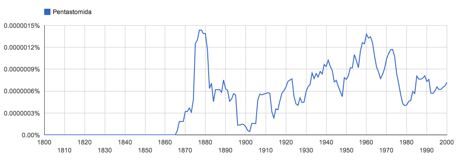
For example, the name widely used name Pentastomida itself was widely attributed to Diesing, 1836, but the word did not appear in the literature until 1905.


A quick check of Google Ngrams shows this to be simply false:

Pentastomida

I don't need taxonomic expertise to see this, I simply need decent text indexing. So, if you have a list of names, you have something that it will soon be largely possible to recreate using automated methods (i.e., text mining). With a little sophistication we could mine the literature for further details, such as synonymy, etc. Annotation and clarification of a few "edge cases" where things get tricky will always be needed, but if you want to argue that your lists deserves "Attribution, Rights and Licensing" then you fail to realise that your list is going to be increasing easy to recreate simply by crawling the web.

It seems to me that most taxonomic databases are little more than digitised 5x3 index cards, and lack any details on the provenance of the names they contain. They often don't have links to the primary literature, and if they do cite that literature they typically do so in a way that makes it hard to find the actual publication. I once gave a talk which included the slide below showing taxonomic databases as being "in the way" between taxonomists and users of taxonomic information:

Users

In the old days building taxonomic databases required expertise and access to obscure, hard to find, physical literature. A catalogue of names was a way to summarise that information (since we couldn't share access). Now we are in an age where more and more primary taxonomic information is available to all, which removes most of the rationale for taxonomic databases. Users can go directly to taxonomic information themselves, which mean they can get the "good stuff", and maybe even cite it (giving us provenance and credit, which I regard as basically the same thing). In many ways taxonomic databases are transitional phenomena (like phone directories, remember those), and one could argue are now in the way of the taxonomists' Holy Grail, getting their work cited.

Lastly, any discussion of "Attribution, Rights and Licensing of names and compilations of names" reflects one of the great self inflicted wounds of biodiversity informatics, namely the reluctance to freely share data. As we speak terrabytes of genomics data are whizzing around the planet, people are downloading entire copies of GenBank and creating new databases. All of this without people fussing over "Attribution, Rights and Licensing." It's time for taxonomic databases to get over themselves and focus on making biodiversity data as accessible and available as genomics data.