Showing posts with label IPNI. Show all posts

Wednesday, June 13, 2018

Liberating links between datasets using lightweight data publishing: an example using IPNI and the taxonomic literature

Ipni logo I've written a short paper entitled "Liberating links between datasets using lightweight data publishing: an example using plant names and the taxonomic literature" (phew) and put a preprint on bioRxiv (https://doi.org/10.1101/343996) while I figure out where to publish it. Here's the abstract:

Constructing a biodiversity knowledge graph will require making millions of cross links between diversity entities in different datasets. Researchers trying to bootstrap the growth of the biodiversity knowledge graph by constructing databases of links between these entities lack obvious ways to publish these sets of links. One appealing and lightweight approach is to create a "datasette", a database that is wrapped together with a simple web server that enables users to query the data. Datasettes can be packaged into Docker containers and hosted online with minimal effort. This approach is illustrated using a dataset of links between globally unique identifiers for plant taxonomic names, and identifiers for the taxonomic articles that published those names.

In some ways the paper is simply a record of me trying to figure out how to publish a project that I've been working on for several years, namely linking names from BioNames. The preprint discusses various options, before settling on "datasettes", which is a nice method developed by Simon Willison (@simonw) to wrap up simple databases with their own web server and query API and make them accessible on the web. These can run on a local machine, or be packaged up as a Docker container, which is what I've done. You play with the database here: https://ipni.sloppy.zone. If this link is offline, then you can grab the container here https://hub.docker.com/r/rdmpage/ipni/ and run it yourself. If, like me, you're new to Docker, then I recommend grabbing a copy of Kitematic.

The datasette interface is simple but gives you lots of freedom to explore the data.

Fig1

For example, you have ability to query the data using SQL, e.g.:
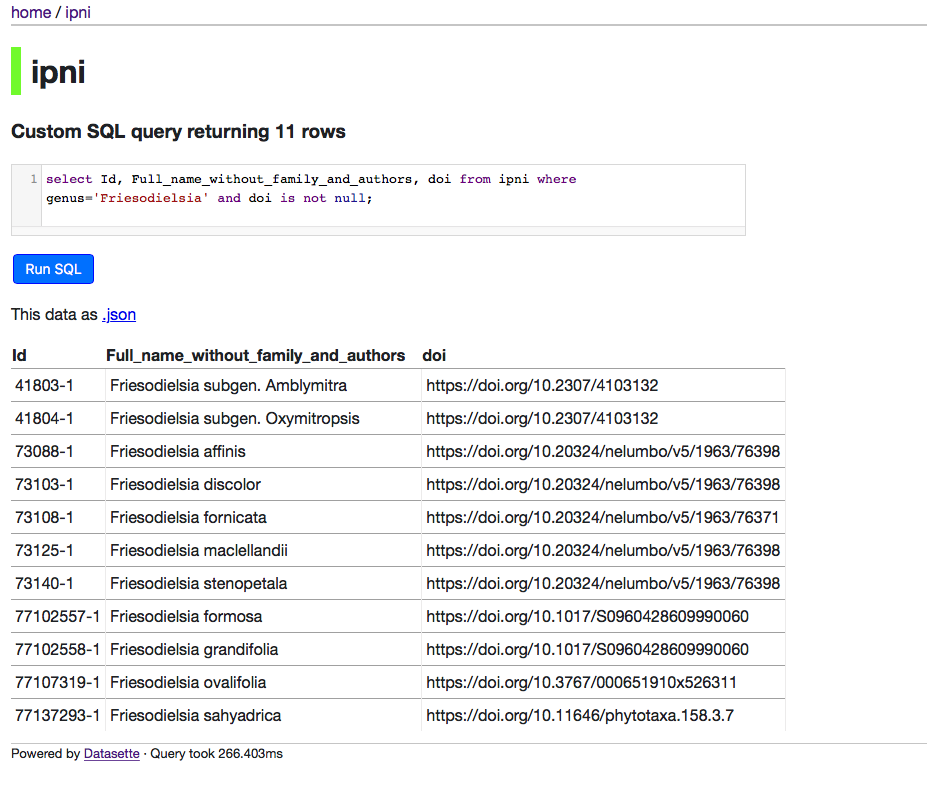
Fig2

One advantage of this approach is that the data is more accessible. I could just dump the database somewhere but then you'd have to download a large file and figure out how query it. This way, you can play with it straight away. It also means people can make use of it before I make up my mind how best to package it (for example, as part of a larger database of eukaryote names). This is one of the main motivations behind the paper, how to avoid the trap of spending years cleaning and augmenting data and not making it available to others because of the overhead of building a web site around the data. I may look at liberating some other datasets using this approach.

Friday, March 18, 2016

The Plant List, GBIF, and the primary literature

TL;DR; The Plant List is now in GBIF http://doi.org/10.15468/btkum2.

Readers of this blog may recall that I've had a somewhat jaundiced view of The Plant List. The first version was release with a Creative Commons Attribution-NonCommercial-NoDerivs (CC BY-NC-ND) license which allowed copying so long as didn't create a derived work (The Plant List: nice data, shame it's not open). This is frankly about the silliest possible license for a data set as, from my perspective, the whole reason for releasing data is so that it can be combined and enhanced with other data.

The second release (version 1.1) dropped an explicit CC license in favour of almost the reverse position (!). You can't copy the list "as is" without permission, but you can make derivative works "without prior written permission from us" (see Terms of Use for The Plant List). Progress, of a sort.

So, for the last week I've been working on getting a version of The Plant List into GBIF, and I've finally managed to achieve this. There's isn't a single place you can grab the whole plant list, so you have to scrape the web site for CSV files, then glue them together. I would could argue that converting the data into the Darwin Core Archive is a derived work, but in case this seems not derivative enough (of course, nobody seems ready to define just what "derived" actually means) I started to augment the list of names by adding bibliographic identifiers. I've long argued (see e.g. Surfacing the deep data of taxonomy) that a fundamental limitation of existing taxonomic database is that they don't explicitly link to the primary literature. This is why I built BioNames, and why I've been working to link the "micro citations" in IPNI to identifiers such as DOIs, JSTOR likes, BioStor URLs and BHL page links (see project on github). So, I've added about 120,000 DOIs and JSTOR links to names in the plant list. This is a subset of the links I've found for IPNI, but for this first release I've tried to keep things simple. I've also made the link between Plant List name and DOI/JSTOR via the IPNI identifier for a name, and the Plant List has ommitted quite a few IPNI ids for reasons which aren't clear.

The Plant List version I've created is available in GBIF (http://doi.org/10.15468/btkum2 and http://www.gbif.org/dataset/d9a4eedb-e985-4456-ad46-3df8472e00e8). Having another list of plant names will be a useful addition to the checklists that GBIF already has, even if the Plant List is already somewhat out of date.

DOIs

One feature of enhanced Plant List in GBIF is that for a subset of names (currently about 10%) there are direct links to the original publication of that name. For example, the record for Haniffia albiflora in the Plant List has a fairly cryptic bibliographic citation Nordic J. Bot. 20: 287 2000 and no link to that publication. In the version I've uploaded to GBIF the name Haniffia albiflora looks like this: Haniffia Note the full citation. But more importantly, the Publisher record link is the DOI http://doi.org/10.1111/j.1756-1051.2000.tb00745.x so clicking on it takes you to the original description of this species: Doi4 There is a lot of plant taxonomic literature available in JSTOR, sadly most of it (along with specimen images) behind a paywall (see Why are botanists locking away their data in JSTOR Plant Science?). Some of the links from GBIF take you to JSTOR: Doi3 The DOI landscape is evolving, and there are now multiple DOI registration agencies minting DOIs for scientific papers. CrossRef provides easily the best services for discovery and metadata harvesting, other agencies often have no equivalent, which makes it hard to discover DOIs for those papers hard. I've spent some time getting this information for Chinese and Taiwanese articles, e.g. http://dx.doi.org/10.6165/tai.1985.30.5: Doi1 and http://dx.doi.org/10.3969/j.issn.2095-0845.2005.04.002: Doi2 to give two example of articles that are now linked to from the corresponding species page in GBIF.

It's all about the links To reiterate, I believe that one of the key challenges facing biodiversity informatics is cross linking between disparate types of data and source of information. At the moment most of our data resides in disconnected silos. The links I'm adding to plant names are a small step, but they can lead to all sorts of possibilities. For example, users of GBIF can click on a link and see the original paper. If, for example, GBIF doesn't have a map for the species discussed in that paper, it's likely that the paper may have some information (e.g., the type locality). If users click on the links, then that is going to drive more traffic to the original literature, thus increasing its visibility. Furthermore, now that we have a taxon identifier (from GBIF) linked to a bibliographic identifier, we can go in the opposite direction. Earlier I proposed a Javascript bookmarklet as a way to augment the information on a web page (see Rethinking annotating biodiversity data). We could have a popup on a article web page that can tell the user about the taxa mentioned in that paper. If GBIF has a ma for those taxa, we can immediately place that paper in a geospatial context (e.g., Africa). This is barely scratching the surface of what is possible once we start breaking out of silos and share deeply linked data.

Sunday, August 09, 2015

More Neo4J tests of GBIF taxonomy: Using IPNI to find objective synonyms

Following on from Testing the GBIF taxonomy with the graph database Neo4J I've added a more complex test that relies on linking taxa to names. In this case I've picked some legume genera (Coursetia and Poissonia) where there have been frequent changes of name. By mapping the GBIF taxa to IPNI names (and associated LSIDs) we can build a graph linking taxa to names, and then to objective synonyms (by resolving the IPNI LSIDs and following the links to the basionym), see http://gist.neo4j.org/?4df5af75d42e0f963e5d.

In this example we find species that occur twice in the GBIF taxonomy, which logically should not happen as the names are objective synonyms. We can detect these problems if we have access to nomenclatural data. in this case, because IPNI has tracked the names changes, we can infer that, say, Coursetia heterantha and Poissonia heterantha are synonyms, and hence only one of these should appear in the GBIF classification. This is an example that illustrates the desirability of separating names and taxa, see Modelling taxonomic names in databases.

Monday, November 11, 2013

Names and nomenclators: just do it already!

Quick notes on taxonomic names (again). It's a continuing source of bafflement that the biodiversity community is making a dog's breakfast of names. It seems we are forever making it more complicated than it needs to be, forever minting new acronyms that pollute the landscape without actually contributing anything useful, and forever promising shiny new tools and services without every actually delivering them. Meanwhile people and projects that build upon names are left to deal with a mess.

It seems to me that it would be nice if we had a single place to go to get definitive information on a name, and that place would give us a unique identifier that we could use in our own databases as a way to clean up and reconcile our data. For example, if we have a bibliographic database we can map citations to DOIs and then use those to identify the articles. If we have a list of journal names, we can map those to ISSNs and clean up our data. Likewise, if we have a classification such as GBIF or NCBI, we should be able to map the names in those classifications onto standard identifiers for taxonomic names.

The frustrating thing is we already have standard identifiers for taxonomic names. Since around 2005 we have been serving LSIDs for plant and animal names. We have Index Fungorum, IPNI, ION, and ZooBank, all serving LSIDs, all serving RDF, all using the same TDWG vocabulary.

The nomenclators vary in size and scope, but we have the three major, multicellular eukaryotes covered (circles proportional to number of names in each database):
Nomenclators

There is some duplication, both within nomenclators (IPNI and ION I'm looking at you) and between nomenclators (ION and ZooBank have the same scope, although ZooBank is dwarfed by ION, anyone care to explain why we have both...?). All four databases are actively growing, partly through direct registration of new taxonomic names.

So, we're basically done, right? Surely all we need to do is harvest the LSIDs for all these names, put them into a single triple store, and wrap some basic services around them? If the nomenclators provide a list of recent changes (e.g., as an RSS feed) then we could continuously update the store with new names. Then any database or classification could reconcile it's names with those in the nomenclators. They could also then augment their own records by making use of additional data the nomenclators have, such as objective synonomies and links to original descriptions. In other words, we could have a model like this:
Taxonmodel
Classifications represent a view of how taxa are related, the names associated with those taxa are stored in nomenclators. This means that classification databases like GBIF and NCBI are not in the business of managing names, they simply link to the nomenclators (in the same way that a bibliographic database can link to DOI, ISSNs, and author ids such as ORCID and VIAF).

We have almost all of this infrastructure in place already. In one of the unsung triumphs of TDWG we have all the nomenclators serving data in the same format using the same technology. And yet we have singly failed to do anything useful with this extraordinary resource! Instead we seem more interested in contributing more projects to the acronym soup of biodiversity informatics. All around us projects to assign and link identifiers for publications (CrossRef), data (DataCite), and people (ORCID) are taking off. The infrastructure for taxonomic names has been in place since 2005, we could be doing the same sort of things CrossRef, DataCite and ORCID are doing in their domains. Why aren't we?

Thursday, May 06, 2010

Linnaeus meets the Internet: PLoS + Botany = #fail

C2914D0E-13E9-4CA6-BE0A-7A8645BC6A72.jpgTo much fanfare (e.g., Nature News, "Linnaeus meets the Internet" doi:10.1038/news.2010.221), on May 5th PLoS ONE published Sandy Knapp's "Four New Vining Species of Solanum (Dulcamaroid Clade) from Montane Habitats in Tropical America" doi:10.1371/journal.pone.0010502. To quote the Nature News piece:
The paper represents the culmination of a campaign to institute the electronic publication of scientific names, a case Knapp and others have made in journals including Nature[doi:10.1038/446261a]. Allowing electronic publication should make accessing information easier for scientists worldwide — especially those in developing countries who may not have access to fully stocked libraries. This, in turn, will aid conservation efforts, Knapp says.

Given the profile of this paper, "...the first time new plant names have been published in a purely electronic journal and still complied with ICBN rules", you'd think the participants would ensure the electronic aspects of the publication worked. Sadly, this is not the case.

The four names in question have apparently been deposited in IPNI with the following LSID's:

  • Solanum aspersum: urn:lsid:ipni.org:names:77103633-1

  • Solanum luculentum: urn:lsid:ipni.org:names:77103634-1

  • Solanum sanchez-vegae: urn:lsid:ipni.org:names:77103635-1

  • Solanum sousae: urn:lsid:ipni.org:names:77103636-1


Today is May 6th. None of these names are returned by a search of IPNI, for example http://www.ipni.org/ipni/simplePlantNameSearch.do?find_wholeName= returns this:

ipni1.png

Resolving the LSID returns this:

<?xml version="1.0" encoding="UTF-8"?>
<rdf:RDF xmlns:xsi="http://www.w3.org/2001/XMLSchema-instance"
xmlns:dc="http://purl.org/dc/elements/1.1/"
xmlns:dcterms="http://purl.org/dc/terms/"
xmlns:tn="http://rs.tdwg.org/ontology/voc/TaxonName#"
xmlns:tm="http://rs.tdwg.org/ontology/voc/Team#"
xmlns:tcom="http://rs.tdwg.org/ontology/voc/Common#"
xmlns:p="http://rs.tdwg.org/ontology/voc/Person#"
xmlns:rdf="http://www.w3.org/1999/02/22-rdf-syntax-ns#"
xmlns:owl="http://www.w3.org/2002/07/owl#">
<tn:TaxonName rdf:about="urn:lsid:ipni.org:names:77103633-1">
<tcom:versionedAs rdf:resource="urn:lsid:ipni.org:names:77103633-1:1.2"/>
<tcom:Deleted>Yes</tcom:Deleted>
</tn:TaxonName>
</rdf:RDF>

Hmmm, so apparently this record has been "deleted"?

The paper also states that:
The IPNI LSIDs (Life Science Identifiers) can be resolved and the associated information viewed through any standard web browser by appending the LSID contained in this publication to the prefix http://ipni.org/.

This sentence mirrors similar ones in other PLoS ONE papers saying we can resolve ZooBank LSIDs by appending the LSID to http://zoobank.org (e.g., see doi:10.1371/journal.pone.0001787).

Thing is, URLs such as http://ipni.org/urn:lsid:ipni.org:names:77103633-1 return a 404 from Kew (any IPNI LSID I've tried does this).


Update As per Alan Paton's comment below, the http://ipni.org prefix now works.


So, to recap:

  1. The names aren't in IPNI

  2. The LSIDs state the record has been deleted

  3. The LSID's can't be resolved by the means stated in the paper

Now, I don't know what happened (perhaps IPNI wanted to hold off until the paper actually appeared before releasing the names), but the paper is out, the buzz in Nature is out, and IPNI doesn't have the resolver in place, yet alone the names.

Given the milestone this paper represents, and the fuss over the publication of the name Darwinius, you'd expect the bioinformatics side of it to be, you know, actually working. In these circumstances, how on Earth do we make the case that the LSID and name databasing side of taxonomic publication is useful?

Tuesday, July 14, 2009

Using Google Spreadsheets and RSS feeds to edit IPNI

One thing I find myself doing a lot is creating Excel spreadsheets and filling them will lists of taxonomic names and bibliographic references, for which I then try to extract identifiers (such as DOIs). This is a tedious business, but the hope is that by doing it once I can create a useful resource. However, often I get bored and the spreadsheets lie forgotten in some deep recess of my computer's hard drive.

It occurs to me that making these spreadsheets publicly available would be useful, but how to do this? In particular, how to do this in a way that makes it easy for me to extract recent edits, and to update the data from new sources? Google Spreadsheets seems an obvious answer, but I wasn't aware of just how obvious until I started playing with the spreadsheet APIs. These enable you to add data via the API (using HTTP PUT and ATOM), which means that I can easily push new data to the spreadsheet.

As a test, I've harvested the IPNI RSS feeds I created earlier (see http://bioguid.info/rss), extracted basic details about the name and any bibliographic identifiers my RSS generator had found, and sent these direct to a Google Spreadsheet. Some IPNI references didn't parse, so I can manually edit these, and many references lack an identifier (my tools usually finds those with DOIs). Often with a bit searching one can turn up a URL or a Handle to a paper, or even simply expand on the bibliographic details (which are a bit skimpy in IPNI). I'm also toying with using Zotero as an online bibliographic store for references that don't have an online presence.

So, what I've got now is a spreadsheet that can be edited, updated, and harvested, and will persist beyond any short term enthusiasm I have for trying to annotate IPNI.

Thursday, May 07, 2009

Nomenclators + digitised literature = fail


Continuing with RSS feeds, I've now added wrappers around IPNI that will return for each plant family a list of names added to the IPNI database in the last 30 days. You can see the list at here.

One thing which is a constant source of frustration for me is the disconnect between nomenclators (lists of published names for species) and scientific publishing. The unit of digitisation for a publisher is the scientific article, but nomenclators often cite not the article in which a name was published, but the page on which the name appears.

For example, consider IPNI record 77096979-1 (or, if you prefer LSIDs urn:lsid:ipni.org:names:77096979-1). It is for the begonia Begonia ozotothrix, and the citation is:

Edinburgh J. Bot. 66(1): 105 (-110; figs. 1, 4-5, map). 2009 [Mar 2009]

Very detailed, and great if I have access to a physical library that has the Edinburgh Journal of Botany -- I just find volume 66 on the shelf and turn to page 105. But, I want this on my computer now ("library" - who they?). How do I find this reference on the web? The answer, is not easily. Tools such as OpenURL, which could be used, assume that I know at least the starting page of the article, but IPNI doesn't tell me that. Nor do I have an article title, which might help, but a Google search on "Begonia ozotothrix" finds the article:

TWO NEW SPECIES OF BEGONIA ( BEGONIACEAE) FROM CENTRAL SULAWESI, INDONESIA
D C Thomas, W H Ardi and M Hughes
Edinburgh Journal of Botany 66, 103 (2009)
doi:10.1017/S0960428609005320

Note the DOI! This article exists on the web, so why can't IPNI give me the DOI? They've gone to a lot of trouble to describe the citation in great detail, but adding the DOI brings the record into the 21st century and the web (the DOI is even printed on the article!).

I think nomenclators need to make a concerted effort to integrate with the digital scientific literature, otherwise they will remain digital backwaters that make the implicit assumption that their users have access to libraries such as that at the Royal Botanic Gardens, Edinburgh (pictured).

For recently published articles there's absolutely no reason not to store the DOI. Finding these retrospectively is a pain, but I need these for my RSS feed (and other projects) so one thing I added a while ago to bioGUID's OpenURL resolver is the ability to search for an article given an arbitrary page. For example,

http://bioguid.info/openurl/?genre=article&title=Edinburgh J. Bot.&volume=66&pages=105

will search various sources (such as CrossRef) to find an article that includes page 105. Now, I just have to have a parser that can make sense of IPNI bibliographic citations...