Showing posts with label BHL. Show all posts

Friday, June 04, 2021

Thoughts on BHL, ALA, GBIF, and Plazi

If you compare the impact that BHL and Plazi have on GBIF, then it's clear that BHL is almost invisible. Plazi has successfully in carved out a niche where they generate tens of thousands of datasets from text mining the taxonomic literature, whereas BHL is a participant in name only. It's not as if BHL lacks geographic data. I recently added back a map display in BioStor where each dot is a pair of latitude and longitude coordinates mentioned in an article derived from BHL's scans.

This data has the potential to fill in gaps in our knowledge of species distributions. For example, the Atlas of Living Australia (ALA) shows the following map for the cladoceran (water flea) Simocephalus:

Compare this to the localities mentioned in just one paper on this genus:

Timms, B. V. (1989). Simocephalus Schoedler (Cladocera: Daphniidae) in tropical Australia. The Beagle, 6, 89–96. Retrieved from https://biostor.org/reference/241776

There are records in this paper for species that currently have no records at all in ALA (e.g., Simocephalus serrulatus):

As it stands BioStor simply extracts localities, it doesn't extract the full "material citation" from the text (that is, the specimen code, date collected, locality, etc. for each occurrence). If it did, it would then be in a position to contribute a large amount of data to ALA and GBIF (and elsewhere). Not only that, if it followed the Plazi model this contribution would be measurable (for example, in terms of numbers of records added, and numbers of data citations). Plazi makes some of its parsing tools available as web services (e.g., http://tb.plazi.org/GgWS/wss/test and https://github.com/gsautter/goldengate-webservices), so in principle we could parse BHL content and extract data in a form usable by ALA and GBIF.

Notes on Plazi web service

The endpoint is http://tb.plazi.org/GgWS/wss/invokeFunction and it accepts POST requests, e.g. data=Namibia%3A%2058%20km%20W%20of%20Kamanjab%20Rest%20Camp%20on%20road%20to%20Grootberg%20Pass%20%2819%C2%B038%2757%22S%2C%2014%C2%B024%2733%22E%29&functionName=GeoCoordinateTaggerNormalizing.webService&dataUrl=&dataFormat=TXT and returns XML.

Tuesday, April 06, 2021

It's been a while...

Is it's been a while since I've blogged here. The last few months have been, um, interesting for so many reasons. Meanwhile in my little corner of the world there's been the constant challenge of rethinking how to teach online-only, whilst also messing about with a bunch of things in a rather unfocused way (and spending way too much time populating Wikidata). So here I'll touch on a few rather random topics that have come up in the last few months, and elsewhere on this blog I'll try and focus on some of the things that I'm working on. In many ways this blog post is really to serve as a series of bookmarks for things I'd like to think about a bit more.

Taxonomic precision and the "one tree"

One thing that had been bugging me for a while was my inability to find the source of a quote about taxonomic precision that I remembered as a grad student. I was pretty sure that David Penny and Mike Handy had said it, but where? Found it at last:

Biologists seem to seek “The One Tree” and appear not to be satisfied by a range of options. However, there is no logical difficulty with having a range of trees. There are 34,459,425 possible trees for 11 taxa (Penny et al. 1982), and to reduce this to the order of 10-50 trees is analogous to an accuracy of measurement of approximately one part in 106.

Many measurements in biology are only accurate to one or two significant figures and pale when compared to physical measurements that may be accurate to 10 significant figures. To be able to estimate an accuracy of one tree in 106 reflects the increasing sophistication of tree reconstruction methods. (Note that, on this argument, to identify an organism to a species is also analogous to a measurement with an accuracy of approximately one in 106.). — "Estimating the reliability of evolutionary trees" p.414 doi:10.1093/oxfordjournals.molbev.a040407

I think this quote helps put taxonomy and phylogeny in the broader context of quantitative biology. Building trees that accurately place taxa is a computationally challenging task that yields some of the most precise measurements in biology.

Barcodes for everyone

This is yet another exciting paper from Rudolf Meier's lab (see earlier blog post Signals from Singapore: NGS barcoding, generous interfaces, the return of faunas, and taxonomic burden). The preprint doi:10.1101/2021.03.09.434692 is on bioRxiv. It feels like we are getting ever-closer to the biodiversity tricorder.

Barcodes for Australia

Donald Hobern (@dhobern) has been blogging about insects collected in malaise traps in Aranda, Australian Capital Territories (ACT). The insects are being photographed (see stream on Flickr) and will be barcoded.

No barcodes please we're taxonomists!

A paper with a title like "Minimalist revision and description of 403 new species in 11 subfamilies of Costa Rican braconid parasitoid wasps, including host records for 219 species" (Harvey et al. doi:10.3897/zookeys.1013.55600 was always likely to cause problems, and sure enough some taxonomists had a meltdown. A lot of the arguments centered around whether DNA sequences counted as words, which seems surreal. DNA sequences are strings of characters, just like natural language. Unlike English, not all languages have word breaks. Consider Chinese for example, where search engines can't break text up into words for indexing, but instead use n-grams. I mention this simply because n-grams are a useful way to index DNA sequences and to compute sequence similarly without performing a costly sequence alignment. I used this technique in my DNA barcode browser. If we move beyond arguments about whether a picture and a DNA sequence is enough to describe a species (if all species every discovered were described this way we'd arguably be much better off than we are now) I think there is a core issue here, namely the relative size of the intersection between taxa that have been described classically (i.e., with words) and those described almost entirely by DNA (e.g., barcodes) will likely drop as more and more barcoding is done, and this has implications for how we do biology (see Dark taxa: GenBank in a post-taxonomic world).

Bioschema

The dream of linked data rumbles on. Schema.org is having a big impact on standardising basic metadata encoded in web sites, so much so that anyone building a web site now needs to be familiar with schema.org if you want your site to do well in search engine rankings. I made extensive use of schema.org to model bibliographic data on Australian animals for my Ozymandias project.

Bioschemas aims to provide a biology-specific extension to schema.org, and is starting to take off. For example, GBIF pages for species now have schema.org embedded as JSON-LD, e.g. the page for Chrysochloris visagiei Broom, 1950 has this JSON-LD embedded in a <script type="application/ld+json"> tag:

{ "@context": [ "https://schema.org/", { "dwc": "http://rs.tdwg.org/dwc/terms/", "dwc:vernacularName": { "@container": "@language" } } ], "@type": "Taxon", "additionalType": [ "dwc:Taxon", "http://rs.tdwg.org/ontology/voc/TaxonConcept#TaxonConcept" ], "identifier": [ { "@type": "PropertyValue", "name": "GBIF taxonKey", "propertyID": "http://www.wikidata.org/prop/direct/P846", "value": 2432181 }, { "@type": "PropertyValue", "name": "dwc:taxonID", "propertyID": "http://rs.tdwg.org/dwc/terms/taxonID", "value": 2432181 } ], "name": "Chrysochloris visagiei Broom, 1950", "scientificName": { "@type": "TaxonName", "name": "Chrysochloris visagiei", "author": "Broom, 1950", "taxonRank": "SPECIES", "isBasedOn": { "@type": "ScholarlyArticle", "name": "Ann. Transvaal Mus. vol.21 p.238" } }, "taxonRank": [ "http://rs.gbif.org/vocabulary/gbif/rank/species", "species" ], "dwc:vernacularName": [ { "@language": "eng", "@value": "Visagie s Golden Mole" }, { "@language": "eng", "@value": "Visagie's Golden Mole" }, { "@language": "eng", "@value": "Visagie's Golden Mole" }, { "@language": "eng", "@value": "Visagie's Golden Mole" }, { "@language": "", "@value": "Visagie's golden mole" }, { "@language": "eng", "@value": "Visagie's Golden Mole" }, { "@language": "deu", "@value": "Visagie-Goldmull" } ], "parentTaxon": { "@type": "Taxon", "name": "Chrysochloris Lacépède, 1799", "scientificName": { "@type": "TaxonName", "name": "Chrysochloris", "author": "Lacépède, 1799", "taxonRank": "GENUS", "isBasedOn": { "@type": "ScholarlyArticle", "name": "Tabl. Mamm. p.7" } }, "identifier": [ { "@type": "PropertyValue", "name": "GBIF taxonKey", "propertyID": "http://www.wikidata.org/prop/direct/P846", "value": 2432177 }, { "@type": "PropertyValue", "name": "dwc:taxonID", "propertyID": "http://rs.tdwg.org/dwc/terms/taxonID", "value": 2432177 } ], "taxonRank": [ "http://rs.gbif.org/vocabulary/gbif/rank/genus", "genus" ] } }

For more details on the potential of Bioschemas see Franck Michel's TDWG Webinar.

OCR correction

Just a placeholder to remind me to revisit OCR correction and the dream of a workflow to correct text for BHL. I came across hOCR-Proofreader (which has a Github repo). Internet Archive now provides hOCR files as one of its default outputs, so we're getting closer to a semi-automated workflow for OCR correction. For example, imagine having all this set up on Github so that people can correct text and push those corrections to Github. So close...

Roger Hyam keeps being awesome

Roger just keeps doing cool things that I keep learning from. In the last few months he's been working on a nice interface to the World Flora Online (WFO) which, let's face it, is horrifically ugly and does unspeakable things to the data. Roger is developing a nicer interface and is doing some cool things under the hood with identifiers that inspired me to revisit LSIDs (see below).

But the other thing Roger has been doing is using GraphQL to provide a clean API for the designer working with him to use. I have avoided GraphQL because it couldn't see what problem it solved. It's not a graph query language (despite the name), it breaks HTTP caching, it just seemed that it was the SOAP of today. But, if Roger's using it, I figured there must be something good here (and yes, I'm aware that GraphQL has a huge chunk of developer mindshare). As I was playing with yet another knowledge graph project I kept running into the challenge of converting a bunch of SPARQL queries into something that could be easily rendered in a web page, which is when the utility of GraphQL dawned on me. The "graph" in this case is really a structured set of results that correspond to the information you want to render on a web page. This may be the result of quite a complex series of queries (in my case using SPARQL on a triple store) that nobody wants to actually see. The other motivator was seeing DataCite's use of GraphQL to query the "PID Graph". So, I think I get it now, in the sense that I see why it is useful.

LSIDs back from the dead

In part inspired by Roger Hyam's work on WFO I released a Life Science Identifier (LSID) Resolver to make LSIDs resolvable. I'll spare you the gory details, but you can think of LSIDs as DOIs for taxonomic names. They came complete with a decentralised resolution mechanism (based on Internet domain names) and standards for what information they return (RDF as XML), and millions were minted for animal, fungi, and plant names. For various reasons they didn't really take off (they were technically tricky to use and didn't return information in a form people could read, so what were the chances?). Still, they contain a lot of valuable information for those of us interested in having lists of names linked to the primary literature. Over the years I have been collecting them and wanted a way to make them available. I've chosen a super-simple approach based on storing them in compressed form in GitHub and wrapping that repo in simple web site. Lots of limitations, but I like the idea that LSIDs actually, you know, persist.

DOIs for Biodiversity Heritage Library

In between everything else I've been working with BHL to add DOIs to the literature that they have scanned. Some of this literature is old and of limited scientific value (but sure looks pretty - Nicole Kearney is going to take me to task for saying that), but a lot of it is recent, rich, and scientifically valuable. I'm hoping that the coming months will see a lot of this literature emerge from relative obscurity and become a first class citizen of the taxonomic and biodiversity literature.

Summary

I guess something meaningful and deep should go here... nope, I'm done.

Saturday, October 24, 2020

Visualising article coverage in the Biodiversity Heritage Library

It's funny how some images stick in the mind. A few years ago Chris Freeland (@chrisfreeland), then working for Biodiversity Heritage Library (BHL), created a visualisation of BHL content relevant to the African continent. It's a nice example of small multiples.


For more than a decade (gulp) I've been extracting articles from the BHL and storing them in BioStor. My approach is to locate articles based on metadata (e.g., information on title, volume, and pagination) and store the corresponding set of BHL pages in BioStor. BHL in turn regularly harvests this information and displays these articles as "parts" on their web site. Most of this process is semi-automated, but still requires a lot of manual work. One thing I've struggled with is getting a clear sense of how much progress has been made, and how much remains to be done. This has become more pressing given work I'm doing with Nicole Kearney (@nicolekearney) on Australian content. Nicole has a team of volunteers feeding me lists of article metadata for journals relevant to Australian biodiversity, and it would be nice to see where the remaining gaps are.

So, motivated by this, and also a recent comment by Nicky Nicolson (@nickynicolson) about the lack of such visualisations, I've put together a crude tool to try and capture the current state of coverage. You can see the results here: https://rdmpage.github.io/bhl-article-coverage/.

As an example, here is v.25:pt.2 (1988) of Memoirs of the Queensland Museum. Each contiguous block of colour highlights an article in this volume:


This scanned item-level view is constructed for each item (typically a volume or an issue). I then generate a PNG bitmap thumbnail of this display for each volume, and display them together in a page for the corresponding journal (e.g., Memoirs of the Queensland Museum):

So at a glance we can see the coverage for a journal. Gray represents pages that have not been assigned to an article, so if you want to add articles to BHL those are the volumes to focus on.

There's an argument to be made that it is crazy to spend a decade extracting some 226,000 articles semi-automatically. Ideally we could use a tool like machine learning to identify articles in BHL. It would be a huge time saver if we could simply run a BHL article through a tool that could (a) extract article-level metadata and (b) associate that with the corresponding set of scanned pages. Among the possible approaches would be to develop a classifier that would assign each page in a scanned volume to a category such as "article start", "article end", "article", "plate", etc. In effect, we want a tool that can could segment scans into articles (and hence reproduce the coverage diagrams shown above) simply based on attributes of the page images. This doesn't solve the entire problem, we still need to extract metadata (e.g., article titles), but it would be a start. However, it poses the classic dilemma, do I keep doing this manually, or do I stop adding articles and take the time to learn a new technology in the hope that eventually I will end up adding more articles than if I'd persisted with the manual approach?


Friday, November 10, 2017

Exploring images in the Biodiversity Literature Repository

A post by on the Plaza blog Expanded access to images in the Biodiversity Literature Repository has prompted me to write up a little toy I created earlier this week.

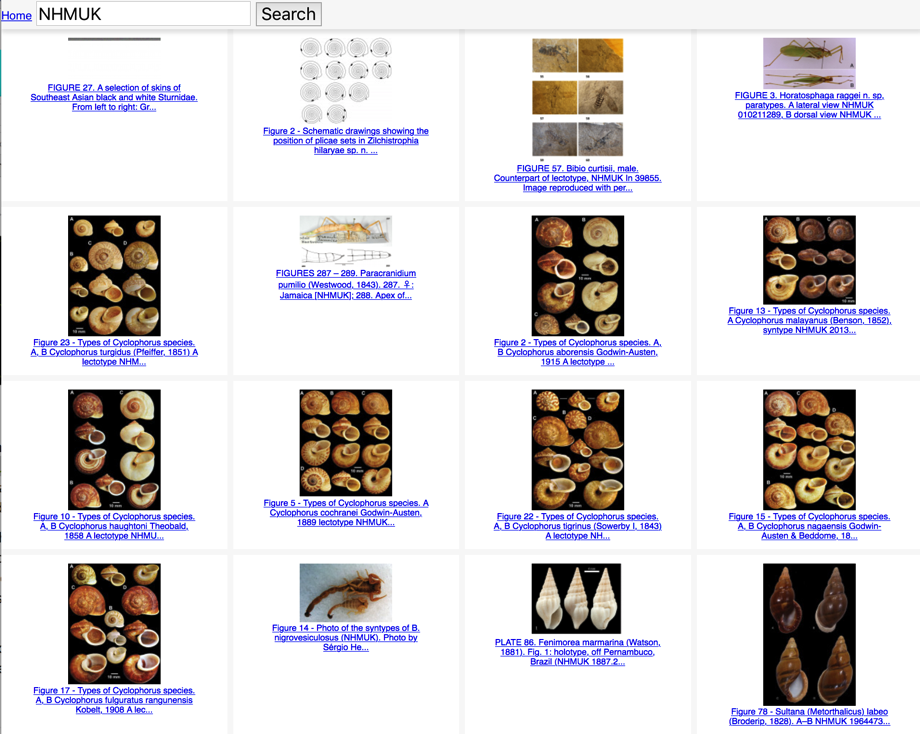
The Biodiversity Literature Repository (BLR) is a repository of taxonomic papers hosted by Zenodo. Where possible Plazi have extracted individual images and added those to the BLR, even if the article itself is not open access. The justification for being able to do this is presented here: DOI:10.1101/087015. I'm not entirely convinced by their argument (see Copyright and the Use of Images as Biodiversity Data) but rather than rehash that argument I decide dit would be much more fun to get a sense of what is in the BLR. I built a tool to scrape data from Zenodo and store it in CouchDB, put a simple search engine on top (using the search functionality in Cloudant) to search within the figure captions, and wrote some code to use a cloud-based image server to generate thumbnails for the images in Zenodo (some of which are quite big). The tool is hosted at Heroku, you can try it out here: https://zenodo-blr-interface.herokuapp.com/.

Screenshot 2017 11 10 11 03 30

This is not going to win any design awards, I'm simply trying to get a feel for what imagery BLR has. My initial reactions was "wow!". There's a rich range of images, including phylogenies, type specimens, habitats, and more. Searching by museum codes, e.g. NHMUK is a quick way to discover images of specimens from various collections.

Screenshot 2017 11 10 11 22 05

Based on this experiment there are at least two things I think would be fun to do.

Adding more images

BLR already has a lot of images, but the biodiversity literature is huge, and there's a wealth of imagery elsewhere, including journals not in BLR, and of course the Biodiversity Heritage Library (BHL). Extracting images from articles in BHL would potentially add a vast number of additional images.

Machine learning

Machine learning is hot right now, and anyone using iNaturalist is probably aware of their use of computer vision to suggest identifications for images you upload. It would be fascinating to apply machine learning to images in the BLR. Even basic things such as determining whether an image is a photo or a drawing, how many specimens are included, what the specimen orientation is, what part of the organism is being displayed, is the image a map (and of what country) would be useful. There's huge scope here for doing something interesting with these images.

The toy I created is very basic, and merely scratches the surface of what could be done (Plazi have also created their own tool, see http://github.com/punkish/zenodeo). But spending a few minutes browsing the images is well worthwhile, and if nothing else is a reminder of both how diverse life is, and how active taxonomists are in trying to discover and describe that diversity.

Tuesday, October 03, 2017

TDWG 2017: thoughts on day 1

Some random notes on the first day of TDWG 2017. First off, great organisation with the first usable conference calendar app that I've seen (https://tdwg2017.sched.com).

I gave the day's keynote address in the morning (slides below).

It was something of a stream of consciousness brain dump, and tried to cover a lot of (maybe too much) stuff. Among the topics I covered were Holly Bik's appeal for better links between genomic and taxonomic data, my iSpecies tool, some snarky comments on the Semantic Web (and an assertion that the reason that GenBank succeeded was due more to network effects than journals requiring authors to submit sequences there), a brief discussion of Wikidata (including using d3sparql to display classifications, see here), and the use of Hexastore to query data from BBC Wildlife. I also talked about Ted Nelson, Xanadu, using hypothes.is to annotate scientific papers (see Aggregating annotations on the scientific literature: a followup on the ReCon16 hackday), social factors in building knowledge graphs (touching on ORCID and some of the work by Nico Franz discussed here), and ended with some cautionary comments on the potential misuse of metrics based on knowledge graphs (using "league tables" of cited specimens, see GBIF specimens in BioStor: who are the top ten museums with citable specimens?).

TDWG is a great opportunity to find out what is going on in biodiversity informatics, and also to get a sense of where the problems are. For example, sitting through the Financial Models for Sustaining Biodiversity Informatics Products session you couldn't help being struck by (a) the number of different projects all essentially managing specimen data, and (b) the struggle they all face to obtain funding. If this was a commercial market there would be some pretty drastic consolidation happening. It also highlights the difficulty of providing services to a community that doesn't have much money.

I was also struck by Andrew Bentley's talk Interoperability, Attribution, and Value in the Web of Natural History Museum Data. In a series of slides Andrew outlined what he felt collections needed from aggregators, researchers, and publishers, e.g.:

Chatting to Andrew at the evening event at the Canadian Museum of Nature, I think there's a lot of potential for developing tools to provide collections with data on the use and impact of their collections. Text mining the biodiversity literature on a massive scale to extract (a) mentions of collections (e.g., their institutional acronyms) and (b) citations of specimens could generate metrics that would be helpful to collections. There's a great opportunity here for BHL to generate immediate value for natural history collections (many of which are also contributors to BHL).

Also had a chance to talk to Jorrit Poelen who works on Global Biotic Interactions (GloBI). He made some interesting comparisons between Hexastores (which I'd touched on in my keynote) and Linked Data Fragments.

The final session I attended was Towards robust interoperability in multi-omic approaches to biodiversity monitoring. The overwhelming impression was that there is a huge amount of genomic data, much of which does not easily fit into the classic, Linnean view of the world that characterises, say, GBIF. For most of the sequences we don't know what they are, and that might not be the most interesting question anyway (more interesting might be "what do they do?"). The extent to which these data can be shoehorned into GBIF is not clear to me, although doing so may result in some healthy rethinking of the scope of GBIF itself.

Wednesday, May 31, 2017

Wikidata, WikiCite, and the "bibliography of life"

3hhZSGOn 400x400Last week I was at WikiCite 2017, a fascinating three day event in Vienna. Wikicite is "a proposal to build a bibliographic database in Wikidata to serve all Wikimedia projects", and is attracting increasing attention from academics, librarians, publishers, data geeks, and others. You can get a sense of the project by following @WikiCite on Twitter.

I went to the meeting in part to learn more about WikiCite, and also to spend some time hacking on Wikispecies. I'd been to only one Wiki event before (a Wiki Science Conference) so I'm still finding my way around this community. I spent the first two days listening to talks while coding away (more on this below), but on Wednesday put my own coding aside to join a bunch of people hacking the CrossRef event API in a great session led by Joe Wass. I've put some notes and code in GitHub. The event API tracks what people do with DOIs, including adding them to Wikipedia pages when citing a source in support of an assertion. A significant fraction of DOI resolutions are from Wikipedia pages, which is one reason why CrossRef was present at WikiCite.

Wikidata

In practice WikiCite's goal of building a bibliographic database to serve all Wikimedia projects means that articles, books, and other bibliographic items that are cited by Wikimedia projects will each be added to Wikidata. For example, the ZooKeys paper "Diversity of manota williston (Diptera, mycetophilidae) in ulu temburong national park, brunei" is item Q21188431 in Wikidata. Wikidata stores the key bibliographic metadata, including identifiers such as the DOI (which many at the WikiCite meeting pronounced "doy" much to my initial confusion). Screenshot 2017 05 31 12 46 43

This article was published in ZooKeys, which itself has a Wikidata item (Q219980), so in Wikidata the article is linked to the journal (i.e., "ZooKeys" isn't just a dumb string but a link to another Wikidata item). The article is also linked to two articles that it cites, and each of these is also a Wikidata item.

These citation links are one reason people are interested in WikiCite - it could be the basis of a free and open citation graph (for the benefits of such a graph see this piece by David Shotton doi:10.1038/502295a, a participant at the meeting in Vienna). Already some cool tools are being built on top of citation data in Wikidata, such as Scholia by Finn Årup Nielsen, Daniel Mietchen and Egon Willighagen. Here, for example, is my academic profile based on information in Wikidata. It's woefully incomplete, but intriguing. For a more complete example view Egon Willighagen's profile.

To some extent the utility of tools like Scholia will depend on how complete Wikidata's coverage is of the academic literature, which in turn raises the inevitable question of scope. Does Wikicite want to include just the literature cited in the various Wikimedia projects, or does it want to expand to include the total sum of academic literature?

Wikispecies, Wikidata and the bibliography of life

Wikispecies is one of the Wikimedia projects, and the only one that is topic-specific (the others are typically global in scope but have content in different languages, or host different data types such as images, scanned books, or structured data). As I've sketched out in an earlier post (Thoughts on Wikipedia, Wikidata, and the Biodiversity Heritage Library) I think Wikicite and Wikidata are potentially very important to projects such as BHL and the "bibliography of life". Much of our knowledge about the world's biodiversity is contained in the academic literature, and much of this is poorly known with no central database where we can find it, and much of it is still not digitised. It is tempting to think that Wikidata might be a platform around which the biodiversity community could focus its efforts on assembling a global database of biodiversity literature. Already major taxonomic journals such as ZooKeys are being fed into Wikidata, so it has a significant corpus of biodiversity literature already.

One way to grow this corpus is to focus on Wikispecies. In a post before the Wikicite meeting (Notes for WikiCite 2017: Wikispecies reference parsing) I elaborated on this idea. There are two stumbing blocks, one specific to Wikispecies, one a more general Wikidata issue.

The first issue is that Wikispecies bibliographic data is relatively unstructured, which makes converting it into structured data something of a challenge. I spent much of Wikicite hacking some code to do this on Glitch (more on Glitch later), you can see the results here: https://acoustic-bandana.glitch.me. This web site takes a Wikispecies reference and tries to convert it into CSL-JSON. Still very much a work in progress, but I've started building tools that use this web site as a service and process larger numbers of Wikispecies citations.

The second issue is how you get data into Wikidata, and this is something that's never been entirely clear to me. There are tools for adding an article using its DOI (sourcemd) but this isn't scalable, and doesn't handle the case of articles that don't have DOIs. This is still a "How do you Snapchat? You just Snapchat" moment. Wikidata desparately needs tools and a clear procedure whereby people like me with lots of bibliographic data can contribute.

Wikispecies

Another reason for my interest in Wikispecies (and other sources of bibliographic data such as the listed of cited literature being made available by CrossRef, see The Initiative for Open Citations) is that this data can be fed into BHL to locate more articles in that archive. Once these articles have been located they are stored in BioStor and BHL itself, but it makes sense to have them more accessible, and Wikidata looks to be an obvious candidate. Given that Wikispecies is essentially a crowd-source taxonomic database there is considerable overlap in content between Wikispecies and BHL. The Wikidata data model also allows for some of things that taxonomists care about, such as linking dates of publication to evidence relative to those dates (in older publications determining the publication date often requires quite extensive research).

Summary

Leaving aside the specific issues about how to get bibliographic data into Wikidata, I guess the question to ask is whether it makes sense to be developing large databases of bibliographic data without either using Wikidata as the platform to hold that data, or at least linking to Wikidata. Projects such as Gene Wiki are migrating from Wikipedia to Wikidata (see "Wikidata as a semantic framework for the Gene Wiki initiative" doi:10.1093/database/baw015), perhaps those of us interested in biodiversity literature could use projects like Gene Wiki as role models for how we could both contribute and benefit from Wikidata and Wikicite.

I've barely scratched the surface of what was discussed at Wikicite, for more details see the program. It is a very different sort of meeting in that the participants come from pretty diverse backgrounds, which helps shake up your own assumptions about what matters and how things should be done. It's also great that it's a meeting at which people write code or otherwise hack stuff together, so things actually get done. I've come away with lots to think about, and renewed enthusiasm about the role Wikimedia is playing in structuring our knowledge about the world.

Friday, March 24, 2017

Notes for WikiCite 2017: Wikispecies reference parsing

Wikispecies logo svg In preparation for WikiCite 2017 I'm looking more closely at extracting bibliographic information from Wikispecies. The WikiCite project "is a proposal to build a bibliographic database in Wikidata to serve all Wikimedia projects". One reason for doing this is so that each factual statement in WikiData can be linked to evidence for that statement. Practical efforts towards this goal include tools to add details of articles from CrossRef and PubMed straight into Wikidata, and tools to extract citations from Wikipedia (as these are likely to be sources of evidence for statements made in Wikipedia articles).

Wikispecies occupies a rather isoldated spot in the Wiikipedia landscape. Unlike other sites which are essentially comprehensive encyclopedias in different languages, Wikispecies focusses on one domain - taxonomy. In a sense, it's a prototype of Wikidata in that it provides basic facts (who described what species when, and what is the classification of those species) that in principle can be reused by any of the other wikis. However, in practice this doesn't seem to have happened much.

What Wikispecies has become, however, is a crowd-sourced database of the taxonomic literture. For someone like me who is desparately gathering up bibliographic data so that I can extract articles from the Biodiversity Heritage Library (BHL), this is a potential goldmine. But, there's a catch. Unlike, say, the English language Wikipedia which has a single widely-used template for describing a publication, Wikispecies has it's own method of representing articles. It uses a somewhat confusing mix of templates for author names, and then uses barely standardised formatting rules to mark out parts of a publication (such as journal, volume, issue, etc.). Instead of a single template to describe a publication, in Wikispecies a publication my itself be described by a unique template. This has some advantages, in that the same reference can be transcluded into multiple articles (in other words, you enter the bibliographic details once). But this leaves us with many individual templates with multiple, idiosyncratic styles of representing bibliographic data. Some have tried to get the Wikispecies community to adopt the same template as Wikipedia (see e.g., this discussion) but this proposal has met with a lot of resistance. From my perspective as a potential consumer of data, the current situation in Wikispecies is frustrating, but the reality is that the people who create the content get to decide how they structure that content. And understandably, they are less than impressed by requests that might help others (such as data miners) at the expense of making their own work more difficult.

In summary, if I want to make use of Wikispecies I am going to need to develop a set of parsers than can make a reasonable fist of parsing all the myriad citation formats used in Wikispecies (my first attempts are on GitHub). I'm looking at parsing the references and converting them to a more standard format in JSON (I've made some notes on various bibliographic formats in JSON such as BibJSON and CSL-JSON). One outcome of this work will be, I hope, more articles discovered in BHL and hence added to BioStor), and more links to identifiers, which could be fed back into Wikispecies. I also want to explore linking the authors of these papers to identifiers, as already sketched out in The Biodiversity Heritage Library meets Wikidata via Wikispecies: adding author identifiers to BioStor.

Wednesday, January 11, 2017

The Biodiversity Heritage Library meets Wikidata via Wikispecies: adding author identifiers to BioStor

I've added an experimental feature to BioStor that uses data from Wikidata and Wikispecies to augment what information BioStor displays on authors. This is a crude first step towards the goal of representing all the data in BioStor as a "knowledge graph" where articles, journals, and authors are all treated as entities, all have identifiers, and we can explore relationships between those entities (e.g., citation, co-authorship, etc.). At the moment this is true of articles, which have Biostor URLs (and in many cases DOIs), and for most journals which are identified by their ISSN. Using identifiers helps reduce ambiguity, especially if there are multiple ways to represent the same thing (e.g., all the alternative ways to write a journal name can be circumvented by using the journal's ISSN).

However, BioStor doesn't have a way to identify authors beyond simply searching for a name. As a first step to tackling this problem I've added a little widget that displays information about an author based on the name you are searching for. For example, searching for George Albert Boulenger will give you a list of publications where the author name is "George Albert Boulenger", as well as a picture of the author and some identifiers (from sources such as VIAF, ISNI, IPNI, and Wikidata):

Screenshot 2017 01 11 16 30 57

For now this widget is independent of the data in BioStor. I don't link an article to its author(s) using identifiers for those authors, nor have I tackled the problem of clustering all the variations in people's names together into one set of names that share the same identifier (see Equivalent author names) nor do I attempt to match names to identifiers (see Reconciling author names using Open Refine and VIAF) other than by an exact text search (for details see below). At this stage I just want to get a sense of what identifiers exist for an author, and what I can learn from those identifiers. I also want to explore the potential of Wikispecies as a source of data on people and publications, and how this relates to Wikidata (for earlier thoughts on using Wikipedia for the same goal see Thoughts on Wikipedia, Wikidata, and the Biodiversity Heritage Library).

Wikispecies

I confess I've never really "got" Wikispecies (e.g., Wikispecies is not a database), it seems to exist in isolation from Wikipedia, which is arguably more informative about many species. But there are a couple of things Wikispecies does very well. Firstly, it is building a rich, crowd-sourced bibliography of papers on the taxonomy of many different species. Readers of iPhylo will recall how many times I've expressed frustration at the nearly evidence-free nature of many online taxonomic databases that simply have lists of names unconnected to the primary literature. Many Wikispecies pages have long lists of papers, making it a potential goldmine. Recently there is a lot of interest in extracting bibliographic data from Wikipedia (see WikiCite). Wikispecies could also be harvested, although a major obstacle any such project faces is the lack of a consistent format for references in Wikispecies.

The other nice thing about Wikipecies is that it has articles on taxonomic authorities, and these often list publications by those authors, and also list external identifiers for those authors, such as the VIAF and ISNI identifiers used in the library world, IPNI and ZooBank identifiers used in taxonomic databases, and ORCID which is becoming the de-facto identifier for academic researchers. This information also ends up in Wikidata.

Using Wikidata to glue things together

Wikidata is an interesting project that, like Wikispecies, I've been in two minds about (see Wikidata, Wikipedia, and #wikisci). However, I've started to make more use of it recently. Inspired by the Wikidata:SPARQL query service/2016 SPARQL Workshop I decided to explore the SPARQL query interface to Wikidata. I was struck by one of the example queries involving Wikispecies, and so after a little bit of messing about came up with a query that takes the name of an author and returns some identifiers from Wikidata, as well as an image of that person if one is available. I restrict the results to people that have an article about them in Wikispecies, because I want start exploring using those articles to make assertions about authorship. Here is a query to search for "George Albert Boulenger":

SELECT *
WHERE
{
  ?item rdfs:label "George Albert Boulenger"@en .
  ?article schema:about ?item .
  ?article schema:isPartOf  .
  OPTIONAL {
   ?item wdt:P213 ?isni .
	}
  OPTIONAL {
   ?item wdt:P214 ?viaf .
	}
  OPTIONAL {
   ?item wdt:P18 ?image .
	}
  OPTIONAL {
   ?item wdt:P496 ?orcid .
	}
  OPTIONAL {
   ?item wdt:P586 ?ipni .
	}
  OPTIONAL {
   ?item wdt:P2006 ?zoobank .
	}
}

This query simply asks whether Wikidata has an item on this person, whether that item is linked to Wikispecies, what identifiers Wikidata has, and whether there is an image of the person. You can see the query "live" here:

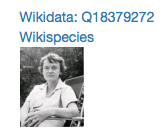
I've added some code to BioStor to do this query on the fly, and display the results. So, for Boulenger we get: Screenshot 2017 01 11 17 04 16 Here is the result for noted carcinologist Jocelyn Crane who currently lacks identifiers: Screenshot 2017 01 11 17 05 32 A nice surprise was Bernard Landry: Screenshot 2017 01 11 17 07 14 Note the ORCID 0000-0002-6005-1067. Interestingly, Bernard Landry's ORCID profile doesn't list any publications, whereas we can see lists of these in BioStor and Wikispecies.
Where next?

There are several obstacles to mapping the names of authors to identifiers. One is simply the lack of identifiers. This seems to be rapidly becoming less of a problem with the efforts of the library community around VIAF, the rise of ORCID for living researchers, and the creation of Wikidata items for every taxonomist in Wikispecies. The next challenge is clustering the different ways of writing the same person's name into sets that represent the same person. As discussed above, there are tools for this. Furthermore, with Wikipedia and Wikispecies we have sources of lists of publications linked to a person and their identifiers, which should simplify the task considerably. What is nice about this is that it relies on a crowd-sourcing effort which is already well-established, namely those people who in adding articles to Wikispecies and Wikipedia are created a curated database of publications linked to authors. In many cases those publications are linked to BHL (the source that BioStor extracts its articles from), so many of the links between publications and people are essentially lying there, just waiting for some skilful harvesting.

Friday, December 23, 2016

Taxonomic name timelines for BHL

Given a big corpus of literature one of the fun things to do is look at how the use of a term has changed over time. When did people first use a particular word? When did one word start to replace another, etc.? Google's Ngram Viewer is perhaps the best known tool for exploring these questions.

In the context of biodiversity doing something similar for BHL is an obvious thing to do. I've made various clunky attempts in the past (e.g., Biodiversity Heritage Library sparklines) but these all died.

Ryan Schenk (who did a lot of the user interface for my BioNames project) wrote a very stylish tool to display changes in names over time. Called "Synynyms" his tool is now defunct, but you can read about it here and the source code is on github. Ryan would take a name, find synonyms, then graph the changes in use of all those names over time.

Bison bison Linnaeus 1758 synynyms 1024x675

The death of Synynyms has not gone unnoticed:

I've had a tool for my own use that searches BHL for a name and displays the results after first trying to aggregate the hits in a sensible way. For example, if there is more than one hit in a scanned volume, and those hits al fall on pages in the same article in BioStor, then I display the BioStor article, instead of a list of each hit separately. Inspired by @PhyloJCAM's question I've built a simple tool to explore the use of one or more name over time.

Located in the "labs" section of BioStor, the BHL timeline takes one or more names and searches for those names in BHL, displaying the results as a chart and a list of hits. I often use it simply to search BHL for a particular name, but you can also use it to compare names, e.g. Aspidoscelis costata and Cnemidophorus costatus:

Screenshot 2016 12 23 06 38 32

The timeline tool is pretty crude, and it's slow if there are lots of hits in BHL. So, it's not as slick as Synynyms (Ryan Schenk is a clever programmer than I am). Still, it is a useful way to explore BHL and discover articles that you might not have known existed.

Friday, August 12, 2016

Spatial search in BioStor

I've been experimenting with simple spatial search in BioStor, as shown in the demo below. If you go to the map on BioStor you can use the tools on the left to draw a box or a polygon on the map, and BioStor will search it's database for articles that mention localities that occur in that region. If you click on a marker you can see the title of the article, clicking on that title takes you to the article itself.

This is all rather crude (and a little slow), but it provides another way to dive into the content I've been extracting from the BHL. One thing I've been doing is looking at protected areas (often marked on Open Street Map), drawing a simple polygon around that area, then seeing if BioStor knows anything about that area.

For the technically minded, this tool is an extension of the Searching GBIF by drawing on a map demo, and uses the geospatial indexing offered by Cloudant.

Thursday, May 26, 2016

Thoughts on Wikipedia, Wikidata, and the Biodiversity Heritage Library

Given that Wikipedia, Wikidata, and the Biodiversity Heritage Library (BHL) all share the goal of making information free, open, and accessible, there seems to be a lot of potential for useful collaboration. Below I sketch out some ideas.

BHL as a source of references for Wikipedia

Wikipedia likes to have sources cited to support claims in its articles. BHL has a lot of articles that could be cited by Wikipedia articles. By adding these links, Wikipedia users get access to further details on the topic of interest. BHL also benefits from greater visibility resulting from visits from Wikipedia readers.

In the short term BHL could search Wikipedia for articles that could benefit from links to BHL (see below). In the long term as more and more BHL articles get DOIs this will become redundant as Wikipedia authors will discover articles via CrossRef.

There are various ways to search Wikipedia to get a sense of what links could be added. For example, you can search the Wikipedia API for pages that link to a particular web domain (see https://www.mediawiki.org/wiki/API:Lists/All#Exturlusage). Here's a search for articles linking to biostor.org https://en.wikipedia.org/w/api.php?action=query&list=exturlusage&euquery=biostor.org&eulimit=20.

A quick inspection suggests that many of these links could be improved (for example, some have outdated links to PDFs and not to the article), so we can locate Wikipedia articles that could be edited. It is likely that Wikipedia articles that have one link to BHL or BioStor may have other citations that could be linked.

Wikipedia as a source of content

One of the big challenges facing BHL is extracting articles from its content. My own BioStor is one approach to tackling this problem. BioStor takes citation details for articles and attempts to locate them in BHL - the limiting factor is access to good-quality citation data. Wikipedia is potentially an untapped source of citation data. Each page that uses the "Cite" template could be mined for citations, which in turn could be used to locate articles. Wikipedia pages using the Cite template can be found via the API, e.g. https://en.wikipedia.org/w/api.php?action=query&list=embeddedin&eititle=Template:Cite&eilimit=20&format=json. Alternatively, we could mine particular types of pages (e.g., those on taxa or taxonomists), or mine Wikispecies (which doesn't use the same citation formatting as Wikipedia).

Wikidata as a data store

If Wikidata aims to be a repository of all structured data relevant to Wikipedia, then this includes bibliographic citations (see WikiCite 2016 ), hence many articles in BHL will end up in Wikidata. This has some interesting implications, because Wikidata can model data with more fidelity than many other sources of bibliographic information. For example, it supports multiple languages as well as multiple representations of the sample language - the journal Acta Herpetologica Sinica https://www.wikidata.org/wiki/Q24159308 in Wikidata has not only the Chinese title (兩棲爬行動物學報) but the pinyin transliteration "Liangqi baxing dongwu yanjiu". Rather than attempt to replicate a community-editable database, Wikidata could be the place to manage article and journal-related metadata.

Disambiguating people

As we move from "strings to things" we need to associate names for things with identifiers for those things. I've touched on this already in Possible project: mapping authors to Wikipedia entries using lists of published works. Ideally each author in BHL would be associated with a globally unique identifier, such as ORCID or ISNI. Contributors to Wikipedia and Wikidata have been collecting these for individuals with Wikipedia articles. If those Wikipedia pages have links to BHL content then we can semi-automate the process of linking people to identifiers.

Caveats

There are a couple of potential "gotchas" concerning Wikipedia and BHL. The licenses used for content are different, BHL is typically CC-BY-NC whereas Wikipedia is CC-BY. The "non commercial" restriction used by BHL is a deal-breaker for sharing content such as page images with Wikicommons.

Wikipedia and Wikidata are communities, and I've often found this makes it challenging to find out how to get things done. Who do you contact to make a decsioon about some new feature you'd like to add? It's not at all obvious (unless you're a part of that community). Existing communities with accepted practices can be resistant to change, or may not be convinced that what you'd like to do is a benefit. For example, I think it would be great to have a Wikipedia page for each journal. Not everyone agrees with this, and one can expend a lot of energy debating the pros and cons. The last time I got seriously engaged with Wikipedia I ended up getting so frustrated I went off in a huff and built my own wiki. This is where a "Wikipedian in residence" might be helpful.

Friday, April 15, 2016

The Biodiversity Heritage Library at 10: Let's talk impact interview by @UDCMRK

As part of BHL's "Celebrating 10 years of inspiring discovery through free access to biodiversity knowledge" at the NHM and Kew Gardens in London, I was interviewed by Martin Kalfatovic (@UDCMRK). We chatted about BHL, the work I've been doing on BioStor, and the future of BHL. I haven't had the courage to watch it myself, but if you want to watch an academic giving Roger Hyam a run for his money in the "flappy hands" stakes, and not knowing whether to look at the camera, Martin, or towards the distant horizon, then here is the video.

Thursday, September 17, 2015

On having multiple DOI registration agencies for the same journal

On Friday I discovered that BHL has started issuing CrossRef DOIs for articles, starting with the journal Revue Suisse de Zoologie. The metadata for these articles comes from BioStor. After a WTF and WWIC moment, I tweeted about this, and something of a Twitter storm (and email storm) ensued:

To be clear, I'm very happy that BHL is finally assigning article-level DOIs, and that it is doing this via CrossRef. Readers of this blog may recall an earlier discussion about the relative merits of different types of DOIs, especially in the context of identifiers for articles. The bulk of the academic literature has DOIs issued by CrossRef, and these come with lots of nice services that make them a joy to use if you are a data aggregator, like me. There are other DOI registration agencies minting DOIs for articles, such as Airiti Library in Taiwan (e.g., doi:10.6165/tai.1998.43(2).150) and ISTIC (中文DOI) in China (e.g., doi:10.3969/j.issn.1000-7083.2014.05.020) (pro tip, if you want to find out the registration agency for a DOI, simply append it to http://doi.crossref.org/doiRA/, e.g. http://doi.crossref.org/doiRA/10.6165/tai.1998.43(2).150). These provide stable identifiers, but not the services needed to match existing bibliographic data to the corresponding DOI (as I discovered to my cost while working with IPNI).

However, now things get a little messy. From 2015 PDFs for Revue Suisse de Zoologie are being uploaded to Zenodo, and are getting DataCite DOIs there (e.g., doi:10.5281/zenodo.30012). This means that the most recent articles for this journal will not have CrossRef DOIs. From my perspective, this is a disappointing move. It removes the journal from the CrossRef ecosystem at a time when the uptake of CrossRef DOIs for taxonomic journals is at an all time high (both ZooKeys and Zootaxa have CrossRef DOIs), and now BHL is starting to issue CrossRef DOIs for the "legacy" literature (bear in mind that "legacy" in this context can mean articles published last year).

I've rehearsed the reasons why I think CrossRef DOIs are best elsewhere, but the keys points are that articles are much easier to discover (e.g., using http://search.crossref.org), and are automatically first class citizens of the academic literature. However, not everybody buys these arguments.

Maybe a way forward is to treat the two types of DOI as identifying two different things. The CrossRef DOI identifies the article, not a particular representation. The Zenodo DOI (or any DataCite DOI) for a PDF identifies that representation (i.e., the PDF), not the article.

Having CrossRef and Zenodo  DataCite DOIs coexist

This would enable CrossRef and Zenod DOIs to coexist, providing we can (a) have some way of describing the relationship between the two kinds of DOI (e.g., CrossRef DOI - hasRepresentation -> Zenodo DOI).

This would give freedom to those who want the biodiversity literature to be part of the wider CrossRef community to mint CrossRef DOIs to do so. It gives those articles the benefits that come with CrossRef DOIs (findability, being included in lists of literature cited, citation statistics, customer support when DOIs break, altmetrics, etc.)

It would also enable those who want to ensure stable access to the contents of the biodiversity literature to use archives such as Zenodo, and have the benefits of those DOIs (stability, altmetrics, free file storage and free DOIs).

Having multiple DOIs for the same thing is, I'd argue, at the very least, unhelpful. But if we tease apart the notion of what we are identifying, maybe they can coexist. Otherwise I think we are in danger of making choices that, while they seem locally optimal (e.g., free storage and minting of DOIs), may in the long run cause problems and run counter to the goal of making the taxonomic literature has findable as the wider literature.

Wednesday, September 02, 2015

Hypothes.is revisited: annotating articles in BioStor

YClX4 gV Over the weekend, out of the blue, Dan Whaley commented on an earlier blog post of mine (Altmetrics, Disqus, GBIF, JSTOR, and annotating biodiversity data. Dan is the project lead for hypothes.is, a tool to annotate web pages. I was a bit dismissive as hypothes.is falls into the "stick note" camp of annotation tools, which I've previously been critical of.

However, I decided to take another look at hypothes.is and it looks like a great fit to another annotation problem I have, namely augmenting and correcting OCR text in BioStor (and, by extension, BHL). For a subset of BioStor I've been able to add text to the page images, so you can select that text as you would on a web page or in a PDF with searchable text. If you can select text, you can annotate it using hypothes.is. Then I discovered that not only is hypothes.is a Chrome extension (which immediately limits who will use it), you can add it to any web site that you publish. So, as an experiment I've added it to BioStor, so that people can comment on BioStor using any modern browser.

So far, so good, but the problem is I'm relying on the "crowd" to come along and manually annotate the text. But I have code that can take text and extract geographic localities (e.g., latitude and longitude pairs), specimen does, and taxonomic names. What I'd really like to do is be able pre-process the text, locate these features, then programmatically add those as annotations. Who wants to do this manually when a computer can do most of it?

Hypothesi.is, it turns out, has an API that, while a bit *cough* skimpy on documentation, enables you to add annotations to text. So now I could pre-process the text, and just ask people to add things that have been missed, or flag errors on the automated annotations.

This is all still very preliminary, but as an example here's a screen shot of a page in BioStor together with geographic annotations displayed using hypothes.is (you can see this live here: http://biostor.org/reference/147608/page/1 (make sure you click on the widgets at the top right of the page to see the annotations):

Hypothesis

The page shows two point localities that have been extracted from the text, together with a static Google Map showing the localities (hypothesis.is supports Markdown in annotations, which enables links and images to be embedded).

Not only can we write annotations, we can also read them, so if someone adds an annotation (e.g., highlights a specimen code that was missed, or some text that OCR has messed up) we could retrieve that and, for example, index the corrected text to improve findability.

Lots still to do, but these early experiments are very encouraging.

Monday, August 10, 2015

Demo of full-text indexing of BHL using CouchDB hosted by Cloudant

One of the limitations of the Biodiversity Heritage Library (BHL) is that, unlike say Google Books, its search functions are limited to searching metadata (e.g., book and article titles) and taxonomic names. It doesn't support full-text search, by which I mean you can't just type in the name of a locality, specimen code, or a phrase and expect to get back much in the way of results. In fact, in many cases when I Google a phrase that occurs in BHL content I'm more likely to find that phrase in content from the Internet Archive, and then it's a matter of following the links to the equivalent item in BHL.

So, as an experiment I've created a live demo of what full-text search in BHL could look like. I've done this using the same infrastructure the new BioStor is built on, namely CouchDB hosted by Cloudant. Using BHL's API I've grabbed some volumes of the British Ornithological Club's Bulletin and put them into CouchDB (BHL's API serves up JSON, so this is pretty straightforward to do). I've added the OCR text for each page, and asked Cloudant to index that. This means that we can now search on a phrase in BHL (in the British Ornithological Club's Bulletin) and get a result.

I've made a quick and dirty demo of this approach and you can see it in the "Labs" section on BioStor, so you can try it here. You should see something like this:

Bhl couchdb The page image only appears if you click on the blue labels for the page. None of this is robust or optimised, but it is a workable proof-of-concept of how fill-text search could work.

What could we do with this? Well, all sorts of searches are no possible. We can search for museum specimen codes, such as 1900.2.27.13. This specimen is in GBIF (see http://bionames.org/~rpage/material-examined/www/?code=BMNH%201900.2.27.13) so we could imagine starting to link specimens to the scientific literature about that specimen. We can also search for locations (such as Mt. Albert Edward), or common names (such as crocodile).

Note that I've not completed uploading all the page text and XML. Once I do I'll have a better idea of how scalable this approach is. But the idea of having full-text search across all of BHL (or, at least the core taxonomic journals) is tantalising.

Technical details

Initially I simply displayed a list of the pages that matched the search term, together with a fragment of text with the search term highlighted. Cloudant's version of CouchDB provides these highlights, and a "group_field" that enabled me to group together pages from the same BHL "item" (roughly corresponding to a volume of a journal).

This was a nice start, but I really wanted to display the hits on the actual BHL page. To do this I grabbed the DjVu XML for each BHL page for British Ornithological Club's Bulletin, and used a XSLT style-sheet that renders the OCR text on top of the page image. You can't see the text because it I set the colour of the text to "rgba(0, 0, 0, 0)" (see http://stackoverflow.com/a/10835846) and set the "overflow" style to "hidden". But the text is there, which means you can select with the mouse and copy and paste it. This still leaves the problem of highlighting the text that matches the search term. I originally wrote the code for this to handle species names, which comprise two words. So, each DIV in the HTML has a "data-one-word" and "data-two-words" attribute set, which contains the first (and forst plus second) word in the search term, respectively. I then use a JQuery selector to set the CSS of each DIV that has a "data-one-word" or "data-two-words" attribute that matches the search term(s). Obviously, this is terribly crude, and doesn't do well if you've more than two word sin your search query.

As an added feature, I use CSS to convert the BHL page scan to a black-and-white image (works in Webkit-based browsers).

Thursday, July 23, 2015

Purposeful Games and the Biodiversity Heritage Library

0a5c989ef8f5b9523b2119808a9f15ab

These are some quick thoughts on the games on the BHL site, part of the Purposeful Gaming and BHL Project. As mentioned on Twitter, I had a quick play of the Beanstalk game and got bored pretty quickly. I should stress that I'm not a gamer (although my family includes at least one very serious gamer, and a lot of casual players). Personally, if I'm going to spend a large amount of time with a computer I want to be creating something, so gaming seems like a big time sink. Hence, I may not be the best person to review the BHL games. Anyhow...

It seems to me that there are a couple of ways games like this might work:

  1. You want to complete the game so you can do something you really want to do. This is the essence of solving CAPTCHAs, I'll solve your stupid puzzle so that I can buy my tickets.
  2. The game itself is engaging, and what you are asked to do is a natural part of the game's world. When you swipe candy, bits of candy may explode, or fall down (this is a good thing, apparently), or when you pull back a slingshot and release the bird, you get to break stuff).

The BHL games are trying to get you to do one activity (type in the text shown in a fragment of a BHL book) and this means, say, a tree grows bigger. To me this feels like a huge disconnect (cf. point 2 above), there is no connection between what I'm doing and the outcome.

Worse, BHL is an amazing corpus of text and images, and this is almost entirely hidden from me. If I see a cool looking word, or some old typeface, there's no way for me to dig deeper (what text did that come from?, what does that phrase mean?). I get no sense of where the words come from, or whether I'm doing anything actually useful. For things like ReCAPTCHA (where you helped OCR books) this doesn't matter because I don't care about the books, I want my tickets. But for BHL I do care (and BHL should want at least some of the players to care as well).

So, remembering that I'm not a gamer, here are some quick ideas for games.

Find that species

One reason BHL is so useful is it contains original taxonomic descriptions. Sometimes the OCR is too poor for the name to extracted from the description. Imagine a game where the player has a list of species (with cute pictures) and is told to go find them in the text. Imagine that we have a pretty good idea where they are (from bibliographic data we could, for example, know the page the name should occur on), the player hunts for the word on the page, and when they find it and mark it. BHL then gets corrected text and confirmation that the name occurs on that page. Players could select taxa (e.g., birds, turtles, mosses) that they like.

Find lat/longs

BHL text is full of lat/long pairs, often the OCR is not quite good enough to extract them. Imagine that we can process BHL to find things that look like lat/long pairs. Imsgine that we can read enough of the text to get a sense of where in the world the text refers to. Now, have a game where we pick a spot on a map and find things related to that spot. Say we get presented with OCR text that may refer to that locality, we fix it, and the map starts get populated. A bit like Yelp and Four Square, we could imagine badges for the most articles found about a place.

Find the letter/font

There are lots of cool symbols and fonts in BHL, someone might be interested collecting these. Simple things might be diphthongs such as æ. Older BHL texts are full of these, often misinterpreted. Other examples are male and female symbols. Perhaps we could have a game where we try and guess what symbol the OCR text actually matches - in other words, show the OCR text first, player tries to guess actual symbol, then the image appears, and then player types in actual symbol. Goal is to get good at predicting OCR errors.

Games like this would really benefit if the player could see (say, on the side) the complete text. Imagine that you correct a word, then you see it comes from a gorgeous plate of a bird. Imagine you could then correct any of the there words on that page.

Word eaters

Imagine the layer is presented with a page with text and, a bit like Minecraft's monsters, things appear which start to "eat" the words. You need to check as many words as possible before the text is eaten. Perhaps structure things in such a way that checked words form a barrier to the word-eating creatures and buy you some time, or like Minecraft, fixing a bad OCR word blasts a radius free of the word eaters. As an option (again, like Minecraft) turn off the eaters and just correct the words at your leisure.

Countdown

Based on the UK game show, present a set of random letters (as images), player makes longest word they can, then check against dictionary, this tells you what letters they think the images represent.

Falling words

Have page fragments fall from the top of the screen, and have a key word displayed (say, "sternum", or enable player to type a word in) then display images of words whose OCR text resembles this (in other words, have a bunch of OCR text indexed using methods that allow for errors). As the word images fall, the player taps on an image that matches the word and they are collected. Maybe add features such as a timeline to show when the word was used (i.e., the date of the BHL text), give the meaning of the word, lightly chide players who enter words like "f**k" (that'd be me), etc.

Summary

Like comedy, I imagine that designing games is really, really hard. But the best games I've seen create a world that the player is immersed in and which makes sense within the rules of that world. Regardless of whether these ideas are any good, my concern is that the BHL games seem completely divorced from context, and the game play bears no relation to outcomes in the game.

Wednesday, December 24, 2014

I'm worried about the Biodiversity Heritage Library (BHL)

BHL Small LogoOne of my guilty pleasures on a Sunday morning is browsing new content on the Biodiversity Heritage Library (BHL). Indeed, so addicted am I to this that I have an IFTTT.com feed set to forward the BHL RSS feed to my iPhone (via the Pushover app. So, when I wake most Sunday mornings I have a red badge on Pushover announcing fresh BHL content for me to browse, and potentially add to BioStor.

But lately, there has been less and less content that is suitable for BioStor, and this reflects two trends that bother me. The first, which I've blogged about before, is that an increasing amount of BHL content is not hosted by BHL itself. Instead, BHL has links to external providers. For the reasons I've given earlier, I find this to be a jarring user experience, and it greatly reduces the utility of BHL (for example, this external content is not taxonomically searchable).

The other trend that worries me is that recently BHL content has been dominated by a single provider, namely the U.S. Department of Agriculture. To give you a sense of how dominant the USDA now is, below is a chart of the contribution of different sources to BHL over time.

Chart annotated

I built this chart by querying the BHL API and extracting data on each item in BHL (source code and raw data available on github). Unfortunately the API doesn't return information on what each item was scanned, but because the identifier for each item (its ItemID) is an increasing integer, if we order the items by their integer ID then we order them by the date they were added. I've binned the data into units of 1000 (in other words, every item with an ItemID < 1000 is in bin 0, ItemIDs 1000 to 1999 are in bin 1, and so on). The chart shows the top 20 contributors to BHL, with the Smithsonian as the number one contributor.

The chart shows a number of interesting patterns, but there are a couple I want to highlight. The first is the noticeable spikes representing the addition of externally hosted material (from the American Museum of Natural History Library and the Biblioteca Digital del Real Jardin Botanico de Madrid). The second is the recent dominance of content from the USDA.

Now, to be fair, I must acknowledge that I have my own bias as to what BHL content is most valuable. My own focus is on the taxonomic literature, especially original descriptions, but also taxonomic revisions (useful for automatically extracting synonyms). Discovering these in BHL is what motivated me to build BioStor, and then BioNames, the later being a database that aims to link every animal taxon name to its original description. BioNames would be much poorer if it wasn't for BioStor (and hence BHL).

If, however, your interest is agriculture in the United States, then the USDA content is obviously a potential goldmine of information on topics such as past crop use, pricing policies, etc. But this a topic that is both taxonomically narrow (economically important organisms are a tiny fraction of biodiversity), and, by definition, geographically narrow.

To be clear, I don't have any problem with BHL having USDA content as such, it's a tremendous resource. But I worry that lately BHL has been pretty much all USDA content. There is still a huge amount of literature that has yet to be scanned. I'd like to see BHL actively going after major museums and libraries that have yet to contribute. I especially want to see more post-1923 content. BHL has managed to get post-1923 content from some of its contributors, it needs a lot more. On obvious target is those institutions that signed the Bouchout Declaration. If you've signed up to providing "free and open use of digital resources about biodiversity", then let's see something tangible from that - open up your libraries and your publications, scan them, and make them part of BHL. I'm especially looking at European institutions who (with some notable exceptions) really should be doing a lot better.

It's possible that the current dominance of USDA content is a temporary phenomenon. Looking at the chart above, BHL acquires content in a fairly episodic manner, suggesting that it is largely at the mercy of what its contributors can provide, and when they can do so. Maybe in a few months there will be a bunch of content that is taxonomically and geographically rich, and I will be spending weekends furiously harvesting that content for BioStor. But until then, my Sundays are not nearly as much fun as they used to be.