Showing posts with label CrossRef. Show all posts

Wednesday, August 03, 2022

Papers citing data that cite papers: CrossRef, DataCite, and the Catalogue of Life

Quick notes to self following on from a conversation about linking taxonomic names to the literature. There are different sorts of citation:
  1. Paper cites another paper
  2. Paper cites a dataset
  3. Dataset cites a paper
Citation type (1) is largely a solved problem (although there are issues of the ownership and use of this data, see e.g. Zootaxa has no impact factor. Citation type (2) is becoming more widespread (but not perfect as GBIF's #citethedoi campaign demonstrates. But the idea is well accepted and there are guides to how to do it, e.g.:
Cousijn, H., Kenall, A., Ganley, E. et al. A data citation roadmap for scientific publishers. Sci Data 5, 180259 (2018). https://doi.org/10.1038/sdata.2018.259
However, things do get problematic because most (but not all) DOIs for publications are managed by CrossRef, which has an extensive citation database linking papers to other paopers. Most datasets have DataCite DOIs, and DataCite manages its own citations links, but as far as I'm aware these two systems don't really taklk to each other. Citation type (3) is the case where a database is largely based on the literature, which applies to taxonomy. Taxonomic databases are essentially collections of literature that have opinions on taxa, and the database may simply compile those (e.g., a nomenclator), or come to some view on the applicability of each name. In an ideal would, each reference included in a taxonomic database would gain a citation, which would help better reflect the value of that work (a long standing bone of contention for taxonomists). It would be interesting to explore these issues further. CrossRef and DataCite do share Event Data (see also DataCite Event Data). Can this track citations of papers by a dataset? My take on Wayne's question:
Is there a way to turn those links into countable citations (even if just one per database) for Google Scholar?
is that he's is after type 3 citations, which I don't think we have a way to handle just yet (but I'd need to look at Event Data a bit more). Google Scholar is a black box, and the academic coimmunity's reliance on it for metrics is troubling. But it would be interetsing to try and figure out if there is a way to get Google Scholar to index the citations of taxonomic papers by databases. For instance, the Catalogue of Life has an ISSN 2405-884X so it can be treated as a publication. At the moment its web pages have lots of identifiers for people managing data and their organisations (lots of ORCIDs and RORs, and DOIs for individual datasets (e.g., checklistbank.org) but precious little in the way of DOIs for publications (or, indeed, ORCIDs for taxonomists). What would it take for taxonomic publications in the Catalogue of Life to be treated as first class citations?

Tuesday, February 08, 2022

Duplicate DOIs (again)

This blog post provides some background to a recent tweet where I expressed my frustration about the duplication of DOIs for the same article. I'm going to document the details here.

The DOI that alerted me to this problem is https://doi.org/10.2307/2436688 which is for the article

Snyder, W. C., & Hansen, H. N. (1940). THE SPECIES CONCEPT IN FUSARIUM. American Journal of Botany, 27(2), 64–67.

This article is hosted by JSTOR at https://www.jstor.org/stable/2436688 which displays the DOI https://doi.org/10.2307/2436688 .

This same article is also hosted by Wiley at https://bsapubs.onlinelibrary.wiley.com/doi/abs/10.1002/j.1537-2197.1940.tb14217.x with the DOI https://doi.org/10.1002/j.1537-2197.1940.tb14217.x.

Expected behaviour

What should happen is if Wiley is going to be the publisher of this content (taking over from JSTOR), the DOI 10.2307/2436688 should be redirected to the Wiley page, and the Wiley page displays this DOI (i.e., 10.2307/2436688). If I want to get metadata for this DOI, I should be able to use CrossRef's API to retrieve that metadata, e.g. https://api.crossref.org/v1/works/10.2307/2436688 should return metadata for the article.

What actually happens

Wiley display the same article on their web site with the DOI 10.1002/j.1537-2197.1940.tb14217.x. They have minted a new DOI for the same article! The original JSTOR DOI now resolves to the Wiley page (you can see this using the Handle Resolver), which is what is supposed to happen. However, Wiley should have reused the original DOI rather than mint their own.

Furthermore, while the original DOI still resolves in a web browser, I can't retrieve metadata about that DOI from CrossRef, so any attempt to build upon that DOI fails. However, I can retrieve metadata for the Wiley DOI, i.e. https://api.crossref.org/v1/works/10.1002/j.1537-2197.1940.tb14217.x works, but https://api.crossref.org/v1/works/10.2307/2436688 doesn't.

Why does this matter?

For anyone using DOIs as stable links to the literature the persistence of DOIs is something you should be able to rely upon, both for people clicking on links in web browsers and developers getting metadata from those DOIs. The whole rationale of the DOI system is a single, globally unique identifier for each article, and that these DOIs persist even when the publisher of the content changes. If this property doesn't hold, then why would a developer such as myself invest effort in linking using DOIs?

Just for the record, I think CrossRef is great and is a hugely important part of the scholarly landscape. There are lots of things that I do that would be nearly impossible without CrossRef and its tools. But cases like this where we get massive duplication of DOIs when a publishers takes over an existing journal fundamentally breaks the underlying model of stable, persistent identifiers.

Wednesday, May 31, 2017

Wikidata, WikiCite, and the "bibliography of life"

3hhZSGOn 400x400Last week I was at WikiCite 2017, a fascinating three day event in Vienna. Wikicite is "a proposal to build a bibliographic database in Wikidata to serve all Wikimedia projects", and is attracting increasing attention from academics, librarians, publishers, data geeks, and others. You can get a sense of the project by following @WikiCite on Twitter.

I went to the meeting in part to learn more about WikiCite, and also to spend some time hacking on Wikispecies. I'd been to only one Wiki event before (a Wiki Science Conference) so I'm still finding my way around this community. I spent the first two days listening to talks while coding away (more on this below), but on Wednesday put my own coding aside to join a bunch of people hacking the CrossRef event API in a great session led by Joe Wass. I've put some notes and code in GitHub. The event API tracks what people do with DOIs, including adding them to Wikipedia pages when citing a source in support of an assertion. A significant fraction of DOI resolutions are from Wikipedia pages, which is one reason why CrossRef was present at WikiCite.

Wikidata

In practice WikiCite's goal of building a bibliographic database to serve all Wikimedia projects means that articles, books, and other bibliographic items that are cited by Wikimedia projects will each be added to Wikidata. For example, the ZooKeys paper "Diversity of manota williston (Diptera, mycetophilidae) in ulu temburong national park, brunei" is item Q21188431 in Wikidata. Wikidata stores the key bibliographic metadata, including identifiers such as the DOI (which many at the WikiCite meeting pronounced "doy" much to my initial confusion). Screenshot 2017 05 31 12 46 43

This article was published in ZooKeys, which itself has a Wikidata item (Q219980), so in Wikidata the article is linked to the journal (i.e., "ZooKeys" isn't just a dumb string but a link to another Wikidata item). The article is also linked to two articles that it cites, and each of these is also a Wikidata item.

These citation links are one reason people are interested in WikiCite - it could be the basis of a free and open citation graph (for the benefits of such a graph see this piece by David Shotton doi:10.1038/502295a, a participant at the meeting in Vienna). Already some cool tools are being built on top of citation data in Wikidata, such as Scholia by Finn Årup Nielsen, Daniel Mietchen and Egon Willighagen. Here, for example, is my academic profile based on information in Wikidata. It's woefully incomplete, but intriguing. For a more complete example view Egon Willighagen's profile.

To some extent the utility of tools like Scholia will depend on how complete Wikidata's coverage is of the academic literature, which in turn raises the inevitable question of scope. Does Wikicite want to include just the literature cited in the various Wikimedia projects, or does it want to expand to include the total sum of academic literature?

Wikispecies, Wikidata and the bibliography of life

Wikispecies is one of the Wikimedia projects, and the only one that is topic-specific (the others are typically global in scope but have content in different languages, or host different data types such as images, scanned books, or structured data). As I've sketched out in an earlier post (Thoughts on Wikipedia, Wikidata, and the Biodiversity Heritage Library) I think Wikicite and Wikidata are potentially very important to projects such as BHL and the "bibliography of life". Much of our knowledge about the world's biodiversity is contained in the academic literature, and much of this is poorly known with no central database where we can find it, and much of it is still not digitised. It is tempting to think that Wikidata might be a platform around which the biodiversity community could focus its efforts on assembling a global database of biodiversity literature. Already major taxonomic journals such as ZooKeys are being fed into Wikidata, so it has a significant corpus of biodiversity literature already.

One way to grow this corpus is to focus on Wikispecies. In a post before the Wikicite meeting (Notes for WikiCite 2017: Wikispecies reference parsing) I elaborated on this idea. There are two stumbing blocks, one specific to Wikispecies, one a more general Wikidata issue.

The first issue is that Wikispecies bibliographic data is relatively unstructured, which makes converting it into structured data something of a challenge. I spent much of Wikicite hacking some code to do this on Glitch (more on Glitch later), you can see the results here: https://acoustic-bandana.glitch.me. This web site takes a Wikispecies reference and tries to convert it into CSL-JSON. Still very much a work in progress, but I've started building tools that use this web site as a service and process larger numbers of Wikispecies citations.

The second issue is how you get data into Wikidata, and this is something that's never been entirely clear to me. There are tools for adding an article using its DOI (sourcemd) but this isn't scalable, and doesn't handle the case of articles that don't have DOIs. This is still a "How do you Snapchat? You just Snapchat" moment. Wikidata desparately needs tools and a clear procedure whereby people like me with lots of bibliographic data can contribute.

Wikispecies

Another reason for my interest in Wikispecies (and other sources of bibliographic data such as the listed of cited literature being made available by CrossRef, see The Initiative for Open Citations) is that this data can be fed into BHL to locate more articles in that archive. Once these articles have been located they are stored in BioStor and BHL itself, but it makes sense to have them more accessible, and Wikidata looks to be an obvious candidate. Given that Wikispecies is essentially a crowd-source taxonomic database there is considerable overlap in content between Wikispecies and BHL. The Wikidata data model also allows for some of things that taxonomists care about, such as linking dates of publication to evidence relative to those dates (in older publications determining the publication date often requires quite extensive research).

Summary

Leaving aside the specific issues about how to get bibliographic data into Wikidata, I guess the question to ask is whether it makes sense to be developing large databases of bibliographic data without either using Wikidata as the platform to hold that data, or at least linking to Wikidata. Projects such as Gene Wiki are migrating from Wikipedia to Wikidata (see "Wikidata as a semantic framework for the Gene Wiki initiative" doi:10.1093/database/baw015), perhaps those of us interested in biodiversity literature could use projects like Gene Wiki as role models for how we could both contribute and benefit from Wikidata and Wikicite.

I've barely scratched the surface of what was discussed at Wikicite, for more details see the program. It is a very different sort of meeting in that the participants come from pretty diverse backgrounds, which helps shake up your own assumptions about what matters and how things should be done. It's also great that it's a meeting at which people write code or otherwise hack stuff together, so things actually get done. I've come away with lots to think about, and renewed enthusiasm about the role Wikimedia is playing in structuring our knowledge about the world.

Wednesday, February 03, 2016

Bootstrapping the biodiversity knowledge graph with JSON-LD

In a recent Twitter conversation including David Shorthous and myself (and other poor souls who got dragged in) we discussed how to demonstrate that adopting JSON-LD as a simple linked-data friendly format might help bootstrap the long awaited "biodiversity knowledge graph" (see below for some suggestions for keeping JSON-LD simple). David suggests partnering with "Three small, early adopting projects". I disagree.

I think we need to approach this problem, not from the perspective of who would like to try this approach, but what would it take to really be useful? I think if we look at the structure of the biodiversity knowledge graph and look at who has what identifiers, we can gain some insight into what the next steps are.

Sinks

A fundamental problem is that many data providers are essentially dead ends in terms of building a network. They have data, but no connections, and so they are "sinks". A data browser goes there and can't go any further, it has to retrace its steps and go somewhere else. For example, your typical museum might serve up its collection data like this: Museum The museum has its own identifiers (e.g., a URL) and that's the only identifier in the data. Nomenclators are much the same: Nomen You get a nomenclator-specific identifier such as an LSID, but no other identifiers. Once again, if you are a data-crawler traversing the web of data, this is a dead end. (This is why I've become obsessed with linking nomenclators to the primary literature, I want to stop them being dead ends).

Connected sources

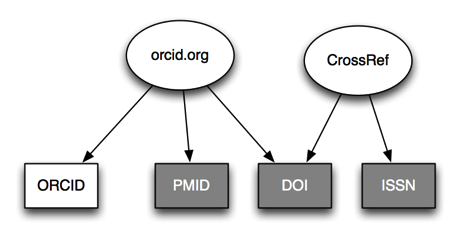
Then there are sources which have at least one external identifier, that is, an identifier that they themselves don't control. For example, CrossRef manages DOIs for articles, but if you get metadata for a DOI you also get an ISSN (identifying a journal): Crossref Now we have a connection to an external source of data, and some we can traverse the data graph further, which means we can start asking questions (such as how many articles in this journal have DOIs?).

Another connected source is ORCID: Orcid This gives us identifiers for authors (the ORCID) linked to article identifiers such as DOIs and PubMed ids (PMID). Follow the DOI to CrossRef and we can link people to articles to journals. Oc

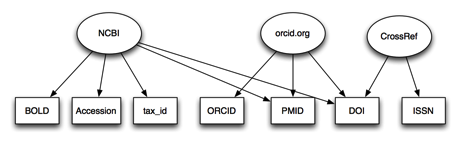
Another connected source is the NCBI: Ncbi NCBI has several internal identifiers (PMIDs, GenBank accession numbers, tax_ids) all of which lead to rich resources, and it's possible to get a lot of information by staying within NCBI's own silo, but there are external links such as DOIs (usually found attached to PubMed articles or to GenBank accessions) and links to external records such as DNA barcodes in BOLD.

Lets join CrossRef, ORCID, and NCBI together: All Now we have a bipartite graph linking sources with identifiers. We can imagine playing a game where we try and connect different entities by moving through the graph. For example, we could take an author identified by an ORCID, follow a DOI to a PMID, a PMID to a set of accessions numbers, and then be able to list all the sequences that an author has published. We could also step back and ask questions about which identifiers are the most useful in terms of making connections between different sources, and which sources provide the most cross links.

Filling in the gaps

Now, the graph above is obviously incomplete. I've restricted it to a few of the key services that I'm familiar with, and make use of external identifiers. One of the big obstacles to fleshing out the biodiversity knowledge graph is the frequent lack of reuse of identifiers. It's not enough to pump out data in linked-data form, you need to build the links. And not just "same as" style links connecting multiple identifiers for the same thing, you need to connect identifiers for different things. Until we tackle that, linked data approaches will not deliver much in the way of value. Hence we need sources that provide genuinely linked data by reusing exiting, external identifiers. If we have name in a nomenclator with a citation string, it needs to link that dumb literature string to a DOI. If we have a taxon concept, it needs to link the name of that taxon to a name in a nomenclator. If we have a specimen that has been sequenced, it needs to give the accession number of that sequence.

From this perspective, choosing which kinds of data with which to explore JSON-LD and a linked data graph should be driven by how connected those sources are: the more connected the more interesting the questions that we can ask. Sadly the vast majority of biodiversity data providers don't provide the kind of connected data we need, which means we continually pay lip service to linked data without feeding it the kind of data it needs in order to grow.

* Notes on JSON-LD

It is relatively easy to write horrible JSON-LD, so I think it would be useful to strive to make it as simple and as human-readable as possible (ignoring the @context block which is always going to be awful, this is the price we pay for simplicity elsewhere). To this end I think we should do at least the following:

  1. No URLs as identifiers URLs are ugly, and they are not reliable as identifiers. Providers can change URLs, even for persistent identifiers. The DOI prefix has changed from http://dx.doi.org/ to the preferred http://doi.org/, and the rise of HTTPS (prompted by concerns about security, among other issues, see Google's motives, part 2) is going to break a lot of older URLs (see Web Security - "HTTPS Everywhere" harmful). These changes keep happening, so lets try and shield ourselves from these by using standard prefixes for identifiers (such as 'DOI') for a DOI. Put all the alternative URL resolver prefixes in the @context block and use prefixes such as those standardised by http://identifiers.org (which basically formalises what many people in bioinformatics have been doing for a while).
  2. No prefixes for keys In other words, no CURIEs. Don't write "dwc:CatalogueNumber", just write "CatalogueNumber". I don't want to be told where the term comes from (that's what @context is for). If you have a namespace clash (i.e., two terms that are the same unless you include the namespace) then IMHO you're doing it wrong. Either you're using more than one vocabulary for the same thing (why?), or you've not modelling the data at the appropriate level of granularity. Either way, let's avoid clutter and keep things simple and readable.

Monday, January 25, 2016

iSpecies is back: mashing up species data

A decade ago (OMG, that can't be right, an actual decade ago) I created "iSpecies", a simple little tool to mashup a variety of data from GBIF, NCBI, Yahoo, Wikipedia, and Google Scholar to create a search engine for species. It was written in PHP, relied on some degree of *cough* web scraping to get its data, and was a bit of a toy (although that didn't stop me complaining that it could do more than EOL at the time). Eventually I got sick of dealing with Google Scholar constantly changing it's HTML and blocking IP addresses to stop people harvesting data (I once managed to get my entire campus blocked), or services disappearing such as Yahoo's image search, and I eventually pulled the plug on it.

A short course I run on "phyloinformatics" starts this week and one of the examples I show is a crude Javascript-based mashup. It struck me that I could tweak that and recreate a simple version of iSpecies, and that's exactly what I've done: http://ispecies.org.

Ispecies

It's nothing fancy, just takes a species name and searches GBIF, EOL, CrossRef, and Open Tree of Life, grabs some data and puts it together on a web page. There are lots of limitations (e.g., only fetches the first 300 localities in GBIF, requires scientific names, tree viewer is pretty awful) but it was pretty simple to put together. It's entirely client-side based, the code is all in the HTML file (and a few Javascript libraries) (the code is on GitHub: https://github.com/rdmpage/ispecies).

Fun as this was, there's a bigger problem with iSpecies and that's that it is a "mashup". I'm simply grabbing data from different sources and redisplaying it. What I really want is what has been described as a "mashup" (awful term, don't use it), that is, I want to combine the data so that it is more than the sum of its parts. For example, some of the data could be cross linked (especially if add a few more sources and we drill down a bit). Some of the papers discovered by CrossRef may include original descriptions, or may be the source of some of the points plotted on the GBIF map. Some may include the phylogenies used to build the Open Tree of Life tree. In order to build a data mashup instead of a web mashup we need to operate at the level of data rather than just human-readable web pages. That is the next thing I'd like to work on, and in many ways it shouldn't be a big leap. The new iSpecies was fairly easy to create because we now have a bunch of web services that all speak JSON. It's a small step from JSON to JSON-LD (especially if the JSON-LD is constructed with reuse in mind). So while it's nice to see iSpecies back, there's a much more interesting next step to think about.

Thursday, September 17, 2015

On having multiple DOI registration agencies for the same journal

On Friday I discovered that BHL has started issuing CrossRef DOIs for articles, starting with the journal Revue Suisse de Zoologie. The metadata for these articles comes from BioStor. After a WTF and WWIC moment, I tweeted about this, and something of a Twitter storm (and email storm) ensued:

To be clear, I'm very happy that BHL is finally assigning article-level DOIs, and that it is doing this via CrossRef. Readers of this blog may recall an earlier discussion about the relative merits of different types of DOIs, especially in the context of identifiers for articles. The bulk of the academic literature has DOIs issued by CrossRef, and these come with lots of nice services that make them a joy to use if you are a data aggregator, like me. There are other DOI registration agencies minting DOIs for articles, such as Airiti Library in Taiwan (e.g., doi:10.6165/tai.1998.43(2).150) and ISTIC (中文DOI) in China (e.g., doi:10.3969/j.issn.1000-7083.2014.05.020) (pro tip, if you want to find out the registration agency for a DOI, simply append it to http://doi.crossref.org/doiRA/, e.g. http://doi.crossref.org/doiRA/10.6165/tai.1998.43(2).150). These provide stable identifiers, but not the services needed to match existing bibliographic data to the corresponding DOI (as I discovered to my cost while working with IPNI).

However, now things get a little messy. From 2015 PDFs for Revue Suisse de Zoologie are being uploaded to Zenodo, and are getting DataCite DOIs there (e.g., doi:10.5281/zenodo.30012). This means that the most recent articles for this journal will not have CrossRef DOIs. From my perspective, this is a disappointing move. It removes the journal from the CrossRef ecosystem at a time when the uptake of CrossRef DOIs for taxonomic journals is at an all time high (both ZooKeys and Zootaxa have CrossRef DOIs), and now BHL is starting to issue CrossRef DOIs for the "legacy" literature (bear in mind that "legacy" in this context can mean articles published last year).

I've rehearsed the reasons why I think CrossRef DOIs are best elsewhere, but the keys points are that articles are much easier to discover (e.g., using http://search.crossref.org), and are automatically first class citizens of the academic literature. However, not everybody buys these arguments.

Maybe a way forward is to treat the two types of DOI as identifying two different things. The CrossRef DOI identifies the article, not a particular representation. The Zenodo DOI (or any DataCite DOI) for a PDF identifies that representation (i.e., the PDF), not the article.

Having CrossRef and Zenodo  DataCite DOIs coexist

This would enable CrossRef and Zenod DOIs to coexist, providing we can (a) have some way of describing the relationship between the two kinds of DOI (e.g., CrossRef DOI - hasRepresentation -> Zenodo DOI).

This would give freedom to those who want the biodiversity literature to be part of the wider CrossRef community to mint CrossRef DOIs to do so. It gives those articles the benefits that come with CrossRef DOIs (findability, being included in lists of literature cited, citation statistics, customer support when DOIs break, altmetrics, etc.)

It would also enable those who want to ensure stable access to the contents of the biodiversity literature to use archives such as Zenodo, and have the benefits of those DOIs (stability, altmetrics, free file storage and free DOIs).

Having multiple DOIs for the same thing is, I'd argue, at the very least, unhelpful. But if we tease apart the notion of what we are identifying, maybe they can coexist. Otherwise I think we are in danger of making choices that, while they seem locally optimal (e.g., free storage and minting of DOIs), may in the long run cause problems and run counter to the goal of making the taxonomic literature has findable as the wider literature.

Tuesday, October 21, 2014

On identifiers (again)

I'm going to the TDWG Identifier Workshop this weekend, so I thought I'd jot down a few notes. The biodiversity informatics community has been at this for a while, and we still haven't got identifiers sorted out.

From my perspective as both a data aggregator (e.g., BioNames) and a data provider (e.g., BioStor) there are four things I think we need to tackle in order to make significant progress.

Discoverability (strings to things)


A basic challenge is to go from strings, such as bibliographic citations, specimen codes, taxonomic names, etc., to digital identifiers for those things. Most of our data is not born digital, and so we spend a lot of time mapping strings to identifiers. For example, publishers do this a lot when they take the list of literature cited at the end of a manuscript and add DOIs. Hence, one of the first things CrossRef did was provide a discovery service for publishers. This has now morphed into a very slick search tool http://search.crossref.org. Without discoverabilty, nobody is going to find the identifiers in the first place.

Resolvability


Given an identifier it has to be resolvable (for both people and machines), and I'd argue that at least in the early days of getting that identifier accepted, there needs to be a single point of resolution. Some people are arguing that we should separate identifiers from their resolution, partly based on arguments that "hey, we can always Google the identifier". This argument strikes me as wrong-headed for a several of reasons.

Firstly, Google is not a resolution service. There's no API, so it's not scalable. Secondly, if you Google an identifier (e.g., 10.7717/peerj.190) you get a bunch of hits, which one is the definitive source of information on the thing with that identifier? It's not at all obvious, and indeed this is one of the reasons publishers adopted DOIs in the first place. If you Google a paper you can get all sorts of hits and all sorts of versions (preprint, manuscripts, PDFs on multiple servers, etc.). In contrast the DOI gives you a way to access the definitive version.

Another way of thinking about this is in terms of trust. At some point down the road we might have tools that can assess the trust worthiness of a source, and we will need these if we develop decent tools to annotate data (see More on annotating biodiversity data: beyond sticky notes and wikis). But until then the simplest way to engender trust is to have a single point of resolution (like http://dx.doi.org for DOIs). Think about how people now trust DOIs. They've become a mark of respectability for journals (no DOIs, you're not a serious journal), and new ideas such as citing diagrams and data gained further credence once sites like figshare started using DOIs.

Another reason resolvability matters is that I think it's a litmus test of how serious we are. One reason LSIDs failed is that we made them too hard to resolve, and as a consequence people simply minted "fake" LSIDs, dumb strings that didn't resolve. Nobody complained (because, let's face it, nobody was using them), so LSIDs became devalued to the point of uselessness. Anybody can mint a string and call it an identifier, if it costs nothing that's a good estimate of its actual value.

Persistence


Resolvability leads to persistence. Sometimes we hear the cliche that "persistence is a social matter, not a technological one". This is a vacuous platitude. The kind of technology adopted can have a big impact on the sociology.

The easiest form of identifier is a simple HTTP URL. But let's think about what happens when we use them. If I spend a lot of time mapping my data to somebody else's URLs (e.g., links to papers or specimens) I am taking a big risk in assuming that the provider of those URLs will keep those "live". At the same time, in linking to those URLs, I constrain the provider - if they decide that their URL scheme isn't particularly good and want to change it (or their institution decides to move to new servers or a new domain), they will break resources like mine that link to them. So a decision they made about their URL structure - perhaps late one Friday afternoon in one of those meetings where everybody just wants to go to the pub - will come back to haunt them.

One way to tackle this is indirection, which is the idea behind DOIs and PURLs, for example. Instead of directly linking to a provider URL, we link to an intermediate identifier. This means that I have some confidence that all my hard work won't be undone (I have seen whole journals disappear because somebody redesigned an institutional web site), and the provider can mess with different technologies for serving their content, secure in the knowledge that external parties won't be affected (because they link to the intermediate identifier). Programmers will recognise this as encapsulation.

Some have argued that we can achieve persistence by simply insisting on it. For example, we fire off a memo to the IT folks saying "don't break these links!". Really? We have that degree of power over our institutional IT policies? This also misses the great opportunity that centralised indirection provides us with. In the case of DOIs for publications, CrossRef sits in the middle, managing the DOIs (in the sense that if a DOI breaks you have a single place to go and complain). Because they also aggregate all the bibliographic metadata, they are automatically able to support discoverability (they can easily map bibliographic metadata to DOIs). So by solving persistence we also solve discoverability.

Network effects


Lastly, if we are serious about this we need to think about how to engineer the widespread adoption of the identifier. In other words, I think we need network effects. When you join a social networking site, one of the first things they do is ask permission to see your "contacts" (who you already know). If any of those people are already on the network, you can instantly see that ("hey, Jane is here, and so is Bob"). Likewise, the network can target those you know who aren't on the network and prompt them to join.

If we are going to promote the use of identifiers, then it's no use thinking about simply adding identifiers to things, we need to think about ways to grow the network, ideally by adding networks at a time (like a person's list of contacts), not single records. CrossRef does this with articles: when publishers submit an article to CrossRef, they are encouraged to submit not just that article and it's DOI, but the list of all references in the list of literature cited, identified where possible by DOIs. This means CrossRef is building a citation graph, so it can quickly demonstrate value to its members (through cited-by linking).

So, we need to think of ways of demonstrating value, and growing the network of identifiers more rapidling than one identifier at a time. Otherwise, it is hard to see how it would gain critical mass. In the context of, say, specimens, I think an obvious way to do this is have services that tell a natural history collection how many times its specimens have been cited in the primary literature, or have been used as vouchers for DNA seqences. We can then generate metrics of use (as well as start to trace the provenance of our data).


Summary


I've no idea what will come out of the TDWG Workshop, but my own view is that unless we tackle these issues, and have a clear sense of how they interrelate, then we won't make much progress. These things are intertwined, and locally optimal solutions ("hey, it's easy, I'll just slap a URL on everything") aren't enough ("OK, how exactly do I find your URL? What happens when it breaks?"). If we want to link stuff together as part of the infrastructure of biodiversity informatics, then we need to think strategically. The goal is not to solve the identifier problem, the goal is to build the biodiversity knowledge graph.

Thursday, May 15, 2014

DOIs are not enough

I had a long Twitter conversation with Terry Catapano (@catapanoth) today, and as can happen with a distracted stream of tweets, I think we were a little at cross purposes. This blog post is an attempt to unpack the debate.

What prompted the conversation was the following paper:
Emery, Carlo et al (1899). Formiche di Madagascar raccolte dal Sig. A. Mocquerys nei pressi della Baia di Antongil (1897-1898).. Bullettino della Società Entomologica Italiana: 31 (1899) pp. 263-290. 10.5281/zenodo.9785
Not the paper so much, as the fact that it is stored on the Zenodo repository (which I was only looking at because of the announcement that GitHub now supports DOIs through Zenodo). Given that the PDF for Emery's paper was uploaded by the Plazi project, I wondered what was the intention of assigning a Zenodo DOI to this paper, rather than one from CrossRef.

Not all DOIs are equal


As Geoffrey Bilder notes in his post DOIs unambiguously and persistently identify published, trustworthy, citable online scholarly literature. Right?
...some have adopted a cargo-cult practice of seeing the mere presence of a DOI on a publication as a putative sign of “citability” or “authority.”
There is a danger that we fall into the trap of thinking that all we need to do is slap a DOI on a paper and all the good things that we associate with DOIs will magically happen. This isn't the case. Not all DOIs are the same. Zenodo DOIs are proved by DataCite, and DataCite DOis don't have all the features that CrossRef provides for their DOIs.

CrossRef provides some key services, one of the most important is discoverability. Given a bibliographic references, CrossRef has tools that can find whether it has a DOI (e.g., http://search.crossref.org). I use this a lot to map taxonomic papers to DOIs (by a lot I mean searching for DOIs for tens of thousands of articles). Most people don't do this, but you benefit from this service every time you read an article and see the literature cited section decorated with DOIs. Publishers use CrossRef's tools to convert citations from dumb strings to useful links. This feature we come to expect from any modern article relies on CrossRef have definitive metadata for lots (millions) or articles, all of which have DOIs. When publishers submit article metadata when registering their DOIs, they usually submit lists of literature cited (and the DOIs). This means that CrossRef is building a citation database, which you can see if you visit the web page for an article and see a "cited by" link.

Then there are additional services. Given that CrossRef has high quality bibliographic metadata for articles, if you have a DOI there is no need to type in the details of a paper. Most bibliographic software such as Mendeley and Zotero can take a DOI and flesh out those details for you. If a DOI fails to resolve, you can contact CrossRef Support and have somebody investigate. Then there are the new services such as FundRef and Prospect, which provide information on who funded a paper, and what text and data mining rights are available for a paper.

Why use DOIs?


The rationale for using DOIs for articles is so that they can be unambiguously identified, which in turn means we can build a robust citation network. But this requires infrastructure, and that is what CrossRef provides through tools like citation to DOI matching. Other DOI registration agencies don't do this, and CrossRef isn't aware of other DOIs, so putting, say, a DataCite DOI (such as those used by Zenodo) on an article doesn't achieve the primary goal of a DOI (embedding it in the citation graph of academic literature).

Hence, I regard putting a Zenodo DOI as basically a wasted opportunity. If we aren't making the primary biodiversity literature discoverable, and hence linkable, then all we are doing is keeping that literature in a ghetto (and reinforcing the impression that this literature, and taxonomy itself, really doesn't matter). It is striking that if you read a recent paper that describes a new species, the bulk of the systematic or ecological literature has DOIs, but the bulk of the taxonomic literature does not. If it doesn't have a CrossRef DOI, it's effectively invisible. All academic literature should get first class DOIs. Whether it's "legacy" or not is irrelevant, the Royal Society of London has DOIs on articles going back to 1800, these are now as accessible as any paper published today.

Eyes on the prize


So, if we are going to bring the taxonomic literature into the mainstream, make it discoverable and citable, then we should focus on bringing that literature into CrossRef's infrastructure. Archives like JSTOR do it, the Biodiversity Heritage Library (BHL) does it for some of its content (and they should be doing it at article level, right now).

One response to this is to say "but doesn't this cost money?" Of course it does. Everything does, nothing is free. What frustrates me most about this is that it's the wrong question. The first question should not be "how much does this cost?". If it is, you've already lost sight of the goal. Instead, we should be asking, "What do we want? Where do we need to be able to do to progress our field?". Once we articulate that, then we figure out how to pay for it. And we figure that out because we've decided this is what we need.

I think we want discoverable, citable taxonomic literature, embedded in the rest of the scientific literature and the publishing process. We don't get that by simply buying the cheapest DOIs available and slapping them on articles. To do so is to fundamentally misunderstand why DOIs matter, and to ignore the role that infrastructure plays in their success in academic publishing.

Wednesday, July 17, 2013

Augmenting ZooKeys bibliographic data to flesh out the citation graph

Zookeys logoIn a previous post (Learning from eLife: GitHub as an article repository) I discussed the advantages of an Open Access journal putting its article XML in a version-controlled repository like GitHub. In response to that post Pensoft (the publisher of ZooKeys) did exactly that, and the XML is available at https://github.com/pensoft/ZooKeys-xml.

OK, "now what?" I hear you ask. Originally I'd used the example of incorrect bibliographic data for citations as the motivation, but there are other things we can do as well. For example, when reading a ZooKeys article (say, using my eLife Lens-inspired viewer) I notice references that should have a DOI but which don't. With the XML available I could add this. This adds another link in the citation graph (in this case connecting the ZooKeys paper with the article it cites). If Pensoft were to use that XML to regenerate the HTML version of the article on their web site then the reader will be able to click on the DOI and read the cited article (instead of the "cut-and-paste-and-Google-it" dance). Furthermore, Pensoft could update the metadata they've submitted to CrossRef, so that CrossRef knows that the reference with the newly added DOI has been cited by the ZooKeys paper.

To experiment with this I've written some scripts that take ZooKeys XML, extract each citation from the list of literature cited, and look up DOIs for each reference that lacks them (using the CrossRef metadata search API). If a DOI is found then I insert it into the original XML. I then push this XML to my fork of Pensoft's repository (https://github.com/rdmpage/ZooKeys-xml). I can then ask Pensoft to update their repository (by issuing a "pull request"), and if Pensoft like what they see, they can accept my edits.

Automating the process makes this much more scalable, although manual editing will still be useful in some cases, especially where the original references haven't been correctly atomised into title, journal, etc.

So that the output is visible independently of Pensoft deciding whether to accept it, I've updated my Zookeys article viewer to fetch the XML not from the ZooKeys web site, but from my GitHub repository. This means you get the latest version of the XML, complete with additional DOIs (if any have been added).

Initial experiments are encouraging, but it's also apparent that lots of citations lack DOIs. However, this doesn't mean that they aren't online. Indeed, a growing number of articles are available through my BioStor repository, and through BioNames. Both of these sites have an API, so the next step is to add them to the script that augments the XML. This brings us a little closer to the ultimate goal of having every taxonomic paper online and linked to every paper that either cites, or is cited by, that paper.

Monday, May 27, 2013

Multiple DOIs for the same article issued by different publishers

DoiI've stumbled on a case where two different publishers have issued different DOIs for the same articles. In this case, Springer and J-State both publish the Japanese Journal of Ichthyology (ISSN 0021-5090). The following article:
Randall, J. E., & McCarthy, L. J. (1989). Solea stanalandi, a new sole from the Persian Gulf. Japanese Journal of Ichthyology, 36(2), 196–199. doi:10.1007/BF02914322

is published by Springer with the DOI http://dx.doi.org/10.1007/BF02914322, and this DOI is registered with CrossRef. J-Stage publish the same article, with the DOI (http://dx.doi.org/10.11369/jji1950.36.196). This DOI is not registered with CrossRef. I haven't been able to find an easy way to discover the DOI registration agency for a DOI (surely there should be a simple service that tells me this?).

This illustrates a problem with the success of DOIs and the existence of multiple registration agencies. When there was essentially a single agency for publications (CrossRef) it was relatively easy to ensure that DOIs for publications were unique. Now that there are multiple DOI registration agencies it is possible for conflicts to arise. We might expect this to be rare, after all, surely there's only one publisher for an article? However, the publishing landscape is more complicated that that, with articles being served by multiple publishers, and archiving projects like JSTOR and BHL having content that overlaps with that of existing publishers. Messy (sigh).

Tuesday, March 26, 2013

Towards DOIs for Biodiversity Heritage Library articles

The new look Biodiversity Heritage Library includes articles extracted from BioStor, which is a step forwards in making the "legacy" biodiversity literature more accessible. But we still have some way to go. In particular the articles lack the obvious decoration of a modern article, the DOI. Consequently these articles still live in a twilight zone where they are cited in the literature but not linked to. DOIs are becoming more common for taxonomic articles. Zookeys has them, and now Zootaxa has adopted them (and will be applying them retrospectively to thousands of already published articles). Major archives of back issues digitised by Taylor and Francis, and Wiley, for example, also have DOIs.

One obstacle to assigning CrossRef DOIs to articles in BHL is the convention that DOIs are typically managed by the publisher of the journal. But in a number of cases the publisher may no longer exist, the journal may no longer be published, or the publisher may lack the commercial resources to support DOIs. In these cases perhaps BHL could adopt the role of publisher?

Another approach is that adopted by a number of other digital archives, whereby the archive assigns DOIs to articles, but these DOIs are registered not through CrossRef but with another DOI registration agency, such as DataCite. For example the Swiss Electronic Academic Library Service (SEALS) archive assigns DOIs to individual articles, such as http://dx.doi.org/10.5169/seals-88913.

There are some limitations to not using CrossRef DOIs, in particular, you don't get the full benefits of their metadata-based services such as getting metadata from a DOI, discovering DOIs from metadata, or citation linking. But all is not lost. Some services support both CrossRef and DataCite DOIs, such as http://crosscite.org/citeproc. For example, for the DOI 10.5169/seals-88913 we get some basic formatting:

Perret, Jean-Luc. (1961). Etudes herpétologiques africaines III. Société Neuchâteloise des Sciences Naturelles. doi:10.5169/seals-88913

This still leaves us lacking some services, such as finding DOIs for articles cited in a manuscript. However this is a service we can provide, and will have to anyway if we want to find all the digitised literature available (e.g., archives such as SEALS as well as numerous instances of DSpace). My preference would be for CrossRef DOIs, but if that proves problematics we can still get much of the functionality we need using other DOI providers.

Thursday, November 22, 2012

BioStor in the cloud

CloudantQuick note on an experimental version of BioStor that is (mostly) hosted in the cloud. BioStor currently runs on a Mac Mini and uses MySQL as the database. For a number of reasons (it's running on a Mac Mini and my knowledge of optimising MySQL is limited) BioStor is struggling a bit. It's also gathered a lot of cruff as I've worked on ways to map article citations to the rather messy metadata in BHL.

So, I've started to play with a version that runs in the cloud using my favourite database, CouchDB. The data is hosted by Cloudant, which now provides full text search powered by Lucene. Essentially, I simply take article-level metadata from BioStor in BibJSON format and push that to Cloudant. I then wrote a simple wrapper around querying CouchDB, couple that with the Documentcloud Viewer to display articles and citeproc-js to format the citations (not exactly fun, but someone is bound to ask for them), and a we have a simple, searchable database of literature.

If you want to try the cloud-based version go to http://biostor-cloud.pagodabox.com/ (code on Github).

Bcloud

I've been wanting to do this for a while, partly because this is how I will implement my entry in EOL's computational data challenge, but also because CrossRef's Metadata search shows the power of finding references simply by using full text search (I've shamelessly borrowed some of the interface styling from Karl Ward's code). David Shorthouse demonstrates what you can do using CrossRef's tool in his post Conference Tweets in the Age of Information Overconsumption. Given how much time I spend trying to parse taxonomic citations and match them to articles in CrossRef's database, or BioStor, I'm looking forward to making this easier.

There are two major limitations of this cloud version of BioStor (aprt from the fact it has only a subset of the articles in BioStor). The first is that the page images are still being served from my Mac Mini, so they can be a bit slow to load. I've put the metadata and the search engine in the cloud, but not the images (we're talking a terabyte or two of bitmaps).

The other limitation is that there's no API. I hope to address this shortly, perhaps mimicking the CrossRef API so if one has code that talks to CrossRef it could just as easily talk to BioStor.

Monday, October 22, 2012

Resolving free-form citations

Cms logoCrossRef have released CrossRef Metadata Search a nice tool that can take a free-form citation and return possible matches from CrossRef's database. If you get a match CrossRef can take the DOI and format for you it in a variety of styles using DOI content negotiation.

If, like me, you spend a lot of time trying to find DOIs (and other identifiers) for articles by first parsing citations into their component parts, then this is good news. It's also good news for publishers that may balk at one of CrossRef's requirements for joining its club: if you want DOIs for your articles it's not enough to submit metadata for your article, you also need to submit the list of references that article cites, including their DOIs. This requirement enables CrossRef to offer their "cited by" service, but imposes a burden on smaller journals operating on a tight budget (e.g., Zootaxa). With CrossRef Metadata Search you can just send author-supplied citation strings from the manuscript and have a good chance of finding the corresponding DOI, if it exists.

Of course, the service only works if the article has a DOI, so it's not a complete solution to being able to parse bibliographic citations into their component parts. But it's a nice model, and I'm tempted to apply the same approach to my databases, such as BioStor or my ever growing Mendeley library (which is larger than the Mendeley desktop client can easily handle). A quick way to do this would be to use Cloudant which has cloud-based CouchDB coupled with a Lucene-based fulltext search engine. If I've time I may try and put a demo together.

Wednesday, July 11, 2012

Citations, Social Media & Science

Quick note that Morgan Jackson (@BioInFocus) has written nice blog post Citations, Social Media & Science inspired by the fact that the following paper:

Kwong, S., Srivathsan, A., & Meier, R. (2012). An update on DNA barcoding: low species coverage and numerous unidentified sequences. Cladistics, no–no. doi:10.1111/j.1096-0031.2012.00408.x

cites my "Dark taxa" in the body of the text but not in the list of literature cited. This prompted some discussion of DOIs and blog posts on Twitter:


Read Morgan's post for more on this topic. While I personally would prefer to see my blog posts properly cited in papers like doi:10.1111/j.1096-0031.2012.00408.x, I suspect the authors did what they could given current conventions (blogs lack DOIs, are treated differently from papers, and many publishers cite URLs in the text, not the list of references cited). If we can provide DOIs (ideally from CrossRef so we become part of the regular citation network), suitable archiving, and — most importantly — content that people consider worthy of citation then perhaps this practice will change.

Friday, April 20, 2012

Quick thoughts on specimen identifiers

Based on recent discussions my sense is that our community will continue to thrash the issue of identifiers to death, repeating many of the debates that have gone on (and will go on) in other areas. To be trite, it seems to me we have three criteria: cheap, resolvable, and persistent. We get to pick two.

Cheap and resolvable means URLs, which everybody is nervous about because they break. They don't have to break, but for a bunch of reasons they do.

Cheap and persistent means things like Darwin Triplet Core or URNs. You can write things on paper and they will persist (the Biodiversity Heritage Library shows us that), but how in the digital era do we do anything with this? If it's not resolvable what, exactly, is the point? We tried URNs — even ones that were resolvable (LSIDs) — and that was a disaster (we learnt a lot, but what a mess).

Resolvable and persistent. This is where technologies such as DOIs reside. If every specimen had a DOI would we still be having this discussion? We'd have a resolvable identifier that is resistant to change (including loss of museum domain names, specimens moving to new institutions, etc.), and one that is already in use by CrossRef and DataCite, and will also play ball with linked data folks.

In practical terms, what if we had a convention that each collection gets it's own DOI prefix "10.nnnn", after which it appends whatever specimen identifier makes sense (and is unique within that collection).

The bulk of specimen identifiers in the wild are of the form "Institution" "Catalogue number", e.g. ANSP 332467 (from the example I discussed in BHL and GBIF as biomedical databases).

If we wrote this as a DOI of the form <doi prefix>/Collection/InstitutionCatalogue number then we'd have identifiers that (in part) matched what most people would expect to see. In the example above we would have something like:

10.nnnnn/MAL/ANSP332467

where "MAL" is the acronym for the Malacology collection. This is pretty close to "ANSP 332467", is human friendly, but would also be resolvable. It also carries limited branding, so if the specimen was moved from it's current collection to a new institution, people wouldn't get too upset by the presence of "ANSP"). It would also help make the links between specimen codes and DOIs. We couldn't rely on 10.nnnnn/MAL/ANSP332467 being a specimen in the Academy of Natural Sciences's malacological collection, but it would be a good place to start looking.

As I've argued before, we could centralise the minting of these identifiers using GBIF, but do it in a such a way that host institutions could assume responsibility for it if and when they are able (i.e., initially GBIF is responsible for managing the DOI prefixes for each institution, with the option for institutions to do this). The beauty of identifiers like DOIs is that from the user's perspective the identifier is unchanged.

I'm hoping we'll make some progress on this in the coming months...

Wednesday, October 19, 2011

TDWG Challenge - what is RDF good for?

Last month, feeling particularly grumpy, I fired off an email to the TDWG-TAG mailing list with the subject Lobbing grenades: a challenge. Here's the email:
It's morning and the coffee hasn't quite kicked in yet, but reading through recent TDWG TAG posts, and mindful of the upcoming meeting in New Orleans (which sadly I won't be attending) I'm seeing a mismatch between the amount of effort being expended on discussions of vocabularies, ontologies, etc. and the concrete results we can point to.

Hence, a challenge:

"What new things have we learnt about biodiversity by converting biodiversity data into RDF?"

I'm not saying we can't learn new things, I'm simply asking what have we learnt so far?

Since around 2006 we have had literally millions of triples in the wild (uBio, ION, Index Fungorum, IPNI, Catalogue of Life, more recently Biodiversity Collections Index, Atlas of Living Australia, World Register of Marine Species, etc.), most of these using the same vocabulary. What new inferences have we made?

Let's make the challenge more concrete. Load all these data sources into a triple store (subchallenge - is this actually possible?). Perhaps add other RDF sources (DBpedia, Bio2RDF, CrossRef). What novel inferences can we make?

I may, of course, simply be in "grumpy old arse" mode, but we have millions of triples in the wild and nothing to show for it. I hope I'm not alone in wondering why...

In the context of the TDWG meeting (happening as we speak and which I'm following via Twitter, hashtag #tdwg) Joel Sachs asked me whether I had any specific data in mind that could form the basis of a discussion. So, here goes. I've assembled some small RDF data sets that it might be fun to play with. Each data set is for frogs, and I've divided them into two sets.

Primary data
These data sets are essentially unmodified RDF fetched from data providers:
  • uniprot.rdf Uniprot RDF for frogs in GenBank
  • ion.rdf Index of Organism Names (ION) RDF for taxonomic names for frogs (filtered to just those names that are also in GenBank, the RDF comes from ION LSIDs)
  • crossref.rdf CrossRef RDF for DOIs for publications that published new frog names (obtaining using CrossRef's support for Linked Data for DOIs)
  • dbpedia.rdf Dbpedia RDF for frogs in GenBank (Update 2011-10-20: the dbpedia.rdf file is a bit big, so here is subset.rdf which has just the conservation status and thumbnail image)


These sources give us information on genomics (at least, they tell us which taxa have been sequenced), where and when the original taxonomic description was published, and by whom, as well as some information on conservation status and what the frog looks like (via Dbpedia). Ideally we just load these files into a triple store and then ask a bunch of questions, such as what is the conservation status of frogs sequenced in Genbank?, is there correlation between the conservation status of a frog and the date it was discovered?, who has described the most frog species?, etc.

My contention is that actually we can't do any of this because the data is siloed due to the lack of shared identifiers and vocabularies (I suspect that there is not a single identifier any of these files share). The only way we can currently link these data sets together is by shared string literals (e.g., taxonomic names), in which case why bother with RDF? So my first challenge is to see whether any of the questions I've just listed can actually be tackled using this data.

Glue
In a slightly more constructive mode, to see if we can make progress I'm providing some additional RDF files, based on projects I'm working on to link data together. These files may help provide some of the missing "glue" to connect these data sets.

  • linkout.rdf The list of links between NCBI and Dbpedia (based on mapping in iPhylo LinkOut)
  • ion_doi.rdf A subset of publications listed in ION have DOIs, this file links the corresponding ION LSIDs to those DOIs (this file is from an ongoing project mapping names to primary literature)


The first file links the ION and CrossRef RDF, so we could start to ask questions about dates of discovery, who described what species, etc.. The second file links NCBI taxon ids (in this case in the form of UniProt URIs) to Wikipedia (in the form of Dbpedia URIs). Dbpedia has information on conservation status, and some frogs will also have pictures, so we can start to join genomics to conservation, as well as make some visualisations.

Update
I've now added another RDF file for 1000 georeferenced GenBank sequences for frogs. The file is genbank.rdf. This file is generated from a local, processed version of EMBL, and uses a mixture of Dublin Core and TDWG vocabularies. Here's an example of a single record:

<?xml version="1.0"?>
<rdf:RDF xmlns:dcterms="http://purl.org/dc/terms/"
xmlns:geo="http://www.w3.org/2003/01/geo/wgs84_pos#"
xmlns:owl="http://www.w3.org/2002/07/owl#"
xmlns:rdf="http://www.w3.org/1999/02/22-rdf-syntax-ns#"
xmlns:rdfs="http://www.w3.org/2000/01/rdf-schema#"
xmlns:tcommon="http://rs.tdwg.org/ontology/voc/Common#"
xmlns:toccurrence="http://rs.tdwg.org/ontology/voc/TaxonOccurrence#"
xmlns:uniprot="http://purl.uniprot.org/core/">
<uniprot:Molecule rdf:about="http://bio2rdf.org/genbank:EU566842">
<dcterms:created>2008-07-06</dcterms:created>
<dcterms:modified>2010-12-23</dcterms:modified>
<dcterms:title>EU566842</dcterms:title>
<dcterms:description>Xenopus borealis voucher MHNG:Herp:2644.64
cytochrome oxidase subunit I (COI) gene, partial cds; mitochondrial.</dcterms:description>
<dcterms:subject rdf:resource="http://purl.uniprot.org/taxonomy/8354"/>
<dcterms:relation rdf:parseType="Resource">
<rdf:type rdf:resource="http://rs.tdwg.org/ontology/voc/TaxonOccurrence#TaxonOccurrence"/>
<toccurrence:identifiedToString>Xenopus borealis</toccurrence:identifiedToString>
<toccurrence:decimalLatitude>0.66</toccurrence:decimalLatitude>
<geo:lat>0.66</geo:lat>
<toccurrence:decimalLongitude>37.5</toccurrence:decimalLongitude>
<geo:long>37.5</geo:long>
<toccurrence:verbatimCoordinates>0.66 N 37.5 E</toccurrence:verbatimCoordinates>
<toccurrence:country>Kenya</toccurrence:country>
<dcterms:identifier>MHNG:Herp:2644.64</dcterms:identifier>
</dcterms:relation>
</uniprot:Molecule>
</rdf:RDF>

I've added this simply so one could do some geographical queries.

Missing links
There are still lots of missing links here (for example, there's no explicit link between NCBI and ION, so we'd need to create this using taxonomic names), and we could add further links to the literature via sequences for taxa. Then there's the lack of geographic data. We could get some of this via georeferenced sequences in GenBank, but there's no RDF for this (Bio2RDF does have RDF for sequences but it ignores the bulk of the organismal metadata such as voucher specimens and latitude and longitude).

In many ways it's this lack of links that was point of my original email. The reality is that "linked data" isn't linked to anything like the extent that makes it useful. Simply pumping out RDF won't get us very far until we tackle this problem (see also my earlier post Linked data that isn't: the failings of RDF).

So, if you think RDF is the way to go, please tell me what you can learn from these data files.


Friday, September 30, 2011

Taylor and Francis Online breaks DOIs - lots of DOIs

TandFOnline twitterDOIs are meant to be the gold standard in bibliographic identifier for article. They are not supposed to break. Yet some publishers seem to struggle to get them to work. In the past I've grumbled about BioOne, Wiley, and others as cuplrits with broken or duplicate or disappearing DOIs.

Today's source of frustration is Taylor and Francis Online. T&F Online is powered by (Atypon), which recently issued this glowing press release:

SANTA CLARA, Calif.—20 September 2011—Atypon®, a leading provider of software to the professional and scholarly publishing industry, today announced that its Literatum™ software is powering the new Taylor & Francis Online platform (www.TandFOnline.com). Taylor & Francis Online hosts 1.7 million articles.
...
"The performance of Taylor & Francis Online has been excellent," said Matthew Jay, Chief Technology Officer for the Taylor & Francis Group. "Atypon has proven that it can deliver on schedule and achieve tremendous scale. We're thrilled to expand the scope of our relationship to include new products and developments."

Great, except that lots of T&F DOIs are broken. I've come across two kinds of fail.

DOI resolves to server that doesn't exist
The first is where a DOI resolves to a phantom web address. For example, the DOI doi:10.1080/00288300809509849 resolves to http://tandfprod.literatumonline.com/doi/abs/10.1080/00288300809509849. But the domain tandfprod.literatumonline.com doesn't exist, so the DOI is a dead end.

DOI doesn't resolve
Taylor and Francis have digitised the complete Annals and Magazine of Natural History, a massive journal comprising nearly 20,000 articles from 1841 to 1966, and which has published some seminal papers, including A. R. Wallace's "On the law which has regulated the introduction of new species" doi"10.1080/037454809495509 which forced Darwin's hand (see the Wikipedia page for the successor journal Journal of Natural History. Taylor and Francis are to be congratulated for putting such a great resource online.

Problem is, I've not found a single DOI for any article in Annals and Magazine of Natural History that actually works. If you try and resolve the DOI for Wallace's paper, doi"10.1080/037454809495509, you get the dreaded "Error - DOI not found" web page. So something like 20,000 DOIs simply don't work. The only way to make the DOI work is append it to "http://www.tandfonline.com/doi/abs/", e.g. http://www.tandfonline.com/doi/abs/10.1080/037454809495509. This gets us to the article, but rather defeats the purpose of DOIs.

Why?
Something is seriously wrong with CrossRef's quality control. It can't be too hard to screen all domains to see if they actually exist (this would catch the first error). It can't be too hard to take a random sample of DOIs and check that they work, or automatically check DOIs that are reported as missing. In the case the Annals and Magazine of Natural History the web page for the Wallace article states that it has been available online since 16 December 2009. That's a long time for a DOI to be dead.

There is a wealth of great content that is being made hard to find by some pretty basic screw ups. So CrossRef, Atypon and Taylor and Francis, can we please sort this out?


Wednesday, September 21, 2011

Linked data that isn't: the failings of RDF

OK, a bit of hyperbole in the morning. One of the goals of RDF is to create the Semantic Web, an interwoven network of data seamlessly linked by shared identifiers and shared vocabularies. Everyone uses the same identifiers for the same things, and when they describe these things they use the same terms. Simples.

Of course, the reality is somewhat different. Typically people don't reuse identifiers, and there are usually several competing vocabularies we can chose from. To give a concrete example, consider two RDF documents describing the same article, one provided by CiNii, the other by CrossRef. The article is:

Astuti, D., Azuma, N., Suzuki, H., & Higashi, S. (2006). Phylogenetic Relationships Within Parrots (Psittacidae) Inferred from Mitochondrial Cytochrome-b Gene Sequences(Phylogeny). Zoological science, 23(2), 191-198. doi:10.2108/zsj.23.191

You can get RDF for a CiNii record by appending ".rdf" to the URL for the article, in this case http://ci.nii.ac.jp/naid/130000017049. For CrossRef you need a Linked Data compliant client, or you can do something like this:


curl -D - -L -H "Accept: application/rdf+xml" "http://dx.doi.org/10.2108/zsj.23.191"

You can view the RDF from these two sources here and here.

No shared identifiers
The two RDF documents have no shared identifiers, or at least, any identifiers they do share aren't described in a way that is easily discovered. The CrossRef record knows nothing about the CiNii record, but the CiNii document includes this statement:


<rdfs:seeAlso rdf:resource="http://ci.nii.ac.jp/lognavi?name=crossref
&amp;id=info:doi/10.2108/zsj.23.191" dc:title="CrossRef" />

So, CiNii knows about the DOI, but this doesn't help much as the CrossRef document has the URI "http://dx.doi.org/10.2108/zsj.23.191", so we don't have an explicit statement that the two documents refer to the same article.

The other shared identifier the documents could share is the ISSN for the journal (0289-0003), but CiNii writes this without the "-", and uses the PRISM term "prism:issn", so we have:


<prism:issn>02890003</prism:issn>


whereas CrossRef writes the ISSN like this:


<ns0:issn xmlns:ns0="http://prismstandard.org/namespaces/basic/2.1/">
0289-0003</ns0:issn>


Unless we have a linked data client that normalises ISSNs before it does a SPARQL query we will miss the fact that these two articles are in the same journal.

Inconsistent vocabularies
Both CiNii use the PRISM vocabulary to describe the article, but they use different versions. CrossRef uses "http://prismstandard.org/namespaces/basic/2.1/" whereas CiNii uses "http://prismstandard.org/namespaces/basic/2.0/". Version 2.1 versus version 2.0 is a minor difference, but the URIs are different and hence they are different vocabularies (having version numbers in vocabulary URIs is asking for trouble). Hence, even if CiNii and CrossRef wrote ISSNs in the same way, we'd still not be able to assert that the articles come from the same journal.
Inconsistent use of vocabularies
Both CiNii use FOAF for author names, but they write the names differently:


<foaf:name xml:lang="en">Suzuki Hitoshi</foaf:name>


<ns0:name xmlns:ns0="http://xmlns.com/foaf/0.1/">Hitoshi Suzuki</ns0:name>


So, another missed opportunity to link the documents. One could argue this would be solved if we had consistent identifiers for authors, but we don't. In this case CiNii have their own local identifiers (e.g. http://ci.nii.ac.jp/nrid/1000040179239), and CrossRef has a rather hideous looking Skolemisation: http://id.crossref.org/contributor/hitoshi-suzuki-2gypi8bnqk7yy.

In summary, it's a mess. Both CiNii and CrossRef organisations are whose core business is bibliographic metadata. It's great that both are serving RDF, but if we think this is anything more than providing metadata in a useful format I think we may be deceiving ourselves.

Tuesday, September 20, 2011

Orwellian metadata: making journals disappear

UnknownI've been spending a lot of time recently mapping bibliographic citations for taxonomic names to digital identifiers (such as DOIs). This is tedious work at the best of times (despite lots of automation), but it is not helped but the somewhat Orwellian practices of some publishers. Occasionally when an established journal gets renamed the publisher retrospectively applies that name to the previous journal. For example, in 2000 the journal Entomologica Scandinavica (ISSN 0013-8711) became Insect Systematics & Evolution (ISSN 1399-560X):


(diagram based on WorldCat xISSN history tool, rendered using Google Charts.)

Content for both Entomologica Scandinavica and Insect Systematics & Evolution is available from Ingenta's web site, but every article is listed as being in Insect Systematics & Evolution, and this is reflected in the metadata CrossRef has for each DOI.

For example, the paper
Andersen, N.M. & P.-p. Chen, 1993. A taxonomic revision of pondskater genus Gerris Fabricius in China, with two new species (Hemiptera: Gerridae). – Entomologica Scandinavica 24: 147-166

has the DOI doi:10.1163/187631293X00262 which resolves to a page saying this article was published in Insect Systematics & Evolution. The XML for the DOI says the same thing:


<issn type="print">1399560X</issn>
<issn type="electronic">1876312X</issn>
<journal_title>Insect Systematics & Evolution</journal_title>


In one sense this is no big deal. If you know the DOI then that's all you need to use to refer to the article (and the sooner we abandon fussing with citation styles and just use DOIs the better).

But if you haven't yet found the DOI then this is problem, because if I search CrossRef using the original journal name (Entomologica Scandinavica) I get nothing. As far as CrossRef is concerned the DOI doesn't exist. If, however, I happen to know that Entomologica Scandinavica is now Insect Systematics & Evolution, I rewrite the query and I retrieve the DOI.

It's bad enough dealing with taxonomic names changes without having to deal with journal names changes as well! It would be great if publishers didn't indulge in wholesale renaming old journals, or if CrossRef had a mechanism (perhaps based on WorldCat's xISSN History Visualization Tool) to handle retrospectively renamed journals.

Monday, September 12, 2011

Duplicate DOIs for the same article: alias DOIs, who knew?

As part of a project to map taxonomic citations to bibliographic identifiers I'm tackling strings like this (from the ION record urn:lsid:organismnames.com:name:1405511 for Pseudomyrmex crudelis):

<tdwg_co:PublishedIn>
Systematics, biogeography and host plant associations of the Pseudomyrmex viduus group (Hymenoptera: Formicidae), Triplaris- and Tachigali-inhabiting ants. Zoological Journal of the Linnean Society, 126(4), August 1999: 451-540. 516 [Zoological Record Volume 136]
</tdwg_co:PublishedIn>

I parse the string into its components (e.g., journal, volume, issue, pagination) and use scripts to locate identifiers such as DOIs. I regard DOIs as the gold standard for bibliographic identifiers. The are (usually) unique, and CrossRef provides some really useful services to support them (DOIs now also support linked data if you are in to that sort of thing). Occasionally there are problems, such as duplicate DOIs when material moves from a publisher's site to, say, JSTOR. And some publishers are really, really bad at releasing DOIs that don't resolve. For example, Taylor & Francis Online have at least 18,000 DOIs for the Annals and Magazine of Natural History that don't resolve (e.g., doi:10.1080/00222933809512318 for this paper).

Sometimes my automated scripts for finding DOIs fail and I have to resort to Googling. To my surprise, I found two versions of the paper "Systematics, biogeography and host plant associations of the Pseudomyrmex viduus group (Hymenoptera: Formicidae), Triplaris- and Tachigali-inhabiting ants", each with a different DOI:


Now, this isn't supposed to happen. Interestingly, if you resolve doi:10.1006/zjls.1998.0158, either on the web or using CrossRef's OpenURL resolver, you get the page/metadata for doi:10.1111/j.1096-3642.1999.tb00157.x.

To see what was going on I fired up my local installation of Tony Hammnd's OpenHandle tool (see http://bioguid.info/openhandle/) and entered the Elsevier DOI (10.1006/zjls.1998.0158) and got this:


{
"comment" : "OpenHandle (JSON) - see http://code.google.com/p/openhandle/" ,
"handle" : "hdl:10.1006/zjls.1998.0158" ,
"handleStatus" : {
"code" : "1" ,
"message" : "SUCCESS"
} ,
"handleValues" : [
{
"index" : "100" ,
"type" : "HS_ADMIN" ,
"data" : {
"adminRef" : "hdl:10.1006/zjls.1998.0158?index=100" ,
"adminPermission" : "111111110111"
} ,
"permission" : "1110" ,
"ttl" : "+86400" ,
"timestamp" : "Thu Apr 13 19:09:03 BST 2000" ,
"reference" : []
} ,
{
"index" : "1" ,
"type" : "URL" ,
"data" : "http://linkinghub.elsevier.com/retrieve/pii/S0024408298901583" ,
"permission" : "1110" ,
"ttl" : "+86400" ,
"timestamp" : "Tue Aug 12 16:43:12 BST 2003" ,
"reference" : []
} ,
{
"index" : "700050" ,
"type" : "700050" ,
"data" : "20030811104844000" ,
"permission" : "1110" ,
"ttl" : "+86400" ,
"timestamp" : "Tue Aug 12 16:43:16 BST 2003" ,
"reference" : []
} ,
{
"index" : "1970" ,
"type" : "HS_ALIAS" ,
"data" : "10.1111/j.1096-3642.1999.tb00157.x" ,
"permission" : "1110" ,
"ttl" : "+86400" ,
"timestamp" : "Mon Aug 25 21:06:50 BST 2008" ,
"reference" : []
}
]
}

The interesting bit is the "HS_ALIAS" at the bottom. I'd not come across this before, although it's in the spec (RFC 3651) for all to see (yeah, but who reads those?). The handle system that underlies DOIs has mechanism to support aliases, so that a DOI that originally pointed to a web page (say, for an article) can be redirected to point to another DOI. In this case, the Elsevier DOI redirects to the Wiley DOI ("10.1111/j.1096-3642.1999.tb00157.x" in the HS_ALIAS section), so the user ends up at Wiley's page for this article, not Elsevier's. This provides a way to accommodate changes in article ownership, without requiring an existing publisher to reuse the previous publisher's DOI.

In one sense this seems to defeat the point of DOIs, namely that they are effectively opaque identifiers that any publisher should be able to host. Perhaps in this case the issue is that the DOI prefix ("10.1006" and "10.1111" for Elsevier and Wiley, respectively) corresponds to a publisher, and when something goes wrong with a DOI it's easier to identify who is responsible based on this prefix, rather than the individual DOI.

In any event, next time I come across a duplicate DOI I'll need to check whether it is an alias of another DOI before launching into another rant about the (occasional) failings of DOIs.