Showing posts with label Xanadu. Show all posts

Wednesday, August 26, 2020

Personal knowledge graphs: Obsidian, Roam, Wikidata, and Xanadu


I stumbled across this tweet yesterday (no doubt when I should have been doing other things), and disappeared down a rabbit hole. Emerging, I think the trip was worth it.


Markdown wikis


Among the tools listed by @zackfan01 were Obsidian and Roam, neither of which I heard of before. Both Obsidian and Roam are pitched as "note-taking" apps, they are essentially personal wikis where you write text in Markdown and use [[some text goes here]] to create links to other pages (very like a Wiki). Both highlight backlinks, that is, clearly displaying "what links here" on each page, making it easy to navigate around the graph you are creating by linking pages. Users of Obsidian share these graphs in Discord, rather like something from Martin MacInnes' novel "Gathering Evidence". Personal wikis have been around for a long time, but these apps are elegantly designed and seem fun to use. Looking at these apps I'm reminded of my earlier post Notes on collections, knowledge graphs, and Semantic Web browsers where I moaned about the lack of personal knowledge graphs that supported inference from linked data. I'm also reminded of the Blue Planet II, the BBC, and the Semantic Web: a tale of lessons forgotten and opportunities lost where I constructed an interactive tool to navigate BBC data on species and their ecology (you can see this live at https://rdmpage.github.io/bbc-wildlife/www/), and the fun to be had from simply being able to navigate around a rich set of links. I imagine these Markdown-based wikis could be a great way further explore these ideas.


Personal and global knowledge graphs


Then I began thinking about what if the [[page links]] in these personal knowledge graphs were not just some text but, say, a Wikidata identifier (of the form "Qxxxxx")? Imagine that if you were writing notes on say, a species, you could insert the Wikidata Qid and you would get a pre-populated template that comes with some facts from Wikidata, and you could then use that as a starting point (see for example Toby Hudson Entity Explosion I discussed earlier). Knowing that more and more scholarly papers are being added to Wikidata, this means you could also add bibliographic citations as Qids, fetching all the necessary bibliographic information on the fly from Wikidata. So your personal knowledge graph intersects with the global graph.


Roam


Now, I've not used Roam, but anyone who has is likely to balk at my characterisation of it as "just" a Markdown wiki, because there's more going on here. The Roam white paper talks about making inferences from the text using reasoning or belief networks, although these features don't seem to have had much uptake. But what really struck me as I explored Roam was the notion of not just linking to pages using the [[ ]] syntax, but also linking to parts of pages (blocks) using (( )). In the demo of Roam there are various essays, such as Paul Graham's The Refragmentation, and each paragraph is an addressable block that can be cited independently of the entire essay. Likewise, you can see what pages cite that block.


 Now in a sense these are just like fragment identifiers that we can use to link to parts of a web page, but there's something more here because these fragments are not just locations in a bigger document, they are the components of the document.

Xanadu


This strikes me as rather like Ted Nelson's vision of Xanadu, where you could cite any text at any level of granularity, and that text would be incorporated into the document you were creating via transclusion (i.e., you don't include a copy of the text, you include the actual text). In the context of Roam, this means you have the entire text you want to cite included in the system, so you can then show chunks of it and build up a network of ideas around each chunk. This also means that the text being worked on becomes part of the system, rather than remaining isolated, say, as a PDF or other representation. This also got me thinking about the Plazi project, where taxonomic papers are being broken into component chunks (e.g., figures, taxonomic descriptions, etc.) and these are then being stored in various places and reassembled - rather like Frankenstein's monster - in new ways, for example in GBIF (e.g., https://www.gbif.org/species/166240579) or Species-ID (see doi:10.3897/zookeys.90.1369 ). One thing I've always found a little jarring about this approach is that you lose the context of the work that each component was taken from. Yes, you can find a link to the original work and go there, but what if you could seamlessly click on the paragraph or figure see them as part of the original article? Imagine we had all the taxonomic literature available in this way, so that we can cite any chunk, remix it (which is a key part of floras and other taxonomic monographs), but still retain the original context?

Summary


To come back full circle, in some ways tools like Obsidian and Roam are old hat, we've had wikis for a while, the idea of loading texts into wikis is old (e.g., Wikisource), backlinks are nothing new, etc. But there's something about seeing clean, elegant interpretations of these ideas, free of syntax junk, and accompanied by clear visions of how software can help us think. I'm not sure I will use either app, but they have given me a lot of food for thought.

Wednesday, June 22, 2016

What happens when open access wins?

The last few days I've been re-reading articles about Ted Nelson's work (including ill-fated Project Xanadu), reading articles celebrating his work (brought together in the open access book "Intertwingled"), playing with Hypothes.is, and thinking about annotation and linking. One of the things which distinguishes Nelson's view of hypertext from the current web is that for Nelson links are first class citizens, they are persistent, they are bidirectional, and can be links not just documents but between parts of documents. In the web we have links that are unidirectional, when I link to something, the page I link to has no idea that I've made that link. Knowing who links to you turns out to be both hard to work out, and very valuable. In the academic world, links between articles (citations) form the basis of commercial databases such as the Web of Science. And of course, the distribution of links between web pages forms the basis of Google's search engine. Just as attempts to build free and open citation databases have come to nothing, there is no free and open search engine to compete with Google.

The chapters in "Intertwingled" make clear that hypertext had a long and varied history before being subsumed by the web. One project which caught my eye was Microcosm, which lead me to the paper "Dynamic link inclusion in online PDF journals" (doi:10.1007/BFb0053299, there's a free preprint here). This article tackles the problem of adding links to published papers. These links could be to other papers (citations), to data sets, to records in online databases (e.g., DNA sequences), names of organisms, etc. The authors outline four different scenarios for adding these links to an article.

In first scenario the reader obtains a paper from a publisher (either open access from behind a paywall), then using a "linkbase" that they have access too they add link to the paper.

Links1

This is very much what Hypothes.is offers, you use their tools to add annotations to a paper, and those annotations remain under your control.

In the second scenario, the publisher owns the linkbase and provides the reader with an annotated version of the paper.

Links2

This is essentially what tools like ReadCube offer. The two remaining scenarios cover the case where the reader doesn't get the paper from the publisher but instead gets the links. In one of these scenarios (shown below) the reader sends the paper to the publisher and gets the linked paper back in return, in the other (not shown) the reader gets the links but uses their own tools to embed them in the paper.

Links3

If you're still with me at this point you may be wondering how all of this relates to the title of this essay ("What happens when open access wins?"). Well, imagine that academic publishing eventually becomes overwhelmingly open access, so that publishers are making content available for free. Is this a sustainable business model? Might a publisher, seeing the writing on the wall, start to think about what they can charge for, if not articles (I'm deliberately ignoring the "author pays" model of open access as I'm not convinced this has a long term future).

In the diagrams above the "linkbase" is on the publisher's side in two of the three scenarios. If I was a publisher, I'd be looking to assembling proprietary databases and linking tools to create value that I could then charge for. I'm sure this is happening already. I suspect that the growing trend to open access for publications is not going to be enough to keep access to scientific knowledge itself open. In many ways publications themselves aren't terribly useful, it's the knowledge they contain that matters. Extracting, cross linking, and interpreting that knowledge is going to require sophisticated tools. The next challenge is going to be ensuring that the "linkbases" generated by those tools remain free and open, or an "open access" victory may turn out to be hollow.

Tuesday, January 20, 2015

Bitcoin, Xanadu, Ted Nelson, and the web that wasn't

A couple of articles in the tech press got me thinking this morning about Bitcoin, Ted Nelson, Xanadu, and the web that wasn't. The articles are After The Social Web, Here Comes The Trust Web and Transforming the web into a HTTPA 'database'. There are some really interesting ideas being explored based on centralised tracking of resources (including money, think Bitcoin, and other assets, think content). I wonder whether these developments may make lead to renewed interest in some of the ideas of Ted Nelson.

I've always had a soft-spot for Ted Nelson and his Xanadu project (see my earlier posts on translcusion and Nature's ENCODE app). To get a sense of what he was after, we can compare the web we have with what Nelson envisaged.

The web we have today:

  1. Links are one-way, in that it's easy to link to a site (just use the URL), but it's hard for the target site to find out who links to it. Put another way, like writing a scientific paper, it's easy to cite another paper, but non-trivial to find out who is citing your own work.
  2. Links to another document are simply launching pads to go to that other document, whether it's still there or not.
  3. Content is typically either "free" (paid for by advertising or in exchange for personal data), or behind a paywall and hence expensive.

Nelson wanted:

  1. Links that were bidirectional (so not only did you get cited, but you knew who was citing you)
  2. "Transclusion", where documents would not simply link (=cite) to other documents but would include snippets of those documents. If you cited another document, say to support a claim, you would actually include the relevant fragment of that document in your own document.
  3. A micropayment system so that if your work was "transcluded" you could get paid for that content.

The web we have is in many ways much easier to build, so Nelson's vision lost out. One-way links are easy to create (just paste in a URL), and the 404 error (that you get when a web page is missing) makes it robust to failure. If a page vanishes, things don't collapse, you just backtrack and go somewhere else.

Nelson had a more tightly linked web. He wanted to keep track of who links to whom automatically. Doing this today is the preserve of big operations such as Google (who count links to rank search results) or the Web of Science (who count citations to rank articles and journals - note that I'm using the web and the citation network pretty much interchangeably in this post). Because citation tracking isn't built into the web, you need create this feature, and that costs money (and hence nobody provides access to citation data for free).

In the current web, stuff (content) is either given away for "free" (or simply copied and pasted as if it was free), or locked behind paywalls. Free, of course, is never free. We are either handing over data, being the targets of advertising (better targeted the more data we hand over), or we pay for freedom directly (e.g., open access publication fees in the case of scientific articles). Alternatively, we have the paywalls well know to academics, where much of the world's knowledge is held behind expensive paywalls (in part because publishers need some way to make money, and there's little middle ground between free and expensive).

Nelson's model envisaged micropayments, where content creators would get small payments every time their content was used. Under the transclusion model, only small bits of your content might be used (in the context of a scientific paper, imagine just a single fact or statement was used). You didn't get everything for free (that would destroy the incentive to create), but nor was everything locked up behind prohibitively expensive paywalls. Nelson's model never took off, in part I suspect because there was simply no way to (a) track who was using the content, and (b) collect micropayments.

What is interesting is that Bitcoin seems to deal with the micropayments issue, and the HTTPA protocol (which uses much the same idea as Bitcoin to keep an audit trail of who has accessed and used data) may provide a mechanism to track usage. How is this going to change the current web? Might there be ways to use these ideas to reimagine academic publishing, which at the moment seems caught between steep open access fees or expensive journal subscriptions?

Saturday, September 08, 2012

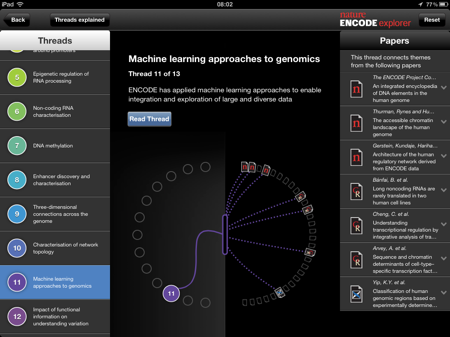
Decoding Nature's ENCODE iPad app - OMG it's full of ePUB

Encode
The release of the ENCODE (ENCyclopedia Of DNA Element) project has generated much discussion (see Fighting about ENCODE and junk). Perhaps perversely, I'm more interested in the way Nature has packaged the information than the debate about how much of our DNA is "junk."

Nature has a website (http://www.nature.com/encode/) that demonstrates the use of "threads" to navigate through a set of papers. Instead of having to read every paper you can pick a topic and Nature has collected a set of extracts on that topic (such as a figure and its caption) from the relevant papers and linked them together as a thread. Here is a video outlining the rationale behind threads.


Threads can be viewed on Nature's web site, and also in the iPad app. The iPad app is elegant, and contains full text for articles from Nature, Genome Research, Genome Biology, BMC Genetics. Despite being from different journals the text and figures from these articles are displayed in the same format in the app. Curious as to how this was done I "disassembled" the iPad app (see Extract and Explore an iOS App in Mac OS X for how to do this. If you've downloaded the app on your iPad and synced the iPad with your Mac, then the apps are in the folder "iTunes/iTunes Media/Mobile Applications" folder inside your "Music" folder. The app contains a file called encode.zip, and inside that folder are the articles and threads, all as ePub files. ePub is the format used by a number of book-reading apps, such as Apple's iBooks. Nature has a lot of experience with ePub, using it in their iPhone and iPad journal apps (see my earlier article on these apps, and my web-based clone for more details).

Photo
ePub has several advantages in this context over, say, PDFs. Because it ePUb is essentially HTML, the text and images can be reflowed, and it is possible to style the content consistently (imagine how much clunkier things would have looked if the app had used PDFs of the articles, each in the different journals' house style). Having the text in ePub also makes creating threads easy, you simply extract the relevant chunks and combine them into a new ePub file.

Threads are an interesting approach, particularly as they cut across the traditional boundaries of individual articles to create a kind of "mash up." Of course, in the ENCODE app these are preselected for you, you can't create your own thread. But you could imagine having an app that would enable you to not just collect the papers relevant to a topic (as we do with bibliographic software), but enable you to extract the relevant chunks and create a personalised mash up across papers from multiple journals, each linked back to the original article (much like Ted Nelson envisioned for the Xanadu project). It will be interesting to see whether thread-like approaches get more widely adopted. Whatever happens, Nature are consistently coming up with innovative approaches to displaying and navigating the scientific literature.

Thursday, March 06, 2008

Word for the day - "transclusion"

Stumbled across Project Xanadu, Ted Nelson's vision of the way the web should be (e.g., BACK TO THE FUTURE: Hypertext the Way It Used To Be). Nelson coined the term "transclusion", including one document in side another by reference. The screen shot of Xanadu Space may help illustrate the idea:

Nelson envisages a web where instead of just one-way links, documents include parts of other documents, and one can view a document side-by-side with the source documents. Modern web browsers transclude images (the image file is not "physically" in the document, rather it exists elsewhere), but mostly they link to other documents via hyperlinks.
Ted Nelson's writings are a fascinating read, partly because they remind you just how much of the web we take for granted, and how thinks could be different (better?). One thing he objects to is that much of the the web simulates paper
Much of the field has imitated paper: in word processing (Microsoft Word and Adobe Acrobat) and the World Wide Web, whose rectangular page layouts become a focal issue. It should be noted that these systems imitate paper under glass, since you can't annotate it.
Nelson also advocates every element of a document having its own unique address, not just at book or article level. This resonates with what is happing with digital libraries. Gregory Crane in his article "What Do You Do with a Million Books?" (doi:10.1045/march2006-crane) notes that:
Most digital libraries still mimic their print predecessors, treating individual objects – commonly chunks of PDF, RTF/Word, or HTML with no standard internal structure – as its constituent units. As digital libraries mature and become better able to extract information (e.g., personal and place names), each word and automatically identifiable chunk of words becomes a discrete object. In a sample 300 volume, 55 million word collection of nineteenth-century American English, automatic named entity identification has added 12,000,000 tags. While this collection focuses on name rich historical materials and includes several reference works, this system already discovers thousands of references to named entities in most book length documents. We thus move from single catalogue entries with a few hundred words to thousands of tagged objects – an increase of at least one order of magnitude with named entities and of at least two orders of magnitude when we consider each individual word as an object.
I discovered Crane's paper via Chris Freeland's post On Name Finding in the BHL. Chris summarises BHL's work on scanning biodiversity literature and extracting taxonomic names. BHL's output is at the level of pages, rather than articles. Existing GUIDs for literature (such as DOIs and SICIs) typically identify articles rather than pages (or page elements), so there's a need to extending these to pages.

Chris also raises the issue of ranking and relevance -- "What do you do with 19,000 pages containing Hymenoptera?". One possibility is to explore Robert Huber's TaxonRank idea (inspired by Google's PageRank). This would require text mining to build synonomy lists from scanned papers, challenging but not impossible. But I suspect that the network of citations is what will help build a sensible way to rank the 19,000 pages.

A while ago people were speculating what Google could do to help biodiversity informatics. I found much of this discussion to be vague, with no clear notion of what Google could actually do. What I think Google is exceptionally good at are two things we need to tackle -- text mining, and extracting information from links. I think this is where BHL and, by extension, EOL, should be devoting much of their resources.