Showing posts with label Facebook. Show all posts

Friday, September 11, 2015

Possible project: natural language queries, or answering "how many species are there?"

Google Google knows how many species there are. More significantly, it knows what I mean when I type in "how many species are there". Wouldn't it be nice to be able to do this with biodiversity databases? For example, how many species of insect are found in Fiji? How would you answer this question? I guess you'd Google it, looking for a paper. Or you'd look in vain on GBIF, and then end up hacking some API queries to process data and come up with an estimate. Why can't we just ask?

On the face of it, natural language queries are hard, but there's been a lot of work down in this area. Furthermore, there's a nice connection with the idea of knowledge graphs. One approach to natural language parsing is to convert a natural language query to a path in a knowledge graph (or, if you're Facebook, the social graph). Facebook has some nice posts describing how their graph search works (e.g., Under the Hood: Building out the infrastructure for Graph Search), and there's a paper describing some of the infrastructure (e.g., "Unicorn: a system for searching the social graph" doi:10.14778/2536222.2536239, get the PDF here).

Natural language queries can seem potentially unbounded, in the sense that the user could type in anything. But there are ways to constrain this, and ways to anticipate what the user is after. For example, Google suggests what you may be after, which gives us clues as to the sort of questions we'd need answers for. It would be a fun exercise to use Google suggest to discover what questions people are asking about biodiversity, then determine what would it take to be able to answer them.

Suggest All very sensible questions that existing biodiversity databases would struggle to answer.

There's a nice presentation by Kenny Bastani where he tackles the problem of bounding the set of possible questions by first generating the questions for which he answers, then caching those so that the user can select from them (using, for example, a type-ahead interface).

Hence, we could generate species counts for all major and/or charismatic taxa for each country, habitat type (or other meaningful category), then generate the corresponding query (e.g., "how many species of birds are there in Fiji", where the yellow and cyan" terms are the things we replace for each query).

One reason this topic appeals is that it is intimiately linked to the idea of a biodiversity knowledge graph, in that answers to a number of questions in biodiversity can be framed as paths in that graph. Do, if we build the graph we should also be asking about ways to query it. In particular, how do we answer the most basic questions of the information we are aggregating in myriad databases.

Friday, September 24, 2010

Mendeley Connect

When I first launched BioStor (an article finding tool built on the top of the (Biodiversity heritage Library) I wanted people to be able to edit metadata and add references, but also minimise the chances that junk would get added. As a quick and dirty deterrent I used reCAPTCHA, so anybody adding a reference or editing the metadata had to pass a CAPTHCA before their edits were accepted.

While reCAPTCHA does the trick, it can be tedious for somebody editing a lot of articles to have to pass a CAPTHCA every time they edit an article. Ed Baker of the International Commission on Zoological Nomenclature (ICZN) has a project to identify all the articles in the Bulletin of Zoological Nomenclature, and has been gently bugging me to add a login feature to BioStor. I played for a while with OpenID, but it occurred to me that Mendeley might be a more sensible strategy. Mendeley's API supports OAuth, a protocol where you can grant an application access to another application, but without giving away any passwords. It's used by Twitter and Facebook, among others. Indeed, a growing number of sites on the web are using Twitter and/or Facebook services to enable users to log in, rather than write their own code to support login, usernames, passwords, etc.

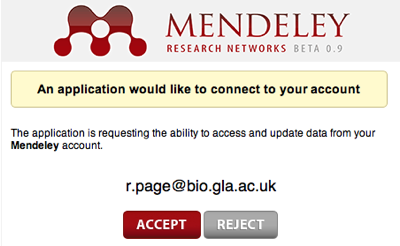
In the case of BioStor, I've added a link to sign in via Mendeley. if you click on it you get taken to a page like this:

connect.png
If you're happy for BioStor to connect to Mendeley, you click on Accept and BioStor won't bug you to fill in a CAPTCHA. Once Mendeley's API matures it would be nice to add features such as the ability to add a reference in BioStor straight to your Mendeley library (this is doable now, but the Mendeley API looses some key metadata such as page numbers).

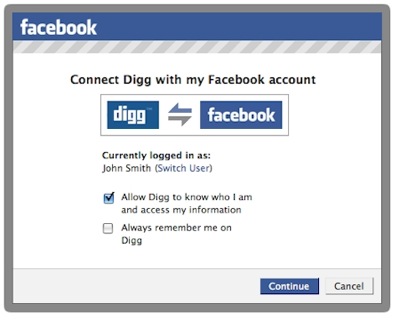
facebook-connect.jpg
But, thinking more broadly, Mendeley has an opportunity here to provide services similar to Facebook Connect. For example, instead of simply having buttons on web pages to bookmark papers, we could have buttons indicating how many people had added a paper to their library, and whether any of those people were in your contacts. We could extend this further an create something like Facebook's Open Graph Protocol, which supports the "Like" button. Or perhaps, we could have an app that integrates with Facebook and harvests your "Likes" that are papers.

Food for thought. Meantime, I hope users like Ed will find BioStor less tedious to use now that they can log in via Mendeley.

Friday, July 30, 2010

Flipboard and BHL

Flipboard is a new application for the iPad that is pitching itself as a personalised social magazine. It's launch created a lot of buzz, so much so that many users were unable to add their Facebook and Twitter accounts to it, much to their chagrin. I was one of these annoyed users, but now that I've been able to login I've been having a play and it's a lot of fun.


Nice typography and a clever layout is part of the attraction, and there has been some discussion about whether the Biodiversity Heritage Library (BHL) could be integrated.

@chrisfreeland @rdmpage #bhlib integration on @flipboard? The fb interface is very polished, familiar and comfortableless than a minute ago via Twitter for iPhone


Personally I'm sceptical. For me the key to Flipboard is not so much the nice interface, but the fact that the content is timely and relevant: timely because it's taken from live streams, and relevant because it comes from sources you select, including those form your social network. BHL doesn't have any of these characteristics. It's a huge digital archive with very little structure, and what structure it does have is largely bibliographic. For this content to work in a Flipboard-like environment I think BHL would need to develop "streams" based on, say taxa, geography, or readership, and these would have to be personalised. In a sense, Flipboard is displaying streams of content assembled by a combination of editors and your social network, and BHL has neither.