A couple of articles in the tech press got me thinking this morning about Bitcoin, Ted Nelson, Xanadu, and the web that wasn't. The articles are After The Social Web, Here Comes The Trust Web and Transforming the web into a HTTPA 'database'. There are some really interesting ideas being explored based on centralised tracking of resources (including money, think Bitcoin, and other assets, think content). I wonder whether these developments may make lead to renewed interest in some of the ideas of Ted Nelson.
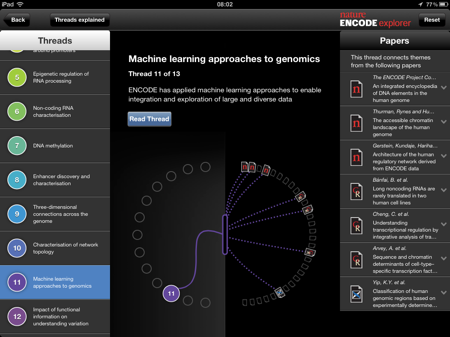
I've always had a soft-spot for Ted Nelson and his Xanadu project (see my earlier posts on translcusion and Nature's ENCODE app). To get a sense of what he was after, we can compare the web we have with what Nelson envisaged.
The web we have today:
- Links are one-way, in that it's easy to link to a site (just use the URL), but it's hard for the target site to find out who links to it. Put another way, like writing a scientific paper, it's easy to cite another paper, but non-trivial to find out who is citing your own work.
- Links to another document are simply launching pads to go to that other document, whether it's still there or not.
- Content is typically either "free" (paid for by advertising or in exchange for personal data), or behind a paywall and hence expensive.
Nelson wanted:
- Links that were bidirectional (so not only did you get cited, but you knew who was citing you)
- "Transclusion", where documents would not simply link (=cite) to other documents but would include snippets of those documents. If you cited another document, say to support a claim, you would actually include the relevant fragment of that document in your own document.
- A micropayment system so that if your work was "transcluded" you could get paid for that content.
The web we have is in many ways much easier to build, so Nelson's vision lost out. One-way links are easy to create (just paste in a URL), and the 404 error (that you get when a web page is missing) makes it robust to failure. If a page vanishes, things don't collapse, you just backtrack and go somewhere else.
Nelson had a more tightly linked web. He wanted to keep track of who links to whom automatically. Doing this today is the preserve of big operations such as Google (who count links to rank search results) or the Web of Science (who count citations to rank articles and journals - note that I'm using the web and the citation network pretty much interchangeably in this post). Because citation tracking isn't built into the web, you need create this feature, and that costs money (and hence nobody provides access to citation data for free).
In the current web, stuff (content) is either given away for "free" (or simply copied and pasted as if it was free), or locked behind paywalls. Free, of course, is never free. We are either handing over data, being the targets of advertising (better targeted the more data we hand over), or we pay for freedom directly (e.g., open access publication fees in the case of scientific articles). Alternatively, we have the paywalls well know to academics, where much of the world's knowledge is held behind expensive paywalls (in part because publishers need some way to make money, and there's little middle ground between free and expensive).
Nelson's model envisaged micropayments, where content creators would get small payments every time their content was used. Under the transclusion model, only small bits of your content might be used (in the context of a scientific paper, imagine just a single fact or statement was used). You didn't get everything for free (that would destroy the incentive to create), but nor was everything locked up behind prohibitively expensive paywalls. Nelson's model never took off, in part I suspect because there was simply no way to (a) track who was using the content, and (b) collect micropayments.
What is interesting is that Bitcoin seems to deal with the micropayments issue, and the HTTPA protocol (which uses much the same idea as Bitcoin to keep an audit trail of who has accessed and used data) may provide a mechanism to track usage. How is this going to change the current web? Might there be ways to use these ideas to reimagine academic publishing, which at the moment seems caught between steep open access fees or expensive journal subscriptions?