Showing posts with label Google. Show all posts

Wednesday, January 15, 2014

What I'll be working on in 2014: knowledge graphs and Google forests

More for my own benefit than anything else I've decided to list some of the things I plan to work on this year. If nothing else, it may make sobering reading this time next year.

A knowledge graph for biodiversity


Google's introduction of the "knowledge graph" gives us a happy phrase to use when talking about linking stuff together. It doesn't come with all the baggage of the "semantic web", or the ambiguity of "knowledge base". The diagram below is my mental model of the biodiversity knowledge graph (this comes from http://dx.doi.org/10.7717/peerj.190, but I sketched most of this for my Elsevier Challenge entry in 2008, see http://dx.doi.org/10.1038/npre.2008.2579.1).

Fig 1 1x

Parts of this knowledge graph are familiar: articles are published in journals, and have authors. Articles cite other articles (represented by a loop in the diagram below). The topology of this graph gives us citation counts (number of times an article has been cited), impact factor (citations for articles in a given journal), and author-based measures such as the H-index (a function of the distribution of citations for each article you have authored). Beyond simple metrics this graph also gives us the means to track the provenance of an idea (by following the citation trail).

Publication

The next step is to grow this graph to include the other things we care about (e.g., taxa, taxon names, specimens, sequences, phylogenies, localities, etc.).

BioNames


I spent a good deal of last year building BioNames (for background see my blog posts or read the paper in PeerJ http://dx.doi.org/10.7717/peerj.190). BioNames represents a small corner of the biodiversity knowledge graph, namely taxonomic names and their associated publications (with added chocolately goodness of links to taxon concepts and phylogenies). In 2014 I'll continue to clean this data (I seem to be forever cleaning data). So far BioNames is restricted to animal names, but now that the plant folks have relaxed their previously restrictive licensing of plant data (see post on TAXACOM) I'm looking at adding the million or so plant names (once I've linked as many as possible to digital identifiers for the corresponding publications).

Spatial indexing


Now that I've become more involved in GBIF I'm spending more time thinking about spatial indexing, and our ability to find biodiversity data on a map. There's a great Google ad that appeared on UK TV late last year. In it, Julian Bayliss recounts the use of Google Earth to discover of virgin rainforest (the "Google forest") on Mount Mabu in Mozambique.


It's a great story, but I keep looking at this and wondering "how did we know that we didn't know anything about Mount Mabu?" In other words, can we go to any part of the world and see what we know about that area? GBIF goes a little way there with its specimen distribution maps, which gives some idea of what is now known from Mount Mabu (although the map layers used by GBIF are terrible compared to what Google offers).

Mabu

But I want to be able to see all the specimens now known from this region (including the new species that have been discovered, e.g. see http://dx.doi.org/10.1007/s12225-011-9277-9 and http://dx.doi.org/10.1080/21564574.2010.516275). Why can't I have a list of publications relevant to this area (e.g., species descriptions, range extensions, ecological studies, conservation reports)? What about DNA sequences from material in this region (e.g., from organismal samples, DNA barcodes, metagenomics, etc.)? If GBIF is to truly be a "Global Biodiversity Information Facility" then I want it to be able to provide me with a lot more information than it currently does. The challenge is how to enable that to happen.

Wednesday, March 13, 2013

Bibliographic metadata pollution

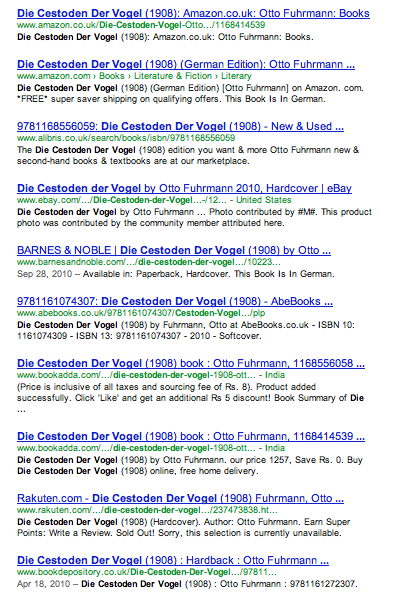
I spend a lot of time searching the web for bibliographic metadata and links to digitised versions of publications. Sometimes I search Google and get nothing, sometimes I get the article I'm after, but often I get something like this:

Google

If I search for Die cestoden der Vogel in Google I get masses of hits for the same thing from multiple sources (e.g., Google Books, Amazon, other booksellers, etc.). For this query we can happily click through pages and pages of results that are all, in some sense, the same thing. Sometimes I get the similar results when searching for an article, multiple hits from sites with metadata on that article, but few, if any with an actual link to the article itself.

One byproduct of putting bibliographic metadata on the web is that we are starting to pollute web space with repetitions of the same (or closely similar) metadata. This makes searching for definitive metadata difficult, never mind actually finding the content itself. In some cases we can use tools such as Google Scholar, which clusters multiple versions of the same reference, but Google Scholar is often poor for the kind of literature I am after (e.g., older taxonomic publications).

As Alan Ruttenberg (@alanruttenbergpoints out, books would seem to be a case where Google could extend its knowledge graph and cluster the books together (using ISBNs, title matching, etc.). But meantime if you think simply pumping out bibliographic metadata is a good thing, spare a thought for those of us trying to wade through the metadata soup looking for the "good stuff".

Thursday, August 02, 2012

Google Knowledge Graph using data from BBC and Wikipedia

Google's Knowledge Graph can enhance search results by display some structured information about a hit in your list of results. It's available in the US (i.e., you need to use www.google.com, although I have seen it occasionally appear for google.co.uk.

Fruitbat
Here is what Google displays for Eidolon helvum (the straw-coloured fruit bat). You get a snippet of text from Wikipedia, and also a map from the BBC Nature Wildlife site. Wikipedia is a well-known source of structured data (in that you can mine the infoboxes for information). The BBC site has some embedded RDFa and structured HTML, and you can also get RDF (just append ".rdf" to the URL, i.e., http://www.bbc.co.uk/nature/life/Straw-coloured_Fruit_Bat.rdf). There doesn't seem to be anything in the RDF about the distribution map, so presumably Google are extracting that information from the HTML.

It would be interesting to think about what other biodiversity data providers, such as GBIF and EOL could do to get their data incorporated into Google's Knowledge Graph, and eventually into these search result snippets.

Monday, June 18, 2012

Fictional taxa

Anyone who works with taxonomic databases is aware of the fact that they have errors. Some taxonomic databases are restricted in scope to a particular taxon in which one or more people have expertise, these then get aggregated into larger databases, which may in turn be aggregated by databases whose scope is global. One consequence of this is that errors in one database can be propagated through many other databases.

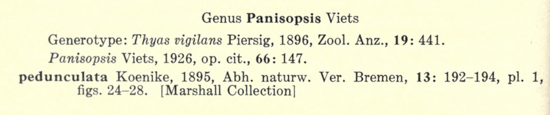
As an example (for reasons I can't remember), I came across the name "Panisopus" (in the water mote family Thyasidae) but was struggling to find any mention of the taxonomic literature associated with this name. If you Google Panisopus the first two pages are full of search results from ITIS, EOL, GBIF, ZipCodeZoo, all listing several species in the genus, and sometimes taxonomic authorities, but no links to the primary literature. If you search BHL for Panisopus you get nothing, nothing at all. It's as if the name didn't exist.

Turns out, that's exactly the point. The name doesn't exist, other than in the various databases that have consumed other databases and recycled this fictional taxon. After some Googling of author's names it became clear that "Panisopus" is probably a misspelling of "Panisopsis", which according to ION was published in:

Viets, K. (1926) Eine nomenklatorische Aenderung im Hydracarinen-Genus Thyas C. L. Koch. Zool Anz Leipzig, 66: 145--148

I can't verify this because this article is not available online. But to give one example, ITIS lists the name "Panisopus pedunculata Keonike, 1895" (TSN 83185). This name should be, as far as I can tell, Panisopsis pedunculata (Koenike, 1895), based on Mitchell, 1954 (http://biostor.org/reference/104266, http://dx.doi.org/10.5962/bhl.title.3110) who on page 36 states:

Mitchell

Note that Panisopsis pedunculata was originally described in a different genus (Koenike 1895 preceeds the publication of the genus name by Viets in 1926). We can locate Koenike's original publication "Nordamerikanische Hydrachniden" in BHL, which I've added to BioStor http://biostor.org/reference/104265, and the original description appears on p. 192 as Thyas pedunculata (note that ITIS misspells the author's name Koenike [o and e transposed], as well as omitting the parentheses around the name).

What I find a little alarming (if not surprising) is that the entirely fictional genus "Panisopus" its accompanying species have ended up in numerous taxonomic databases, and these databases consistently appear in the top Google searches for this name. The good news is that it's becoming increasingly easy to discover these errors, in part because more and more taxonomic literature is coming online, making it possible for users to investigate matters for themselves, rather than rely on unsupported statements in taxonomic databases. I'm continually amazed by how little evidence most taxonomic databases provide for any of the assertions that they make. If a database includes a name, I want some evidence that the name is "real". Show me the publication, or at least give me a citation that I can follow up. I can't take these databases on blind faith, because demonstrably they are replete with errors. Ironically, one measure of success in the Internet age is being in the top 10 hits for a Google search. Now, if the top ten hits are all taxonomic databases I get very, very nervous. It's a good sign the name only exists in those databases.

Tuesday, December 06, 2011

Google doesn't like BioStor anymore

According to Google Analytics BioStor has experienced a big drop in traffic since the start of October:

Panda

At one point I'm getting something like 4500 visits a week, now it's just over a thousand a week. I'm guessing this is due to Google's 'Panda' update. I suspect part of the problem is that in terms of text content BioStor is actually pretty thin. For each article there is some metadata and a few links, so it probably looks a little like a link farm. The bulk of the content is in the page images, which of course, Google can't read.

I'd be interested to know of any other sites in the field that have been affected in the same way (or, indeed, sites which have seen no change in their traffic since October).

Sunday, February 06, 2011

Why is the Atlas of Living Australia is invisible to Google?

Jeff Atwood, one of the co-founders of Stack Overflow recently wrote a blog post Trouble In the House of Google, where he noted that several sites that scrape Stack Overflow content (which Stack Overflow's CC-BY-SA license permits) appear higher in Google's search rankings than the original Stack Overflow pages. When Stack Overflow chose the CC-BY-SA license they made the assumption that:
...that we, as the canonical source for the original questions and answers, would always rank first...That's why Joel Spolsky and I were confident in sharing content back to the community with almost no reservations – because Google mercilessly penalizes sites that attempt to game the system by unfairly profiting on copied content.
Jeff Atwood's post goes on to argue that something is wrong with the way Google is ranking sites that derive content from other sites.

I was reminded of this post when I started to notice that searches for fairly obscure Australian animals would often return my own web site Australian Faunal Directory on CouchDB as the first hit. In one sense this is personally gratifying, but it can also be frustrating because when I Google these obscure taxa it's usually because I'm trying to find data that isn't already in one of my projects.

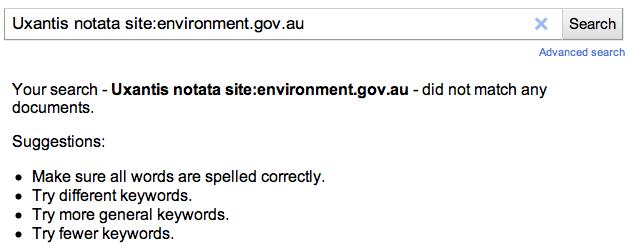
unotata.pic1.JPGBut what I've also noticed is that the site that I obtained the data from, Australian Faunal Directory (AFD), rarely appears in the Google search results. In fact, there are taxa for which Google doesn't find the corresponding page in AFD. For example, if you search for Uxantis notata (shown here in an image from the Key to the planthoppers of Australia and New Zealand) the first hit(s) are from my version of AFD:
Snapshot 2011-02-06 14-05-44.png


Neither the original AFD, nor the Atlas of Living Australia (ALA), which also builds on AFD, appear in the top 10 hits.

Initially I though this is probably an artefact. This is a pretty obscure taxon, maybe things like rounding error in computing PageRank are going to affect search rankings more than anything else. However, if I explicitly tell Google to search for Uxantis notata in the domain environment.gov.au I get no hits whatsoever:

Snapshot 2011-02-06 14-10-32.png

Likewise, the same search restricted to ala.org.au finds nothing, nothing at all. Both AFD and Atlas of Living Australia have pages for this taxon, here, and here, so clearly something is deeply wrong.

Why are the original providers of the data not appearing in Google search results at all? For someone like me who argues that sharing data is a good thing, and sites that aggregate and repurpose data will ultimately benefit the original data providers (for example by sending traffic and Google Juice) this is somewhat worrying. It seems to reinforce the fear that many data providers have: "if I share my data someone will make a better web site than mine and people will go to that web site, rather than the one I've created with my hard-won data." It may well be that data aggregators will score higher than data providers in Google searches, but I hadn't expected data providers to be virtually invisible.

atlasaustraliasm.gifGoogle isn't the problem
If a web site that I hacked together in a few days does better in Google searches than the rather richer pages published by sites such as ALA (with a budget of over $AU 30 million), something is wrong. Unlike the Stack Overflow example discussed above, I don't think the problem here is with Google.
If we search in Google for an "iconic" Australian taxon by name, say the Koala Phascolarctos cinereus, Wikipedia is the first hit (which should be no surprise). ALA doesn't appear in the top ten. If we tell Google to just search the domain ala.org.au we get lots of pages from ALA, but not the actual species page for Phascolarctos cinereus. This suggests that there is something about the way ALA's website works that prevents Google indexing it properly. I'm also a little worried that a major biodiversity project which has as its aim
...to improve access to essential information on Australia’s biodiversity
is effectively invisible to Google.


Thursday, December 23, 2010

BHL and OCR

Some quick notes on OCR. Revisiting my DjVu viewer experiments it really struck me how "dirty" the OCR text is. It's readable, but if we were to display the OCR text rather than the images, it would be a little offputting. For example, in the paper A new fat little frog (Leptodactylidae: Eleutherodactylus) from lofty Andean grasslands of southern Ecuador (http://biostor.org/reference/229) there are 15 different variations of the frog genus Eleutherodactylus:

  • Eleutherodactylus
  • Eleutheroclactylus
  • Eleuthewdactyliis
  • Eleiitherodactylus
  • Eleuthewdactylus
  • Eleuthewdactylus
  • Eleutherodactyliis
  • Eleutherockictylus
  • Eleutlierodactylus
  • Eleuthewdactyhts
  • Eleiithewdactylus
  • Eleutherodactyhis
  • Eleiithemdactylus
  • Eleuthemdactylus
  • Eleuthewdactyhis

Of course, this is a recognised problem. Wei et al. Name Matters: Taxonomic Name Recognition (TNR) in Biodiversity Heritage Library (BHL) (hdl:2142/14919) found that 35% of names in BHL OCR contained at least one wrong character. They compared the performance of two taxonomic name finding tools on BHL OCR (uBio's taxonFinder and FAT), neither of which did terribly well. Wei et al. found that different page types can influence the success of these algorithms, and suggested that automatically classifying pages into different categories would improve performance.

Personally, it seems to me that this is not the way forward. It's pretty obvious looking at the versions of "Eleutherodactylus" above that there are recognisable patterns in the OCR errors (e.g., "u" becoming "ii", "ro" becoming "w", etc.). After reading Peter Norvig's elegant little essay How to Write a Spelling Corrector, I suspect the way to improve the finding of taxonomic names is to build a "spelling corrector" for names. Central to this would be building a probabilistic model of the different OCR errors (such as "u" → "ii"), and use that to create a set of candidate taxonomic names the OCR string might actually be (the equivalent of Google's "did you mean", which is the subject of Norvig's essay). I had hoped to avoid doing this by using an existing tool, such as Tony Rees' TAXAMATCH, but it's a website not a service, and it is just too slow.

I've started doing some background reading on the topic of spelling correction and OCR, and I've created a group on Mendeley called OCR - Optical Character Recognition to bring these papers together. I'm also fussing with some simple code to find misspellings of a given taxonomic names in BHL text, use the Needleman–Wunsch sequence alignment algorithm to align those misspellings to the correct name, and then extract the various OCR errors, building a matrix of the probabilities of the various transformations of the original text into OCR text.

One use for this spelling correction would be in an interactive BHL viewer. In addition to showing the taxonomic names that uBio's taxonFinder has located in the text, we could flag strings that could be misspelt taxonomic names (such as "Eleutherockictylus") and provide an easy way for the user to either accept or reject that name. If we are going to invite people to help clean up BHL text, it would be nice to provide hints as to what the correct answer might be.

Friday, September 11, 2009

Gene Wiki and Google

Andrew Su has posted an analysis of Gene Wiki, a project to provide Wikipedia pages on every human gene:
Here's the take home message: in terms of online gene annotation resources, Gene Cards is the most common top-ranked resource, followed closely by the Gene Wiki / Wikipedia, with NCBI in a very distant third (note the log scale).
top_sites.png

This result is interesting in that an existing resource (Gene Cards) beats Wikipedia, but only just. There are various ways we could interpret this, but from the point of view of biodiversity resources I suspect it emphasises that if there is a good, existing resource that has a lot of traction (i.e., Gene Cards) it will do well in Google Searches. If there is no single dominant resource (as is the case for biodiversity), then it leaves the field open to be dominated by Wikipedia.

Thursday, September 03, 2009

Google and Wikipedia revisited

Given that one response to my post on Fungi in Wikipedia was to say that fungi are also charismatic, so maybe I should try [insert unsexy taxon name here]. So, I've now looked at all the species I extracted from Wikipedia (nearly 72,000), ran the Google searches, and here are the results:

SiteHow many times is it the top hit?
en.wikipedia.org42515
www.birdlife.org2125
commons.wikimedia.org1522
plants.usda.gov1496
species.wikimedia.org1487
animaldiversity.ummz.umich.edu1419
amphibiaweb.org851
www.calflora.org770
www.fishbase.org727
ibc.lynxeds.com699
davesgarden.com659
www.arkive.org510
ukmoths.org.uk414
zipcodezoo.com368
www.itis.gov304
calphotos.berkeley.edu294
www.floridata.com234
www.planetcatfish.com234
www.eol.org226
www.arthurgrosset.com213


The table lists the top twenty sites, based on the number of times each site occupies the number one place in the Google search results. Surprise, surprise, Wikipedia wins hands down.

What is interesting is that the other top-ranking sites tend to be taxon-specific, such as FishBase, Amphibia Web, and USDA Plants. To me this suggests that the argument that Wikipedia's dominance of the search results is because it focusses on charismatic taxa doesn't hold. In fact, the truly charismatic taxa are likely to have their own, richly informative webs sites that will often beat Wikipedia in the search rankings. If your taxon is not charismatic, then it's a different story. This suggests one of two strategies for making taxon web sites that people will find. Either go for the niche market, and make a rich site for a set of taxa that you (and ideally some others) like, or add content to Wikipedia. Sites that span across all taxa will always come up against Wikipedia's dominance in the search rankings. So, it's a choice of being a specialist, or trying to compete with an über-generalist.

Wednesday, September 02, 2009

Fungi in Wikipedia

One response to the analysis I did of the Google rank of mammal pages in Wikipedia is to suggest that Wikipedia does well for mammals because these are charismatic. It's been suggested that for other groups of taxa Wikipedia might not be so prominent in the search results.

As a quick test I extracted the 1552 fungal species I could find in Wikipedia and repeated the analysis. If anything, the results are more dramatic:
Untitled Image.png


Once again, Wikipedia dominates the search rankings. Over 75% of the pages are the top hit in Google. More specialist fungal sites, such as CAB Abstracts Plus and the American Phytopathological Society's online database do pretty well. EOL and the nomenclatural database Index Fungorum barely make an appearance.

If fungi are less "charismatic" than mammals, the implication is that the less charismatic the taxon, the better Wikipedia does (perhaps there is less competition from other sites). Of course, Wikipedia is severely underpopulated with fungal pages, so one could argue that for fungi not in Wikipedia, sites like EOL may do better (relative to other sites), but that would need to be tested. I suspect that sites that provide more broadly useful information (such as APSnet) will continue to dominate the search rankings, followed by scientific articles (for the fungi in Wikipedia the publishers Springer, Wiley, and Elsevier all appear in the top of sites that appear in the Google rankings).

Tuesday, September 01, 2009

Wikipedia mammals and the power law

Playing a bit more with the Wikipedia mammal data, there are some interesting patterns to note. The first is that rank the mammal pages by size (here defined as the number of characters in the source for the page) and plot size against rank then we get a graph that looks very much like a power law:
pow1.png

There are a few large pages on mammals (these are on the left), and lots of small pages (the long tail on the right). If we do a log-log plot we get this:
pow2.png

The straight line is characteristic of a power law. The dip at the far right reflects the fact that Wikipedia pages have a minimum size (for example, they must include a Taxobox). Now, this is a bit crude (I should probably look at "Power-law distributions in empirical data" arXiv:0706.1062v2 before getting too carried away), but power laws are characteristic of the link structure of the web (a few big sites with huge numbers of links, huge numbers of sites with few links), and indeed of at least parts of Wikipedia, such as the Gene Wiki project (see doi:10.1371/journal.pbio.0060175).

In this context, the diagrams are showing that even if mammals are "charismatic megafauna", most of them aren't that charismatic. Wikipedia mammal pages are mostly small. This raises the question of whether the high frequency in which Wikipedia mammal pages appeared in the top of Google searches might be attributed to those large pages on (presumably) charismatic mammals. If this were the case, then we'd expect that small pages wouldn't rank highly in Google searches. So, I plotted page size against Google search rank for the Wikipedia mammal pages:
sizexrank.png

This is a box plot, where the grey boxes represent 50% of the distribution of page size (the horizontal black line is the median), and extreme values are shown as circles. Note that "0" is the highest rank (i.e., the first hit in Google), and 9 is the lowest.

While, not surprisingly, most large Wikipedia pages do well in Google searches, and rarely are large pages low down the rankings, my sense is that small pages can have any rank, from top (0) to bottom (9). If page size (i.e., which is a crude measure of the effort put into editing a Wikipedia page) is a measure of "charisma" (contributors are more likely to edit pages on animals that lots of people know about), then charisma isn't a great predictor of where you come in Google's search results. It's not about size, it's about being in Wikipedia.

Google, Wikipedia, and EOL

One assumption I've been making so far is that when people search for information on an organism using its scientific name, Wikipedia will dominate the search results (see my earlier post for an example of this assumption). I've decided to quantify this by doing a little experiment. I grabbed the Mammal Species of the World taxonomy and extracted the 5416 species names. I then used Google's AJAX search API to look up each name in Google. For each search I took the top 10 hits and recorded for each hit the site URL and the rank in the search results (i.e., 1-10). Below is a table of how many mammal species had a hit in the top 10 Google results (showing just the top 20 most frequent sites).
SiteHits
en.wikipedia.org5266
species.wikimedia.org2934
animaldiversity.ummz.umich.edu2890
commons.wikimedia.org1515
www.itis.gov1418
ctd.mdibl.org1288
www.bioone.org1101
www.uniprot.org1086
encyclopedia.farlex.com1007
www.thewebsiteofeverything.com955
www.answers.com864
vertebrates.si.edu854
www.interaktv.com842
www.arkive.org775
linkinghub.elsevier.com727
www.springerlink.com656
www.eol.org618
www.reference.com576
doi.wiley.com572
noctilio.com566


Wikipedia is the clear winner, with 5266 (97%) of mammals having a Wikipedia page in the top ten Google results. Next comes Wikispecies, then Animal Diversity Web, Wikimedia Commons, ITIS, the Comparative Toxicogenomics Database, BioOne, UniProt (derived from the NCBI taxonomy), and so on. Note that the Encyclopedia of Life comes in 17th.

Things get more interesting if we look at the ranking of search results. The graph below plots the cumulative rank of search results for some of the web sites listed above.
ranks.png

Wikipedia dominates things. For 48% of all mammal species Wikipedia is the first result returned by Google. Just under three quarters of all mammal species are either the first or second top hit in Google. The next best sites are Animal Diversity Web and Wikispecies, which get a small share of first place for some species (19% and 7% respectively). Note that EOL pages manage to make it into the top 10 for only 11% of all mammal species.

What does this all mean? Well, it seems clear that if people are using Google to find information about an organism, then Wikipedia is more likely than anything else to be the first result they see. It is also interesting that for all the energy (and funds) being expended on biodiversity databases (doi:10.1126/science.324_1632), ITIS is the only classical biodiversity database that routinely gets found in these searches (albeit in only a quarter of the searches).

I know I tend to go on a bit about EOL, but if I was running (or funding) EOL, I'd be worried. EOL barely figures in these search results, and is being taken to the cleaners by a volunteer effort (Wikipedia). Furthermore, it seems difficult to envisage what EOL can do to improve things. Sure it can link to (and make use of) content in sites such as Animal Diversity Web, ITIS (and maybe even, gasp, Wikipedia), but that just adds "link love" to those sites. Ironically, perhaps the single thing that would improve EOL's ranking would be if Wikipedia spread some of its link love over EOL, by linking all it's taxon pages to the corresponding EOL page.

But there are bigger issues at stake. Site popularity on the web tends to follow a power law, where a very few web sites grab the vast majority of eye balls. In a old blog post Clay Shirky wrote:

Now, thanks to a series of breakthroughs in network theory by researchers ... we know that power law distributions tend to arise in social systems where many people express their preferences among many options. We also know that as the number of options rise, the curve becomes more extreme. This is a counter-intuitive finding - most of us would expect a rising number of choices to flatten the curve, but in fact, increasing the size of the system increases the gap between the #1 spot and the median spot.


So, creating new and improved biodiversity web sites is likely to have the effect of only increasing the gap between Wikipedia and the rest.

Lastly, as I've mentioned before regarding Wikipedia and citations of taxonomic work, the graph above suggests to me that for anybody wanting to make basic biodiversity information available on the web, and attract readers to basic taxonomic literature, there really is only one game in town.

Tuesday, July 14, 2009

Using Google Spreadsheets and RSS feeds to edit IPNI

One thing I find myself doing a lot is creating Excel spreadsheets and filling them will lists of taxonomic names and bibliographic references, for which I then try to extract identifiers (such as DOIs). This is a tedious business, but the hope is that by doing it once I can create a useful resource. However, often I get bored and the spreadsheets lie forgotten in some deep recess of my computer's hard drive.

It occurs to me that making these spreadsheets publicly available would be useful, but how to do this? In particular, how to do this in a way that makes it easy for me to extract recent edits, and to update the data from new sources? Google Spreadsheets seems an obvious answer, but I wasn't aware of just how obvious until I started playing with the spreadsheet APIs. These enable you to add data via the API (using HTTP PUT and ATOM), which means that I can easily push new data to the spreadsheet.

As a test, I've harvested the IPNI RSS feeds I created earlier (see http://bioguid.info/rss), extracted basic details about the name and any bibliographic identifiers my RSS generator had found, and sent these direct to a Google Spreadsheet. Some IPNI references didn't parse, so I can manually edit these, and many references lack an identifier (my tools usually finds those with DOIs). Often with a bit searching one can turn up a URL or a Handle to a paper, or even simply expand on the bibliographic details (which are a bit skimpy in IPNI). I'm also toying with using Zotero as an online bibliographic store for references that don't have an online presence.

So, what I've got now is a spreadsheet that can be edited, updated, and harvested, and will persist beyond any short term enthusiasm I have for trying to annotate IPNI.

Friday, May 22, 2009

Dryad, DOIs, and why data matters more than journal articles


For the last two days I've been participating in a NESCent meeting on Dryad, a "repository of data underlying scientific publications, with an initial focus on evolutionary biology and related fields". The aim of Dryad is to provide a durable home for the kinds of data that don't get captured by existing databases such as GenBank and TreeBASE (for example, the Excel spreadsheets, Word files, and tarballs of data that, if they are lucky, make it on to a journal's web site as supplementary material (like this example). These data have an alarming tendency to disappear (see "Unavailability of online supplementary scientific information from articles published in major journals" doi:10.1096/fj.05-4784lsf).

Perhaps it was because I was participating virtually (via Adobe Connect, which worked very well), but at times I felt seriously out of step with many of the participants. I got the sense that they regard the scientific article as primary, data as secondary, and weren't entirely convinced that data needed to be treated in the same way as a publication. I was arguing that Dryad should assign DOIs to data sets, join CrossRef, and ensure data sets were cited in the same way as papers. For me this is a no brainer -- by making data equivalent to a publication, journals don't need to do anything special, publishers know how to handle DOIs, and will have fewer qualms than handling URLs, which have a nasty tendency to break (see "Going, Going, Gone: Lost Internet References" doi:10.1126/science.1088234).

Furthermore, being part of CrossRef would bring other benefits. Their cited-by linking service enables publishers to display lists of articles that cite a given paper -- imagine being able to do this for data sets. Dryad could display not just the paper associated with publication of the data set, but all subsequent citations. As an author, I'd love to see this. It would enable me to see what others had done with my data, and provide an incentive to submit my data to Dryad (providing incentives to authors to archive data is a big issue, see Mark Costello's recent paper doi:10.1525/bio.2009.59.5.9).

Not everyone saw things this way, and it's often a "reality check" to discover that things one takes for granted are not at all obvious to others (leading to mutual incomprehension). Many editors, understandably, think of the the journal article as primary, and data as something else (some even struggle to see why one would want to cite data). There's also (to my mind) a ridiculous level of concern about whether ISI would index the data. In the age of Google, who cares? Partly these concerns may reflect the diversity of the participants. Some subjects, such as phylogenetics, are built on reuse of previous data, and it's this reuse that makes data citation both important and potentially powerful (for more on this see my papers hdl:10101/npre.2009.3173.1 and doi:10.1093/bib/bbn022). In many ways, the data is more important than the publication. If I look at a phylogenetics paper published, say 5 or more years ago, the methods may be outmoded, the software obsolete (I might not be able to run it on a modern machine), and the results likely to be outdated (additional data and/or taxa changing the tree). So, the paper might be virtually useless, but the data continues to be of value. Furthermore, the great thing about data (especially sequence data) is that it can be used in all sorts of unexpected ways. In disciplines such as phylogenetics, data reuse is very common. In other areas in evolution and ecology, this might not be the case.

It will be clear from this that I buy the idea articulated by Philip Bourne (doi:10.1371/journal.pcbi.0​010034) that there's really no difference between a database and a journal article and that the two are converging (I've argued for a long time that the best thing that could happen to phylogeneics would be if Molecular Phylogenetics and Evolution and TreeBASE were to merge and become one entity). Data submission would equal publication. In the age of Google where data is unreasonably effective (doi:10.1109/mis.2009.36, PDF here), privileging articles at the expense of data strikes me as archaic.

So, whither Dryad? I wish it every success, and I'm sure it will be a great start. There are some very clever people behind it, and it takes a lot of work to bring a community on board. However, I think Dryad's use of Handles is a mistake (they are the obvious choice of identifier given Dryad is based on DSpace), as this presents publishers with another identifier to deal with, and has none of the benefits of DOIs. Indeed, I would go further and say that the use of Handles + DSpace marks Dryad as being basically yet another digital library project, which is fine, but it puts it outside the mainstream of science publishing, and I think that is a strategic mistake. An example of how to do things better is Nature Precedings, which assigns DOIs to manuscripts, reports, and presentations. I think the use of DOIs in this context demonstrated that Nature was serious, and valued these sorts of resource. Personally, I'd argue that Dryad should be more ambitious, and see itself as a publisher, not a repository. In fact, it could think of itself as a journal publisher. Ironically, maybe the editors at the NESCent meeting were well advised to be wary, what they could be witnessing is the formation of a new kind of publication, where data is the article, and the article is data.

Thursday, April 16, 2009

Short URLs

Short URLs have been a topic of discussion recently, perhaps sparked by the article URL Shorteners: Which Shortening Service Should You Use?. Many will have encountered short URLs in Twitter tweets. Leigh Dodds (@ldodds) asked
Remind me: why do we need short urls at all, rather than a better solution? Removing arbitrary limits (or better impl. thereof) seems better
I guess Leigh's talking about the need for short URLs in tweets, but I wonder about the more general question of why we need URL shorteners at all. Reading the Guardian (physical copy in a coffee shop) I keep coming across URLs in the text, such as bit.ly/seth52, that is short, no "http://" prefix, and labelled in a human readable form (the short URL's in Seth Finkelstein's column are all of the form bit.ly/seth[n]).

It occurs to me that these URLs are almost like tags, the names have locally significant meaning, and are memorable. In a sense the URL shortening service acts as a new namespace. Imagine if you can't get a desired domain name, but can get a customised URL with that name. The tyranny of the DNS as the sole naming authority is weakened a little. In some ways this mirrors how many people use the web. Instead of typing in full domain names, they enter a search term into Google and go to the site they want (often the top hit). Imagine if Google provided a URL shortening service (in a sense their search engine is a slightly clunky one already).

The other reasons I'm interested in this is because of ugly identifiers such as urn:lsid:zoobank.org:act:6FFAFC2C-D46B-4959-BA03-C38477B9DFF1. This version, bit.ly/polina is a bit nicer. Plus, I get usage statistics on the short version (meaning I don't need to implement this myself). If we use the Guardian as an example, perhaps journal publishers using LSIDs such as urn:lsid:zoobank.org:act:6FFAFC2C-D46B-4959-BA03-C38477B9DFF1 would prefer to use custom, shortened URLs to make the text more readable, and collect usage statistics as well.

Tuesday, December 16, 2008

Reading books

One advantage of flying to the US is the chance to do some reading. At Newark (EWR) I picked up Guy Kawasaki's "Reality Check", which is a fun read. You can get a flavour of the book from this presentation Guy gave in 2006.


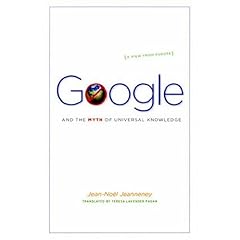
While at MIT for the Elsevier Challenge I was browsing in the MIT book shop and stumbled across "Google and the Myth of Universal Knowledge" by Frenchman Jean-Noël Jeanneney. It's, um, very French. I have some sympathy with his argument, but ultimately it comes across as European whining about American success. And the proposed solution involves that classic European solution -- committees! In many ways it's really a librarian complaing about Google (again), which librarians just need to get over:


OK, I'm not really doing the arguments justice, but I'm getting a little tired of European efforts that are essentially motivated by "well the Americans are doing this, so we need to do something as well."

Lastly, I also bought Linda Hill's "Georeferencing: The Geographic Associations of Information", which is a little out of date (what, no Google Maps or Google Earth?), but is nevertheless an interesting read, and has lots of references to georeferencing in biodiversity informatics. Given that my efforts for the challenge in this area where so crude, it's something I need to think about a bit more deeply.

Now, if I can just find my gate...

Monday, March 10, 2008

Google's Social Graph API

Google's Social Graph API was released earlier this year.

The motivation:
With so many websites to join, users must decide where to invest significant time in adding their same connections over and over. For developers, this means it is difficult to build successful web applications that hinge upon a critical mass of users for content and interaction. With the Social Graph API, developers can now utilize public connections their users have already created in other web services. It makes information about public connections between people easily available and useful.
Apart from the obvious application to scientific databases (for example, utilising connections such as co-authorship), imagine the same idea applied to data.

Tuesday, February 05, 2008

The Data Wars


Wired 16.01 has an article entitled The Data Wars by Josh McHugh. A quote from the printed version:
They call it scraping — when web companies automatically harvest information from the likes of Yahoo, Google, and craigslist. Now the Internet establishment is clamping down.

It's a sobering read for those of us who advocate harvesting data from as many sources as possible, more so in light of Microsoft's bid to buy Yahoo. Yahoo provides free access to many of its tools via an API (such as the image search I use in iSpecies, and in this sense is much more open than Google. Might this change under Microsoft...?