Showing posts with label open data. Show all posts

Wednesday, August 10, 2016

On asking for access to data

In between complaining about the lack of open data in biodiversity (especially taxonomy), and scraping data from various web sites to build stuff I'm interested in, I occasionally end up having interesting conversations with the people whose data I've been scraping, cleaning, cross-linking, and otherwise messing with.

Yesterday I had one of those conversations at Kew Gardens. Kew is a large institution that is adjusting to a reduced budget, a changing ditigal landscape, and a rethinking of it's science priorities. Much of Kew's data has not been easily accessible to the outside world, but this is changing. Part of the reason for this is that Defra, which part-funds Kew, is itself opening up (see Ellen Broad's fascinating post Lasers, hedgehogs and the rise of the Age of Yoghurt: reflections on #OpenDefra).

During this conversation I was asked "Why didn't you just ask for the data instead of scraping it? We would most likely have given it to you." My response to this was "well, you might have said no". In my experience saying "no" is easy because it is almost always the less risky approach. And I want a world where we don't have to ask for data, in the same way that we don't ask to get source code for open source software, and we don't ask to download genomic data from GenBank. We just do it and, hopefully, do cool things with it. Just as importantly, if things don't work out and we fail to make cool things, we haven't wasted time negotiating access for something that ultimately didn't work out. The time I lose is simply the time I've spent playing with the data, not any time negotiating access. The more obstacles you put in front of people playing with your data, the fewer innovative uses of that data you're likely to get.

But it was pointed out to me that a consequence of just going ahead and getting the data anyway is that it doesn't necessarily help people within an organisation make the case for being open. The more requests for access to data that are made, the easier it might be to say "people want this data, lets work to make it open". Put another way, by getting the data I want regardless, I sidestep the challenge of convincing people to open up their data. It solves my problem (I want the data now) but doesn't solve it for the wider community (enabling everyone to have access).

I think this is a fair point, but I'm going to try and wiggle away from it. From a purely selfish perspective, my time is limited, there are only so many things I can do, and making the political case for opening up specific data sets is not something I really want to be doing. In a sense, I'm more interested in what happens when the data is open. In other words, let's assume the battle for open has been won, what do we then? So, I'm essentially operating as if the data is already open because I'm betting that it will be at some point in time.

Without wishing to be too self-serving, I think there are ways that treating closed data as effectively open can help make the case that the data should (genuinely) open. For example, one argument for being open is that people will come along and do cool things with the data. In my case, "cool" means cross linking taxonomic names with the primary literature, eventually to original decsriptions and fundamental data about the organisms tagged with the taxonomic names (you may feel that this stretches the definitoon of "cool" somewhat). But adding value to data is hard work, and takes time (in some cases I've invested years in cleaning and linking the data). The benefits from being open may take time, especially if the data is messy, or relatively niche so that few people are prepared to invest the time necessary to do the work.

Some data, such as the examples given in Lasers, hedgehogs and the rise of the Age of Yoghurt: reflections on #OpenDefra will likely be snapped up and give rise to nice visualisations, but a lot of data won't. So, imagine that you're making the case for data to be open, and one of your arguments is "people will do cool things with it", eventually you win that argument, the data is opened up... and nothing happens. Wouldn't it be better if once the data is open, those of us who have been beavering away with "illicit" copies of the data can come out of the woodwork and say "by the way, here are some cool things we've been doing with that data"? OK, this is a fairly self-serving argument, but my point is that while internal arguments about being open are going on I have three choices:

  1. Wait until you open the data (which stops me doing the work I want to do)
  2. Help make the case for being open (which means I engage in politics, an area in which I have zero aptitude)
  3. Assume you will be open eventually, and do the work I want to do so that when you're open I can share that work with you, and everyone else
Call me selfish, but I choose option 3.

Tuesday, May 10, 2016

State of open knowledge about the World's Plants

A1BHupvRKew has released a new report today, entitled the State of the World's Plants, complete with it's own web site https://stateoftheworldsplants.com. Its aim:

...by bringing the available information together into one document, we hope to raise the profile of plants among the global community and to highlight not only what we do know about threats, status and uses, but also what we don’t. This will help us to decide where more research effort and policy focus is required to preserve and enhance the essential role of plants in underpinning all aspects of human wellbeing.

This is, of course, a laudable goal, and a lot of work has gone into this report, and yet there are some things about the report that I find very frustrating.

  1. PDF but no ePub It's nice to have an interactive web site as well as a glossy PDF, but why restrict yourself to a PDF? Why not an ePub so people can view it and rescale fonts for their device, etc. Why not provide the original text in a form people can translate? The report states that much of the newly discovered plant biodiversity is found in Brazil and China, why not make it easier to support automatic translation into Portuguese and Chinese?
  2. Why no DOI for the report? If this is such an important document, why doesn't it have a DOI so it can be easily cited?
  3. Why no DOIs for cited literature? The report cites 219 references, very few of them are accompanied by a DOI, yet most of the references have them. Why not include the DOI so readers can click on that and go straight to the literature. Surely you want to encourage readers to engage with the subject by reading more? The whole point of having digital documents online is that they can link to other documents.
  4. No open access taxonomy Sadly the examples of exciting new plant species discovered are all in closed access publications, including The Gilbertiodendron species complex (Leguminosae: Caesalpinioideae), Central Africa DOI:10.1007/s12225-015-9579-4 published in Kew's own journal Kew Bulletin. This article costs $39.95 / €34.95 / £29.95 to read. Why do taxonomists continue to publish their research, often about taxa in the developing world, behind paywalls?
  5. Why is the data not open? Much of the section on "Describing the world’s plants" uses data from Kew's database IPNI. This database is not open, so how does the reader verify the numbers in the report? Or, more importantly, how does the reader explore the data further and ask questions not asked in the report?

These may seem like small issues given the subject of the report (the perilous state of much of the planet's biodiversity), but if we are to take seriously the goal of "help[ing] us to decide where more research effort and policy focus is required to preserve and enhance the essential role of plants in underpinning all aspects of human wellbeing" then I suggest that open access to knowledge about plant diversity is a key part of that goal.

Over a decade ago Tom Moritz wrote of the need for a "biodiversity commons": DOI:10.1045/june2002-moritz

Provision of free, universal access to biodiversity information is a practical imperative for the international conservation community — this goal should be accomplished by promotion of the Public Domain and by development of a sustainable Biodiversity Information Commons adapting emergent legal and technical mechanisms to provide a free, secure and persistent environment for access to and use of biodiversity information and data. - "Building the Biodiversity Commons" DOI:10.1045/june2002-moritz

The report itself alludes to the importance of "opening up of global datasets with long-time series (such as maps of forest loss)", and yet botany has been slow to do this for much of its data (see Why are botanists locking away their data in JSTOR Plant Science?). We need data on plant taxonomy, systematics, traits, sequences, and distribution to be open and freely available to all, not closed behind paywalls or limited access APIs. Indeed, Donat Agosti has equated copyright to biopiracy (Biodiversity data are out of local taxonomists' reach DOI:10.1038/439392a.

It would be nice to think that Kew, as well as leading the way in summarising the state of the world's plants, would also be leading the way in making that knowledge about those plants open to all.

Friday, May 08, 2015

Putting some bite into the Bouchout Declaration

There are no requirements for signing up. A signature is first and foremost a statement of support for open data . Each signatory can determine how best to make progress towards the goal. Some recommendations are included in the declaration. We hope that signatories will become early adopters of the open access approach, that they will promote change in their institutions, societies and journals, and will position themselves and their institutions as leaders. (from http://www.bouchoutdeclaration.org/faqs/)
M13QFZi4I've put off writing this post about the Bouchout Declaration for a number of reasons. I attended the meeting that launched the declaration last year, and from my perspective that was a frustrating meeting. Much talk about "Open Biodiversity Knowledge Management" with nobody seemingly willing or able to define it (see The vision thing - it's all about the links for some comments I made before attending the meeting), and as much as the signing of the Boechout Declaration provided good theatre, it struck me as essentially an empty gesture. Public pronouncements are all well and good, but are ultimately of little value unless backed up by action. We have institutions that have signed the declaration yet have much of their intellectual output locked behind paywalls (e.g., JSTOR Global Plants). So much for being open.
So, since Donat challenged me, here's what I'd like to see happen. I'd like to see metrics of "openness" that we can use to evaluate just how open the signatories actually are. These metrics could be viewed as ways to try and persuade institutions into sharing data and other information, as a league table we can use to apply pressure, or as a way to survey the field and see what the impediments are to being open (are they financial, legal, cultural, resource, etc.).

Below are some of the things I think we could "score" the openness of biodiversity institutions.

Is the collection digitised and in GBIF?

Simple criterion that is easy to measure. If an institution has specimens or other biological material, is data and or metadata on the collection freely available? What fraction of the collection has been digitised? How good is that digitsation (e.g., what fraction has been georeferenced?). We could define digitisation more broadly to include imaging and sequencing (both are methods of converting analogue specimens into digital objects).

Are the institutional publications digitised? Are they open access?

Some institutions have a history of digitising their in-house publications and making them freely available online (e.g., the AMNH), some even make them fully citable with CrossRef DOIs (e.g., the Australian Museum). But some institutions have, sadly, signed over their publications to commercial publishers or archives that charge for access (e.g., Kew's publications have been digitised by JSTOR, which limits their accessibility). As a foot note, I suspect that those institutions that lost confidence in their in-house publishing operations and outsourced them are the ones who have ended up loosing control of their intellectual output, some of which is now closed off (e.g., some of the NHM London's journals are now the property of Cambridge University Press). Those institutions that maintained a culture of in-house publishing are the ones at the vanguard of digitising and opening up those publications.

Does the institution take part on the Biodiversity Heritage Library?

There are at least two ways to participate in the Biodiversity Heritage Library (BHL), one is by becoming a member and start scanning books from institutional libraries. The other is by granting permission to BHL to scan institutional publications. BHL is often viewed as an archive of "old" literature, but in fact it has some very recent content. Some farsighted organisations have let BHL scan their journals, contributing to BHL becoming an indispensable resource for biodiversity research.

Do institution staff publish in open access journals?

A while ago I complained about how few new species descriptions were in open access journals (The top-ten new species described in 2010 and the failure of taxonomy to embrace Open Access publication). A measure of openness is whether an institution encourages its staff to publish their work in open access journals, and to make their data freely available as well. Some prefer to chase Nature and Science papers, but I'd like to think we could prioritise openness over journal impact factor.

These are just some of the more obvious things that could be used to measure openness. At the same time, it would be useful to develop ways to show the benefits of being open. For example, I've long argued that we could develop citation tracking for specimens. This gives researchers a means to track provenance of information (who said what about the identity of a specimen), and it also gives institutions a way to measure the impact of their collections. Doing this at scale is only going to be possible if collections are digitised, specimens have identifiers of some sort, and we can text mine the literature and associated data for those identifiers (in other words, the data and publications need to be open). So, perhaps on way to help make the case for being open is to develop metrics that are useful for the institutions themselves.

I guess I would have been much more enthusiastic about the Bouchout Declaration if these sort of things had been in place at the start. Anyone can sign a document. Ideas are cheap, execution is everything.

Monday, August 05, 2013

GBIF and open biodiversity data: what license should GBIF use?

GBIF is asking for views on how it should license of data in the GBIF network. The full consultation document is available from Google Drive and DropBox. GBIF is:

...seeking input from all GBIF Participants and stakeholders on the following questions:
  1. Do you have any comments on the plan to associate all GBIF-mediated data with a machine readable licence?
  2. Do you have an opinion on the relative merits of Creative Commons, Open Data Commons or other licence types in the context of the GBIF network?
  3. Which of the two options described in section 8 of this document should GBIF pursue? If you support “Option 2”, would your position be modified if it resulted in a significant decrease in data published to the GBIF network?


The two options referred to above are:

Option 1 – Support restrictions on commercial use

Option 2 – Only support fully free-and-open data

If you have opinions on licensing biodiversity data, please read the consultation document and send your thoughts send to licensing@gbif.org by 5 September 2013.

Friday, March 08, 2013

On Names Attribution, Rights, and Licensing of taxonomic names

Few things have annoyed be as much as the following post on TAXACOM:

The Global Names project will host a workshop to explore options and to make recommendations as to issues that relate to Attribution, Rights and Licensing of names and compilations of names. The aim of the workshop is a report that clarifies if and how we share names.

We seek submissions from all interested parties - nomenclaturalists, taxonomists, aggregators, and users of names. Let us know what (you think) intellectual property rights apply or what rights should be associated with names and compilations of names. How can those who compile names get useful attribution for names, and what responsibilities do they have to ensure that information is authoritative. If there are rights, what kind of licensing is appropriate.

Contributions can be submitted http://names-attribution-rights-and-licensing.wikia.com/wiki/Main_Page, where you will find more information about this event.

I'm trying to work out why this seemingly innocuous post made me so mad. I think this is because I think this fundamentally framing the question the wrong way. Surely the goal is to have a list of names that is global in scope, well documented, and freely usable by all without restriction? Surely we want open and free access to fundamental biodiversity data? In which case, can we please stop having meetings and get on with making this so?

If you frame the discussion as one of "Attribution, Rights and Licensing of names and compilations of names" then you've already lost sight of the prize. You've focussed on the presumed "rights" of name compilers instead.

I would argue that names compilations are somewhat overvalued. They are basically lists of names, sometimes (all to rarely) with some degree of provenance (e.g., a citation to the original use of the name). As I've documented before (e.g., More fictional taxa and the myth of the expert taxonomic database and Fictional taxa) entirely fictional can end up in taxonomic databases with alarming ease. So any claims that these are expert-curated lists should be taken with a pinch of salt.

Furthermore, it is increasingly easy to automate building these lists, given that we have tools for finding names in text, and an ever expanding volume of digitised text becoming available. Indeed, in an ideal world where all taxonomic literature was digitised much of the rationale for taxonomic name databases would disappear (in the same way that library card catalogues are irrelevant in the age of Google). We are fast approaching the point where we can do better than experts. To give just one example, in a recent BHL interview with Gary Poore it was stated that:

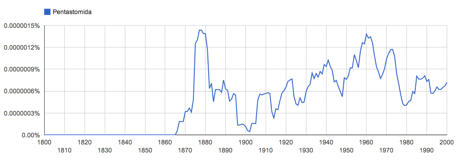
For example, the name widely used name Pentastomida itself was widely attributed to Diesing, 1836, but the word did not appear in the literature until 1905.


A quick check of Google Ngrams shows this to be simply false:

Pentastomida

I don't need taxonomic expertise to see this, I simply need decent text indexing. So, if you have a list of names, you have something that it will soon be largely possible to recreate using automated methods (i.e., text mining). With a little sophistication we could mine the literature for further details, such as synonymy, etc. Annotation and clarification of a few "edge cases" where things get tricky will always be needed, but if you want to argue that your lists deserves "Attribution, Rights and Licensing" then you fail to realise that your list is going to be increasing easy to recreate simply by crawling the web.

It seems to me that most taxonomic databases are little more than digitised 5x3 index cards, and lack any details on the provenance of the names they contain. They often don't have links to the primary literature, and if they do cite that literature they typically do so in a way that makes it hard to find the actual publication. I once gave a talk which included the slide below showing taxonomic databases as being "in the way" between taxonomists and users of taxonomic information:

Users

In the old days building taxonomic databases required expertise and access to obscure, hard to find, physical literature. A catalogue of names was a way to summarise that information (since we couldn't share access). Now we are in an age where more and more primary taxonomic information is available to all, which removes most of the rationale for taxonomic databases. Users can go directly to taxonomic information themselves, which mean they can get the "good stuff", and maybe even cite it (giving us provenance and credit, which I regard as basically the same thing). In many ways taxonomic databases are transitional phenomena (like phone directories, remember those), and one could argue are now in the way of the taxonomists' Holy Grail, getting their work cited.

Lastly, any discussion of "Attribution, Rights and Licensing of names and compilations of names" reflects one of the great self inflicted wounds of biodiversity informatics, namely the reluctance to freely share data. As we speak terrabytes of genomics data are whizzing around the planet, people are downloading entire copies of GenBank and creating new databases. All of this without people fussing over "Attribution, Rights and Licensing." It's time for taxonomic databases to get over themselves and focus on making biodiversity data as accessible and available as genomics data.

Thursday, February 21, 2013

Why are botanists locking away their data in JSTOR Plant Science?

Goet008353Somehow I get the feeling that botanists haven't got the "open data" religion. Not only is the list of plant names list behind a really bad license, but the Global Plants Initiative (GPI) hides its type images behind a JSTOR Plant Sciences paywall. Why is botany determined to keep its data under wraps?

For example, the first specimen on the JSTOR site is the GOET008353, the isotype of Aa achalensis Schltr.. You can see a thumbnail of the specimen (shown on the right), but if you want the full image you need to have a subscription, otherwise you see this message:

The resource you are attempting to access is part of JSTOR Plant Science. JSTOR Plant Science is currently being offered free of charge for all JSTOR participants and not for profit institutions. To learn more about JSTOR Plant Science, please contact plants@jstor.org.


So, without a subscription you don't get to see this in high resolution (the JSTOR site features a higher resolution image and associated viewer):

Resolver

Why would herbariums hand over this imagery? I complained about this on Facebook and Chuck Miller responded that the original herbaria retain control over the images, so they aren't locked away. However, I then when to the herbarium that has this specimen (the Type Database of Herbarium Göttingen (GOET) and search for this specimen I eventually find it listed as 4966. There is no image!

So, the only place I can see this image is on JSTOR, for which I need a subscription. I'm also puzzled by the fact that JSTOR refers to this as "GOET008353", whereas the original herbarium refers to it as "4966". GBIF also has this specimen, which it refers to as GOET GOET-Typen 4966. The GOET008353 is a barcode given to types as part of the GPI digitisation programme. Unfortunately, neither the originating herbarium nor GBIF seems to know about this.

In summary, we have three databases with data on this specimen, each with a different specimen identifier, none of which link to each other, and the available imagery is behind a paywall.

Clearly botany hasn't gotten the memo about open data...

Wednesday, December 29, 2010

The Plant List: nice data, shame it's not open

nd.large.pngThe Plant List (http://www.theplantlist.org/) has been released today, complete with glowing press releases. The list includes some 1,040,426 names. I eagerly looked for the Download button, but none is to be found. You can grab download individual search results (say, at family level), but not the whole data set.

OK, so that makes getting the complete data set a little tedious (there are 620 plant families in the data set), but we can still do it without too much hassle (in fact, I've grabbed the complete data set while writing this blog post). Then I see that the data is licensed under a Creative Commons Attribution-NonCommercial-NoDerivs (CC BY-NC-ND) license. Creative Commons is good, right? In this case, not so much. The CC BY-NC-ND license includes the clause:
You may not alter, transform, or build upon this work.
So, you can look but not touch. You can't take this data (properly attributed, or course) and build your own list, for example with references linked to DOIs, or to the Biodiversity Heritage Library (which is, of course, exactly what I plan to do). That's a derivative work, and the creators of the Plant List don't want you to do that. Despite this, the Plant List want us to use the data:
Use of the content (such as the classification, synonymised species checklist, and scientific names) for publications and databases by individuals and organizations for not-for-profit usage is encouraged, on condition that full and precise credit is given to The Plant List and the conditions of the Creative Commons Licence are observed.
Great, but you've pretty much killed that by using BY-NC-ND. Then there's this:
If you wish to use the content on a public portal or webpage you are required to contact The Plant List editors at editors@theplantlist.org to request written permission and to ensure that credits are properly made.
Really? The whole point of Creative Commons is that the permissions are explicit in the license. So, actually I don't need your permission to use the data on a public portal, CC BY-NC-ND gives me permission (but with the crippling limitation that I can't make a derivative work).

So, instead of writing a post congratulating the Royal Botanic Gardens, Kew and Missouri Botanical Garden (MOBOT) for releasing this data, I'm left spluttering in disbelief that they would hamstring its use through such a poor choice of license. Kew and MOBOT could have made the Plant List available as open data using one of the licenses listed on the Open Definition web site, such as putting the data in the public domain (for example, or using a Creative Commons CC0 license). Instead, they've chosen a restrictive license which makes the data closed, effectively killing the possibility for people to build upon the effort they've put into creating the list. Why do biodiversity data providers seem determined to cling to data for dear life, rather than open it up and let people realise its potential?

Saturday, August 28, 2010

On being open: Mendeley and open data versus open source

Paulo Nuin, not the biggest fan of Mendeley wrote a blog post entitled Mendeley is going to be open source, in which he wrote:

After extensively researching some material online, analysing many blog posts and statements made by people linked to Mendeley, checking my sources, I reached the conclusion that soon Mendeley is going to be open source.

Among the essays Paulo read is Jason Hoyt's post on the Mendeley blog: Dear researcher, which side of history will you be on?. In response to a question about open sourcing the Mendeley client, Jason replied:
I get asked a lot about open sourcing Mendeley when I go to speaking events. I always state that we are open to the possibility, but then ask how many people know how to type a URL verus how many know how to program in C++? That’s why we went with the Open API first instead of open sourcing the desktop software. If you can type a URL, which is what the API is based upon, then you can build on top of Mendeley. You don’t need to know how to program.

Despite the fact that open sourcing the desktop client is the second most requested feature for Mendeley, I think Jason is right. I also think Paulo's campaign to make Mendeley open source is misguided. The client doesn't matter. OK, yes, it's probably the reason most people use Mendeley, but there are lots of competing clients (EndNote, Zotero, Papers, etc.), and there are several bibliographic data formats (RIS, EndNote XML, BibTeX) and essentially one document format (PDF) that they support, so individual users don't have to worry about locking their individual bibliographies into a proprietary format. Couple this with the existence of an API (albeit a pretty crap one), and whether an individual software client is closed or open source doesn't matter much.

Will the data be open?

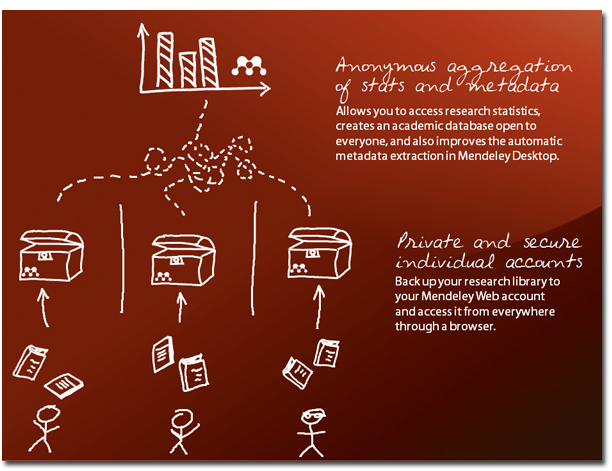
However, what makes Mendeley different is the aggregation of bibliographic data (35 million references and counting).

privacy_1264073462.jpg


I'd argue it's the fate of this aggregation that matters. In a comment on the Guardian's piece Mendeley 'most likely to change the world for the better', Jane Good wrote:
"World-changing potential"? This utopian fantasy stuff is a little much, no? After all, we're talking about a for-profit corporation using closed-source software to monitor private usage habits for monetary gain. And how exactly is this company meant to sustain its millions of dollars of annual burn on a few measly storage subscriptions? At some point the data will have to go up for sale to the highest bidder, plain and simple. The API, as it exists now, does not provide access to that data, and it probably never will, right, DrGinn[sic]?

Toning down the rhetoric, the question is Mendeley, Scopus, Talis – will you be making your data Open?:

But how can a company create an income stream from Open Scientific content? That’s the a question for me for this decade. If we can solve it we can transform the world. If however the linked Open data are all going to be through paywalls, portals, query engines then we regress into the feudal information possession of the past. I hope the companies present in this session can help solve this. It won’t be easy but it has to be done. So I now ask Mendeley, Elsevier/Scopus, Talis: Are your data Openly available for re-use?

For me the question of whether the source code for the Mendeley desktop will be made open source is a red herring, and ultimately a distraction from the real question — will the data be open?