Showing posts with label machine learning. Show all posts

Thursday, August 31, 2023

Document layout analysis

How to cite: Page, R. (2023). Document layout analysis. https://doi.org/10.59350/z574z-dcw92

Some notes to self on document layout analysis.

I’m revisiting the problem of taking a PDF or a scanned document and determining its structure (for example, where is the title, abstract, bibliography, where are the figures and their captions, etc.). There are lots of papers on this topic, and lots of tools. I want something that I can use to process both born-digital PDFs and scanned documents, such as the ABBYY, DjVu and hOCR files on the Internet Archive. PDFs remain the dominant vehicle for publishing taxonomic papers, and aren’t going away any time soon (see Pettifer et al. for a nuanced discussion of PDFs).

There are at least three approaches to document layout analysis.

Rule-based

The simplest approach is to come up rules, such as “if the text is large and it’s on the first page, it’s the title of the article”. Examples of more sophisticated rules are given in Klampfl et al., Ramakrishnan et al., and Lin. Rule-based methods can get you a long way, as shown by projects such as Plazi. But there are always exceptions to rules, and so the rules need constant tweaking. At some point it makes sense to consider probabilistic methods that allow for uncertainty, and which can also “learn”.

Large language models (LLMs)

At the other extreme are Large language models (LLMs), which have got a lot of publicity lately. There are a number of tools that use LLMs to help extract information from documents, such as LayoutLM (Xu et al.), Layout Parser, and VILA (Shen et al.). These approaches encode information about a document (in some case including the (x,y) coordinates of individual words on a page) and try and infer which category each word (or block of text) belongs to. These methods are typically coded in Python, and come with various tools to display regions on pages. I’ve had variable success getting these tools to work (I am new to Python, and am also working on a recent Mac which is not the most widely used hardware for machine learning). I have got other ML tools to work, such as an Inception-based model to classify images (see Adventures in machine learning: iNaturalist, DNA barcodes, and Lepidoptera), but I’ve not succeeded in training these models. There are obscure Python error messages, some involving Hugging Face, and eventually my patience wore out.

Another aspect of these methods is that they often package everything together, such that they take a PDF, use OCR or ML methods such as Detectron to locate blocks, then encode the results and feed them to a model. This is great, but I don’t necessarily want the whole package, I want just some parts of it. Nor does the prospect of lengthy training appeal (even if I could get it to work properly).

The approach that appealed the most is VILA, which doesn’t use (x,y) coordinates directly but instead encodes information about “blocks” into text extracted from a PDF, then uses an LLM to infer document structure. There is a simple demo at Hugging Face. After some experimentation with the code, I’ve ended up using the way VILA represents a document (a JSON file with a series of pages, each with lists of words, their positions, and information on lines, blocks, etc.) as the format for my experiments. If nothing else this means that if I go back to trying to train these models I will have data already prepared in an appropriate format. I’ve also decided to follow VILA’s scheme for labelling words and blocks in a document:

  • Title
  • Author
  • Abstract
  • Keywords
  • Section
  • Paragraph
  • List
  • Bibliography
  • Equation
  • Algorithm
  • Figure
  • Table
  • Caption
  • Header
  • Footer
  • Footnote

I’ve tweaked this slightly by adding two additional tags
from VILA’s Labeling Category Reference, the “semantic” tags “Affiliation” and “Venue”. This helps separate information on author names (“Author”) from their affiliations, which can appear in very different positions to the author’s names. “Venue” is useful to label things such as a banner at the top of an article where the publisher display the name of the journal, etc.

Conditional random fields

In between masses of regular expressions and large language models are approaches such as Conditional random fields (CRFs), which I’ve used before to parse citations (see Citation parsing tool released). Well known tools such as GROBID use this approach.

CRFs are fast, and somewhat comprehensible. But it does require Feature engineering, that is, you need to come up with features of the data to help train the model (for the systematists among you, this is very like coming up with characters for a bunch of taxa). This is were you can reuse the rules developed in a rules-based approach, but instead of having the rules make decisions (e.g., “big text = Title”), you just a rule that detects whether text is big or not, and the model combined with training data then figures out if and when big text means “Title”. So you end up spending time trying to figure out how to represent document structure, and what features help the model get the right answer. For example, methods such as Lin’s for detecting whether there are recurring elements in a document are great source of features to help recognise headers and footers. CRFs also make it straightforward to include dependencies (the “conditional” in the name). For example, a bibliography in a paper can be recognised not just by a line having a year in it (e.g., “2020”), but there being nearby lines that also have years in them. This helps us avoid labelling isolated lines with years as “Bibliography” when they are simply text in a paragraph that mentions a year.

Compared to LLMs this a lot of work. In principle with an LLM you “just” take a lot of training data (e.g., text and location on a page) and let the model to the hard work of figuring out which bit of the document corresponds to which category (e.g., title, abstract, paragraph, bibliography). The underlying model has already been trained on (potentially) vast amounts of text (and sometimes also word coordinates). But on the plus side, training CRFs is very quick, and hence you can experiment with adding or removing features, adding training data, etc. For example, I’ve started training with about ten (10) documents, training takes seconds, and I’ve got serviceable results.

Lots of room for improvement, but there’s a constant feedback loop of seeing improvements, and thinking about how to tweak the features. It also encourages me to think about what went wrong.

Problems with PDF parsing

To process PDFs, especially “born digital” PDFs I rely on pdf2xml, originally written by Hervé Déjean (Xerox Research Centre Europe). It works really well, but I’ve encountered a few issues. Some can be fixed by adding more fonts to my laptop (from XpdfReader), but others are more subtle.

The algorithm used to assign words to “blocks” (e.g., paragraphs) seems to struggle with superscripts (e.g., 1), which often end up being treated as separate blocks. This breaks up lines of text, and also makes it harder to accurately label parts of the document such as “Author” or “Affiliation”.

Figures can also be problematic. Many are simply bitmaps embedded in a PDF and can be easily extracted, but sometimes labelling on those bitmaps, or indeed big chunks of vector diagrams are treated as text, so we end up with story text blocks in odd positions. I need to spend a little time thinking about this as well. I also need to understand the “vet” format pdftoxml extracts from PDFs.

PDFs also have all sorts of quirks, such as publishers slapping cover pages on the front, which make feature engineering hard (the biggest text might now be not be the title but some cruff from the publisher). Sometimes there are clues in the PDF that it has been moodier.! For example, ResearchGate inserts a “rgid” tag in the PDF when it adds a cover page.

Yes but why?

So, why I am doing this? Why battle with the much maligned PDF format. It’s because a huge chunk of taxonomic and other information is locked up in PDFs, and I’d like a simpler, scalable, way to extract some of that. Plazi is obviously the leader in this are in terms of the amount of information they have extracted, but their approach is labour-intensive. I want something that is essentially automatic, that can be trained to handle the idiosyncracities of the taxonomic literature, and can be applied to both born digital PDFs and OCR from scans in the Biodiversity Heritage Library and elsewhere. Even if we could simply extract bibliographic information (to flesh out the citation graph) and the figures, that would be progress.

References

Déjean H, Meunier J-L (2006) A System for Converting PDF Documents into Structured XML Format. In: Bunke H, Spitz AL (eds) Document Analysis Systems VII. Springer, Berlin, Heidelberg, pp 129–140 https://doi.org/10.1007/11669487_12

Klampfl S, Granitzer M, Jack K, Kern R (2014) Unsupervised document structure analysis of digital scientific articles. Int J Digit Libr 14(3):83–99. https://doi.org/10.1007/s00799-014-0115-1

Lin X (2003) Header and footer extraction by page association. In: Document Recognition and Retrieval X. SPIE, pp 164–171 https://doi.org/10.1117/12.472833

Pettifer S, McDERMOTT P, Marsh J, Thorne D, Villeger A, Attwood TK (2011) Ceci n’est pas un hamburger: modelling and representing the scholarly article. Learned Publishing 24(3):207–220. https://doi.org/10.1087/20110309

Ramakrishnan C, Patnia A, Hovy E, Burns GA (2012) Layout-aware text extraction from full-text PDF of scientific articles. Source Code for Biology and Medicine 7(1):7. https://doi.org/10.1186/1751-0473-7-7

Shen Z, Lo K, Wang LL, Kuehl B, Weld DS, Downey D (2022) VILA: Improving Structured Content Extraction from Scientific PDFs Using Visual Layout Groups. Transactions of the Association for Computational Linguistics 10:376–392. https://doi.org/10.1162/tacl_a_00466

Xu Y, Li M, Cui L, Huang S, Wei F, Zhou M (2020) LayoutLM: Pre-training of Text and Layout for Document Image Understanding. In: Proceedings of the 26th ACM SIGKDD International Conference on Knowledge Discovery & Data Mining. pp 1192–1200

Written with StackEdit.

Thursday, July 22, 2021

Citation parsing tool released

Quick note on a tool I've been working on to parse citations, that is to take a series of strings such as:

  • Möllendorff O (1894) On a collection of land-shells from the Samui Islands, Gulf of Siam. Proceedings of the Zoological Society of London, 1894: 146–156.
  • de Morgan J (1885) Mollusques terrestres & fluviatiles du royaume de Pérak et des pays voisins (Presqúile Malaise). Bulletin de la Société Zoologique de France, 10: 353–249.
  • Morlet L (1889) Catalogue des coquilles recueillies, par M. Pavie dans le Cambodge et le Royaume de Siam, et description ďespèces nouvelles (1). Journal de Conchyliologie, 37: 121–199.
  • Naggs F (1997) William Benson and the early study of land snails in British India and Ceylon. Archives of Natural History, 24:37–88.

and return structured data. This is an old problem, and pretty much a "solved" problem. See for example AnyStyle. I've played with AnyStyle and it's great, but I had to install it on my computer rather than simply use it as a web service. I also wanted to explore the approach a bit more as a possible a model for finding citations of specimens.

After trying to install the underlying conditional random fields (CRF) engine used by AnyStyle and running into a bunch of errors, I switched to a tool I could get working, namely CRF++. After figuring out how to compiling a C++ application to run on Heroku I started to wonder how to use this as the basis of a citation parser. Fortunately, I had used the Perl-based ParsCit years ago, and managed to convert the relevant bits to PHP and build a simple web service around it.

Although I've abandoned the Ruby-based AnyStyle I do use AnyStyle's XML format for the training data. I also built a crude editor to create small training data sets that uses a technique published by the author of the blogging tool I'm using to write this post (see MarsEdit Live Source Preview). Typically I use this to correctly annotate examples where the parser failed. Over time I add these to the training data and the performance gets better.

This is pretty much a side project or a side project, but ultimately the goal is to employ it to help extract citation data from publications, both to generate data to populate (BioStor), and also start to flesh out the citation graph for publications in Wikidata.

If you want to play with the tool it is at https://citation-parser.herokuapp.com. At the moment it takes some citation strings and returns the result in CSL-JSON, which is becoming the default way to represent structured bibliographic data. Code is on GitHub.

Friday, May 28, 2021

Finding citations of specimens

Note to self.

The challenge of finding specimen citations in papers keeps coming around. It seems that this is basically the same problem as finding citations to papers, and can be approached in much the same way.

If you want to build a database of reference from scratch, one way is to scrape citations from papers (e.g., from the "literature cited" section), convert those strings into structured data, and add those to your database. In the early days of bibliographic searching this was a common strategy (and I still use it to help populate Wikidata).

Regular expressions are powerful but also brittle, you need to keep tweaking them to accommodate all the minor ways citation styles can differ. This leads to more sophisticated (and hopefully robust) approaches, such as machine learning. Conditional random fields (CRF) are a popular technique, pioneered by tools like Parscite and most recently used in the very elegant anystyle.io. You paste in a citation string and you get back that citation with all the component parts (authors, title, journal, pagination, etc.) separated out. Approaches like this require training data to teach the parser how to recognise the parts of a citation string. One obvious way to generate training data is to have a large bibliographic database, a set of "style sheets" describing all the ways different journals represent citations (e.g., citationstyles.org), and then you can generate lots of training data.

Over time the need for citation parsing has declined somewhat, being replaced by simple fulltext search (exemplified by this Tweet);

Again, in the early days a common method of bibliographic search was to search by keys such as journal name (or ISSN), volume number, and starting page. So you had to atomise the reference into its parts, then search for something that matched those parts. This is tedious (OpenURL anyone?), but helps reduce false matches. If you only have a small bibliographic database searching for reference by string matching can be frustrating because you are likely to get lots of matches, but none of them to the reference you are actually looking for. Given how search works you'll pretty much always get some sort of match. What really helps is if the database has the answer to your search (this is one reason Google is so great, if you have indexed the whole web chances are you have the answer somewhere already). Now that CrossRef's database has grown much larger you can search for a reference using a simple string search and be reasonably confident of getting the a genuine hit. The need to atomise a reference for searching is disappearing.

So, armed with a good database and good search tools we can avoid parsing references. Search also opens up other possibilities, such as finding citations using full text search. Given a reference how do you find where it's been cited? One approach is to parse the text of a reference (A), extract the papers in the "literature cited" section (B, C, D, etc.), match those to a database, and add the "A cites B", "A cites C", etc. links to the database. This will answer "what papers does A cite?" but not "what other papers cite C?". One approach to that question would be to simply take the reference C, convert it to a citation string, then blast through all the full text you could find looking for matches to that citation string - these are likely to be papers that cite reference C. In other words, you are finding that string in the "literature cited" section of the citing papers.

So, to summarise:

  1. To recognise and extract citations as structured data from text we can use regular expressions and/or machine learning.
  2. Training data for machine learning can be generated from existing bibliographic data coupled with rules for generating citation strings.
  3. As bibliographic databases grow in size the need for extracting and parsing citations diminishes. Our databases will have most of the citations already, so that using search is enough to find what we want.
  4. To build a citation database we can parse the literature cited section and extract all references cited by a paper ("X cites")
  5. Another approach to building a citation database is to tackle the reverse question, namely "X is cited by". This can be done by a full text search for citation strings corresponding to X.

How does this relate to citing specimens you ask? Well, I think the parallels are very close:

  • We could use CRF approaches to have something like anystyle.io for specimens. Paste in a specimen from the "Materials examined" section of a paper and have it resolved into its component parts (e.g., collector, locality, date).
  • We have a LOT of training data in the form of GBIF. Just download data in Darwin Core format, apply various rules for how specimens are cited in the literature, and we have our training data.
  • Using our specimen parser we could process the "Materials examined" section of a paper to find the specimens (Plazi extracts specimens from papers, although it's not clear to me how automated this is.)
  • We could also do the reverse: take a Darwin Core Archive for, say, a single institution, generate all the specimen citation strings you'd expect to see people use in their papers, then go search through the full text of papers (e.g., in PubMed Central and BHL) looking for those strings - those are citations of your specimens.

There seems a lot of scope for learning from the experience of people working with bibliographic citations, especially how to build parsers, and the role that "stylesheets" could play in helping to understand how people cite specimens. Obviously, a lot of this would be unnecessary if there was a culture of using and citing persistent identifiers for specimens, but we seem to be a long way from that just yet.

Thursday, July 05, 2018

GBIF at 1 billion - what's next?

How to cite: Page, R. (2018). GBIF at 1 billion - what's next? https://doi.org/10.59350/d8dwz-3v524

GBIF has reached 1 billion occurrences which is, of course, something to celebrate:

An achievement on this scale represents a lot of work by many people over many years, years spent developing simple standards for sharing data, agreeing that sharing is a good thing in the first place, tools to enable sharing, and a place to aggregate all that shared data (GBIF).

So, I asked a question:

My point is not to do this:

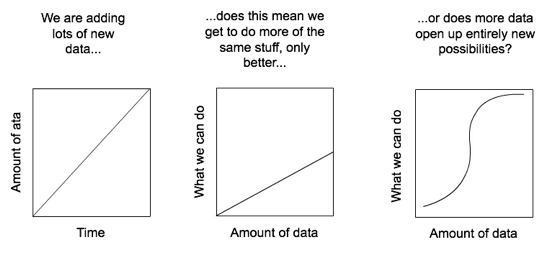
Rather it is to encourage a discussion about what happens when we have large amounts of biodiversity data. Is it the case that as we add data we simply enable more of the same kind of science, only better (e.g., more data for species distribution modelling), or do we reach a point where new things become possible?

Document

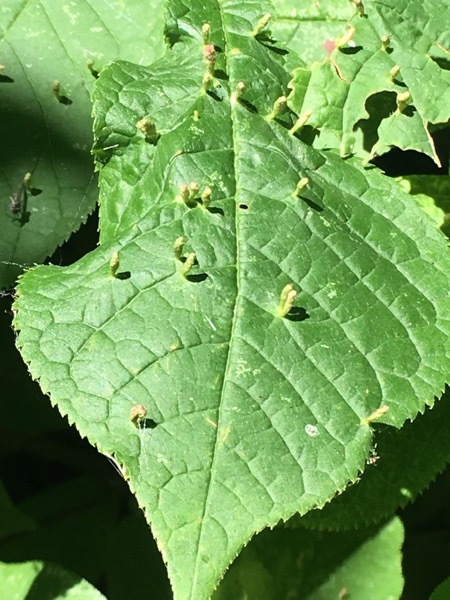
To give a concrete example, consider iNaturalist. This started out as a Masters project to collect photos of organisms on Flickr. As you add more images you get better coverage of biodiversity, but you still have essentially a bunch of pictures. But once you have LOTS of pictures, and those are labelled with species names, you reach the point where it is possible to do something much more exciting - automatic species identification. To illustrate, I recently took the photos below:

Large2 Large

Note the reddish tubular growths on the leaves. I asked iNaturalist to identify these photos and within a few seconds it came back with Eriophyes tiliae, the Red Nail Gall Mite. This feels like magic. It doesn't rely on complicated analysis of the image (as many earlier efforts at automated identification have done) it simply "knows" that images that look like this are typically of the galls of this mite because it has seen many such images before. (Another example of the impact of big data is Google Translate, initially based on parsing lots of examples of the same text in multiple languages.)

The "1 billion" number is not, by itself, meaningful. It's rather that I hope that while we're popping the champagne and celebrating a welcome, if somewhat arbitrary milestone, I'm hoping that someone, somewhere is thinking about whether biodiversity data on this scale enables something new.

Do I have answers? Not really, but here's one fairly small-scale example. One of the big challenges facing GBIF is getting georeferenced data. We spend a lot of time using a variety of tools and databases to convert text descriptions one collection localities into latitude and longitude. Many of these descriptions include phrases such as "5 mi NW of" and so we've developed parsers to attempt to make sense of these. All of these phrases and the corresponding latitude and longitude coordinates have ended up in GBIF. Now, this raises the possibility that after a point, pretty much any locality phrase will be in GBIF, so a way to georeference a locality is simply to search GBIF for that locality and use the associated latitude and longitude. GBIF itself becomes the single best tool to georeference specimen data. To explore this idea I've built a simple tool on glitch https://lyrical-money.glitch.me that takes a locality description and geocodes it using GBIF.

Screenshot 2018 07 05 07 32

You paste in a locality string and it attempt to find that on a map based on data in GBIF. This could be automated, so you could imagine being able to georeference whole collections as part of the process of uploading the data to GBIF. Yes, the devil is in the details, and we'd need ways to flag errors or doubtful records, but the scale of GBIF starts of open up possibilities like this.

So, my question is, "what's next?".

Tuesday, August 04, 2015

Possible project: extract taxonomic classification from tags (folksonomy)

Note to self about a possible project. This PLoS ONE paper:

Tibély, G., Pollner, P., Vicsek, T., & Palla, G. (2013, December 31). Extracting Tag Hierarchies. (P. Csermely, Ed.)PLoS ONE. Public Library of Science (PLoS). http://doi.org/10.1371/journal.pone.0084133
describes a method for inferring a hierarchy from a set of tags (and cites related work that is of interest). I've grabbed the code and data from http://hiertags-beta.elte.hu/home/ and put it on GitHub.

Possible project

Use Tibély et al. method (or others) on taxonomic names extracted from BHL text (or other) and see if we can reconstruct taxonomic classifications. ow do classifications compare to those in databases? Can we enhance existing databases using this technique (e.g., extract classifications from literature for groups pporly represented in existing databases)? Could be part of larger study of what we can learn from co-occurrence of taxonomic names, e.g. Automatically extracting possible taxonomic synonyms from the literature.

Note to anyone reading this: if this project sounds interesting, by all means feel free to do it. These are just notes about things that I think would be fun/interesting/useful to do.