Showing posts with label pagerank. Show all posts

Sunday, February 06, 2011

Why is the Atlas of Living Australia is invisible to Google?

Jeff Atwood, one of the co-founders of Stack Overflow recently wrote a blog post Trouble In the House of Google, where he noted that several sites that scrape Stack Overflow content (which Stack Overflow's CC-BY-SA license permits) appear higher in Google's search rankings than the original Stack Overflow pages. When Stack Overflow chose the CC-BY-SA license they made the assumption that:
...that we, as the canonical source for the original questions and answers, would always rank first...That's why Joel Spolsky and I were confident in sharing content back to the community with almost no reservations – because Google mercilessly penalizes sites that attempt to game the system by unfairly profiting on copied content.
Jeff Atwood's post goes on to argue that something is wrong with the way Google is ranking sites that derive content from other sites.

I was reminded of this post when I started to notice that searches for fairly obscure Australian animals would often return my own web site Australian Faunal Directory on CouchDB as the first hit. In one sense this is personally gratifying, but it can also be frustrating because when I Google these obscure taxa it's usually because I'm trying to find data that isn't already in one of my projects.

unotata.pic1.JPGBut what I've also noticed is that the site that I obtained the data from, Australian Faunal Directory (AFD), rarely appears in the Google search results. In fact, there are taxa for which Google doesn't find the corresponding page in AFD. For example, if you search for Uxantis notata (shown here in an image from the Key to the planthoppers of Australia and New Zealand) the first hit(s) are from my version of AFD:
Snapshot 2011-02-06 14-05-44.png


Neither the original AFD, nor the Atlas of Living Australia (ALA), which also builds on AFD, appear in the top 10 hits.

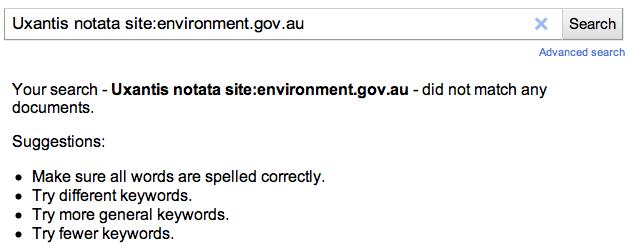
Initially I though this is probably an artefact. This is a pretty obscure taxon, maybe things like rounding error in computing PageRank are going to affect search rankings more than anything else. However, if I explicitly tell Google to search for Uxantis notata in the domain environment.gov.au I get no hits whatsoever:
Snapshot 2011-02-06 14-10-32.png

Likewise, the same search restricted to ala.org.au finds nothing, nothing at all. Both AFD and Atlas of Living Australia have pages for this taxon, here, and here, so clearly something is deeply wrong.

Why are the original providers of the data not appearing in Google search results at all? For someone like me who argues that sharing data is a good thing, and sites that aggregate and repurpose data will ultimately benefit the original data providers (for example by sending traffic and Google Juice) this is somewhat worrying. It seems to reinforce the fear that many data providers have: "if I share my data someone will make a better web site than mine and people will go to that web site, rather than the one I've created with my hard-won data." It may well be that data aggregators will score higher than data providers in Google searches, but I hadn't expected data providers to be virtually invisible.

atlasaustraliasm.gifGoogle isn't the problem
If a web site that I hacked together in a few days does better in Google searches than the rather richer pages published by sites such as ALA (with a budget of over $AU 30 million), something is wrong. Unlike the Stack Overflow example discussed above, I don't think the problem here is with Google.
If we search in Google for an "iconic" Australian taxon by name, say the Koala Phascolarctos cinereus, Wikipedia is the first hit (which should be no surprise). ALA doesn't appear in the top ten. If we tell Google to just search the domain ala.org.au we get lots of pages from ALA, but not the actual species page for Phascolarctos cinereus. This suggests that there is something about the way ALA's website works that prevents Google indexing it properly. I'm also a little worried that a major biodiversity project which has as its aim
...to improve access to essential information on Australia’s biodiversity
is effectively invisible to Google.


Saturday, July 05, 2008

Charting taxonomic knowledge

Nice paper by Robert Huber and Jens Klump has appeared in Computers & Geosciences entitled "Charting taxonomic knowledge through ontologies and ranking algorithms" (doi:10.1016/j.cageo.2008.02.016). The paper is not open access, but you can get some background from the post How TaxonRank works. Here's the abstract.

Since the inception of geology as a modern science, paleontologists have described a large number of fossil species. This makes fossilized organisms an important tool in the study of stratigraphy and past environments. Since taxonomic classifications of organisms, and thereby their names, change frequently, the correct application of this tool requires taxonomic expertise in finding correct synonyms for a given species name. Much of this taxonomic information has already been published in journals and books where it is compiled in carefully prepared synonymy lists. Because this information is scattered throughout the paleontological literature, it is difficult to find and sometimes not accessible. Also, taxonomic information in the literature is often difficult to interpret for non-taxonomists looking for taxonomic synonymies as part of their research.

The highly formalized structure makes Open Nomenclature synonymy lists ideally suited for computer aided identification of taxonomic synonyms. Because a synonymy list is a list of citations related to a taxon name, its bibliographic nature allows the application of bibliometric techniques to calculate the impact of synonymies and taxonomic concepts. TaxonRank is a ranking algorithm based on bibliometric analysis and Internet page ranking algorithms. TaxonRank uses published synonymy list data stored in TaxonConcept, a taxonomic information system. The basic ranking algorithm has been modified to include a measure of confidence on species identification based on the Open Nomenclature notation used in synonymy list, as well as other synonymy specific criteria.

The results of our experiments show that the output of the proposed ranking algorithm gives a good estimate of the impact a published taxonomic concept has on the taxonomic opinions in the geological community. Also, our results show that treating taxonomic synonymies as part of on an ontology is a way to record and manage taxonomic knowledge, and thus contribute to the preservation our scientific heritage.

Thursday, March 06, 2008

PageRank for biodiversity

This will probably tempt fate, but I've an invited manuscript in review for Briefings in Bioinformatics on the topic of identifiers in biodiversity informatics. Readers of this blog will find much of it familiar (DOis, LSIDs, etc.). For fun I constructed a graph for three ant specimens of Probolomyrmex tani, and the images, DNA sequences, and publications that link to these specimens.

Based on this graph I computed the PageRank of each specimen. The motivation for this exercise is that AntWeb lists 43 specimens of this species, in alphabetical order. This is arbitrary. What if we could order them by their "importance"? One way to do this is based on how many times the specimens have been sequenced, photographed, or cited in scientific papers. This gives us a metric for ordering lists of specimens, as well as demonstrating the "value" of a collection (based on people actually using it in their work). I think there is considerable scope for applying PageRank-like ideas to questions in biodiversity informatics. Robert Huber has an intriguing post on TaxonRank that explores this idea further.

Monday, February 04, 2008

Incomplete citation and ranking

Came across the paper "Using incomplete citation data for MEDLINE results ranking" (pmid:16779053, fulltext available in PMC .The authors applied PageRank (the algorithm Google use to rank search results) to papers in MEDLINE and found that PageRank is robust to information loss. In other words, even if a citation database is incomplete it will do a good job of ranking results. This is encouraging, as I'm keen to use this approach to rank both papers and other objects (e.g., sequences and specimens), and will almost certainly never have a complete citation list.