Showing posts with label ITIS. Show all posts

Monday, June 18, 2012

Fictional taxa

Anyone who works with taxonomic databases is aware of the fact that they have errors. Some taxonomic databases are restricted in scope to a particular taxon in which one or more people have expertise, these then get aggregated into larger databases, which may in turn be aggregated by databases whose scope is global. One consequence of this is that errors in one database can be propagated through many other databases.

As an example (for reasons I can't remember), I came across the name "Panisopus" (in the water mote family Thyasidae) but was struggling to find any mention of the taxonomic literature associated with this name. If you Google Panisopus the first two pages are full of search results from ITIS, EOL, GBIF, ZipCodeZoo, all listing several species in the genus, and sometimes taxonomic authorities, but no links to the primary literature. If you search BHL for Panisopus you get nothing, nothing at all. It's as if the name didn't exist.

Turns out, that's exactly the point. The name doesn't exist, other than in the various databases that have consumed other databases and recycled this fictional taxon. After some Googling of author's names it became clear that "Panisopus" is probably a misspelling of "Panisopsis", which according to ION was published in:

Viets, K. (1926) Eine nomenklatorische Aenderung im Hydracarinen-Genus Thyas C. L. Koch. Zool Anz Leipzig, 66: 145--148

I can't verify this because this article is not available online. But to give one example, ITIS lists the name "Panisopus pedunculata Keonike, 1895" (TSN 83185). This name should be, as far as I can tell, Panisopsis pedunculata (Koenike, 1895), based on Mitchell, 1954 (http://biostor.org/reference/104266, http://dx.doi.org/10.5962/bhl.title.3110) who on page 36 states:
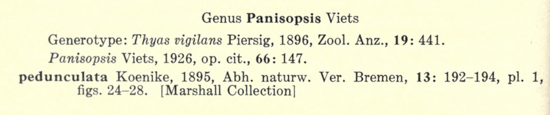
Mitchell

Note that Panisopsis pedunculata was originally described in a different genus (Koenike 1895 preceeds the publication of the genus name by Viets in 1926). We can locate Koenike's original publication "Nordamerikanische Hydrachniden" in BHL, which I've added to BioStor http://biostor.org/reference/104265, and the original description appears on p. 192 as Thyas pedunculata (note that ITIS misspells the author's name Koenike [o and e transposed], as well as omitting the parentheses around the name).

What I find a little alarming (if not surprising) is that the entirely fictional genus "Panisopus" its accompanying species have ended up in numerous taxonomic databases, and these databases consistently appear in the top Google searches for this name. The good news is that it's becoming increasingly easy to discover these errors, in part because more and more taxonomic literature is coming online, making it possible for users to investigate matters for themselves, rather than rely on unsupported statements in taxonomic databases. I'm continually amazed by how little evidence most taxonomic databases provide for any of the assertions that they make. If a database includes a name, I want some evidence that the name is "real". Show me the publication, or at least give me a citation that I can follow up. I can't take these databases on blind faith, because demonstrably they are replete with errors. Ironically, one measure of success in the Internet age is being in the top 10 hits for a Google search. Now, if the top ten hits are all taxonomic databases I get very, very nervous. It's a good sign the name only exists in those databases.

Tuesday, August 26, 2008

Perceptive Pixel Taxonomy Demo


Found this while Googling. Demo by Perceptive Pixel of browsing the ITIS classification using their multi-touch technology. I want one...

Thursday, May 10, 2007

ITIS and DOIs


Following on from my earlier grumble about how the catalogue of Life handles literature, I've spent an afternoon mapping publications in the "itis".publications table in a copy of ITIS to external GUIDs, such as DOIs, Handles, and SICIs in JSTOR. The mapping is not complete by any means, but gives an idea of how many publications have GUIDs.You can view the mapping here. Many of the publications in ITIS are books, which don't have DOIs. A lot of the literature is also old (although this doesn't always mean it won't have a DOI).

Of 4296 records, 324 have DOIs (around 7.5%). Not a lot, but a still a reasonable chunk. At least 700 of the ITIS publications are books (based on having an ISBN), so the percentage is a little higher.

The point of this exercise (following on from my comments on the design flaw in the catalogue of life), is that I think taxonomic databases need to use GUIDs internally to maximise their stability and utility.

Indeed, this is another reason to be disappointed with ZooBank. In addition to a poor way to navigate trees (which prompted me to explore tools such PygmyBrowse), ZooBank does exactly what ITIS and the Catalogue of Life do when it comes to displaying literature -- it displays a text citation (albeit with an invitation to view that record in Zoological Record, a subscription-based service).

For example, the copepod Nitocrellopsis texana was described in ITIS publication 3072, which I've discovered has the the DOI doi:10.1023/A:1003892200897. Given a DOI we have a GUID for the publication, and a direct link to it. In contrast, ZooBank merely gives us:
Nitocrellopsis texana n. sp. from central TX (U.S.A.) and N. ahaggarensis n. sp. from the central Algerian Sahara (Copepoda, Harpacticoida). Hydrobiologia 418 (1-3) 15 January: 82

and a link to Zoological Record. Interesting, even with the resources of ISI behind it, the Zoological Record result doesn't have the DOI.

This for me is one reason ZooBank was so disappointing, it actually provided little of value.

What next? Well, with the 300 or so references mapped to DOIs, one could link those to the ITIS records for the corresponding taxonomic names, and serve these up through somehting like iSpecies, for example. These would be links to the literature, in many cases original descriptions, to supplement the other literature found by iSpecies.