Showing posts with label ZooKeys. Show all posts

Wednesday, January 13, 2016

Surfacing the deep data of taxonomy

My paper "Surfacing the deep data of taxonomy" (based on a presentation I gave in 2011) has appeared in print as part to a special issue of Zookeys:

Page, R. (2016, January 7). Surfacing the deep data of taxonomy. ZooKeys. Pensoft Publishers. http://doi.org/10.3897/zookeys.550.9293
The manuscript was written shortly after the talk, but as is the nature of edited volumes it's taken a while to appear.

My tweet about the paper sparked some interesting comments from David Shorthouse.

This is an appealing vision, because it seems unlikely that having multiple, small communities clustered around taxa will ever have the impact that taxonomists might like to have. Perhaps if we switch to focussing on objects (sequences, specimens, papers), notions of identity (e.g., DOIs, ORCID), and alternative measures of impact we can increase the visibility and perceived importance of the field. In this context, the recent paper "Wikiometrics: A Wikipedia Based Ranking System" http://arxiv.org/abs/1601.01058 looks interesting. A big consideration will be how connected is the network connecting taxonomists, papers, sequences, specimens, and names. If it's anything like the network of readers in Mendeley then we may face some challenges in community building around such a network.

Wednesday, November 06, 2013

ZooKeys, GBIF, and GitHub: fixing Darwin Core Archives part 2

Here's another example of a Darwin Core Archive that is "broken" such that GBIF is missing some information. GBIF data set A checklist to the wasps of Peru (Hymenoptera, Aculeata) comes from Pensoft, and corresponds to the paper:
Rasmussen, C., & Asenjo, A. (2009). A checklist to the wasps of Peru (Hymenoptera, Aculeata). ZooKeys, 15(0). doi:10.3897/zookeys.15.196

As with the previous example GBIF says there are 0 georeferenced records in this dataset. This is odd, because the ZooKeys page for this article lists three supplementary files, including KML files for Google Earth. I've used one to create the image below:

GoogleEarth Image

So, clearly there is georeferenced data here. Looking at the Darwin Core Archive (which I've put on GitHub there are a bunch of issues with this data. The occurrence.txt file has decimal latitude and longitude values with a comma rather than a decimal point, the file has some character encoding issues, and the columns with latitude and longitude data are labelled as "verbatim" fields not "decimal" fields. All of this means GBIF lacks all the point data for this dataset (over 2000 records). If we fix these problems, we get a map like this:


This illustrates one problem with publishing data, namely the data is rarely checked in the same way a manuscript is. Peer-review of data is a phrase that always struck me as odd, because you only get to be able to evaluate a data set by using it. In other words, data almost demands post- rather than pre-publication review. It's only when people start trying to use the data that problems emerge.

At the same time, we could improve checking of data prior to publication. In the case of the Darwin Core Archives I've looked at so far, it would be easier to find the problems if we had a simple tool that could take a Darwin Core Archive, extract the information and display it in various ways. If, for example, we have georeferenced records but we don't get a map, we would immediate wonder why that was, and figure out what the problem was. At the moment it seems easy to send data to GBIF, thinking you are contributing important information, whereas in fact that information never makes it onto a GBIF map.

Wednesday, July 17, 2013

Augmenting ZooKeys bibliographic data to flesh out the citation graph

Zookeys logoIn a previous post (Learning from eLife: GitHub as an article repository) I discussed the advantages of an Open Access journal putting its article XML in a version-controlled repository like GitHub. In response to that post Pensoft (the publisher of ZooKeys) did exactly that, and the XML is available at https://github.com/pensoft/ZooKeys-xml.

OK, "now what?" I hear you ask. Originally I'd used the example of incorrect bibliographic data for citations as the motivation, but there are other things we can do as well. For example, when reading a ZooKeys article (say, using my eLife Lens-inspired viewer) I notice references that should have a DOI but which don't. With the XML available I could add this. This adds another link in the citation graph (in this case connecting the ZooKeys paper with the article it cites). If Pensoft were to use that XML to regenerate the HTML version of the article on their web site then the reader will be able to click on the DOI and read the cited article (instead of the "cut-and-paste-and-Google-it" dance). Furthermore, Pensoft could update the metadata they've submitted to CrossRef, so that CrossRef knows that the reference with the newly added DOI has been cited by the ZooKeys paper.

To experiment with this I've written some scripts that take ZooKeys XML, extract each citation from the list of literature cited, and look up DOIs for each reference that lacks them (using the CrossRef metadata search API). If a DOI is found then I insert it into the original XML. I then push this XML to my fork of Pensoft's repository (https://github.com/rdmpage/ZooKeys-xml). I can then ask Pensoft to update their repository (by issuing a "pull request"), and if Pensoft like what they see, they can accept my edits.

Automating the process makes this much more scalable, although manual editing will still be useful in some cases, especially where the original references haven't been correctly atomised into title, journal, etc.

So that the output is visible independently of Pensoft deciding whether to accept it, I've updated my Zookeys article viewer to fetch the XML not from the ZooKeys web site, but from my GitHub repository. This means you get the latest version of the XML, complete with additional DOIs (if any have been added).

Initial experiments are encouraging, but it's also apparent that lots of citations lack DOIs. However, this doesn't mean that they aren't online. Indeed, a growing number of articles are available through my BioStor repository, and through BioNames. Both of these sites have an API, so the next step is to add them to the script that augments the XML. This brings us a little closer to the ultimate goal of having every taxonomic paper online and linked to every paper that either cites, or is cited by, that paper.

Friday, July 12, 2013

Learning from eLife: GitHub as an article repository

Playing with my eLife Lens-inspired article viewer and some recent articles from ZooKeys I regularly come across articles that are incorrectly marked up. As a quick reminder, my viewer takes the DOI for a ZooKeys article (just append it to http://bionames.org/labs/zookeys-viewer/?doi=, e.g. http://bionames.org/labs/zookeys-viewer/?doi=10.3897/zookeys.316.5132), fetches the corresponding XML and displays the article.

Taking the article above as an example, I was browsing the list of literature cited and trying to find those articles in BioNames or BioStor. Sometimes an article that should have been found wasn't, and on closer investigation the problem was that the ZooKeys XML has mangled the citation. To illustrate, take the following XML:

<ref id="B112"><mixed-citation xlink:type="simple"><person-group><name name-style="western"><surname>Tschorsnig</surname> <given-names>HP</given-names></name><name name-style="western"><surname>Herting</surname> <given-names>B</given-names></name></person-group> (<year>1994</year>) <article-title>Die Raupenfliegen (Diptera: Tachinidae) Mitteleuropas: Bestimmungstabellen und Angaben zur Verbreitung und Ökologie der einzelnen Arten. Stuttgarter Beiträge zur Naturkunde.</article-title> <source>Serie A (Biologie)</source> <volume>506</volume>: <fpage>1</fpage>-<lpage>170</lpage>.</mixed-citation></ref>

I've highlighted the contents of the article-title (title) and source (journal) tags, respectively. Unfortunately the actual title and journal should look like this:

<ref id="B112"><mixed-citation xlink:type="simple"><person-group><name name-style="western"><surname>Tschorsnig</surname> <given-names>HP</given-names></name><name name-style="western"><surname>Herting</surname> <given-names>B</given-names></name></person-group> (<year>1994</year>) <article-title>Die Raupenfliegen (Diptera: Tachinidae) Mitteleuropas: Bestimmungstabellen und Angaben zur Verbreitung und Ökologie der einzelnen Arten. Stuttgarter Beiträge zur Naturkunde.</article-title> <source>Serie A (Biologie)</source> <volume>506</volume>: <fpage>1</fpage>-<lpage>170</lpage>.</mixed-citation></ref>

Tools to find articles that rely on accurately parsed metadata, such as OpenURL, will fail in cases like this. Of course, we could use tools that don't have this requirement, but we could also fix the XML so that OpenURL resolves will succeed.

This is where the example of the journal eLife comes in. They deposit article XML in GitHub where anyone can grab it and mess with it. Let's imagine we did the same for ZooKeys, created a GitHub repository for the XML, and then edited it in cases where the article metadata is clearly broken. A viewer like mine could then fetch the XML, not from ZooKeys, but from GitHub, and thus take advantage of any corrections made.

We could imagine this as part of a broader workflow that would also incorporate other sources of articles, such as BHL. We could envisage workflows that take BHL scans, convert them to editable XML, then repurpose that content (see BHL to PDF workflow for a sketch). I like the idea that there is considerable overlap between the most recent publishing ventures (such as eLife and ZooKeys) and the goal of bringing biodiversity legacy literature to life.

Wednesday, June 19, 2013

A new way to view taxonomic publications

One of goals of BioNames is to be more than simply another taxonomic database. In particular, I'm interested in the idea of having a platform for viewing taxonomic publications. One way to think about this is to consider the experience of viewing Wikipedia. For any given page in Wikipedia there will be links to other, related content in Wikipedia. Reading an article about a city, you can go and read about the country the city occurs in. Reading about a battle, you can discover more about the generals who fought it. The ability to discover all this interconnected information in one place is compelling.

I'd like something similar for taxonomy. Given that a taxonomic database is in essence a collection of taxonomic names and publications, and a taxonomic publication is in essence a collection of names and citations of taxonomic publications, why not embed the publication within the database and have the names and citations link to the corresponding entries in the database?

Based on some earlier efforts (e.g., Towards an interactive taxonomic article: displaying an article from ZooKeys) and inspired by the eLife Lens project, I've created a live demo of a way to view articles from the journal ZooKeys. Below is a screencast:


If you want to try this out, here are some live examples:

Note the pattern in the URL, just append the DOI for an article to http://bionames.org/labs/zookeys-viewer/?doi=

Everything is a bit rough, but it's working well enough for you to get the basic idea. Code is in github Essentially the viewer grabs the ZooKeys HTML, extracts the URL for the XML file, fetches that, then uses some XSLT style sheets to convert the XML into something viewable. There's a sprinkling of Javascript to call the BioNames API. Much of the code could be tweaked to accepted other NLM XML-based articles, such as content from PLoS and the BMC journals.

One direction this could go in is to make a viewer like this the default viewer in BioNames for ZooKeys articles, so that instead of being restricted to a PDF you can interactively navigate between the article and the cited literature. Indeed, the very action of locating cited references in BioNames builds citation links. We could imagine extending the approach to content that isn't in NLM XML, such as Zootaxa PDFs, or content from BHL. Eventually I'd like to have the taxonomic literature fully embedded in the database, not as PDF or image silos, but as documents linked to names and literature. The journal becomes a database.

Monday, June 03, 2013

BioNames and altmetrics

One consequence of having a database of literature with external identifiers such as DOIs is that we can plug into a bunch of external services to get additional information about a reference. For example, altmetric can take a DOI and display some article level metrics. As an experiment I've added code for altmetric badges to the web page in BioNames that displays publications. For example, here is the ZooKeys paper "An extraordinary new family of spiders from caves in the Pacific Northwest (Araneae, Trogloraptoridae, new family)" in BioNames:

Altmetric

The "About" tab displays the altmetric badge with a bunch of metrics of engagement with this paper. If you click on the badge you get more details about what people have been saying about this paper.

It would be great to explore this across the complete set of taxonomic papers so that we could get a sense the degree of engagement people have with the latest taxonomic literature.

Thursday, May 02, 2013

GBIF data quality: visualising Mesibov's millipedes


Bob Mesibov (who has been a guest author on this blog) recently published a paper on data quality in in ZooKeys:

Mesibov, R. (2013). A specialist’s audit of aggregated occurrence records. ZooKeys, 293(0), 1–18. doi:10.3897/zookeys.293.5111

In this paper Bob documents some significant discrepancies between data in his
Millipedes of Australia (MoA) database and the equivalent data in the Atlas of Living Australia and GBIF (disclosure, I was a reviewer of the paper, and also sit on GBIF's science committee). This paper spawned a thread on TAXACOM, and also came up at the GBIF meeting I was at earlier this week.

One thing lacking from the discussion is a clear sense of just how big are the discrepancies between GBIF and MoA data, so I grabbed the data provided by Bob (http://dx.doi.org/10.3897/zookeys.293.5111.app and extracted the records where GBIF and MoA disagreed. I converted these to GeoJSON and threw them on Google Maps:

Mesibov2

You can see a live version here http://bl.ocks.org/rdmpage/raw/5501293/ (it can take a little while for the map to appear). I've connected the MoA and GBIF localities for the same occurrence by a straight line, and the the MoA records are encircled by an estimate of their uncertainty (for many records the circle is invisible at this scale).

There are some fairly spectacular discrepancies, and a lot of relatively small scale displacements of records. Does this matter? The answer to this question will depend on what people want to do with the data. You may regard the discrepancies as serious (certainly it's interesting that there are so many differences between the two data sets), or minor given the geographic scale. But visualising them at least makes it possible to form a judgement.

Monday, December 19, 2011

Towards an interactive taxonomic article: displaying an article from ZooKeys

One of the things I keep revisiting is the way we display scientific articles. Apart from Nature's excellent iPhone and iPad apps, most efforts to re-imagine how we display articles are little more than glorified PDF viewers (e.g., the PLoS iPad app).

Part of the challenge is that if we make the article more interactive we immediately confront the problem of how to link to other content. For example, we may have a lovingly crafted ePub view (e.g., Nature's apps), but what happens when the user clicks on a citation to another paper? If the paper is published by the same journal, then potentially it could be viewed using the same viewer, but if not then we are at the mercy of the other publisher. They will have their own ideas of how to display articles, so the simplest fallback is to display the cited article in a web browser view. The problem with this is that it breaks the user experience - the other publisher is unlikely to follow the same conventions for displaying an article and its links. If we are lucky the cited article might be published in an Open Access journal that provides, say, XML based on the NLM DTD standard. Knowing whether an article is Open Access or not is not straightforward, and different journals have their own unique interpretation of the NLM standard.

Then there is the issue of other kinds of content, such as taxonomic names, specimens, DNA sequences, geographic localities, etc. We lack decent services for many of these objects, as a result efforts like PLoS Biodiversity Hub end up being underwhelming collections of reformatted journal articles, rather then innovative integrations of biodiversity knowledge.

With these issues in mind I've started playing with ZooKeys XML, initially looking at ways to display the article beyond the conventional format. Ultimately I'd like to embed the article in a broader web of citations and data. ZooKeys articles are available in PDF, HTML, and XML. The HTML has links to taxon pages, maps, etc., which is nice, but I personally find this a little jarring because it interrupts the reading experience. The ZooKeys web site also surrounds the article with all paraphernalia of a publisher's web site:

Zookeys
As a first experiment, I've taken the XML for article At the lower size limit for tetrapods, two new species of the miniaturized frog genus Paedophryne (Anura, Microhylidae) http://dx.doi.org/10.3897/zookeys.154.1963 and used a XSLT style sheet to reformat the article. I've borrowed some ideas from Nature's apps, such as the font for the title, displaying the abstract in bold, and showing all the figures in the article as thumbnails near the top. I've also added some basic interactivity, which you can see in the video below. Instead of figures being in one place in the article, wherever a figure is mentioned in the article (e.g., "Fig. 1") if you click on the reference to the figure it appears. If the article display a point locality using latitude and longitude, instead of launching a separate browser window with a Google map, click on the locality and the map appears. The idea is that the flow of reading isn't interrupted, figures, maps, and citations all appear in the text.


This demo (which you can see live at http://iphylo.org/~rpage/zookeys) is limited, but most of its functionality comes from simply reformatting XML using XSLT. There's a little bit of jQuery for animation, and I ended up having to write a PHP script to convert verbatim latitude and longitude coordinates to the decimal coordinates expected by Google Maps, but it's all very light weight. It wouldn't take much to add some JSON queries to make the taxon names clickable (e.g., showing a summary of a taxon from EOL). Because ZooKeys uses the NLM DTD for its XML, some of this code could also be applied to other journals, such as PLoS, so we could start to grow a library of linked, interactive taxonomic articles.

Tuesday, July 06, 2010

ZooKeys publishes articles of the future

The open access taxonomic journal ZooKeys has published a special issue with four papers, each available in HTML, PDF, and XML, the later being extensively marked up. Penev et al. ("Semantic tagging of and semantic enhancements to systematics papers: ZooKeys working examples", doi:10.3897/zookeys.50.538) describes the process involved in creating these XML files. Two papers (doi:10.3897/zookeys.50.506 and doi:10.3897/zookeys.50.505) were created using authoring tools available in Scratchpads, as outlined by Blagoderov et al. ("Streamlining taxonomic publication: a working example with Scratchpads and ZooKeys", doi:10.3897/zookeys.50.539). When you view the HTMl for these articles you can toggle on or off the highlighting citations, taxonomic names, and geographic co-ordinates. Mousing over a taxonomic name, for example, a popup appears with links to GBIF, NCBI, EOL, BHL, Wikipedia, etc.):
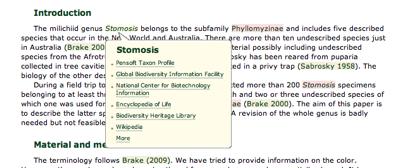
brake.png

I think these papers represent one view of the future of scientific publishing ("article 2.0"), and I'm flattered that Penev et al. cite my Elsevier challenge work (doi:10.1016/j.websem.2010.03.004, preprint at hdl:10101/npre.2009.3173.1) as one of the sources of inspiration (along with the landmark Shotton et al. "Adventures in Semantic Publishing: Exemplar Semantic Enhancements of a Research Article" doi:10.1371/journal.pcbi.1000361, which I've discussed previously). It is also good to see the TaxPub XML schema used by a publisher, and Scratchpads being a part of the process of publishing taxonomic information.

Deep linking

My initial impression is that there is huge of potential here, although I think there is still lots to do. I'm not totally convinced that popups are they way to go (although I've dabbled with them as well), and we need to move beyond simply linking to other sites to a deeper form of integration. For example, a Zookeys article might link to BHL via a taxonomic name, but how about deeper linking? For example, the paper by Brake and von Tschirnhaus (doi:10.3897/zookeys.50.505) contains the following citations:

Biró L (1899) Commensalismus bei Fliegen. Természetrajzi füzetek 22: 198–204.

Kertész K (1899) Verzeichnis einiger, von L. Biró in Neu-Guinea und am Malayischen Archipel gesammelten Dipteren. Természetrajzi füzetek 22: 173–19

Neither reference has any links in the HTML, so the user is under the impression that they aren't available online, but both references have been scanned by BHL. You can see full text for these articles in BioStor (references 52005 and 52004, respectively -- note that the pagination for Biró 1899 is given incorrectly in the paper). This is one area where BHL has a lot to offer publishers, and it would be great to see BHL provide the services publishers need to add these links to their articles.

This integration should go both ways. It's odd that the paper by Brake and von Tschirnhaus contains LSID used by the ZooBank for this paper (urn:lsid:zoobank.org:pub:DABB03F4-A128-43BB-990C-02F25D656B00, see the <self-uri> tag in the XML), but ZooBank doesn't know about the DOI for the paper, hence the ZooBank page for this article has no link to the article itself. It's time to join this stuff together.

What's next?

What I'd really like to see is article XML repurposed as, say, RDF, and used to populate a database so that we can query it. In this way we can start to atomise the article into useful parts, and recombine them in new and interesting ways. Might be something to play with over the summer.

On a practical level, I'm somewhat bemused by the variety of XML formats being used by open access publishers. PLoS use version 2.0 of the NLM Journal Archiving and Interchange Tag Suite, and I wrote a XSLT style sheet to transform PLoS articles for viewing on an iPad. TaxPub is based on version 3.0 of the NLM DTD, which breaks quite a bit of my code relating to citations, so I'll have to tweak this to get it to display Zookeys articles correctly. Handling TaxPub itself will also require some additional work. Then there are the BMC journals, which have their own flavour of XML (based on something called the "KETON DTD"). It's all a bit messy. But I guess it'd be no fun if it was too easy...


Wednesday, August 20, 2008

ZooKeys, DOIs, Open Access, and RSS, but why?


ZooKeys (ISSN 1313-2970) is a new journal for the rapid publication of taxonomic names, rather like Zootaxa. On first glance it has some nice features, such as being Open Access (using the Creative Commons Attribution license), DOIs, and RSS feeds -- although these don't validate, partly due to an error at the bottom of the feeds:
<b>Warning</b>:  Cannot modify header information - headers already sent by (output started 
at /home/pensofto/public_html/zookeys/cache/t_compile/%%C2^C2D^C2D18A7A%%rss.tpl.php:5)
in <b>34</b><br />
So, something to fix there.

The RSS feeds are reasonably informative, although they don't include the DOI, which somewhat defeats the point of having them. DOIs need to be first class citizens in taxonomic literature.

But these are technical matters, the real question is why? Why create a new journal when Zootaxa is pumping out new taxaonomic papers at an astonishing rate. Why not combine forces (DOIs and RSS for Zootaxa, yay!)? There is an editorial doi:10.3897/zookeys.1.11 that is rather coy about this. Yes, Open Access is a Good Thing™, but Zootaxa has some Open Access articles. Why dilute the effort to transform zoological taxonomy by creating a new journal?