Showing posts with label copyright. Show all posts

Friday, November 10, 2017

Exploring images in the Biodiversity Literature Repository

A post by on the Plaza blog Expanded access to images in the Biodiversity Literature Repository has prompted me to write up a little toy I created earlier this week.

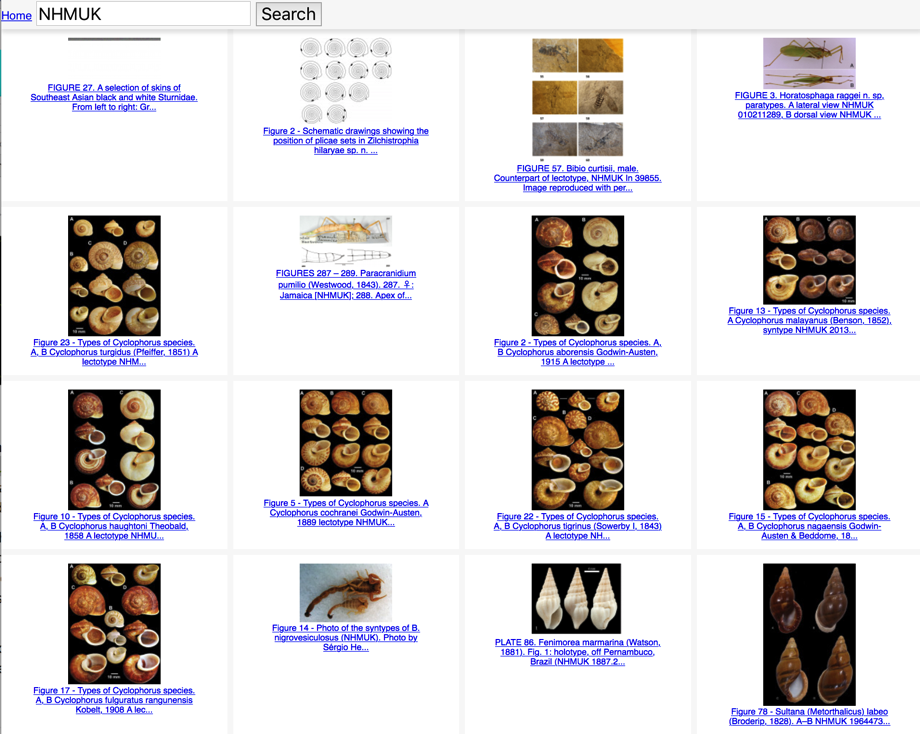
The Biodiversity Literature Repository (BLR) is a repository of taxonomic papers hosted by Zenodo. Where possible Plazi have extracted individual images and added those to the BLR, even if the article itself is not open access. The justification for being able to do this is presented here: DOI:10.1101/087015. I'm not entirely convinced by their argument (see Copyright and the Use of Images as Biodiversity Data) but rather than rehash that argument I decide dit would be much more fun to get a sense of what is in the BLR. I built a tool to scrape data from Zenodo and store it in CouchDB, put a simple search engine on top (using the search functionality in Cloudant) to search within the figure captions, and wrote some code to use a cloud-based image server to generate thumbnails for the images in Zenodo (some of which are quite big). The tool is hosted at Heroku, you can try it out here: https://zenodo-blr-interface.herokuapp.com/.

Screenshot 2017 11 10 11 03 30

This is not going to win any design awards, I'm simply trying to get a feel for what imagery BLR has. My initial reactions was "wow!". There's a rich range of images, including phylogenies, type specimens, habitats, and more. Searching by museum codes, e.g. NHMUK is a quick way to discover images of specimens from various collections.
Screenshot 2017 11 10 11 22 05

Based on this experiment there are at least two things I think would be fun to do.

Adding more images

BLR already has a lot of images, but the biodiversity literature is huge, and there's a wealth of imagery elsewhere, including journals not in BLR, and of course the Biodiversity Heritage Library (BHL). Extracting images from articles in BHL would potentially add a vast number of additional images.

Machine learning

Machine learning is hot right now, and anyone using iNaturalist is probably aware of their use of computer vision to suggest identifications for images you upload. It would be fascinating to apply machine learning to images in the BLR. Even basic things such as determining whether an image is a photo or a drawing, how many specimens are included, what the specimen orientation is, what part of the organism is being displayed, is the image a map (and of what country) would be useful. There's huge scope here for doing something interesting with these images.

The toy I created is very basic, and merely scratches the surface of what could be done (Plazi have also created their own tool, see http://github.com/punkish/zenodeo). But spending a few minutes browsing the images is well worthwhile, and if nothing else is a reminder of both how diverse life is, and how active taxonomists are in trying to discover and describe that diversity.

Tuesday, May 10, 2016

State of open knowledge about the World's Plants

A1BHupvRKew has released a new report today, entitled the State of the World's Plants, complete with it's own web site https://stateoftheworldsplants.com. Its aim:

...by bringing the available information together into one document, we hope to raise the profile of plants among the global community and to highlight not only what we do know about threats, status and uses, but also what we don’t. This will help us to decide where more research effort and policy focus is required to preserve and enhance the essential role of plants in underpinning all aspects of human wellbeing.

This is, of course, a laudable goal, and a lot of work has gone into this report, and yet there are some things about the report that I find very frustrating.

  1. PDF but no ePub It's nice to have an interactive web site as well as a glossy PDF, but why restrict yourself to a PDF? Why not an ePub so people can view it and rescale fonts for their device, etc. Why not provide the original text in a form people can translate? The report states that much of the newly discovered plant biodiversity is found in Brazil and China, why not make it easier to support automatic translation into Portuguese and Chinese?
  2. Why no DOI for the report? If this is such an important document, why doesn't it have a DOI so it can be easily cited?
  3. Why no DOIs for cited literature? The report cites 219 references, very few of them are accompanied by a DOI, yet most of the references have them. Why not include the DOI so readers can click on that and go straight to the literature. Surely you want to encourage readers to engage with the subject by reading more? The whole point of having digital documents online is that they can link to other documents.
  4. No open access taxonomy Sadly the examples of exciting new plant species discovered are all in closed access publications, including The Gilbertiodendron species complex (Leguminosae: Caesalpinioideae), Central Africa DOI:10.1007/s12225-015-9579-4 published in Kew's own journal Kew Bulletin. This article costs $39.95 / €34.95 / £29.95 to read. Why do taxonomists continue to publish their research, often about taxa in the developing world, behind paywalls?
  5. Why is the data not open? Much of the section on "Describing the world’s plants" uses data from Kew's database IPNI. This database is not open, so how does the reader verify the numbers in the report? Or, more importantly, how does the reader explore the data further and ask questions not asked in the report?

These may seem like small issues given the subject of the report (the perilous state of much of the planet's biodiversity), but if we are to take seriously the goal of "help[ing] us to decide where more research effort and policy focus is required to preserve and enhance the essential role of plants in underpinning all aspects of human wellbeing" then I suggest that open access to knowledge about plant diversity is a key part of that goal.

Over a decade ago Tom Moritz wrote of the need for a "biodiversity commons": DOI:10.1045/june2002-moritz

Provision of free, universal access to biodiversity information is a practical imperative for the international conservation community — this goal should be accomplished by promotion of the Public Domain and by development of a sustainable Biodiversity Information Commons adapting emergent legal and technical mechanisms to provide a free, secure and persistent environment for access to and use of biodiversity information and data. - "Building the Biodiversity Commons" DOI:10.1045/june2002-moritz

The report itself alludes to the importance of "opening up of global datasets with long-time series (such as maps of forest loss)", and yet botany has been slow to do this for much of its data (see Why are botanists locking away their data in JSTOR Plant Science?). We need data on plant taxonomy, systematics, traits, sequences, and distribution to be open and freely available to all, not closed behind paywalls or limited access APIs. Indeed, Donat Agosti has equated copyright to biopiracy (Biodiversity data are out of local taxonomists' reach DOI:10.1038/439392a.

It would be nice to think that Kew, as well as leading the way in summarising the state of the world's plants, would also be leading the way in making that knowledge about those plants open to all.