Showing posts with label CouchDB. Show all posts

Friday, August 12, 2016

Spatial search in BioStor

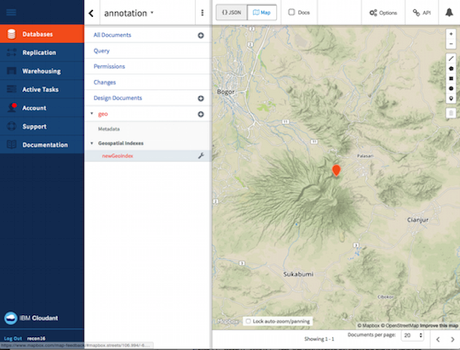
I've been experimenting with simple spatial search in BioStor, as shown in the demo below. If you go to the map on BioStor you can use the tools on the left to draw a box or a polygon on the map, and BioStor will search it's database for articles that mention localities that occur in that region. If you click on a marker you can see the title of the article, clicking on that title takes you to the article itself.

This is all rather crude (and a little slow), but it provides another way to dive into the content I've been extracting from the BHL. One thing I've been doing is looking at protected areas (often marked on Open Street Map), drawing a simple polygon around that area, then seeing if BioStor knows anything about that area.

For the technically minded, this tool is an extension of the Searching GBIF by drawing on a map demo, and uses the geospatial indexing offered by Cloudant.

Thursday, June 23, 2016

Aggregating annotations on the scientific literature: a hack for ReCon 16

7iUlfzBpI will be at ReCon 16 in Edinburgh (hashtag #ReCon_16), the second ReCon event I've attended (see Thoughts on ReCon 15: DOIs, GitHub, ORCID, altmetric, and transitive credit). For the hack day that follows I've put together some instructions for a way to glue together annotations made by multiple people using hypothes.is. It works by using IFTTT to read a user's annotation stream (i.e., the annotations they've made) and then post those to a CouchDB database hosted by Cloudant.

Why, you might ask? Well, I'm interested in using hypothes.is to make machine-readable annotations on papers. For example, we could select a pair of geographic co-ordinates (latitude and longitude) in a paper, tag it "geo", then have a tool that takes that annotation, converts it to a pair of decimal numbers and renders it on a map.

Screenshot 2016 06 23 15 53 07

Or we could be reading a paper and the literature cited lacks links to the cited literature (i.e., there are no DOIs). We could add those by selecting the reference, pasted in the DOI as the annotation, and tagging it "cites". If we aggregate all those annotations then we could write a query that lists all the DOIs of the cited literature (i.e., it builds a small part of the citation graph).

By aggregating across multiple users we effectively crowd source the annotation problem, but in a way that we can still collect those annotations. For this hack I'm going to automate this collection by enabling each user to create an IFTTT recipe that feeds their annotations into the database (they can switch this feature off at any time by switching off the recipe).

Manual annotation is not scalable, but it does enable us to explore different ways to annotate the literature, and what sort of things people may be interested in. For example, we could flag scientific names, great numbers, localities, specimens, concepts, people, etc. We could explore what degree of post-processing would be needed to make the annotations computable (e.g., converting 8°07′45.73″S, 63°42′09.64″W' into decimal latitude and longitude).

If this project works I hope to learn something about people want to extract from the literature, and to what extent having a database of annotations can provide useful information. This will also help inform my thinking about automated annotation, which I've explored in Hypothes.is revisited: annotating articles in BioStor.

Thursday, December 17, 2015

Will JSON, NoSQL, and graph databases save the Semantic Web?

OK, so the title is pure click bait, but here's the thing. It seems to me that the Semantic Web as classically conceived (RDF/XML, SPARQL, triple stores) has had relatively little impact outside academia, whereas other technologies such as JSON, NoSQL (e.g., MongoDB, CouchDB) and graph databases (e.g., Neo4J) have got a lot of developer mindshare.

In biodiversity informatics the Semantic Web has been a round for a while. We've been pumping out millions of RDF documents (mostly served by LSIDs) since 2005 and, to a first approximation, nothing has happened. I've repeatedly blogged about why I think this is (see this post for a summary).

I was an early fan of RDF and the Semantic Web, but soon decided that it was far more hassle than it was worth. The obsession with ontologies, the problems of globally unique identifiers based on HTTP (http-14 range, anyone?), the need to get a lot of ducks in a row all mad it a colossal pain. Then I discovered the NoSQL document database CouchDB, which is a JSON store that features map-reduce views rather than on the fly queries. To somebody with a relational database background this is a bit of a headfuck:

Fault tolerance

But CouchDB has a great interface, can be replicated to the cloud, and is FUN (how many times can you say that about a database?). So I starting playing with CouchDB for small projects, then used it to build BioNames and more recently moved BioStor to CouchDB hosted both locally and in the cloud.

Then there are graph databases such as Neo4J, which has some really cool things such as GraphGists which is a playground where you can create interactive graphs and query them (here's an example I created). Once again, this is FUN.

Another big trend over the last decade is the flight from XML and its hideous complexities (albeit coupled with great power) to the simplicity of JSON (part of the rise of JavaScript). JSON makes it very easy to pass around data in simple key-value documents (with more complexity such as lists if you need them). Pretty much any modern API will serve you data in JSON.

So, what happened to RDF? Well, along with a plethora of formats (XML, triples, quads, etc., etc.) it adopted JSON in the form of JSON-LD (see JSON-LD and Why I Hate the Semantic Web for background). JSON-LD lets you have data in JSON (which both people and machines find easy to understand) and all the complexity/clarity of having the data clearly labelled using controlled vocabularies such as Dublin Core and schema.org. This complexity is shunted off into a "@context" variable where it can in many cases be safely ignored.

But what I find really interesting is that instead of JSON-LD being a way to get developers interested in the rest of the Semantic Web stack (e.g. HTTP URIs as identifiers, SPARQL, and triple stores), it seems that what it is really going to do is enable well-described structured to get access to all the cool things being developed around JSON. For example, we have document databases such as CouchDB which speaks HTTP and JSON, and search servers such as ElasticSearch which make it easy to work with large datasets. There are also some cool things happening with graph databases and Javascript, such as Hexastore (see also Weiss, C., Karras, P., & Bernstein, A. (2008, August 1). Hexastore. Proc. VLDB Endow. VLDB Endowment. http://doi.org/10.14778/1453856.1453965, PDF here) where we create the six possible indexes of the classic RDF [subject,predicate,object] triple (this is the sort of thing can also be done in CouchDB). Hence we can have graph databases implemented in a web browser!

So, when we see large-scale "Semantic Web" applications that actually exist and solve real problems, we may well be more likely to see technologies other than the classic Semantic Web stack. As an example, see the following paper:

Szekely, P., Knoblock, C. A., Slepicka, J., Philpot, A., Singh, A., Yin, C., … Ferreira, L. (2015). Building and Using a Knowledge Graph to Combat Human Trafficking. The Semantic Web - ISWC 2015. Springer Science + Business Media. http://doi.org/10.1007/978-3-319-25010-6_12

There's a free PDF here, and a talk online. The consortium behind this project researchers did extensive text mining, data cleaning and linking, creating a massive collection of JSON-LD documents. Rather than use a triple store and SPARQL, they indexed the JSON-LD using ElasticSearch (notice that they generated graphs for each of the entities they care about, in a sense denormalising the data).

I think this is likely to be the direction many large-scale projects are going to be going. Use the Semantic Web ideas of explicit vocabularies with HTTP URIs for definitions, encode the data in JSON-LD so it's readable by developers (no developers, no projects), then use some of the powerful (and fun) technologies that have been developed around semi-structured data. And if you have JSON-LD, then you get SEO for free by embedding that JSON-LD in your web pages.

In summary, if biodiversity informatics wants to play with the Semantic Web/linked data then it seems obvious that some combination of JSON-LD with NoSQL, graph databases, and search tools like ElasticSearch are the way to go.

Monday, August 10, 2015

Demo of full-text indexing of BHL using CouchDB hosted by Cloudant

One of the limitations of the Biodiversity Heritage Library (BHL) is that, unlike say Google Books, its search functions are limited to searching metadata (e.g., book and article titles) and taxonomic names. It doesn't support full-text search, by which I mean you can't just type in the name of a locality, specimen code, or a phrase and expect to get back much in the way of results. In fact, in many cases when I Google a phrase that occurs in BHL content I'm more likely to find that phrase in content from the Internet Archive, and then it's a matter of following the links to the equivalent item in BHL.

So, as an experiment I've created a live demo of what full-text search in BHL could look like. I've done this using the same infrastructure the new BioStor is built on, namely CouchDB hosted by Cloudant. Using BHL's API I've grabbed some volumes of the British Ornithological Club's Bulletin and put them into CouchDB (BHL's API serves up JSON, so this is pretty straightforward to do). I've added the OCR text for each page, and asked Cloudant to index that. This means that we can now search on a phrase in BHL (in the British Ornithological Club's Bulletin) and get a result.

I've made a quick and dirty demo of this approach and you can see it in the "Labs" section on BioStor, so you can try it here. You should see something like this:

Bhl couchdb The page image only appears if you click on the blue labels for the page. None of this is robust or optimised, but it is a workable proof-of-concept of how fill-text search could work.

What could we do with this? Well, all sorts of searches are no possible. We can search for museum specimen codes, such as 1900.2.27.13. This specimen is in GBIF (see http://bionames.org/~rpage/material-examined/www/?code=BMNH%201900.2.27.13) so we could imagine starting to link specimens to the scientific literature about that specimen. We can also search for locations (such as Mt. Albert Edward), or common names (such as crocodile).

Note that I've not completed uploading all the page text and XML. Once I do I'll have a better idea of how scalable this approach is. But the idea of having full-text search across all of BHL (or, at least the core taxonomic journals) is tantalising.

Technical details

Initially I simply displayed a list of the pages that matched the search term, together with a fragment of text with the search term highlighted. Cloudant's version of CouchDB provides these highlights, and a "group_field" that enabled me to group together pages from the same BHL "item" (roughly corresponding to a volume of a journal).

This was a nice start, but I really wanted to display the hits on the actual BHL page. To do this I grabbed the DjVu XML for each BHL page for British Ornithological Club's Bulletin, and used a XSLT style-sheet that renders the OCR text on top of the page image. You can't see the text because it I set the colour of the text to "rgba(0, 0, 0, 0)" (see http://stackoverflow.com/a/10835846) and set the "overflow" style to "hidden". But the text is there, which means you can select with the mouse and copy and paste it. This still leaves the problem of highlighting the text that matches the search term. I originally wrote the code for this to handle species names, which comprise two words. So, each DIV in the HTML has a "data-one-word" and "data-two-words" attribute set, which contains the first (and forst plus second) word in the search term, respectively. I then use a JQuery selector to set the CSS of each DIV that has a "data-one-word" or "data-two-words" attribute that matches the search term(s). Obviously, this is terribly crude, and doesn't do well if you've more than two word sin your search query.

As an added feature, I use CSS to convert the BHL page scan to a black-and-white image (works in Webkit-based browsers).

Friday, July 31, 2015

Towards a new BioStor

One of my pet projects is BioStor, which has been running since 2009 (gulp). BioStor extracts articles from the Biodiversity Heritage Library (details here: http://dx.doi.org/10.1186/1471-2105-12-187), and currently has over 110,000 articles, all open access. The site itself is showing its age, both in terms of performance and design, so I've wanted to update it for a while now. I made a demo in 2012 of BioStor in the Cloud, but other stuff got in the way of finishing it, and the service that it ran on (Pagodabox) released a new version of their toolkit, so BioStor in the Cloud died.

At last I've found the time to tackle this again, motivated in part because I've had to move BioStor to a new server, and it's performance has been pretty poor. The next version of BioStor is currently sitting at http://biostor.gopagoda.io (the images and map views are good ways to enter the site). It's still being populated, and there is code to tweak, but it's starting to look good enough to use. It has a cleaner article display, built in search (making things much more findable), support for citation styles using citeproc-js, and display of altmetrics (e.g., Another variation on the gymnure theme: description of a new species of Hylomys (Lipotyphla, Erinaceidae, Galericinae).

Once all the data has been moved across and I've cleaned up a few things I plan to make bistor.org point to this new version.

Thursday, August 28, 2014

BioNames database can be downloaded

B8e253dc3be3d84f2c69c51b0af86c03 400x400My BioNames project has been going for over a year now, but I hadn't gotten around to providing bulk access to the data I've been collecting and cleaning. I've gone some way towards fixing this. You can now grab a snapshot of the BioNames database as a Darwin Core Archive here. This snapshot was generated on the 22nd August, so it is already a little out of date (BioNames is edited almost daily as I clean and annotate it when I should be doing other things).

The data dump doesn't capture all the information in the BioNames as I've tried to keep it simple, and Darwin Core is a bit of a pain to deal with. The actual database is in CouchDB which is (mostly) an absolute joy to work with. I replicate the database to Cloudant, which means there's a copy "in the cloud". A number of my other CouchDB projects are also in Cloudant, in the case of Australian Faunal Directory and BOL DNA Barcode Map the data is also served directly from Cloudant.

Wednesday, June 04, 2014

Visual analysis of GBIF data

Tim Roberston and the ream at GBIF are working on some nice visualisations of GBIF data, and have made an early release available for viewing: http://analytics.gbif-uat.org. For a given country, say, the Solomon Islands, you can see numerous plots, mostly like this:

Gbif

Ever the critic, as much as I like this (and appreciate the scale of the task underlying doing analytics on data at the scale of GBIF), what I would really like to see is something that more closely resembles Google Analytics. I want graphs that I can use to get some insight into the data, and which lead me to ask questions (and provide easy for me to discover the answers).

So, I put together a crude, live demo of the sort of thing I'd like to see. You can see it at http://bionames.org/~rpage/gbif-stats (can't promise that this link will be long-lived), and below is a screen shot:
Stats
What I've done is fetch all the occurrence records for the Solomon Islands from GBIF (using the API), dumped that into CouchDB, and generated some simple queries. I display the results using Google Charts. There are some similarities with the tools developed by Javier Otegui, Arturo Ariño, and colleagues.

Otegui, J., Ariño, A. H., Encinas, M. A., & Pando, F. (2013, January 25). Assessing the Primary Data Hosted by the Spanish Node of the Global Biodiversity Information Facility (GBIF). (G. P. S. Raghava, Ed.)PLoS ONE. Public Library of Science (PLoS). doi:10.1371/journal.pone.0055144
Otegui, J., & Arino, A. H. (2012, August 15). BIDDSAT: visualizing the content of biodiversity data publishers in the Global Biodiversity Information Facility network. Bioinformatics. Oxford University Press (OUP). doi:10.1093/bioinformatics/bts359


For fun I've also added a map of the GBIF occurrences (also served from CouchDB).

Here's quick guide to some of the charts. Below you can see (left) a plot of species accumulation over time, that is the total number of species that have been collected up to that time. If we had collected all the species we'd expect this to asymptote (flatten out). If it keeps going up, then we still need to do some sampling. On the right is the number of occurrences recorded for each year. You can see that collecting is highly episodic.

Stats2

To get a little more information on this, I've generated a crude chart where the rows are institutions (e.g., museums and herbaria) that have specimens, and the number of occurrences collected each decade are represented by the shaded boxes (the rightmost box is the current decade) (if you hover over a bar you will see a popup with the decade). To the right is the total number of occurrences.

Chart
From this we can see that there have been some major collections at various times (e.g., Kew in the 1960's, the Australian Museum in the 1970's to 1990's). Strangely, the MCZ has lots of specimens from the 1700's, I suspect we have a data quality issue here. There are certainly some issues with dates in this data set, with about a quarter of occurrences with no date:

Date

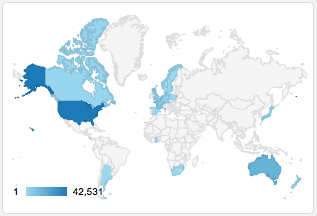
Note that the data for the Solomon Islands, comes from all around the world, mostly from the US. There is a big spike in the date of collection curve in 1944, suggesting a lot of material may be the result of collecting by US servicemen in WW2.

Map

I use a treemap to display the taxonomic distribution of the records, and a donut chart to summarise the taxonomic level to which the occurrences are identified:

Taxa
The treemap is dominated by vertebrates, which I suspect is a poor reflection of the actual taxonomic composition of the Solomon Islands biota. Over 3/4 of the occurrences are identified to species level, which is encouraging, but there's clearly a lot of material that needs some taxonomic work.

Where next


This has been made in a rush, and there is a lot which could be done. For example, some of the charts would be more useful if you could drill down and explore further. This could be done via the GBIF API or portal (for example, by constructing a URL that shows the portal results for the Solomon Islands for a given year of collection).

There are, of course, issues of scalability. I've made this for the 83,364 occurrences currently in the GBIF portal for the Solomon Islands. There would need to be some thought given to how this could be scaled to larger data sets. But I think this is worth pursuing so that we can get further insights into the remarkable database that GBIF is building.

Tuesday, November 27, 2012

Fuzzy matching taxonomic names using ngrams

Quick note to self about possible way to using fuzzy matching when searching for taxonomic names. Now that I'm using Cloudant to host CouchDB databases (e.g., see BioStor in the the cloud) I'd like to have a way to support fuzzy matching so that if I type in a name and misspelt it, there's a reasonable chance I will still find that name. This is the "did you mean?" feature beloved by Google users. There are various ways to tackle this problem, and Tony Rees' TAXAMATCH is perhaps the best known solution.

Cloudant supports Lucence for full text searching, but while this allows some possibility for approximate matching (by appending "~" to the search string) initial experiments suggested it wasn't going to be terribly useful. What does seem to work is to use ngrams. As a crude example, here is a CouchDN view that converts a string (in this case a taxon name) to a series of trigrams (three letter strings) then indexes their concatenation.


{
"_id": "_design/taxonname",
"language": "javascript",
"indexes": {
"all": {
"index": "function(doc) { if (doc.docType == 'taxonName') { var n = doc.nameComplete.length; var ngrams = []; for (var i=0; i < n-2;i++) { var ngram = doc.nameComplete.charAt(i) + doc.nameComplete.charAt(i+1) + doc.nameComplete.charAt(i+2); ngrams.push(ngram); } if (n > 2) { ngrams.push('$' + doc.nameComplete.charAt(0) + doc.nameComplete.charAt(1)); ngrams.push(doc.nameComplete.charAt(n-2) + doc.nameComplete.charAt(n-1) + '$'); } ngrams.sort(); index(\"default\", ngrams.join(' '), {\"store\": \"yes\"}); } }"
}
}
}

To search this view for a name I then generate trigrams for the query string (e.g., "Pomatomix" becomes "$Po Pom oma mat ato tom omi mix ix$" where "$" signals the start or end of the string) and search on that. For example, append this string to the URL of the CouchDB database to search for "Pomatomix":


_design/taxonname/_search/all?q=$Po%20Pom%20oma%20mat%20ato%20tom%20omi%20mix%20ix$&include_docs=true&limit=10


Initial results are promising (searching on bigrams generated an alarming degree of matches that seemed rather dubious). I need to do some more work on this, but it might be a simple and quick way to support "did you mean?" for taxonomic names.

Thursday, November 22, 2012

BioStor in the cloud

CloudantQuick note on an experimental version of BioStor that is (mostly) hosted in the cloud. BioStor currently runs on a Mac Mini and uses MySQL as the database. For a number of reasons (it's running on a Mac Mini and my knowledge of optimising MySQL is limited) BioStor is struggling a bit. It's also gathered a lot of cruff as I've worked on ways to map article citations to the rather messy metadata in BHL.

So, I've started to play with a version that runs in the cloud using my favourite database, CouchDB. The data is hosted by Cloudant, which now provides full text search powered by Lucene. Essentially, I simply take article-level metadata from BioStor in BibJSON format and push that to Cloudant. I then wrote a simple wrapper around querying CouchDB, couple that with the Documentcloud Viewer to display articles and citeproc-js to format the citations (not exactly fun, but someone is bound to ask for them), and a we have a simple, searchable database of literature.

If you want to try the cloud-based version go to http://biostor-cloud.pagodabox.com/ (code on Github).

Bcloud

I've been wanting to do this for a while, partly because this is how I will implement my entry in EOL's computational data challenge, but also because CrossRef's Metadata search shows the power of finding references simply by using full text search (I've shamelessly borrowed some of the interface styling from Karl Ward's code). David Shorthouse demonstrates what you can do using CrossRef's tool in his post Conference Tweets in the Age of Information Overconsumption. Given how much time I spend trying to parse taxonomic citations and match them to articles in CrossRef's database, or BioStor, I'm looking forward to making this easier.

There are two major limitations of this cloud version of BioStor (aprt from the fact it has only a subset of the articles in BioStor). The first is that the page images are still being served from my Mac Mini, so they can be a bit slow to load. I've put the metadata and the search engine in the cloud, but not the images (we're talking a terabyte or two of bitmaps).

The other limitation is that there's no API. I hope to address this shortly, perhaps mimicking the CrossRef API so if one has code that talks to CrossRef it could just as easily talk to BioStor.

Monday, October 22, 2012

Resolving free-form citations

Cms logoCrossRef have released CrossRef Metadata Search a nice tool that can take a free-form citation and return possible matches from CrossRef's database. If you get a match CrossRef can take the DOI and format for you it in a variety of styles using DOI content negotiation.

If, like me, you spend a lot of time trying to find DOIs (and other identifiers) for articles by first parsing citations into their component parts, then this is good news. It's also good news for publishers that may balk at one of CrossRef's requirements for joining its club: if you want DOIs for your articles it's not enough to submit metadata for your article, you also need to submit the list of references that article cites, including their DOIs. This requirement enables CrossRef to offer their "cited by" service, but imposes a burden on smaller journals operating on a tight budget (e.g., Zootaxa). With CrossRef Metadata Search you can just send author-supplied citation strings from the manuscript and have a good chance of finding the corresponding DOI, if it exists.

Of course, the service only works if the article has a DOI, so it's not a complete solution to being able to parse bibliographic citations into their component parts. But it's a nice model, and I'm tempted to apply the same approach to my databases, such as BioStor or my ever growing Mendeley library (which is larger than the Mendeley desktop client can easily handle). A quick way to do this would be to use Cloudant which has cloud-based CouchDB coupled with a Lucene-based fulltext search engine. If I've time I may try and put a demo together.

Monday, December 12, 2011

Exporting data from Australian Faunal Directory on CouchDB

Quick note to self about exporting data from my Australian Faunal Directory on CouchDB project. To export data from a CouchDB view you can use a list function (see Formatting with Show and List). Following the example on the Kanapes IDE blog, I created the following list function:

{
"_id": "_design/publication",
"_rev": "14-467dee8248e97d874f1141411f536848",
"language": "javascript",
"lists": {
"tsv": "function(head,req) {
var row;
start({
'headers': {
'Content-Type': 'text/tsv'
}
});
while(row = getRow()) {
send(row.value + '\\t' + row.key + '\\n');
}}"
},
"views": {
.
.
.
}
}


I can use this function with the view below, which lists Australian Faunal Directory publications by UUID ("value"), indexed by DOI ("key").

Couch

I can get the tab-delimited dump from http://localhost:5984/afd/_design/publication/_list/tsv/doi. Note that instead of, say, /afd/_design/publication/_view/doi to get the view, we use /afd/_design/publication/_list/tsv/doi to get the tab-delimited dump.

I've created files listing DOIs and BioStor ids for publications in the Australian Faunal Directory. I'll play with lists a bit more, specially as I would like to extract the mapping from the Australian Faunal Directory on CouchDB project and add it to the iTaxon project.

Thursday, May 26, 2011

ZooBank on CouchDB: UUIDs, replication, and embedding the literature in taxonomic databases

ZooBankBannerLast December I released a web site called Australian Faunal Directory on CouchDB, which was part of my ongoing exploration of how to build a simple yet useful database of taxonomic names. In particular, I want to link names directly to the primary taxonomic literature. No longer is it adequate to simply list names, or list names with mangled bibliographic details (I'm looking at you, Catalogue of Life). This is the 21st century, so I expect one click from name to literature, or at the most two (via, say, a DOI). Nothing else will cut it.

CouchbaseThe Australian Faunal Directory (AFD) was an eye opener as it was the first serious use I'd made of CouchDB (now CouchBase). I'd played with replicating and forking data in 2010: Catalogue of Life and CouchDB, but the AFD project was bigger, and also inspired me to use web hooks to make the database editable. Suddenly this stuff started to look easy: no schema, simple web services, and tiny amounts of code.

ZooBank
So then my attention turned to ZooBank, which is "the official registry of Zoological Nomenclature, according to the International Commission on Zoological Nomenclature (ICZN)." ZooBank was proposed by Polaszek et al. (2005) in a short piece in Nature ("A universal register for animal names", doi:10.1038/437477a). By providing a registry of names for animals, ultimately it aims to help avoid embarrassing situations such as the example I recount in my paper on BioStor (doi:10.1186/1471-2105-12-187): a recent paper in Nature published the name Leviathan for an extinct sperm whale with a giant bite (doi:10.1038/nature09067), only for authors to have to publish an erratum with a new name (doi:10.1038/nature09381) when it was discovered that Leviathan had already been used for an extinct mammoth.

ZooBank is developed and run by Rich Pyle, and has some nice features, such as RDF export (via LSIDs), but like most taxonomic databases it doesn't link directly to the literature. Where are the DOIs? Where are links to BHL? Where is the ability to add these links? And why is it almost entirely about fish? (OK, I know the answer to that one).

CouchDB
But the thing which really got me thinking about using CouchDB to create a version of ZooBank was Rich Pyle's vision of having a distributed ZooBank, and his insistence on using ugly UUIDs in ZooBank identifiers (e.g., urn:lsid:zoobank.org:act:6BBEF50E-76B4-42EF-97B1-7029DBCD8257). As much as they are ugly, Rich has always argued that they make distributed systems easy because you don't need a centralised system to assign unique identifiers.

Anybody who has played with CouchDB will know that CouchDB uses UUIDs by default to create identifiers for database documents. It also excels at data synchronisation, and can run on platforms large and small (including mobile such as Android and iOS). This means a database could be updated on an iPhone or iPad without an Internet connection, then the data could be synchronised with other databases. Indeed, I developed this CouchDB clone of ZooBank on my MacBook, then pointed it at CouchDB running on my server and within minutes had an exact copy of the database running on the server. This ease of replication, together with the joy of schema-less design makes CouchDB seem an obvious fit to ZooBank.

Demo
You can see the ZooBank on CouchDB demo here. It's not a complete copy of ZooBank, but has most of it. I reuse the UUIDs issued by ZooBank, so that

http://zoobank.org:80/?uuid=6bbef50e-76b4-42ef-97b1-7029dbcd8257

becomes

http://iphylo.org/~rpage/zoobank/6bbef50e-76b4-42ef-97b1-7029dbcd8257

As usual it's all a bit crude, but has some nice features, such as links to BHL content with a built in article viewer I wrote for the AFD project:

EtheostomaWhat's next?
At present only a fraction of the ZooBank references have external links, I hope to add more in the next few days, using both automatic scripts and the web hook interface. The search interface needs work, and being that ZooBank is about nomenclature and not taxonomy, it might be useful to add a classification (say from the Catalogue of Life) so that users can navigate around the names (and get a sense of how many are *cough* fish).

At present to display a reference I do one of four things:
  1. If reference is in BHL I use my article viewer
  2. If there is a freely available PDF online I display that using Google Docs PDF viewer
  3. If 1 and 2 don't apply, but there is a DOI then I resolve the DOI and display the result in an IFRAME (yuck)
  4. If none of 1-3 apply I display a blank rectangle

There are a couple ways we could improve this. The first is to enhance the display of BHL content by making use of the structure of the source DjVu files. Another is to make use of the XML now being made available by the journal Zookeys (see my blog post, and Pensoft's announcement that ZooKeys is now being archived by PubMed Central, complete with taxonomic markup). There are a lot of ZooKeys articles in ZooBank, so there's a lot of potential for embedding an article viewer that takes Zookeys XML and redisplays it with taxonomic names and references as clickable links that link to other ZooBank content. That way we approach the point where taxonomic literature becomes a first class citizen of a taxonomic database.

Thursday, December 02, 2010

Linking taxonomic databases to the primary literature: BHL and the Australian Faunal Directory

Continuing my hobby horse of linking taxonomic databases to digitised literature, I've been working for the last couple of weeks on linking names in the Australian Faunal Directory (AFD) to articles in the Biodiversity Heritage Library (BHL). AFD is a list of all animals known to occur in Australia, and it provides much of the data for the recently released Atlas of Living Australia. The data is available as series of CSV files, and these contain quite detailed bibliographic references. My initial interest was in using these to populate BioStor with articles, but it seemed worthwhile to try and link the names and articles together. The Atlas of Living Australia links to BHL, but only via a name search showing BHL items that have a name string. This wastes valuable information. AFD has citations to individual books and articles that relate to the taxonomy of Australian animals — we should treat that as first class data.

So, I cobbled together the CSV files, some scripts to extract references, ran them through the BioStor and bioGUID OpenURL resolvers, and dumped the whole thing in a CouchDB database. You can see the results at Australian Faunal Directory on CouchDB.

afd.png


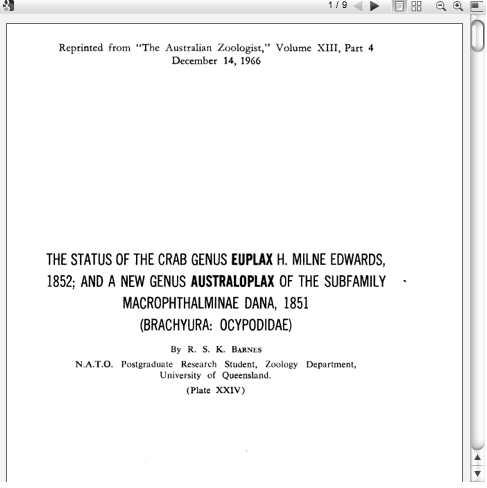
The site is modelled on my earlier experiment with putting the Catalogue of Life on CouchDB. It's still rather crude, and there's a lot of stuff I need to work on, but it should illustrate the basic idea. You can browse the taxonomic hierarchy, view alternative names for each taxon, and see a list of publications related to those names. If a publication has been found in BioStor then the site displays a thumbnail of the first page, and if you click on the reference you see a simple article viewer I wrote in Javascript.

v1.png


For PDFs I'm experimenting with using Google's PDF viewer (the inspiration for the viewer above):

v2.png


How it was made
Although in principle linking AFD to BHL via BioStor was fairly straight forward, these are lots of little wrinkles, such as errors in bibliographic metadata, and failure to parse some reference strings. To help address this I created a public group on Mendeley where all the references I've extracted are stored. This makes it easy to correct errors, add identifiers such as DOIs and ISSNs, and upload PDFs. For each article a reference to the original record in AFD is maintained by storing the AFD identifier (a UUID) as a keyword.

The taxonomy and the mapping to literature is stored in a CouchDB database, which makes a lot of things (such as uploading new versions of documents) a breeze.

It's about the links
The underlying motivation is that we are awash in biodiversity data and digitisation projects, but these are rarely linked together. And it's more than just linking, it's bring the data together so that we can compute over it. That's when things will start to get interesting.

Monday, November 01, 2010

CouchDB and Lucene

Quick notes to self on fulltext search and CouchDB. Note that links to CouchDB are local to my machine(s),and won't work unless you are me, or have a copy of the same database running on your machine). CouchDB and Lucene adds fulltext indexing to CouchDB. After a few false starts I now have this working. The documentation is a little misleading, you don't need to clone the github repository, nor use Maven to build couchdb-lucene (at least, I didn't). Instead I grabbed couchdb-lucene-0.5.6, unpacked it, used that as is.

To configure CouchDB I ended up editing the configuration using Futon (there's a link "Add a new section" down the bottom of the Configuration page), then I restarted CouchDB. The things to add are:


[couchdb]
os_process_timeout=60000 ; increase the timeout from 5 seconds.
[external]
fti=/path/to/python /path/to/couchdb-lucene/tools/couchdb-external-hook.py
[httpd_db_handlers]
_fti = {couch_httpd_external, handle_external_req, <<"fti">>}


To start couchdb-lucene, just cd couchdb-lucene-0.5.6 and bin/run.

Then it's a case of adding a fulltext index. In Futon I start adding a regular design document, then edit the Javascript. For example, here is a simple index on document titles:


{
"_id": "_design/lucene",
"_rev": "2-96b333dfc77866a13c0de7f856d27b6c",
"language": "javascript",
"fulltext": {
"by_title": {
"index": "function(doc) {
var ret=new Document();
ret.add(doc.title);
return ret;
}"
}
}
}


Once the indexing has been completed, you can search the CouchDB database using a URL like this: http://localhost:5984/col2010ref/_fti/_design/lucene/by_title?q=frog+new+species.

Lots more to do here, but with spatial queries and now fulltext search, it's time to start building something...

Friday, October 01, 2010

Replicating and forking data in 2010: Catalogue of Life and CouchDB

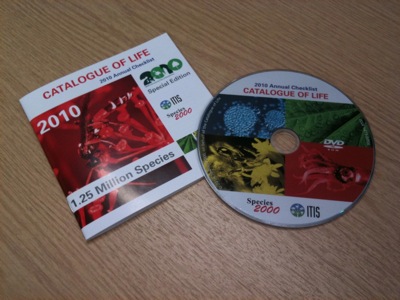
Time (just) for a Friday folly. A couple of days ago the latest edition of the Catalogue of Life (CoL) arrived in my mailbox in the form of a DVD and booklet:

photo.JPG
While in some ways it's wonderful that the Catalogue of Life provides a complete data dump of its contents, this strikes me as a rather old-fashioned way to distribute it. So I began to wonder how this could be done differently, and started to think of CouchDB. In particular, I began to think of being able to upload the data to a service (such as Cloudant) where the data could be stored and replicated at scale. then I began to think about forking the data. The Catalogue of Life has some good things going for it (some 1.25 million species, and around 2 million names), and is widely used as the backbone of sites such as EOL, GBIF, and iNaturalist.org, but parts of it are broken. Literature citations are often incomplete or mangled, and in places it is horribly out of date.

Rather than wait for the Catalogue of Life to fix this, what if we could share the data, annotate it, correct mistakes, and add links? In particular, what if we link the literature to records in the Biodiversity Heritage Library so at we can finally start to connect names to the primary literature (imagine clicking on a name and being able to see the original species description). We could have something akin to github, but instead of downloading and forking code, we download and fork data. CouchDB makes replicating data pretty straightforward.

So, I've started to upload some Catalogue of Life records to a CouchDB instance at Cloudant, and write a simple web site to display these records. For example, you can see the record for at http://iphylo.org/~rpage/col/?id=e9fda47629c1102b9a4a00304854f820:

croc.png
The e9fda47629c1102b9a4a00304854f820 in this URL is the UUID of the record in CouchDB, which is also the UUID embedded in the (non-functional) CoL LSIDs. This ensures the records have a unique identifier, but also one that is related to the original record. You can search for names, or browse the immediate hierarchy around a name. I hope to add more records over time as I explore this further — at the moment I've added a few lizards, wasps, and conifers while I explore how to convert the CoL records into a sensible JSON object to upload to CouchDB.

The next step is to think about this as a way to distribute data (want a copy of CoL, just point your CouchDB at the Cloudant URL and replicate it), and to think about how to build upon the basic records, editing and improving them, then thinking about how to get that information into a future version of the Catalogue.

Wednesday, September 22, 2010

GeoCouch

@mikeal a little tedious. you can take OSM and then convert it to SHP and then http://github.com/maxogden/shp2geocouchless than a minute ago via web


The tweet above inspired me to take a quick look at GeoCouch, a version of CouchDB that supports spatial queries. This is something I need if I'm going to start playing seriously with CouchDB. So, it was off to Installing and working with GeoCouch, grabbing a copy of HomeBrew (yet another package manager for Mac OS X), in the hope of installing GeoCouch. Things went fairly smoothly, although it took what seemed like an age to build everything. But I now have GeoCouch running. Previously I'd been running CouchDB using http://janl.github.com/couchdbx/, which launches vanilla CouchDB. However, if you launch CouchDBX after starting GeoCouch from the command line, CouchDBX is talking to GeoCouch.

I then grabbed shp2geocouch to try some shape files (I grabbed some shape files from the IUCN to play with). If you're on a Mac grab GISLook to get Quick Look previews of these files. Since I'm new to ruby there were a couple of gotchas, such as lacking some prerequisites (httparty and couchrest, both installed by typing gem install <name of package>), and there was the small matter of needing to add ~/.gem/ruby/1.8/bin to my path so I could find shp2geocouch (spot the ruby neophyte). The shape file didn't get processed completely, but at least I managed to get some data into GeoCouch.

gis.png
So far I've been playing with the examples at http://github.com/vmx/couchdb, and things seem to work. At least, the basic bounding box queries work. I'm tempted to play with this some more (and get my head arounbd GeoJSON), perhaps trying to recreate the functionality of my Elsevier Challenge entry, for which I wrote a custom key-value database that was awfully clunky.

Friday, September 10, 2010

CouchDB, Mendeley, and what I really want in an iPad article viewer

Playing with @couchdb, starting to think of the Mendeley API as a read/write JSON store, and having a reader app built on that...less than a minute ago via Tweetie for Mac


It's slowly dawning on me that many of the ingredients for an alternative different way to browse scientific articles may already be in place. After my first crude efforts at what an iPad reader might look like I've started afresh with a new attempt, based on the Sencha Touch framework. The goal here isn't to make a polished app, but rather to get a sense of what could be done.

The first goal is to be able to browse the literature as if it was a connected series of documents (which is what, of course, it is). This requires taking the full text of an article, extracting the citations, and making them links to further documents (also with their citations extracted, and so on). Leaving aside the obvious problem that this approach is limited to open access articles, an app that does this is going to have to store a lot of bibliographic data as the reader browses the literature (otherwise we going to have to do all the processing on the fly, and that's not going to be fast enough). So, we need some storage.

MySQL
One option is to write a MySQL database to hold articles, books, etc. Doable (I've done more of these than I care to remember), but things get messy pretty quickly, especially as you add functionality (tags, fulltext, figures, etc.).

RDF
Another option is to use RDF and a tripe store. I've played with linked data quite a bit lately (see previous "Friday follies" here and here), and I thought that a triple store would be a great way support an article browser (especially as we add additional kinds of data, such as sequences, specimens, phylogenies, etc.). But linked data is a mess. For the things I care about there are either no canonical identifiers, or too many, and rarely does the primary data provider served linked data compliant URLs (e.g., NCBI), hence we end up with a plethora of wrappers around these sources. Then there's the issue of what vocabularies to use (once again, there are either none, or too many). As a query language SPARQL isn't great, and don't even get me started on the issue of editing data. OK, so I get the whole idea of linked data, it's just that the overhead of getting anything done seems too high. You've got to get a lot of ducks to line up.

CounchDBlogo.png
So, I started playing with CounchDB, in a fairly idle way. I'd had a look before, but didn't really get my head around the very different way of querying a database that CouchDB requires. Despite this learning curve, CouchDB has some great features. It stores documents in JSON, which makes it trivial to add data as objects (instead of mucking around with breaking them up into tables for SQL, or atomising them into triples for RDF), it supports versioning right out of the box (vital because metadata is often wrong and needs to be tidied up), and you talk to it using HTTP, which means no middleware to get in the way. You just point your browser (or curl, or whatever HTTP tool you have) and send GET, POST, PUT, or DELETE commands. And now it's in the cloud.

In some ways ending up with CouchDB (or something similar) seems inevitable. The one "semantic web" tool that I've made most use of is Semantic MediaWiki, which powers the NCBI to Wikipedia mapping I created in June. Semantic Mediawiki has it's uses, but occasionally it has driven me to distraction. But, when you get down to it, Semantic Mediawiki is really just a versioned document store (where the documents are typically key-value pairs), over which have been laid a pretty limited query language and some RDF export features. Put like this, most of the huge Mediawiki engine underlying Semantic MediaWiki isn't needed, so why not cut to the chase and use a purpose-built versioned document store? Enter CouchDB.

Browsing and Mendeley
So, what I have in mind is a browser that crawls a document, extracting citations, and enabling the reader to explore those. Eventually it will also extract all the other chocolatey goodness in an article (sequences, specimens, taxonomic names, etc.), but for now I'm focussing on articles and citations. A browser would need to store article metadata (say, each time it encounters an article for the first time), as well as update existing metadata (by adding missing DOIs, PubMed ids, citations, etc.), so what easier way than as JSON in a document store such as CouchDB? This is what I'm exploring at the moment, but let's take a step back for a second.

The Mendeley API, as poorly developed as it is, could be treated as essentially a wrapper around a JSON document store (the API stores and returns JSON), and speaks HTTP. So, we could imagine a browser that crawls the Mendeley database, adding papers that aren't in Mendeley as it goes. The act of browsing and reading would actively contribute to the database. Of course, we could spin this around, and argue that a crawler + CouchDB could pretty effectively create a clone of Mendeley's database (albeit without the social networking features that come with have a large user community).

This is another reason why the current crop of iPad article viewers, Mendeley's included, are so disappointing. There's the potential to completely change the way we interact with the scientific literature (instead of passively consuming PDFs), and Mendeley is ideally positioned to support this. Yes, I realise that for the vast majority of people being able to manage their PDFs and format bibliographies in MS Word are the killer features, but, seriously, is that all we aspire too?