Showing posts with label Zotero. Show all posts

Wednesday, December 08, 2010

First thoughts on CiteBank and BHL-Europe

This week saw the release of two tools from the Biodiversity Heritage Library, CiteBank and the BHL-Europe portal. Both have actually been quietly around for a while, but were only publicly announced last week.

In developing a new tool there are several questions to ask. Does something already exist that meets my needs? If it doesn't exist, can I build it using an existing framework, or do I need to start from scratch? As a developer it's awfully tempting sometimes to build something from scratch (I'm certainly guilty of this). Sometimes a more sensible approach is to build on something that already exists, particularly if what you are building upon is well supported. This is one of the attractions of Drupal, which underlies CiteBank and Scratchpads. In my own work I've used Semantic Mediawiki to support editable, versioned databases, rather than roll my own. Perhaps the more difficult question for a developer is whether they need to build anything at all. What if there are tools already out there that, if not exacty what you want, are close enough (or most likely will be by the time you finish your own tool).

CiteBank
bhlsquare_reasonably_small.png
CiteBank is an open access platform to aggregate citations for biodiversity publications and deliver access to biodiversity related articles. CiteBank aggregates links to content from digital libraries, publishers, and other bibliographic systems in order to provide a single point of access to the world’s biodiversity literature, including content created by its community of users. CiteBank is a project of the Biodiversity Heritage Library (BHL).

I have two reactions to CiteBank. Firstly, Drupal's bibliographic tools really suck, and secondly, why do we need this? As I've argued earlier (see Mendeley, BHL, and the "Bibliography of Life"), I can't see the rationale for having CiteBank separate from an existing bibliographic database such as Mendeley or Zotero. These tools are more mature, better supported, and address user needs beyond simply building lists of papers (e.g., citing papers when writing manuscripts).

For me, one of BHL's goals should be integrating the literature they have scanned into mainstream scientific literature, which means finding articles, assigning DOIs, and becoming in effect a digital publishing platform (like BioOne or JSTOR). Getting to this point will require managing and cleaning metadata for many thousands of articles and books. It seems to me that you want to gather this metadata from as many sources as possible, and expose it to as many eyes (and algorithms) as possible to help tidy it up. I think this is a clear case of it being better to use an existing tool (such as Mendeley), rather than build a new one. If a good fraction of the world's taxonomists shared their person bibliographies on Mendeley we'd pretty much have the world's taxonomic literature in one place, without really trying.

BHL-Europe

logo.jpg
It's early days for BHL-Europe, and they've taken the "lets use an existing framework" approach, basing the BHL-Europe portal on DISMARC, the later being a EU-funded project to "encourage and support the interoperability of music related data".

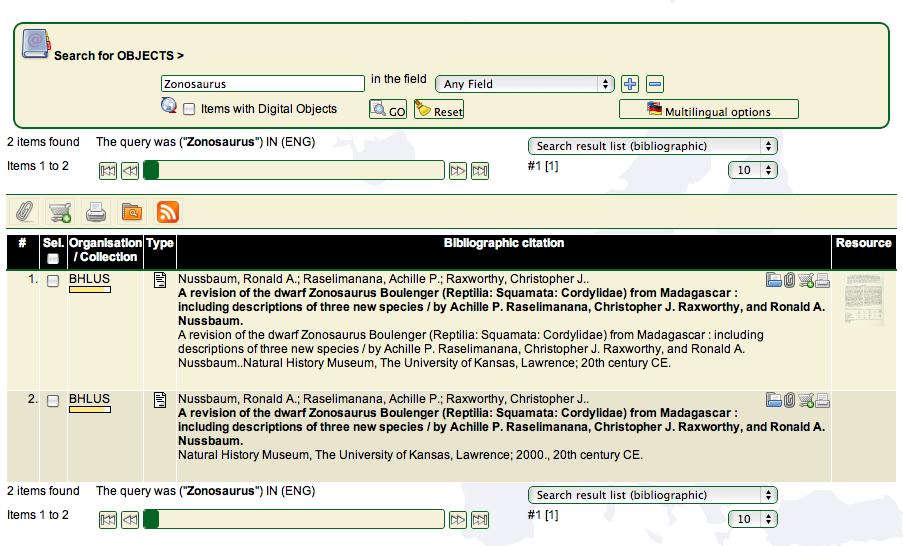
BHL-Europe is the kind of web site only its developers could love. It's spectacularly ugly, and a classic example of what digital libraries came up with while Google was quietly eating their lunch. Here's the web site showing search results for "Zonosaurus":
bhleu.png


Yuck! Why do these things have to be so ugly?. DISMARC was designed to store metadata about digital objects, specifically music. Look at commercial music interfaces such as iTunes, Spotify, and Last.fm. Or even academic projects such as mSpace.

To be useful BHL-Europe really needs to provide an interface that reflects what its users care about, for example taxonomic names, classification, and geography. It can't treat scientific literature as a bunch of lifeless metadata objects (but then again, DISMARC managed to do this for music).

Where next?
CiteBank and BHL-Europe seem further additions to the worthy but ultimately deeply unsatisfying attempts to improve access biodiversity literature. To date our field has failed to get to grips with aggregating metadata (outside of the library setting), creating social networks around that aggregation, and providing intuitive interfaces that enable users to search and browse productively. These are big challenges. I'd like to see the resources that we have put to better use, rather than being used to build tools where suitable alternatives already exist (CiteBank), or used to shoe horn data into generic tools that are unspeakably ugly (BHL-Europe portal) and not fit for purpose. Let's not reinvent the wheel, and let's not try and convince ourselves that squares make perfectly good wheels.

Thursday, October 08, 2009

Linking Bulletin of Zoological Nomenclature to BHL

5839_200px.1254992426.png

After some fussing and hair pulling I've constructed a demo of linking a journal to the Biodiversity Heritage Library and displaying the results in Zotero (see my earlier post for rationale).

After some searching I managed to retrieve metadata for several hundred article from the Bulletin of Zoological Nomenclature. Using a local copy of the BHL metadata, I wrote a script that looked up each article in BHL and found the URL of the first page in the article. I then created a Zotero group for this journal and uploaded the linked references.

You can browse the group, and if you belong to Zotero you can join the group and get a local copy of the references (which you can edit and correct, the harvesting won't be perfect).

I've also added these references to my
bioGUID OpenURL resolver, making it easy to find a given article. For example, the OpenURL link http://bioguid.info/openurl/?genre=article&issn=0007-5167&volume=51&spage=7 displays a page for the article "Doris grandiflora Rapp, 1827 (currently Dendrodoris grandiflora; Mollusca, Gastropoda): proposed conservation of the specific name", together with a link to the article in BHL.


Wednesday, October 07, 2009

Zotero group for Biodiversity Heritage Library content

One thing I find myself doing (probably more often than I should) is adding a reference to my Zotero library for an item in the Biodiversity Heritage Library (BHL). BHL doesn't have article-level metadata (see But where are the articles?), so when I discover a page of interest (e.g., one that contains the original description of a taxon) I store metadata for the article containing that page in my Zotero library. Typically this involves manually step back through scanned pages until I find the start of the article, then store that URL as well as the page number as a Zotero item. As an example, here is the record for Ogilby , J. Douglas (1907). A new tree frog from Brisbane. Proceedings of the Royal Society of Queensland 20:31-32. The URL in the Zotero record http://www.biodiversitylibrary.org/page/13861218 take you to the first page of this article.

One reason for storing metadata in Zotero is so that these reference are made available through the bioGUID OpenURL resolver. This is achieved by regularly harvesting the RSS feed for my Zotero account, and adding items in that feed to the bioGUID database of articles. This makes Zotero highly attractive, as I don't have to write a graphical user interface to create bibliographic records. BHL have their own citation editor in the works ("CiteBank"), based on the ubiquitous Drupal, but I wonder whether Zotero is the better bet -- it has a bunch of nice features, including being able to sync local copies across multiple machines, and store local copies of PDFs (synced using WebDAV).

For fun I've created a Zotero group called Biodiversity Heritage Library which will list articles that I've extracted from BHL. At some point I may investigate automating this process of extracting articles (using existing blbiliographic metadata mapped to BHL page numbers), but for now there a mere 27 manually acquired items listed in the BHL group.


Tuesday, July 14, 2009

Zotero: creating bibliographies in the cloud

zotero_z_32px.png

Lately I've become more and more interested in moving data off my machine(s) and into the cloud. I'm keen to do this partly to avoid having data in one place (e.g., a machine at work) when I need it someplace else (e.g., at home), and there are great tools for doing this (such as the wonderful Dropbox).

As a developer, the cloud appeals, not so much because of the compute power that some are salivating over, but because it may free me from having to create my own software. For example, some time ago I have created an OpenURL resolver to help me find articles online. I harvest a bunch of sources, such as CrossRef, PubMed, some OPAI respositories, etc., but there's always times where I find a reference online that I'd like to add, and that reference doesn't have an identifier such as a DOI.

Typically I add these manually, or by importing a file. I could write some interface code to add (and edit) a bibliographic reference (and, indeed I did some time back), but wouldn't it be great if somebody else had done this for me?

idisk.png
Well, there are some tools out there for handling bibliographies online, such as Connotea, Mendeley, and Zotero (a Firefox add-on). Initially I was skeptical of Zotero (and I'm not a big Firefox user), but now that I'm looking for a place to store obscure papers it's rapidly growing on me. I like the fact that I can add references in situ, and that I can upload PDFs (which can be stored remotely on a WebDAV disk such as an iDisk). But what makes Zotero even more attractive is that it generates an RSS feed of my bibliography, which I can then harvest just as I harvest other resources.

Using a resource like Zotero saves me the hassle of having to write my own bibliographic editor, plus I benefit from using a tool that's a lot more polished than one I could make. Because of this, and my experience with the Google Spreadsheets API, I'm ultimately aiming to never have to write a user interface again. If I write services, and rely on third parties to make tools that can either generate services I can use, or consume my services, then my life becomes a lot simpler.

OK, perhaps I exaggerate. I like making interfaces, such as my eBio09 entry, or the experiment with SpaceTree. However, I can imagine a situation where I don't have to write a data entry interface ever again.

Wednesday, April 15, 2009

LSIDs, to proxy or not to proxy?

The LSID discussion rumbles on (see my earlier post). One issue that has re-emerged is the use of HTTP proxies in RDF documents. In a recent email Greg Whitbread wrote:

The existing TDWG recommendation that "5. All references to LSIDs within RDF documents should use the proxified form", basically states that LSID will never appear in any way other than bundled into an http URI - if we are also to publish data as RDF.

That sounds as if it means that those wanting to use LSID resolution will first have to extract the LSID part from the http URI which will now appear everywhere we would expect to find our unique identifier.

Donald [Hobern] has presented a strong case for unique identifiers conforming to the LSID specification but we have now an equally strong case that in its http form our identifier must behave as a dereferenceable URN per W3C linked data recommendations.
My own view is that the RDF should always contain a canonical, un-proxied version of an identifier (whether LSID or DOI), because:
  1. having only the proxied version assumes that there is only one suitable proxy (there may be multiple ones)
  2. it assumes that the specified proxy will always exist (our track record in durable HTTP services is poor)
  3. assumes the specified proxy will always match conform to current standards
  4. it imposes an overhead on clients that want the canonical identifier (i.e., they have to strip away the proxy)
I predict that for any meaningful, successful (read "actually used") identifier there will be multiple services that will be capable of consuming that identifier, not just HTTP proxies. DOIs can be proxied (by several servers, including http://dx.doi.org/ and http://hdl.handle.net ), resolved using OpenURL resolvers, etc.

In order to play ball with Linked Data, there are several ways forward:
  1. always refer to LSIDs in their proxied form (see above for reasons why this might not be a good idea)
  2. ensure that at least one proxy exists which can resolve LSIDs in a linked data friendly way (see bioGUID as an example)
  3. use or develop linked data clients that understand LSIDs (e.g., http://linkeddata.uriburner.com/, see this view of urn:lsid:zoobank.org:pub:2C6BD020-B54A-4119-9693-3231C9FCEFA6)
2 and 3 already exist, so I'm not so keen on 1.

For me this is one of the biggest hurdles facing using HTTP URIs as identifiers -- I have to choose one. As an analogy, I can identify a book using an ISBN (say, 0226644677). How do I represent this in RDF? Well, I could use an HTTP URI, say http://www.amazon.com/Tangled-Trees-Phylogeny-Cospeciation-Coevolution/dp/0226644677/ , or maybe http://www.worldcat.org/isbn/0226644677. There are many, many I could choose from. However, so long as I know that the ISBN is 0226644677, I'm free to use whatever URI best suits my needs. So, what I really want is the ISBN by itself.

Imagine, for example, a publisher such as PLoS or Magnolia Press (publisher of Zootaxa), both of which have recently published taxonomic papers containing LSIDs (e.g., doi:10.1371/journal.pone.0001787). They might want to display LSIDs linked to their own LSID resolver that embellishes the metadata with information they have (e.g., they might wish to highlight links to other content that they host). In a sense this is much the same idea as supported by OpenURL COinS, where OpenURL-format metadata is embedded in a HTML document and the user choose what resolver to use to resolve the links (including tools such as Zotero).

Having LSIDs prefixed with a HTTP proxy makes these task a little harder.