Showing posts with label specimens. Show all posts

Friday, May 28, 2021

Finding citations of specimens

Note to self.

The challenge of finding specimen citations in papers keeps coming around. It seems that this is basically the same problem as finding citations to papers, and can be approached in much the same way.

If you want to build a database of reference from scratch, one way is to scrape citations from papers (e.g., from the "literature cited" section), convert those strings into structured data, and add those to your database. In the early days of bibliographic searching this was a common strategy (and I still use it to help populate Wikidata).

Regular expressions are powerful but also brittle, you need to keep tweaking them to accommodate all the minor ways citation styles can differ. This leads to more sophisticated (and hopefully robust) approaches, such as machine learning. Conditional random fields (CRF) are a popular technique, pioneered by tools like Parscite and most recently used in the very elegant anystyle.io. You paste in a citation string and you get back that citation with all the component parts (authors, title, journal, pagination, etc.) separated out. Approaches like this require training data to teach the parser how to recognise the parts of a citation string. One obvious way to generate training data is to have a large bibliographic database, a set of "style sheets" describing all the ways different journals represent citations (e.g., citationstyles.org), and then you can generate lots of training data.

Over time the need for citation parsing has declined somewhat, being replaced by simple fulltext search (exemplified by this Tweet);

Again, in the early days a common method of bibliographic search was to search by keys such as journal name (or ISSN), volume number, and starting page. So you had to atomise the reference into its parts, then search for something that matched those parts. This is tedious (OpenURL anyone?), but helps reduce false matches. If you only have a small bibliographic database searching for reference by string matching can be frustrating because you are likely to get lots of matches, but none of them to the reference you are actually looking for. Given how search works you'll pretty much always get some sort of match. What really helps is if the database has the answer to your search (this is one reason Google is so great, if you have indexed the whole web chances are you have the answer somewhere already). Now that CrossRef's database has grown much larger you can search for a reference using a simple string search and be reasonably confident of getting the a genuine hit. The need to atomise a reference for searching is disappearing.

So, armed with a good database and good search tools we can avoid parsing references. Search also opens up other possibilities, such as finding citations using full text search. Given a reference how do you find where it's been cited? One approach is to parse the text of a reference (A), extract the papers in the "literature cited" section (B, C, D, etc.), match those to a database, and add the "A cites B", "A cites C", etc. links to the database. This will answer "what papers does A cite?" but not "what other papers cite C?". One approach to that question would be to simply take the reference C, convert it to a citation string, then blast through all the full text you could find looking for matches to that citation string - these are likely to be papers that cite reference C. In other words, you are finding that string in the "literature cited" section of the citing papers.

So, to summarise:

  1. To recognise and extract citations as structured data from text we can use regular expressions and/or machine learning.
  2. Training data for machine learning can be generated from existing bibliographic data coupled with rules for generating citation strings.
  3. As bibliographic databases grow in size the need for extracting and parsing citations diminishes. Our databases will have most of the citations already, so that using search is enough to find what we want.
  4. To build a citation database we can parse the literature cited section and extract all references cited by a paper ("X cites")
  5. Another approach to building a citation database is to tackle the reverse question, namely "X is cited by". This can be done by a full text search for citation strings corresponding to X.

How does this relate to citing specimens you ask? Well, I think the parallels are very close:

  • We could use CRF approaches to have something like anystyle.io for specimens. Paste in a specimen from the "Materials examined" section of a paper and have it resolved into its component parts (e.g., collector, locality, date).
  • We have a LOT of training data in the form of GBIF. Just download data in Darwin Core format, apply various rules for how specimens are cited in the literature, and we have our training data.
  • Using our specimen parser we could process the "Materials examined" section of a paper to find the specimens (Plazi extracts specimens from papers, although it's not clear to me how automated this is.)
  • We could also do the reverse: take a Darwin Core Archive for, say, a single institution, generate all the specimen citation strings you'd expect to see people use in their papers, then go search through the full text of papers (e.g., in PubMed Central and BHL) looking for those strings - those are citations of your specimens.

There seems a lot of scope for learning from the experience of people working with bibliographic citations, especially how to build parsers, and the role that "stylesheets" could play in helping to understand how people cite specimens. Obviously, a lot of this would be unnecessary if there was a culture of using and citing persistent identifiers for specimens, but we seem to be a long way from that just yet.

Friday, August 15, 2014

Some design notes on modelling links between specimens and other kinds of data

If we view biodiversity data as part of the "biodiversity knowledge graph" then specimens are a fairly central feature of that graph. I'm looking at ways to link specimens to sequences, taxa, publications, etc., and doing this across multiple data providers. Here are some rough notes on trying to model this in a simple way.

For simplicity let's suppose that we have this basic model:

Core

A specimen comes from a locality (ideally we have the latitude and longitude of that locality), it is assigned to a taxon, we have data derived from that specimen (e.g., one or more DNA sequences), and we have one or more publications about that specimen (e.g., a paper that publishes a taxon name for which the specimen is a type, or a paper that publishes a sequence for which the specimen is a voucher).

Ncbi

NCBI


In GenBank we have sequences that have accession numbers, and these are linked to taxa (identified by NCBI tax ids). A nice feature of sequence databases is that taxa are explicitly defined by extension, that is, a taxon is the set of sequences assigned to a given taxon. Most (but not all, see Miller et al. doi:10.1186/1756-0500-2-101) sequences are also linked to a publication, which will usually have a PubMed id (PMID), and sometimes a DOI. Many sequences are also georeferenced (see Guest post: response to "Putting GenBank Data on the Map"). Most sequences aren't linked to a voucher specimen, but there is the implict notion of a source (in RDF-speak, many specimens are "blank nodes" Blank nodes for specimens without URI). Some sequences are associated with a specimen that has a museum code, and some are explicitly linked to the specimen by a URL.

Barcodes

DNA barcodes


Barcodes, as represented in BOLD are similar to sequences in GenBank. We have explicit taxa ("BINs") each of which has a URL, some also having DOIs. Most barcodes are georeferenced. There's some ambiguity about whether the URL for a barcode record identifies the barcode sequence, the specimen, or both. There may be a voucher code for the specimen. Some barcodes are linked to publications, but not (as far as I can see) in the data obtained from the API. Some barcodes are linked to the corresponding record in GenBank (which may or may not be supressed, see Dark taxa even darker: NCBI pulls (some) DNA barcodes from GenBank (updated)).

Gbif

GBIF


At it's core GBIF has occurrence records (many of these are specimen-based, but the majority of data in GBIF is actually observation-based), each of which has a unique id, and which is linked to a taxon, also with a unique id. As with the sequence databases, a taxon is a set of occurrences that have been assigned to that taxon. Many records in GBIF are georeferenced. There are limited cross links to other database - some occurrences list associated GenBank sequences. Some GBIF occurrences actually are sequences (e.g., the European Molecular Biology Laboratory Australian Mirror and the soon to be indexed Geographically tagged INSDC sequences), and barcodes are also making their way into GBIF (e.g., Zoologische Staatssammlung Muenchen - International Barcode of Life (iBOL) - Barcode of Life Project Specimen Data). Links to publications are limited.

Museum

Museums and herbaria


Some individual natural history collections which are online provide specimen-level web pages and URLs (some even have DOIs, see DOIs for specimens are here, but we're not quite there yet), and some museums list associated GenBank sequences. In the diagram I've not linked the specimens to a taxon, because most specimens are tagged by a name, not an explicit taxon concept (unlike NCBI, BOLD, or GBIF).

Literature

Literature


Literature databases (represented here by BioStor, but could be other sources such as ZooKeys, for example) may contain articles that mention specimen codes. These articles may also mention taxon names, and geographic localities (including coordinates) (see, for example, Linking GBIF and the Biodiversity Heritage Library. Mining text for names, specimens, and localities is fairly easy, but linking these together is harder (i.e., this specimen is of this taxon, and was found at this locality).

Linking together


If we have these separate sources and this trivial model, then we can imagine trying to tie information about the same specimen together across the different databases. Why might we want to do this. Here are three reasons:

  1. Augmentation Combining information can enhance our understanding of a specimen. Perhaps a specimen in GBIF is a geographic outlier. A publication that mentions the specimen includes it in a new taxon, perhaps discovered by sequencing DNA extarcted from that specimen. Linking this information together resolves the problematic distribution.
  2. Provenance What is the evidence that a particular specimen belongs to a particualr taxon, or was collected at a particular locality? If we connect specimens to the literature we we can review the evidence for ourselves. If we have sequences we can run BLAST, build a tree, and see if we should rethink our classification of that sequence. Imagine being able to browse GBIF and see the evidence for each dot on the map?
  3. Citation Mentions in the literature, use as vouchers for DNA barcoding or other forms of sequencing can be thought of a "citation" of that specimen. Museums hosting that material could use metrics base don this to demonstrate the value of their collection (see also The impact of museum collections: one collection ≈ one Nobel Prize).
Model

Making the links


All this is well and good, the trick is to actually make the links. Here things get horribly messy very quickly. Museum specimens are cited in inconsistent ways, we don't have widely used unique, resolvable specimen identifiers, and even if we did have these identifiers we don't have a global discovery mechanism for matching voucher codes to identifiers. GBIF would be an obvious part of a "global discovery mechanism" (bit like CrossRef but for specimens), GBIF can have multiple records for the same specimen. Sometimes this is because GBIF not only aggregates data from primary sources (such as museums) but also other aggregations which may themselves already include specimens harvested from primary sources. GBIF can also have multiple records because museums keep messing with their databases, try new variants of the Darwin Core triple, etc., resulting in records that look "new" to GBIF. Whole collections can be duplicate din this way.

One way to tackle this multiplicity of specimen records is to think in terms of "clusters" of specimens that are, in some sense, the same thing across multiple databases. For example, clustering a set of duplicated GBIF records together with the sequences derived from those specimens, perhaps including a DNA barcode, and a list of papers that mention that specimen. This is represented by the yellow bar through the diagram, it connects all the different pieces of information about a specimen into a single cluster. More *cough* later.

Monday, April 21, 2014

Is collecting specimens necessary?

Some interesting threads in TAXACOM today (yes, really). The following article has appeared in Science:
Minteer, B. A., Collins, J. P., Love, K. E., & Puschendorf, R. (2014, April 18). Avoiding (Re)extinction. Science. American Association for the Advancement of Science (AAAS). doi:10.1126/science.1250953 (paywall)
The authors argue that "The availability of adequate alternative methods of documentation, including high-resolution photography, audio recording, and nonlethal sampling, provide an opportunity to revisit and reconsider field collection practices and policies."

This has brought a swift response from Kevin Winkler
(Re)affirming the specimen gold standard who argues that physical specimens are vital for much of the science that museum collections support.

At the same time, David Schindel has posted on Minimum standards for e-voucher documentation, that is, DNA samples where no physical voucher exists (e.g., because the organism is a member of an endangered species, or still alive).

Tuesday, January 15, 2013

iDigBio: You are putting identifiers on the wrong thing

LogoThe Integrated Digitized Biocollections (iDigBio) project aims to advance digitising US biodiversity collections. They recently published a GUID Guide for Data Providers. In the PDF document I read this:
It has been agreed by the iDigBio community that the identifier represents the digital record (database record) of the specimen not the specimen itself. Unlike the barcode that would be on the physical specimen, for instance, the GUID uniquely represents the digital record only. (emphasis added)

My heart sank. There's nothing wrong with having identifiers for metadata (apart from inviting the death spiral that is metadata about metadata), but surely the key to integrating specimens with other biodiversity data is to have globally unique identifiers for the specimens.

Now, identifiers for metadata can be useful. For example, there is a specimen of Parathemisto japonica in the National Museum of Natural History, Smithsonian Institution with the label "USNM 100988". The NMNH web site has a picture of the index card for this specimen:

Search php

This is an image of the metadata, not the specimen itself. We could link the metadata to this image, but of course we also want to link it to the actual specimen.

Specimens are the things we collect, preserve, dissect, measure, sequence, photograph, and so on. I want to link a specimen to the sequences that have been obtains from that specimen, I want to list the publications that cite that specimen, I want to be able to aggregate data on a specimen from multiple sources, I want to be able to add annotations including misidentifications, simple typos, or missing georeferencing.

Key to this is having identifiers for specimens. Identifiers for metadata about those specimens is not good enough. By analogy with bibliographic citation, one of the important decisions CrossRef made was that DOIs for articles identify the article, not the metadata about the article, or any of the different formats (HTML, PDF, print) and article may occur in. This means we can build databases about things and relationships (this article cites that one, these articles were authored by this person, etc.).

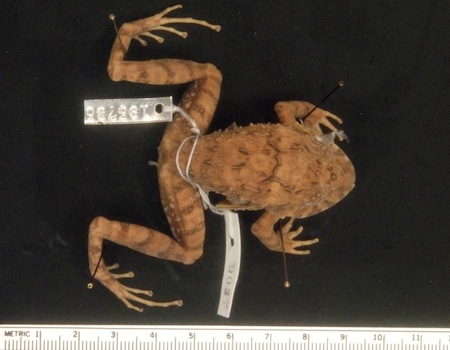
As it stands, if we don't have identifiers for specimens then we can't link data together. For example, the frog specimen "USNM 195785" is depicted in the image below (from EOL):

89351 orig

It is also listed in various papers in BioStor. In the absence of a globally unique identifier for this specimen how do I make these links? "USNM 195785" won't do because there are at least four specimens in the USNM with the catalogue number "195785". The GBIF occurrence id for this specimen (http://data.gbif.org/occurrences/244405570) would be an obvious candidate, were it not for the fact that GBIF has no concept of stable identifiers and its occurrence ids regularly change.

I confess I'm flabbergasted that iDigBio has avoid tackling the issue of specimen identifiers. If any museum wants to discover how its collection is being used to support science it will want to find the citations of its specimens in scientific papers and databases. This requires identifiers for specimens.

Friday, April 20, 2012

Quick thoughts on specimen identifiers

Based on recent discussions my sense is that our community will continue to thrash the issue of identifiers to death, repeating many of the debates that have gone on (and will go on) in other areas. To be trite, it seems to me we have three criteria: cheap, resolvable, and persistent. We get to pick two.

Cheap and resolvable means URLs, which everybody is nervous about because they break. They don't have to break, but for a bunch of reasons they do.

Cheap and persistent means things like Darwin Triplet Core or URNs. You can write things on paper and they will persist (the Biodiversity Heritage Library shows us that), but how in the digital era do we do anything with this? If it's not resolvable what, exactly, is the point? We tried URNs — even ones that were resolvable (LSIDs) — and that was a disaster (we learnt a lot, but what a mess).

Resolvable and persistent. This is where technologies such as DOIs reside. If every specimen had a DOI would we still be having this discussion? We'd have a resolvable identifier that is resistant to change (including loss of museum domain names, specimens moving to new institutions, etc.), and one that is already in use by CrossRef and DataCite, and will also play ball with linked data folks.

In practical terms, what if we had a convention that each collection gets it's own DOI prefix "10.nnnn", after which it appends whatever specimen identifier makes sense (and is unique within that collection).

The bulk of specimen identifiers in the wild are of the form "Institution" "Catalogue number", e.g. ANSP 332467 (from the example I discussed in BHL and GBIF as biomedical databases).

If we wrote this as a DOI of the form <doi prefix>/Collection/InstitutionCatalogue number then we'd have identifiers that (in part) matched what most people would expect to see. In the example above we would have something like:

10.nnnnn/MAL/ANSP332467

where "MAL" is the acronym for the Malacology collection. This is pretty close to "ANSP 332467", is human friendly, but would also be resolvable. It also carries limited branding, so if the specimen was moved from it's current collection to a new institution, people wouldn't get too upset by the presence of "ANSP"). It would also help make the links between specimen codes and DOIs. We couldn't rely on 10.nnnnn/MAL/ANSP332467 being a specimen in the Academy of Natural Sciences's malacological collection, but it would be a good place to start looking.

As I've argued before, we could centralise the minting of these identifiers using GBIF, but do it in a such a way that host institutions could assume responsibility for it if and when they are able (i.e., initially GBIF is responsible for managing the DOI prefixes for each institution, with the option for institutions to do this). The beauty of identifiers like DOIs is that from the user's perspective the identifier is unchanged.

I'm hoping we'll make some progress on this in the coming months...

Wednesday, January 18, 2012

Yet another reason why we need specimen identifiers, now!

This message appeared on the TAXACOM mailing list:

It is getting more and more necessary for taxonomists to demonstrate
that they are useful and used. This does not only apply to the
individual scientists, but also to institutions with taxonomic
collections, such as museums and herbaria.

In an attempt to live up to that increasing demand for documentation,
the leadership of the Natural History Museum of Denmark has issued an
order to its curatorial staff - The staff members are requested to
document which publications from 2011, written entirely by external
scientists, that in one way or another are based on material in the
collections of the Museum.


Given that most specimens lack resolvable digital identifiers (a theme I've harped on about before, most recently in the context of DNA barcoding), answering this kind of query ends up being a case of searching publications for text strings that contain the acronym of the collection. The sender of the message, Ib Friis, is alarmed at this prospect:

In publications, material from our herbarium at "C" is normally referred
to in text strings of one of the following forms: "(C)", "(C, ", ", C,"
or " C)". But a search in for example Google Scholar or other search
engines result in overflow of thousands and thousands of hits, even
when these text strings are combined with other relevant words such as
"botany", "plants", etc.


In an earlier paper "Biodiversity informatics: the challenge of linking data and the role of shared identifiers" (http://dx.doi.org/10.1093/bib/bbn022) (free preprint available here: hdl:10101/npre.2008.1760.1) I argued that having resolvable identifiers for specimens could enable measures of "citation" to be computed for specimens (and data derived from those specimens). Just as we have citation counts for articles and impact factors for journals, we could have equivalent measures for specimens and collections. These measures may keep administrators happy, for scientists I think the real benefits will be the ability to trace the provenance of some data, and the fate of data they themselves have collected or published.

For things such as publications it is trivial to track their usage. For example, to find the number of times the article "Biodiversity informatics: the challenge of linking data and the role of shared identifiers" has been cited, I simply enter the DOI into Google Scholar, e.g. http://scholar.google.co.uk/scholar?q=10.1093/bib/bbn022. Imagine being able to do the same for specimens?

For this to happen, museum specimens need digital identifiers. If museums are serious about quantifying the impact of their collections, they should make assigning digital identifiers a priority.

Sunday, December 11, 2011

DNA Barcoding, the Darwin Core Triplet, and failing to learn from past mistakes

Banner05
Given various discussions about identifiers, dark taxa, and DNA barcoding that have been swirling around the last few weeks, there's one notion that is starting to bug me more and more. It's the "Darwin Core triplet", which creates identifiers for voucher specimens in the form <institution-code>:<OPTIONAL collection-code>:<specimen-id>. For example,

MVZ:Herp:246033

is the identifier for specimen 246033 in the Herpetology collection of the Museum of Vertebrate Zoology (see http://arctos.database.museum/guid/MVZ:Herp:246033).

On the face of it this seems a perfectly reasonable idea, and goes some way towards addressing the problem of linking GenBank sequences to vouchers (see, for example, http://dx.doi.org/10.1016/j.ympev.2009.04.016, preprint at PubMed Central). But I'd argue that this is a hack, and one which potentially will create the same sort of mess that citation linking was in before the widespread use of DOIs. In other words, it's a fudge to postpone adopting what we really need, namely persistent resolvable identifiers for specimens.

In many ways the Darwin Core triplet is analogous to an article citation of the form <journal>, <volume>:<starting page>. In order to go from this "triplet" to the digital version of the article we've ended up with OpenURL resolvers, which are basically web services that take this triple and (hopefully) return a link. In practice building OpenURL resolvers gets tricky, not least because you have to deal with ambiguities in the <journal> field. Journal names are often abbreviated, and there are various ways those abbreviations can be constructed. This leads to lists of standard abbreviations of journals and/or tools to map these to standard identifiers for journals, such as ISSNs.

This should sound familiar to anybody dealing with specimens. Databases such as the Registry of Biological Repositories and the Biodiversity Collectuons Index have been created to provide standardised lists of collection abbreviations (such as MVZ = Museum of Vertebrate Zoology). Indeed, one could easily argue that the what we need is an OpenURL for specimens (and I've done exactly that).

As much as there are advantages to OpenURL (nicely articulated in Eric Hellman's post When shall we link?), ultimately this will end in tears. Linking mechanisms that depend on metadata (such as museum acronyms and specimen codes, or journal names) are prone to break as the metadata changes. In the case of journals, publishers can rename entire back catalogues and change the corresponding metadata (see Orwellian metadata: making journals disappear), journals can be renamed, merged, or moved to new publishers. In the same way, museums can be rebranded, specimens moved to new institutions, etc. By using a metadata-based identifier we are storing up a world of hurt for someone in the future. Why don't we look at the publishing industry and learn from them? By having unique, resolvable, widely adopted identifiers (in this case DOIs) scientific publishers have created an infrastructure we now take for granted. I can read a paper online, and follow the citations by clicking on the DOIs. It's seamless and by and large it works.

On could argue that a big advantage of the Darwin Core triplet is that it can identify a specimen even if it doesn't have a web presence (which is another way of saying that maybe it doesn't have a web presence now, but it might in the future). But for me this is the crux of the matter. Why don't these specimens have a web presence? Why is it the case that biodiversity informatics has failed to tackle this? It seems crazy that in the context of digital data (DNA sequences) and digital databases (GenBank) we are constructing unresolvable text strings as identifiers.

But, of course, much of the specimen data we care about is online, in the form of aggregated records hosted by GBIF. It would be technically trivial for GBIF to assign a decent identifier to these (for example, a DOI) and we could complete the link between sequence and specimen. There are ways this could be done such that these identifiers could be passed on to the home institutions if and when they have the infrastructure to do it (see GBIF and Handles: admitting that "distributed" begets "centralized").

But for now, we seem determined to postpone having resolvable identifiers for specimens. The Darwin Core triplet may seem a pragmatic solution to the lack of specimen identifiers, but it seems to me it's simply postponing the day we actually get serious about this problem.


Tuesday, October 21, 2008

OpenURL for specimens


As part of the slow rebuild of bioguid.info, and as part of the Challenge, I've started making an OpenURL resolver for specimens. Partly this is just a wrapper around DiGIR providers, but it's also a response to the lack of GUIDs for specimens. In the same way that I think OpenURL for papers only really makes sense in a world without GUIDs for literature (DOIs pretty much take care of that), given the lack of specimen GUIDs we are left to resolve specimens based on metadata.

For example, the holotype of Pseudacris fouquettei (shown in photo by Suzanne L. Collins, original here) is TNHC 63583. In a digital world, I want the paper describing this taxon, and the specimen(s) assigned to it to be a click away. In this spirit, here is an OpenURL link for the specimen: http://bioguid.info/openurl/?genre=specimen &institutionCode=TNHC &collectionCode=Herps &catalogNumber=63583. Click on this link and you get a page with some very basic information on the specimen. If you want more, append "&display=json" to the URL to get a JSON response.

So, armed with this, TNHC 63583 becomes resolvable, and joining the pieces becomes a little easier.