Showing posts with label JSON. Show all posts

Thursday, July 22, 2021

Towards a WikiCite search engine

I've released a simple search engine for publications in Wikidata. Wikicite Search takes its name from the WikiCite project, which was an initiative to create a bibliographic database in Wikidata. Since bibliographic data is a core component of taxonomic research (arguably taxonomy is mostly tracing the fate of the "tags" we call taxonomic names) I've spent some time getting taxonomic literature into Wikidata. Since there are bots already adding articles by harvesting sources such as CrossRef and PubMed, I've focussed on literature that is harder to add, such as articles with non-CrossRef DOIs, or those without DOIs at all.

Once you have a big database, you are then faced with the challenge of finding things in that database. Wikidata supports generic search, but I wanted something more closely geared to bibliographic data. Hence Wikicite Search. Over the last few years I've made several attempts at a bibliographic search engine, for this project I've finally settled on some basic ideas:

  1. The core data structure is CSL-JSON, a simple but rich JSON format for expressing bibliographic data.
  2. The search engine is Elasticsearch. The documents I upload include the CSL-JSON for an article, but also a simple text representation of the article. This text representation may include multiple languages if, for example, the article has a title in more than one language. This means that if an article has both English and Chinese titles you can find it searching in either language.
  3. The web interface is very simple: search for a term, get results. If the search term is a Wikidata identifier you get just the corresponding article, e.g. Q98715368.
  4. There is a reconciliation API to help match articles to the database. Paste in one citation per line and you get back matches (if found) for each citation.
  5. Where possible I display a link to a PDF of the article, which is typically stored in the Internet Archive or accessible via the Wayback Machine.

There are millions of publications in Wikidata, currently less than half a million are in my search engine. My focus is narrowly on eukaryote taxonomy and related topics. I will be adding more articles as time permits. I also periodically reload existing articles to capture updates to the metadata made by the Wikidata community - being a wiki the data in Wikidata is constantly evolving.

My goal is to have a simple search tool that focusses on matching citation strings. In other words, it is designed to find a reference you are looking for, rather than be a tool to search the taxonomic literature. If that sounds contradictory, consider that my tool will only find a paper about a taxon if it is explicitly named in the title. A more sophisticated search engine would support things like synonym resolution, etc.

The other reason I built this is to provide an API for accessing Wikidata items and displaying them in other formats. For example, an article in the WikiCite search engine can be retrieved in CSL-JSON format, or in RDF as JSON-LD.

As always, it's very early days. But I don't think it's unreasonable to imagine that as Wikidata grows we could envisage having a search engine that includes the bulk of the taxonomic literature.

Friday, March 24, 2017

Notes for WikiCite 2017: Wikispecies reference parsing

Wikispecies logo svg In preparation for WikiCite 2017 I'm looking more closely at extracting bibliographic information from Wikispecies. The WikiCite project "is a proposal to build a bibliographic database in Wikidata to serve all Wikimedia projects". One reason for doing this is so that each factual statement in WikiData can be linked to evidence for that statement. Practical efforts towards this goal include tools to add details of articles from CrossRef and PubMed straight into Wikidata, and tools to extract citations from Wikipedia (as these are likely to be sources of evidence for statements made in Wikipedia articles).

Wikispecies occupies a rather isoldated spot in the Wiikipedia landscape. Unlike other sites which are essentially comprehensive encyclopedias in different languages, Wikispecies focusses on one domain - taxonomy. In a sense, it's a prototype of Wikidata in that it provides basic facts (who described what species when, and what is the classification of those species) that in principle can be reused by any of the other wikis. However, in practice this doesn't seem to have happened much.

What Wikispecies has become, however, is a crowd-sourced database of the taxonomic literture. For someone like me who is desparately gathering up bibliographic data so that I can extract articles from the Biodiversity Heritage Library (BHL), this is a potential goldmine. But, there's a catch. Unlike, say, the English language Wikipedia which has a single widely-used template for describing a publication, Wikispecies has it's own method of representing articles. It uses a somewhat confusing mix of templates for author names, and then uses barely standardised formatting rules to mark out parts of a publication (such as journal, volume, issue, etc.). Instead of a single template to describe a publication, in Wikispecies a publication my itself be described by a unique template. This has some advantages, in that the same reference can be transcluded into multiple articles (in other words, you enter the bibliographic details once). But this leaves us with many individual templates with multiple, idiosyncratic styles of representing bibliographic data. Some have tried to get the Wikispecies community to adopt the same template as Wikipedia (see e.g., this discussion) but this proposal has met with a lot of resistance. From my perspective as a potential consumer of data, the current situation in Wikispecies is frustrating, but the reality is that the people who create the content get to decide how they structure that content. And understandably, they are less than impressed by requests that might help others (such as data miners) at the expense of making their own work more difficult.

In summary, if I want to make use of Wikispecies I am going to need to develop a set of parsers than can make a reasonable fist of parsing all the myriad citation formats used in Wikispecies (my first attempts are on GitHub). I'm looking at parsing the references and converting them to a more standard format in JSON (I've made some notes on various bibliographic formats in JSON such as BibJSON and CSL-JSON). One outcome of this work will be, I hope, more articles discovered in BHL and hence added to BioStor), and more links to identifiers, which could be fed back into Wikispecies. I also want to explore linking the authors of these papers to identifiers, as already sketched out in The Biodiversity Heritage Library meets Wikidata via Wikispecies: adding author identifiers to BioStor.

Wednesday, July 22, 2015

Steve Baskauf on RDF and the "Rod Page Challenge"

Rdf w3c icon 128Steve Baskauf has concluded a thoughtful series of blog posts on RDF and biodiversity informatics with http://baskauf.blogspot.co.uk/2015/07/confessions-of-rdf-agnostic-part-7.html. In this post he discussed the "Rod Page Challenge", which was a series of grumpy posts I wrote (starting with this one) where I claimed RDF basically sucked, and to illustrate this I issued a challenge for people to do something interesting with some RDF I provided. Since this RDF didn't have a stable home I've put it on GitHub and it has a DOI http://dx.doi.org/10.5281/zenodo.20990 courtesy of GitHub's integration with Zenodo.

I argued that the RDF typically available was basically useless because it wasn't adequately linked (see Reflections on the TDWG RDF "Challenge"). Two of the RDF files I provided were created specifically created to tackle this problem (derived from my projects iPhylo Linkout http://dx.doi.org/10.1371/currents.RRN1228 and the precursor to BioNames http://dx.doi.org/10.7717/peerj.190). This marked pretty much the end of any interest I had in pursuing RDF.

Towards the end of Steve's post he writes:

At the close of my previous blog post, in addition to revisiting the Rod Page Challenge, I also promised to talk about what it would take to turn me from an RDF Agnostic into an RDF Believer. I will recap the main points about what I think it will take in order for the Rod Page Challenge to REALLY be met (i.e. for machines to make interesting inferences and provide humans with information about biodiversity that would not be obvious otherwise):

  1. Resource descriptions in RDF need to be rich in triples containing object properties that link to other IRI-identified resources.
  2. "Discovery" of IRI-identified resources is more likely to lead to interesting information when the linked IRIs are from Internet domains controlled by different providers.
  3. Materialized entailed triples do not necessarily lead to "learning" useful things. Materialized entailed triples are useful if they allow the construction of more clever or meaningful queries, or if they state relationships that would not be obvious to humans.

Steve's point 1 is essentially the point I was making with the challenge. At the time of the challenge, RDF from major biodiversity informatics projects was in silos, with few (if any) links to external resources (the kinds of things Steve refers to in his point 2). As a result, the promised benefits from RDF simply haven't materialised. The lesson I took from this is that we need rich, dense cross-links between data sources (the "biodiversity knowledge graph"), and that's one reason I've been obsessed with populating BioNames, which links animal names to the primary literature (I'm planning to extend this to plants as well). Turns out , creating lots of cross links is really hard work, much harder than simply pumping out a bunch of RDF and waiting for it to automagically coalesce into an all-connected knowledge graph.

I posed the challenge back in 2011, and since then I think the landscape has changed to the extent that I wonder if trying to "fix" RDF is really the way forward.

XML is dead

Anyone (sane) developing for the web and wanting to move data around is using JSON, XML is hideous and best avoided. Much of the early work on RDF used XML, which only made things even harder than they already were. JSON beats XML, to the extent that RDF itself now has a JSON serialisation, JSON-LD. But JSON-LD is about more than the semantic web (see JSON-LD and Why I Hate the Semantic Web), and has the great advantage that you can actually ignore all the RDF cruft (i.e., the namespaces) and simply treat the data as key-value pairs (yay!). Once you do that, then you can have fun with the data, especially with databases such as CouchDB ("fun" and "database" in the same sentence, I know!).

Key-value pairs, document stores, and graph databases

The NoSQL "movement" has thrown up all sorts of new ways to handle data and to think about databases. We can think of RDF as describing a graph, but it carries the burden of all the namespaces, vocabularies, and ontologies that come with it. Compare that with the fun (there's that word again) of graph databases such as Neo4J with its graph gists. The Neo4J folks have made a great job of publicising their approach, and making it easy and attractive to play with.

So, we're in a interesting time when there are a bunch of technologies available, and I think maybe it's time to ask whether the community's allegiance to RDF and the Semantic Web has been somewhat misplaced...

Friday, September 10, 2010

CouchDB, Mendeley, and what I really want in an iPad article viewer

Playing with @couchdb, starting to think of the Mendeley API as a read/write JSON store, and having a reader app built on that...less than a minute ago via Tweetie for Mac


It's slowly dawning on me that many of the ingredients for an alternative different way to browse scientific articles may already be in place. After my first crude efforts at what an iPad reader might look like I've started afresh with a new attempt, based on the Sencha Touch framework. The goal here isn't to make a polished app, but rather to get a sense of what could be done.

The first goal is to be able to browse the literature as if it was a connected series of documents (which is what, of course, it is). This requires taking the full text of an article, extracting the citations, and making them links to further documents (also with their citations extracted, and so on). Leaving aside the obvious problem that this approach is limited to open access articles, an app that does this is going to have to store a lot of bibliographic data as the reader browses the literature (otherwise we going to have to do all the processing on the fly, and that's not going to be fast enough). So, we need some storage.

MySQL
One option is to write a MySQL database to hold articles, books, etc. Doable (I've done more of these than I care to remember), but things get messy pretty quickly, especially as you add functionality (tags, fulltext, figures, etc.).

RDF
Another option is to use RDF and a tripe store. I've played with linked data quite a bit lately (see previous "Friday follies" here and here), and I thought that a triple store would be a great way support an article browser (especially as we add additional kinds of data, such as sequences, specimens, phylogenies, etc.). But linked data is a mess. For the things I care about there are either no canonical identifiers, or too many, and rarely does the primary data provider served linked data compliant URLs (e.g., NCBI), hence we end up with a plethora of wrappers around these sources. Then there's the issue of what vocabularies to use (once again, there are either none, or too many). As a query language SPARQL isn't great, and don't even get me started on the issue of editing data. OK, so I get the whole idea of linked data, it's just that the overhead of getting anything done seems too high. You've got to get a lot of ducks to line up.

CounchDBlogo.png
So, I started playing with CounchDB, in a fairly idle way. I'd had a look before, but didn't really get my head around the very different way of querying a database that CouchDB requires. Despite this learning curve, CouchDB has some great features. It stores documents in JSON, which makes it trivial to add data as objects (instead of mucking around with breaking them up into tables for SQL, or atomising them into triples for RDF), it supports versioning right out of the box (vital because metadata is often wrong and needs to be tidied up), and you talk to it using HTTP, which means no middleware to get in the way. You just point your browser (or curl, or whatever HTTP tool you have) and send GET, POST, PUT, or DELETE commands. And now it's in the cloud.

In some ways ending up with CouchDB (or something similar) seems inevitable. The one "semantic web" tool that I've made most use of is Semantic MediaWiki, which powers the NCBI to Wikipedia mapping I created in June. Semantic Mediawiki has it's uses, but occasionally it has driven me to distraction. But, when you get down to it, Semantic Mediawiki is really just a versioned document store (where the documents are typically key-value pairs), over which have been laid a pretty limited query language and some RDF export features. Put like this, most of the huge Mediawiki engine underlying Semantic MediaWiki isn't needed, so why not cut to the chase and use a purpose-built versioned document store? Enter CouchDB.

Browsing and Mendeley
So, what I have in mind is a browser that crawls a document, extracting citations, and enabling the reader to explore those. Eventually it will also extract all the other chocolatey goodness in an article (sequences, specimens, taxonomic names, etc.), but for now I'm focussing on articles and citations. A browser would need to store article metadata (say, each time it encounters an article for the first time), as well as update existing metadata (by adding missing DOIs, PubMed ids, citations, etc.), so what easier way than as JSON in a document store such as CouchDB? This is what I'm exploring at the moment, but let's take a step back for a second.

The Mendeley API, as poorly developed as it is, could be treated as essentially a wrapper around a JSON document store (the API stores and returns JSON), and speaks HTTP. So, we could imagine a browser that crawls the Mendeley database, adding papers that aren't in Mendeley as it goes. The act of browsing and reading would actively contribute to the database. Of course, we could spin this around, and argue that a crawler + CouchDB could pretty effectively create a clone of Mendeley's database (albeit without the social networking features that come with have a large user community).

This is another reason why the current crop of iPad article viewers, Mendeley's included, are so disappointing. There's the potential to completely change the way we interact with the scientific literature (instead of passively consuming PDFs), and Mendeley is ideally positioned to support this. Yes, I realise that for the vast majority of people being able to manage their PDFs and format bibliographies in MS Word are the killer features, but, seriously, is that all we aspire too?

Wednesday, September 30, 2009

Visualising the Biodiversity Heritage Library as a Timeline

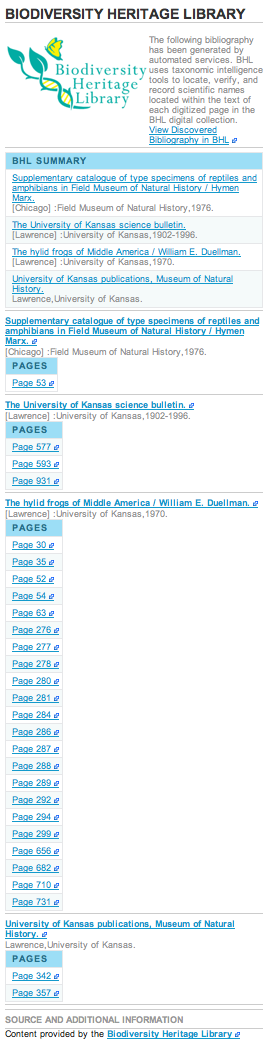
bhlstrip.pngOne thing about the Encyclopedia of Life which bugs me no end is the awful way it displays the bibliography generated from the Biodiversity Heritage Library (BHL). The image on the right shows the bibliography for the frog Hyla rivularis Taylor, 1952. It's one long, alphabetical list of pages. How can a user make sense of this? It's even more annoying because the BHL is one of the cornerstones of EOL, and one could argue that BHL content is one of the few thing pages EOL offer that distinguishes them from cheap and cheerful mashups such as iSpecies. Can't we do something a little better?

BHL has an API (documented here), so I decided to experiment. As I mentioned in an earlier post (Biodiversity Heritage Library, Google books, and metadata quality), a key piece of metadata about a bibliographic reference is its date. This is especially so for the taxonomic literature, where the earliest reference that contains a name may (depending on how complete BHL scanning is) be the first description of that name. So, it would be nice to order the BHL bibliography by date. Turns out it's possible to get dates from quite a few BHL items, providing one fusses with regular expressions long enough.

So, in principle we could sort BHL content by dates. But, we could go one better and visualise them. As an experiment, I've put together a demo that uses the SIMILE Timeline widget to display the BHL bibliography for a taxon. Here's a screenshot of the bibliography for Hyla rivularis:
bhltimeline.png


You can generate others at http://bioguid.info/bhl/. The demo has been thrown together in haste, but here's what it does:
  1. Takes a taxon name and tries to find it in uBio. This gives us the NamebankID BHL needs
  2. Calls the BHL API and retrieves the bibliography for the NamebankID found in step 1
  3. Parses the BHL result, trying to extract dates (often the dates are ranges, e.g. 1950-1955)
  4. The previous step generates a JSON document which can be displayed by Timeline

If you click on an item you get a list of pages, clicking on any those takes to you to the page in BHL. Items that have a range of dates are displayed as horizontal lines, items with a well-defined date are shown as points. Note that my code for working out the date of an item will probably fail on some items, and some items don't have any dates at all. Hence, not every item in BHL will appear in the timeline.

It would be nice to embellish the results a little (for example, group pages into articles, refine the dates, etc.) but I think this goes a little way to demonstrating what can be done. We could also add articles obtained from other sources (e.g., Google Scholar, PubMed) to the same display, providing an overview of published knowledge about a taxon.

Wednesday, October 29, 2008

OpenURL for Genbank records

Following on from adding specimens to my OpenURL resolver, I've added support for GenBank records. Either an OpenURL request such as http://bioguid.info/openurl?id=genbank:DQ502033, or the short URL http://bioguid.info/genbank/DQ502033 will resolve the GenBank record for accession number DQ502033.

The HTML isn't much to look at, the real goodness is the JSON (obtained by appending "&display=json" to the OpenURL request, or ".json" to the short form, e.g. http://bioguid.info/genbank/DQ502033.json).

The resolver gets the sequence form NCBI, does a little post processing, then displays the result. Postprocesisng includes parsing the latitude and longitude coordinates (something of a mess in GenBank, see my earlier metacrap rant), extracting specimen codes, adding bibliographic GUIDs (such as DOIs, Handles, or URLs), finding uBio namebankID's for hosts, etc. Note that some records have a key called "taxonomic_group". This is to provide clues for resolving museum specimens -- often the DiGIR provider needs to know what kind of taxon you are searching for.

The aim is to have a simple service that returns somewhat cleaned up GenBank records that I (and others) can play with.

Wednesday, September 03, 2008

Hell is other people's data

Starting to get serious about the Grand Challenge. First step is to parse the XML data Elsevier made available. Sadly this is only for Molecular Phylogenetics and Evolution for 2007, I would have liked the whole journal in XML to avoid hassles with parsing PDF. However, XML is not without it's own problems. I'm slowly getting my head around Elsevier's XML (which is, it has to be said, documented in depth). Two tools I find invaluable are the oXygen XML editor, and Marc Liyanage's TextXSLT application.


As a first attempt, I'm converting Elsevier XML into JSON (being a much simpler format to handle). I'm just after what I regard as the core data, namely the bibliography, and the tables (rich with GenBank accession numbers, specimen codes, and geocoordinates). There are a few "gotchas", such as misisng namespaves to add, and HTML entities that need to be added. Then there's the fact that the XML describes both the document content and it's presentation. Tables can get complicated (cells can span more than one row or column), which makes tasks such as identifying cell contents by using the heading of the corresponding column a bit harder. I hope to put a XSLT style sheet online once I'm happy that it can handle most, if not all the tables I've come across. Then the fun of trying to extract the information can begin.