Showing posts with label ORCID. Show all posts

Wednesday, August 03, 2022

Papers citing data that cite papers: CrossRef, DataCite, and the Catalogue of Life

Quick notes to self following on from a conversation about linking taxonomic names to the literature. There are different sorts of citation:
  1. Paper cites another paper
  2. Paper cites a dataset
  3. Dataset cites a paper
Citation type (1) is largely a solved problem (although there are issues of the ownership and use of this data, see e.g. Zootaxa has no impact factor. Citation type (2) is becoming more widespread (but not perfect as GBIF's #citethedoi campaign demonstrates. But the idea is well accepted and there are guides to how to do it, e.g.:
Cousijn, H., Kenall, A., Ganley, E. et al. A data citation roadmap for scientific publishers. Sci Data 5, 180259 (2018). https://doi.org/10.1038/sdata.2018.259
However, things do get problematic because most (but not all) DOIs for publications are managed by CrossRef, which has an extensive citation database linking papers to other paopers. Most datasets have DataCite DOIs, and DataCite manages its own citations links, but as far as I'm aware these two systems don't really taklk to each other. Citation type (3) is the case where a database is largely based on the literature, which applies to taxonomy. Taxonomic databases are essentially collections of literature that have opinions on taxa, and the database may simply compile those (e.g., a nomenclator), or come to some view on the applicability of each name. In an ideal would, each reference included in a taxonomic database would gain a citation, which would help better reflect the value of that work (a long standing bone of contention for taxonomists). It would be interesting to explore these issues further. CrossRef and DataCite do share Event Data (see also DataCite Event Data). Can this track citations of papers by a dataset? My take on Wayne's question:
Is there a way to turn those links into countable citations (even if just one per database) for Google Scholar?
is that he's is after type 3 citations, which I don't think we have a way to handle just yet (but I'd need to look at Event Data a bit more). Google Scholar is a black box, and the academic coimmunity's reliance on it for metrics is troubling. But it would be interetsing to try and figure out if there is a way to get Google Scholar to index the citations of taxonomic papers by databases. For instance, the Catalogue of Life has an ISSN 2405-884X so it can be treated as a publication. At the moment its web pages have lots of identifiers for people managing data and their organisations (lots of ORCIDs and RORs, and DOIs for individual datasets (e.g., checklistbank.org) but precious little in the way of DOIs for publications (or, indeed, ORCIDs for taxonomists). What would it take for taxonomic publications in the Catalogue of Life to be treated as first class citations?

Friday, June 21, 2019

Messages from Melbourne: Towards linking all the things

I'm doing some work with Nicole Kearney (@nicolekearney) at the Melbourne Museum on the general theme of "linking all the things". It's the end of the first full week we've had, so here's a quick update of what we've been up to.

Brainstorming

The things we want to do are being captured as a project on GitHub. This is where we come up with ideas, comment on then, then try to figure out which ones can be done. So far there are three things we've made a serious start on.

Unpaywall

Unpaywall is a project by Impactstory. It is sort of a Sci-Hub without the legal issues (for the record, I think Alexandra Elbakyan's work on Sci-Hub is nothing short of heroic). Unpaywall scans open access archives for legal, freely available versions of articles and makes them easy to find. If you have Firefox or Chrome you can get a plugin that lights up if the paywall article you're looking at has a free version somewhere else.
Nicole has long wanted the BHL to provide data to Unpaywall, because BHL has open access versions of many papers relevant to taxonomy and biodiversity more broadly defined. After a bit of digging we figured out that Unpaywall didn't have access to BHL's data, so we've set about fixing that. We've got the data harvested, but we're still waiting for Unpaywall to process that data. So, for now, we're still waiting for the little green light to appear on pages such as this one: https://doi.org/10.1080/00222932208632640.


Adding taxonomic literature to Atlas of Living Australia

Part of "linking all the things" is making the taxonomic literature a first class citizen of biodiversity databases. It is frankly embarrassing to see how much better the scientific literature is handled by projects such as Wikipedia than scientific databases such as GBIF and the ALA. We've decided to try and do something about this by showing how easily the literature could be embedded into the existing ALA web site. Nicole crafted a mockup of the ALA names tab, and I wrote some code to make it "live". For example, if you click on this link you will see a list of publications for Pauropsalta herveyensis Owen & Moulds, 2016. Note that we have DOIs and links to BHL where ever possible (and we use Unpaywall's API to flag whether an article with a DOI is freely available). We want this literature (the primary evidence for what we know about a species) to be visible and accessible. The demo is powered by my Ozymandias project, but we hope to work out a mechanism for delivering the mapping between taxa and literature to ALA (and, indeed, anyone else) as a dataset.
Because Ozymandias only has data for animals, we've had to exclude plants from this demo. I'm frantically trying to figure out how to work with data in Australia's plant name databases to resolve this. I'm discovering that never mind having more than one name for the same species, taxonomists also delight in having many different ways of representing taxonomic information in their databases. So, plants will be a challenge.


Mapping taxonomists to ORCID and Wikidata

One reason for adding literature to taxonomic databases is to make the work of taxonomists more visible. One way to do this is to move beyond using only "dumb strings" as people names and linking taxonomists to their ORCIDs and to entries in Wikidata (this is something I touched on in Ozymandias, and David Shorthouse is doing on an epic scale in Bloodhound). We're playing with the idea of being able to generate a list of active taxonomists in Australia, linked to their identifiers and publications, solely based on querying Wikidata. The first step is to try and automate the initial mapping between taxonomists and Wikidata as much as possible, we've only just started looking at this.

Summary

It is early days, and we're still identifying things we could work on. As always, there are so manythings which could be done, we're hoping we can make progress on at least some of these in the next few weeks.

Wednesday, May 09, 2018

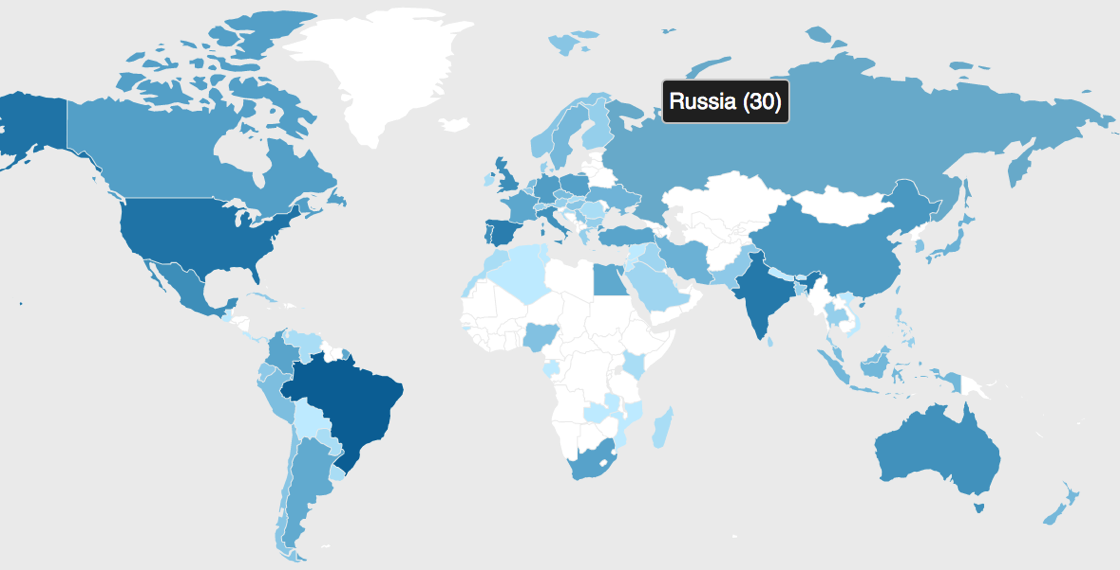
World Taxonomists and Systematists via ORCID

Taxonomist mapDavid Shorthouse (@dpsspiders) makes some very cool things, and his latest project World Taxonomists & Systematists is a great example of using automation to assemble a list of the world's taxonomists and systematists. The project uses ORCID. As many researchers will know, ORCID's goal is to have every researcher uniquely identified by an ORCID id (mine is https://orcid.org/0000-0002-7101-9767) that is linked to all a researcher's academic output, including papers, datasets, and more. So David has been querying ORCID for keywords such as taxonomist, taxonomy, nomenclature, or systematics to locate taxonomists and add them to his list. For more detail see his post on the ORCID blog.

Using ORCIDs to help taxonomists gain visibility is an idea that's been a round for a little while. I blogged about it in Possible project: #itaxonomist, combining taxonomic names, DOIs, and ORCID to measure taxonomic impact, at which time David was already doing another cool piece of work linking collectors to ORCIDs and their collecting effort, see e.g. data for Terry A. Wheeler.

There are, of course, a bunch of obstacles to this approach. Many taxonomists lack ORCIDs, and I keep coming across "private" ORCIDs where taxonomists have an ORCID id but don't make their profile public, which makes it hard to identify them as taxonomists. Typically I discover these profiles via metadata in CrossRef, which will list the ORCID id for any authors that have them and have made them know to the publisher of their paper.

ORCID ids are only available for people who are alive (or alive recently enough to have registered), so there will be many taxonomists who will never have an ORCID id. In this case, it may be Wikidata to the rescue:

Many taxonomists have Wikidata entries because they are either notable enough to be in Wikipedia, or they have an entry in Wikispecies, and people like Andy Mabbett (@pigsonthewing) have been diligently ensuring these people have Wikidata entries. There's huge scope for making use of these links.

Meanwhile, if you are a taxonomist or a systematist and you don't have an ORCID, get yourself one at ORCID, claim your papers, and you should appear shortly in the World Taxonomists & Systematists list.

Wednesday, January 11, 2017

The Biodiversity Heritage Library meets Wikidata via Wikispecies: adding author identifiers to BioStor

I've added an experimental feature to BioStor that uses data from Wikidata and Wikispecies to augment what information BioStor displays on authors. This is a crude first step towards the goal of representing all the data in BioStor as a "knowledge graph" where articles, journals, and authors are all treated as entities, all have identifiers, and we can explore relationships between those entities (e.g., citation, co-authorship, etc.). At the moment this is true of articles, which have Biostor URLs (and in many cases DOIs), and for most journals which are identified by their ISSN. Using identifiers helps reduce ambiguity, especially if there are multiple ways to represent the same thing (e.g., all the alternative ways to write a journal name can be circumvented by using the journal's ISSN).

However, BioStor doesn't have a way to identify authors beyond simply searching for a name. As a first step to tackling this problem I've added a little widget that displays information about an author based on the name you are searching for. For example, searching for George Albert Boulenger will give you a list of publications where the author name is "George Albert Boulenger", as well as a picture of the author and some identifiers (from sources such as VIAF, ISNI, IPNI, and Wikidata):

Screenshot 2017 01 11 16 30 57

For now this widget is independent of the data in BioStor. I don't link an article to its author(s) using identifiers for those authors, nor have I tackled the problem of clustering all the variations in people's names together into one set of names that share the same identifier (see Equivalent author names) nor do I attempt to match names to identifiers (see Reconciling author names using Open Refine and VIAF) other than by an exact text search (for details see below). At this stage I just want to get a sense of what identifiers exist for an author, and what I can learn from those identifiers. I also want to explore the potential of Wikispecies as a source of data on people and publications, and how this relates to Wikidata (for earlier thoughts on using Wikipedia for the same goal see Thoughts on Wikipedia, Wikidata, and the Biodiversity Heritage Library).

Wikispecies

I confess I've never really "got" Wikispecies (e.g., Wikispecies is not a database), it seems to exist in isolation from Wikipedia, which is arguably more informative about many species. But there are a couple of things Wikispecies does very well. Firstly, it is building a rich, crowd-sourced bibliography of papers on the taxonomy of many different species. Readers of iPhylo will recall how many times I've expressed frustration at the nearly evidence-free nature of many online taxonomic databases that simply have lists of names unconnected to the primary literature. Many Wikispecies pages have long lists of papers, making it a potential goldmine. Recently there is a lot of interest in extracting bibliographic data from Wikipedia (see WikiCite). Wikispecies could also be harvested, although a major obstacle any such project faces is the lack of a consistent format for references in Wikispecies.

The other nice thing about Wikipecies is that it has articles on taxonomic authorities, and these often list publications by those authors, and also list external identifiers for those authors, such as the VIAF and ISNI identifiers used in the library world, IPNI and ZooBank identifiers used in taxonomic databases, and ORCID which is becoming the de-facto identifier for academic researchers. This information also ends up in Wikidata.

Using Wikidata to glue things together

Wikidata is an interesting project that, like Wikispecies, I've been in two minds about (see Wikidata, Wikipedia, and #wikisci). However, I've started to make more use of it recently. Inspired by the Wikidata:SPARQL query service/2016 SPARQL Workshop I decided to explore the SPARQL query interface to Wikidata. I was struck by one of the example queries involving Wikispecies, and so after a little bit of messing about came up with a query that takes the name of an author and returns some identifiers from Wikidata, as well as an image of that person if one is available. I restrict the results to people that have an article about them in Wikispecies, because I want start exploring using those articles to make assertions about authorship. Here is a query to search for "George Albert Boulenger":

SELECT *
WHERE
{
  ?item rdfs:label "George Albert Boulenger"@en .
  ?article schema:about ?item .
  ?article schema:isPartOf  .
  OPTIONAL {
   ?item wdt:P213 ?isni .
	}
  OPTIONAL {
   ?item wdt:P214 ?viaf .
	}
  OPTIONAL {
   ?item wdt:P18 ?image .
	}
  OPTIONAL {
   ?item wdt:P496 ?orcid .
	}
  OPTIONAL {
   ?item wdt:P586 ?ipni .
	}
  OPTIONAL {
   ?item wdt:P2006 ?zoobank .
	}
}

This query simply asks whether Wikidata has an item on this person, whether that item is linked to Wikispecies, what identifiers Wikidata has, and whether there is an image of the person. You can see the query "live" here:

I've added some code to BioStor to do this query on the fly, and display the results. So, for Boulenger we get: Screenshot 2017 01 11 17 04 16 Here is the result for noted carcinologist Jocelyn Crane who currently lacks identifiers: Screenshot 2017 01 11 17 05 32 A nice surprise was Bernard Landry: Screenshot 2017 01 11 17 07 14 Note the ORCID 0000-0002-6005-1067. Interestingly, Bernard Landry's ORCID profile doesn't list any publications, whereas we can see lists of these in BioStor and Wikispecies.
Where next?

There are several obstacles to mapping the names of authors to identifiers. One is simply the lack of identifiers. This seems to be rapidly becoming less of a problem with the efforts of the library community around VIAF, the rise of ORCID for living researchers, and the creation of Wikidata items for every taxonomist in Wikispecies. The next challenge is clustering the different ways of writing the same person's name into sets that represent the same person. As discussed above, there are tools for this. Furthermore, with Wikipedia and Wikispecies we have sources of lists of publications linked to a person and their identifiers, which should simplify the task considerably. What is nice about this is that it relies on a crowd-sourcing effort which is already well-established, namely those people who in adding articles to Wikispecies and Wikipedia are created a curated database of publications linked to authors. In many cases those publications are linked to BHL (the source that BioStor extracts its articles from), so many of the links between publications and people are essentially lying there, just waiting for some skilful harvesting.

Wednesday, February 03, 2016

Bootstrapping the biodiversity knowledge graph with JSON-LD

In a recent Twitter conversation including David Shorthous and myself (and other poor souls who got dragged in) we discussed how to demonstrate that adopting JSON-LD as a simple linked-data friendly format might help bootstrap the long awaited "biodiversity knowledge graph" (see below for some suggestions for keeping JSON-LD simple). David suggests partnering with "Three small, early adopting projects". I disagree.

I think we need to approach this problem, not from the perspective of who would like to try this approach, but what would it take to really be useful? I think if we look at the structure of the biodiversity knowledge graph and look at who has what identifiers, we can gain some insight into what the next steps are.

Sinks

A fundamental problem is that many data providers are essentially dead ends in terms of building a network. They have data, but no connections, and so they are "sinks". A data browser goes there and can't go any further, it has to retrace its steps and go somewhere else. For example, your typical museum might serve up its collection data like this: Museum The museum has its own identifiers (e.g., a URL) and that's the only identifier in the data. Nomenclators are much the same: Nomen You get a nomenclator-specific identifier such as an LSID, but no other identifiers. Once again, if you are a data-crawler traversing the web of data, this is a dead end. (This is why I've become obsessed with linking nomenclators to the primary literature, I want to stop them being dead ends).

Connected sources

Then there are sources which have at least one external identifier, that is, an identifier that they themselves don't control. For example, CrossRef manages DOIs for articles, but if you get metadata for a DOI you also get an ISSN (identifying a journal): Crossref Now we have a connection to an external source of data, and some we can traverse the data graph further, which means we can start asking questions (such as how many articles in this journal have DOIs?).

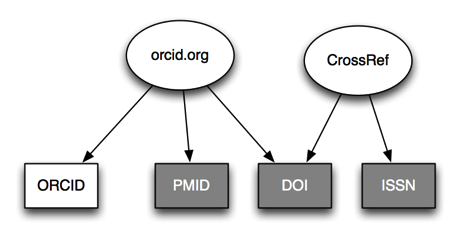
Another connected source is ORCID: Orcid This gives us identifiers for authors (the ORCID) linked to article identifiers such as DOIs and PubMed ids (PMID). Follow the DOI to CrossRef and we can link people to articles to journals. Oc
Another connected source is the NCBI: Ncbi NCBI has several internal identifiers (PMIDs, GenBank accession numbers, tax_ids) all of which lead to rich resources, and it's possible to get a lot of information by staying within NCBI's own silo, but there are external links such as DOIs (usually found attached to PubMed articles or to GenBank accessions) and links to external records such as DNA barcodes in BOLD.
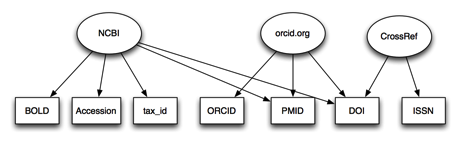
Lets join CrossRef, ORCID, and NCBI together: All Now we have a bipartite graph linking sources with identifiers. We can imagine playing a game where we try and connect different entities by moving through the graph. For example, we could take an author identified by an ORCID, follow a DOI to a PMID, a PMID to a set of accessions numbers, and then be able to list all the sequences that an author has published. We could also step back and ask questions about which identifiers are the most useful in terms of making connections between different sources, and which sources provide the most cross links.

Filling in the gaps

Now, the graph above is obviously incomplete. I've restricted it to a few of the key services that I'm familiar with, and make use of external identifiers. One of the big obstacles to fleshing out the biodiversity knowledge graph is the frequent lack of reuse of identifiers. It's not enough to pump out data in linked-data form, you need to build the links. And not just "same as" style links connecting multiple identifiers for the same thing, you need to connect identifiers for different things. Until we tackle that, linked data approaches will not deliver much in the way of value. Hence we need sources that provide genuinely linked data by reusing exiting, external identifiers. If we have name in a nomenclator with a citation string, it needs to link that dumb literature string to a DOI. If we have a taxon concept, it needs to link the name of that taxon to a name in a nomenclator. If we have a specimen that has been sequenced, it needs to give the accession number of that sequence.

From this perspective, choosing which kinds of data with which to explore JSON-LD and a linked data graph should be driven by how connected those sources are: the more connected the more interesting the questions that we can ask. Sadly the vast majority of biodiversity data providers don't provide the kind of connected data we need, which means we continually pay lip service to linked data without feeding it the kind of data it needs in order to grow.

* Notes on JSON-LD

It is relatively easy to write horrible JSON-LD, so I think it would be useful to strive to make it as simple and as human-readable as possible (ignoring the @context block which is always going to be awful, this is the price we pay for simplicity elsewhere). To this end I think we should do at least the following:

  1. No URLs as identifiers URLs are ugly, and they are not reliable as identifiers. Providers can change URLs, even for persistent identifiers. The DOI prefix has changed from http://dx.doi.org/ to the preferred http://doi.org/, and the rise of HTTPS (prompted by concerns about security, among other issues, see Google's motives, part 2) is going to break a lot of older URLs (see Web Security - "HTTPS Everywhere" harmful). These changes keep happening, so lets try and shield ourselves from these by using standard prefixes for identifiers (such as 'DOI') for a DOI. Put all the alternative URL resolver prefixes in the @context block and use prefixes such as those standardised by http://identifiers.org (which basically formalises what many people in bioinformatics have been doing for a while).
  2. No prefixes for keys In other words, no CURIEs. Don't write "dwc:CatalogueNumber", just write "CatalogueNumber". I don't want to be told where the term comes from (that's what @context is for). If you have a namespace clash (i.e., two terms that are the same unless you include the namespace) then IMHO you're doing it wrong. Either you're using more than one vocabulary for the same thing (why?), or you've not modelling the data at the appropriate level of granularity. Either way, let's avoid clutter and keep things simple and readable.

Monday, August 10, 2015

Possible project: mapping authors to Wikipedia entries using lists of published works

220px Boulenger George 1858 1937One of the less glamorous but necessary tasks of data cleaning is mapping "strings to things", that is, taking strings such as "George A. Boulenger" and mapping them to identifiers, such as ISNI: 0000 0001 0888 841X. In case of authors such as George Boulenger, one way to do this would be through Wikipedia, which has entries for many scientists, often linked to identifiers for those people (see the bottom of the Wikipedia page for George A. Boulenger and look at the "Authority Control" section).

How could we make these mappings? Simple string matching is one approach, but it seems to me that a more robust approach could use bibliographic data. For example, if I search for George A. Boulenger in BioStor, I get lots of publications. If at least some of these were listed on the Wikipedia page for this person, together with links back to BioStor (or some other external identifier, such as DOIs), then we could do the following:

  1. Search Wikipedia for names that matched the author name of interest
  2. If one or more matches are found, grab the text of the Wikipedia pages, extract any literature cited (e.g., in the {cite} tag), get the bibliographic identifiers, and see if they match any in our search results.
  3. If we get one or more hits, then it's likely that the Wikipedia page is about the author of the papers we are looking at, and so we link to it.
  4. Once we have a link to Wikipedia, extract any external identifier for that person, such as ISNI or ORCID.
For this to work, it requires that the Wikipedia page cites works by the author in a way that we can harvest, and uses identifiers that we can match to those in the relevant database (e.g., BioStor, Crossef, etc.). We might also have to look at Wikipedia pages in multiple languages, given that English-language Wikipedia may be lacking information on scholars from non-English speaking countries (this will be a significant issue for many early taxonomists).

Based on my limited browsing of Wikipedia, there seems to be little standardisation of entries for people, certainly little in how their published works are listed (the section heading, format, how many, etc.). The project I'm proposing would benefit from a consistent set of guidelines for how to include a scholar's output.

What makes this project potentially useful is that it could help flesh out Wikipedia pages by encouraging people to add lists of published works, it could aid bibliographic repositories like my own BioStor by increasing the number of links they get from Wikipedia, and if the Wikipedia page includes external identifiers then it helps us go from strings to things by giving us a way to locate globally unique identifiers for people.

Wednesday, June 24, 2015

Thoughts on ReCon 15: DOIs, GitHub, ORCID, altmetric, and transitive credit

Man03gTw 400x400I spent last Friday and Saturday at (Research in the 21st Century: Data, Analytics and Impact, hashtag #ReCon_15) in Edinburgh. Friday 19th was conference day, followed by a hackday at CodeBase. There's a Storify archive of the tweets so you can get a sense of the meeting.

Sitting in the audience a few things struck me.

  1. No identifier wars, DOIs have won and are everywhere.
  2. GitHub is influencing the way we do science, but we've much still to learn.
  3. ORCIDs are gaining traction.
  4. Nobody really understands "impact".

GitHub

GitHub is becoming more and more important, not only as a repository of scientific code and data, but as a useful model of sorts of things we need to be doing. Arron Smith gave a fascinating talk on GitHub. Apart from the obvious things such as version control, Arfon discussed the tools and mindset of open source programmers, and who that could be applied to scientific data. For example, software on GitHub is often automatically tested for bugs (and GitHub displays a badge saying whether things are OK). Imagine doing this for a data set, having it automatically checked for errors and/or internal consistency. Reproducibility is a big topic in science, but open source software has to be reproducible by default in the sense that it has to be able to be downloaded and compiled on a user's computer. This is just a couple of the things Arfon covered, see his slides for more.

Transitive Credit

One idea which particularly struck me was that of "transitive credit":

Katz, D. S. (2014, February 10). Transitive Credit as a Means to Address Social and Technological Concerns Stemming from Citation and Attribution of Digital Products. JORS. Ubiquity Press, Ltd. http://doi.org/10.5334/jors.be

From the above paper:

The idea of transitive credit is as follows: The credit map for product A, which is used by product B, feeds into the credit map for product B. For example, product A is a software package equally written by two authors and its credit map is that 50 percent of the credit for this should go the lead developer, 20 percent to the second developer, and 10 percent to the third developer. In addition, 5 percent should go to each of the four libraries that are needed to run the code. When this product is created and registered, this credit map is registered along with it. Product B is a paper that obtains new science results, and it depended on Product A. The person who registers the publication also registers its credit map, in this case 75 percent to her/himself, and 25 percent to the software code previous mentioned. Credit is now transitive, in that the lead software developer of the code can be given credit for 12.5 percent of the paper. If another paper is later written that extends the product B paper and gives 10% credit to that paper, the lead software package developer will also have 1.25% credit for the new paper.
The idea of being able to track credit across derived products is interesting, and is especially relevant to projects such as GBIF, where users can download large datasets that are themselves aggregations of data from numerous different providers (making it was to calculate the relative contributions of each provider). If we then track citations of that data (and citations of those citations) we could give data providers a better estimate of the actual impact of their data.

Impact

Euan Adie of altimetric talked about "impact", and remarked on an example of a paper being cited in a policy document and this being picked up by altimetric and seen by the authors of the paper, who had no idea that their work had influenced a policy document. This raises some intriguing possibilities, related to the idea of "transitive credit" above.

In building BioNames I've added the ability to show altimetric "donuts" and I'm struck by examples like this one (see also reference in BioNames):

JENKINS, P. D., & ROBINSON, M. F. (2002, June). Another variation on the gymnure theme: description of a new species of Hylomys (Lipotyphla, Erinaceidae, Galericinae). Bulletin of The Natural History Museum. Zoology Series. Cambridge University Press (CUP) doi:10.1017/S0968047002000018

This paper has no recent "buzz" (e.g., Twitter, Facebook, Mendeley) but is cited on three Wikipedia pages. So, this paper has impact, albeit in social media. Many papers like this will slip below the social media radar but will be used by various databases and may contribute to subsequent work. Perhaps we could expand alt metrics sources of information to include some of those databases. For example, if a paper has been aggregated/cited by a major databases (such as GBIF) then it would be nice to see that on the altimetric donut. For authors this gives them another example of the impact of their work, but for the databases it's also an opportunity to increase engagement (if people have relevant work that doesn't appear in the donut they can take steps to have that work included in the aggregation). Obviously there are issues about what databases to count as providing signal for alt metrics, but there's scope here to broaden and quantify our notion of impact.

Hackday

The ReCon hackney was an pretty informal event held at CodeBase just down from Edinburgh Castle, and apparently the largest start-up incubator in the European tech scene. It was a pretty amazing place, and a great venue for a hackney. I spent the day looking at the ORCID API and seeing if I could create some mashups with Journal Map and my own BioNames. One goal was to see if we could generate a map of researcher's study sites starting with their ORCID, using ORCID's API to retrieve a list of their publications, then talking to the Journal Map API to get point localities for those papers. The code worked, but the results were a little disappointing because Jim Caryl and I were focussing on University of Glasgow researchers, and they had few papesri n Journal Map. The code, such as it is, is in GitHub.

My original idea was to focus on BioNames, and see how many authors of taxonomic papers had ORCIDs. Initial experiments seemed promising (see GitHub for code and data). Time was limited, so I got as far has building lists of DOIs from BioNames and discovering the associated ORCIDs. The next steps would be (a) providing ORCID login to BioNames, and using ORCID to help cluster author name strings in BioNames. Still much to do.

I've not been to many hackdays/hackathons, but I find them much more rewarding than simply sitting in a lecture theatre and listening to people talk. Combining both types of meeting is great, and I look forward to similar event sin the future.

Friday, November 01, 2013

Annotating and cleaning GBIF data: Darwin Core Archive, GitHub, ORCID, and DataCite

E9815d877cd092a19918df74e04f0415GbifTwittergithub2TwitterThis is a quick sketch of a way to combine existing tools to help clean and annotate data in GBIF, particularly (but not exclusively) occurrence data.

GitHub


The data provider puts a Darwin Core Archive (expanded, not zipped) into a GitHub repository. GBIF forks the repository, cleans the data, and uploads that to GBIF to populate the database behind the portal.

DOI


When GBIF firsts loads the repository it assigns it a DOI (using, say, DataCite). Actually we assign two DOIs, one for this version of the data (e.g., 10.1234/data.v1) and one for all versions of the data, say 10.1234/data. The data is considered to be published, authorship is determined by the provider, which may be an individual, a project, an institution, etc.

Big scale annotation and cleaning


Anyone familiar with GitHub can fork the repository of data and do their own cleaning (e.g., fixing dates, latitudes and longitudes, links to taxon names, etc.).

Small scale, casual annotation


Anyone visiting the GBIF portal and noticing an error (or something that they want to comment on) does so on the portal. Behind the scenes these comments are stored as issues on the GBIF repository in GitHub. To do this GBIF can either (a) enable users with an existing GitHub account to link that to their GBIF user account, or (b) create a GitHub account for the user. The user need not actually interact directly with GitHub (a similar approach is described by Mark Holder for the social curation of phylogenetic studies).

This means all annotation, big or small, is in the open and on GitHub. There is very little programming to do, GBIF simply talks to GitHub using GitHub's API. GBIF could display known "issues" for a dataset, so portal users immediate know if any data has been flagged as problematic.

All the annotations belong to the "community", in the sense that each annotation is linked to GitHub user (even if the user might not ever actually go to GitHub). This also means that the provider can, at any point, pull in those annotations so they can update their own data (and hence gain direct benefit form exposing it in the first place).

Updating


When GBIF decides that enough annotations have been made and resolved, the latest version of the repository is loaded into GBIF and gets a new DOI (e.g., 10.1234/data.v2). This means an analysis based on that version is citable. We add a link to the overall DOI so someone who doesn't care about versions can still cite the data.

Authorship and credit


Now we come to the fun part. The revision will include the input from a bunch of people. This will be recorded on GitHub, but that will only mean something the handful of geeks who think GitHub is awesome. But, let's imagine that we do the following:

  1. Anyone with a GBIF account can link that to their ORCID (if you are a researcher you really should have one of these).
  2. Anyone contributing to this version of the repository gets authorship (appended to the end of the list, so the original provider is first author).
  3. GBIF uses the ORCID API to automatically load the DOI of the new version of the dataset onto the list of works for each contributor. They instantly get credit as an co-author of a citable dataset, and this appears on their ORCID profile.

Benefits


This approach has a number of benefits:
  1. It creates citable data
  2. It gives credit in a way many people will recognise (authorship of a citable work that has a DOI)
  3. The annotations are freely available, there is a complete version history, anyone can contribute at whatever scale suits them.
  4. Anyone can grab the repo at any time and load it into their own system, including the original provider, who can see what people are added to their original data.
  5. There is virtually no programming to do, no new domain-specific protocols, everything is pretty much in place. GitHub does versioning, DataCite does citable identifiers, ORCID handles identify and credit.

Caveats


There are a couple of potential issues. Darwin Core Archive data files can be large, and GitHub can be less effective with large files (although it is ideally suited to the delimited-text files that Darwin Core Archive uses, see Git (and Github) for Data). One approach to impose a limit on the size of an individual "occurrence.txt" file in the archive, so we may have multiple files, none of which is too big. Another task will be linking issues to specific occurrences (if they concern just one occurrence), the GitHub issues will be at level of the complete file. This could be handled in a form-based interface on GBIF that sent the occurrenceID as part of the issue report.

Summary


The key point of this proposal is that everything is in place already to do this. The ducks are lining up, and serious, credible projects are handling the things we need (versioning, identifiers, credit). Sometimes the smart thing is to do nothing and wait to someone else solves the problems you face. I think the waiting may be over.