Showing posts with label design. Show all posts

Thursday, October 06, 2011

My favourite Apple moment

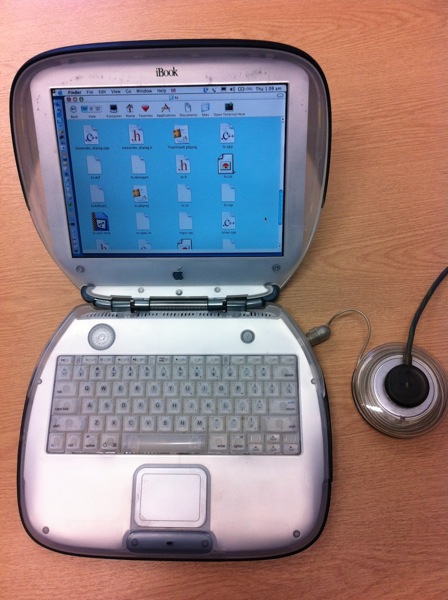
In light of today's news here's my favourite Mac, the original iBook.
Ibookclam
In many ways, it wasn't the machine itself so grabbed me (cool as it was), it was the experience of unpacking it when it arrived in my office over a decade ago. In the box with the computer and the mains cord was a disc about the size of a hockey puck (on the right in the image above). I looked at it and wondered what on Earth it was. It looked like a giant yo-yo, with cable wrapped around instead of string. Then the penny dropped — it was the power supply. You plugged the mains cord into the yo-yo, then unwound just as much cord as you needed (oh, and when you connected it in to your iBook the plug glowed orange if the battery needed charging, green if it was fully charged). The child inside me squealed with delight (being a grown up I laughed out loud, rather than actually squealing).

The iBook still works (the battery is long dead, but plug the yo-yo into the mains and it still works), and it manages to run an early version of Mac OS X.

If anybody has to ask why people love Apple products, it's not because of the "brand", or the "exclusivity", it's because of the joy they can invoke. Someone cared enough to make the most mundane task — plugging a laptop into the mains — into a thing of beauty.

Monday, February 02, 2009

Wiki modelling - Part 2

Modelling taxa is a bit trickier. I've sketched my ideas for distinguishing name strings and taxonomic names earlier. That's the easy stuff. What about "taxonomic concepts" and "OTUs"? As a first pass, I'm looking at linking taxon names to classifications via GUIDs. If a taxon appears in a classification then the GUID of the corresponding node in the classification is an attribute of the taxon name, and each classification GUID (representing a node in a classification) corresponds to a page in the Wiki.


I claim no originality for this, it's very close to how uBio models classification concepts:


The trick here is going to be ensuring that I can do sensible queries, such as linking a node in a classification to alternative names.

The other entity that I need to think carefully about are OTUs (Operational Taxonomic Units). By OTUs I mean the taxa that appear in phylogenetic trees. In the TbMap project I mapped TreeBASE taxa to names in external databases, but noted that TreeBASE taxa are better thought of as OTUs:

...many taxon names in TreeBASE are best though of as Operational Taxonomy Units (OTUs) rather than taxonomic names. They identify a set of observations for a particular specimen, set of specimens, or a taxon. For instance, "Eleutherodactylus crassidigitus FMNH257676 Panama" (TaxonID T51971) refers to a 1200 base pair stretch of mitochondrial DNA (AY273113) obtained from Field Museum Natural History specimen FMNH 257676, which has been identified as Eleutherodactylus crassidigitus. [see doi:10.1186/1471-2105-8-158.

Taxa in phylogenetic trees may be single sequences, multiple sequences (from one or more specimens), or aggregates of information from multiple taxa. The challenge is to model these in the simplest way that reflects this, but also makes queries feasible. What I'm aiming for is for the user to click on a node in a phylogeny, and be taken to a page that best corresponds to the entity in the tree, but at the same time enable queries that will list all phylogenies that contain a given taxon.

Wiki modelling - Part 1

Time to make some notes. I've been playing with using Sematic Mediawiki to create a database of taxonomic names, literature, specimens, sequences, and phylogenies. One challenge is to come up with simple ways to model these entities, in a way that makes both data entry simple and querying as simple as possible. Some things are straightforward. For example, a publication can be modelled like this:

OK, I've ignored the attributes. The diagram simply shows the use of MediaWiki REDIRECT to enable the use of standard publication GUIDs as Wiki page names (see earlier posts for more details, and a hack to deal with problem characters in DOIs). One benefit of GUID REDIRECTs is that I can refer to publications using GUIDs, and the wiki user will be taken to the article page without any fuss.

Likewise, we can model a journal like this:

Again, GUIDs are REDIRECT pages. This means an article page can have the ISSN of the publication it appears in as one of its attributes, and we can then use ISSNs in our queries.

People are a bit trickier, given the absence of GUIDs (or the desire to keep obvious ones, such as email addresses, private) (see doi:10.1371/journal.pcbi.1000247 for some background). I plan to have a single page for each author, and have alternative spellings link to that page:


This is one motivation for my work on equivalent author names. By finding clusters of equivalent names it would be possible to pre-populate the wiki with author names from bibliographic databases, whilst minimising the number of duplicate pages for the same author.