Friday, July 09, 2010

Wikipedia paper out

cover-medium.jpgMy short note on "Wikipedia as an Encyclopaedia of Life" has appeared in Organisms Diversity & Evolution (doi:10.1007/s13127-010-0028-9) (yes, I do occasionally write papers). A preprint of this paper is available on Nature Precedings (hdl: 10101/npre.2010.4242.1).

My presentation at iEvoBio covers much the same ground, and is included below, although the paper was written before I made the mapping from NCBI taxa to Wikipedia pages.


Thursday, July 08, 2010

Show me the trees! Playing with the TreeBASE API

Being in an unusually constructive mood, I've spent the last couple of days playing with the TreeBASE II API, in an effort to find out how hard it would be to replace TreeBASE's frankly ghastly interface.

After some hair pulling and bad language I've got something to work. It's very crude, but gives a glimpse at what can be done. If you visit http://iphylo.org/~rpage/mytreebase/ and enter a taxon name, my code paddles off and queries TreeBASE to see if it has any phylogenies for that taxon. Gears grind, RSS feeds are crunched, a triple store is populated, NEXUS files are grabbed and Newick trees extracted, small creatures are needlessly harmed, and at last some phylogeny thumbnails are rendered in SVG (based on code I mentioned earlier), grouped by study. Functionality is limited (you can't click on the trees to make them bigger, for example), and the bibliographic information TreeBASE stores for studies is a bit ropey, but you get the idea.

mytreebase.png

What I'm looking for at this stage is a very simple interface that answers the question "show me the trees", which I think is the most basic question you can ask of TreeBASE (and one its own web interface makes unnecessarily hard). I've also gained some inspiration from the BioText search engine.

If you want to give it a try, here are some examples. These examples should be fairly responsive as the data is cached, but if you try searching for other taxa you may have a bit of a wait while my code talks to TreeBASE.


Tuesday, July 06, 2010

ZooKeys publishes articles of the future

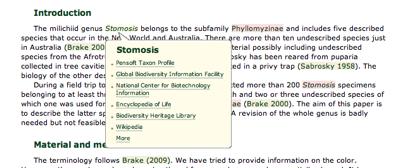
The open access taxonomic journal ZooKeys has published a special issue with four papers, each available in HTML, PDF, and XML, the later being extensively marked up. Penev et al. ("Semantic tagging of and semantic enhancements to systematics papers: ZooKeys working examples", doi:10.3897/zookeys.50.538) describes the process involved in creating these XML files. Two papers (doi:10.3897/zookeys.50.506 and doi:10.3897/zookeys.50.505) were created using authoring tools available in Scratchpads, as outlined by Blagoderov et al. ("Streamlining taxonomic publication: a working example with Scratchpads and ZooKeys", doi:10.3897/zookeys.50.539). When you view the HTMl for these articles you can toggle on or off the highlighting citations, taxonomic names, and geographic co-ordinates. Mousing over a taxonomic name, for example, a popup appears with links to GBIF, NCBI, EOL, BHL, Wikipedia, etc.):

brake.png

I think these papers represent one view of the future of scientific publishing ("article 2.0"), and I'm flattered that Penev et al. cite my Elsevier challenge work (doi:10.1016/j.websem.2010.03.004, preprint at hdl:10101/npre.2009.3173.1) as one of the sources of inspiration (along with the landmark Shotton et al. "Adventures in Semantic Publishing: Exemplar Semantic Enhancements of a Research Article" doi:10.1371/journal.pcbi.1000361, which I've discussed previously). It is also good to see the TaxPub XML schema used by a publisher, and Scratchpads being a part of the process of publishing taxonomic information.

Deep linking

My initial impression is that there is huge of potential here, although I think there is still lots to do. I'm not totally convinced that popups are they way to go (although I've dabbled with them as well), and we need to move beyond simply linking to other sites to a deeper form of integration. For example, a Zookeys article might link to BHL via a taxonomic name, but how about deeper linking? For example, the paper by Brake and von Tschirnhaus (doi:10.3897/zookeys.50.505) contains the following citations:

Biró L (1899) Commensalismus bei Fliegen. Természetrajzi füzetek 22: 198–204.

Kertész K (1899) Verzeichnis einiger, von L. Biró in Neu-Guinea und am Malayischen Archipel gesammelten Dipteren. Természetrajzi füzetek 22: 173–19

Neither reference has any links in the HTML, so the user is under the impression that they aren't available online, but both references have been scanned by BHL. You can see full text for these articles in BioStor (references 52005 and 52004, respectively -- note that the pagination for Biró 1899 is given incorrectly in the paper). This is one area where BHL has a lot to offer publishers, and it would be great to see BHL provide the services publishers need to add these links to their articles.

This integration should go both ways. It's odd that the paper by Brake and von Tschirnhaus contains LSID used by the ZooBank for this paper (urn:lsid:zoobank.org:pub:DABB03F4-A128-43BB-990C-02F25D656B00, see the <self-uri> tag in the XML), but ZooBank doesn't know about the DOI for the paper, hence the ZooBank page for this article has no link to the article itself. It's time to join this stuff together.

What's next?

What I'd really like to see is article XML repurposed as, say, RDF, and used to populate a database so that we can query it. In this way we can start to atomise the article into useful parts, and recombine them in new and interesting ways. Might be something to play with over the summer.

On a practical level, I'm somewhat bemused by the variety of XML formats being used by open access publishers. PLoS use version 2.0 of the NLM Journal Archiving and Interchange Tag Suite, and I wrote a XSLT style sheet to transform PLoS articles for viewing on an iPad. TaxPub is based on version 3.0 of the NLM DTD, which breaks quite a bit of my code relating to citations, so I'll have to tweak this to get it to display Zookeys articles correctly. Handling TaxPub itself will also require some additional work. Then there are the BMC journals, which have their own flavour of XML (based on something called the "KETON DTD"). It's all a bit messy. But I guess it'd be no fun if it was too easy...


Monday, July 05, 2010

iEvoBio: where to find out what went on

large.png
Now that I'm back in Glasgow, albeit rather jet-lagged, time for a quick summary of the first iEvoBio meeting, held at the Evolution meetings. I thought the meeting went very well, but perhaps I should leave that judgement to others. Meantime, if you want to see what the fuss was about, here are some ways to catch up.

Slides
Presentations from iEvoBio are going up at SlideShare, including the great keynotes by Jonathan Eisen and Rob Guralnick.

Abstracts
Abstracts and some presentations are going up at Nature Precedings, where you can add comments, and vote on abstracts you particularly like.

Challenge
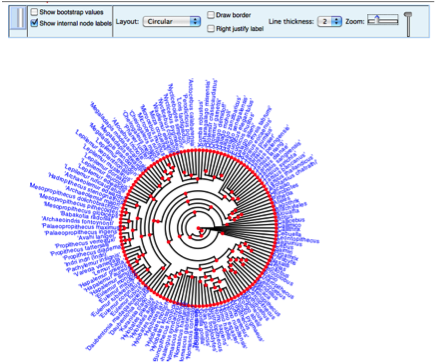
We had five entries for the visualisation challenge. The audience voted for a clear winner, but second place was a dead heat, so we chose to split the second place prize money. Here are the entries:

PlaceScreen shotLink
1stbox.pngPhyloBox
2nd equaljsphylo.pngjsPhyloSVG
2nd equalgengis.pngGenGIS
nexplorer.pngEOL tree viewer
nexplorer.pngNexplorer

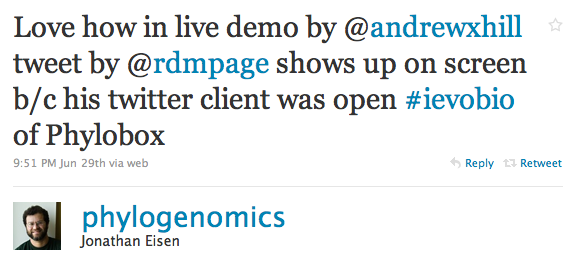
The entries gave live demos and participated in the software bazaar so people could get to play with them hands on. Doing live demos is brave, especially if you have a Twitter client on, as Andrew Hill discovered:


tweet.png


Photos
What would Jesus sequence?

Photos tagged with "ievobio10" are going up at Flickr, including my photo of Jonathan Eisen's "what would Jesus sequence?" t-shirt.

Twitter
You can follow the iEvoBio tweet stream by searching for ievobio at Twitter. I've grabbed this tweet stream and hope to do something interesting with it when I get the chance. One message that seems clear is that having keynote speakers who have a big Twitter presence is a great help in generating buzz.


The organising committee has a lot to digest as we reflect on the meeting, but personally I really liked the variety of formats (keynotes, short talks, lightning talks, software bazaar, and birds of a feather), the shortness of the meeting (2 days), and the fact that everything was in one place (no jumping between concurrent sessions). Feel free to add your thoughts below.

Friday, June 25, 2010

Evolution 2010 talk schedule for iCal

ical.png
In a moment of madness brought on by trying to make sense of 10 Mb of conference schedule for Evolution 2010, I extracted the text from the schedule and created a series of crude iCal files that I can add to my iCal calendar on my Mac (and hence sync to my iPhone). This way I can set reminders of specific talks I want to see.

I'm making these ical files available here, on the understanding that you can use them entirely at your own risk (some talks may be missing due to errors in parsing the file).

Tuesday, June 22, 2010

Mashing up NCBI and Wikipedia using treemaps

Having made a first stab at mapping NCBI taxa to Wikipedia, I thought it might be fun to see what could be done with it. I've always wanted to get quantum treemaps working (quantum treemaps ensure that the cells in the treemap are all the same size, see my 2006[!] blog post for further description and links). After some fussing I have some code that seems to do the trick. As an example, here is a quantum treemap for Laurasiatheria.

qt.png
The diagram shows the NCBI taxonomy subtree rooted on Laurasiatheria, with images (where available) from Wikipedia for the children of the the children of that node. In other words, the images correspond to the tips of the tree below:

laurasiatheria.png

There's a lot to be done to tidy this up, but there is potential to create a nice, visual way to navigate through the NCBI taxonomy (it might work well on the iPhone or iPad, for example).

Thursday, June 17, 2010

NCBI to Wikipedia links are now live...

The 52,956 links from NCBI to Wikipedia that I've been busy creating are now "live." If you go to a NCBI taxon such as Sphaerius you'll see something like this:

linkout.png

Clicking the "Wikipedia" link takes you to the Wikipedia page for this taxon. You can see all the links to Wikipedia using the query loproviphylo[filter]. Here are some additional links to try:

NCBIWikipedia
8353Xenopus
83698Banksia
9766 Balaenoptera

Thanks to Scott Federhen and Kathy Kwan at NCBI for all their assistance in getting this into NCBI Linkout.

Fixing errors
There will be errors and omissions. The best way to fix these is by using the iPhylo Linkout wiki. The page for a NCBI taxon is always http://iphylo.org/linkout/Ncbi:xxxx where xxxx is the NCBI taxonomy id. You can edit/annotate the link there (click on the "edit with form" for a simple web form). I plan to regularly update the links based on this the wiki.

Future
NCBI Linkout provide access statistics so it will be interesting to see how much traffic goes from NCBI to Wikipedia. It will also be interesting to see if this is correlated with increased editing of those Wikipedia pages.

PLoS doesn't "get" the iPad (or the web)

PLoS recently announced a dedicated iPad app, that covers all the PLoS Journals, and which is available from the App Store. Given the statement that "PLoS is committed to continue pushing the boundaries of scientific communication" I was expecting something special. Instead, what we get (as shown) in the video below is a PDF viewer with a nice page turning effect (code here). Maybe it's Steve Job's fault for showing iBooks when he first demoed the iPad, but there desire to imitate 3D page turning effects leaves me cold (for a nice discussion of how this can lead to horribly mixed metaphors see iA's Designing for iPad: Reality Check).


But I think this app shows that PLoS really don't grok the iPad. Maybe it's early days, but I find it really disappointing that page-turning PDFs is the first thing they come up with. It's not about recreating the paper experience on a device! There's huge scope for interactivity, which the PLoS app simply ignores — you can't select text, and none of the references. It also ignores the web (without which, ironically, PLoS couldn't exist).

Instead of just moaning about this, I've spent a couple of days fussing with a simple demo of what could be done. I've taken a PLoS paper ("Discovery of the Largest Orbweaving Spider Species: The Evolution of Gigantism in Nephila", doi:10.1371/journal.pone.0007516), grabbed the XML, applied a XSLT style sheet to generate some HTML, and added a little Javascript functionality. References are displayed as clickable links inline. If you click on one a window pops up displaying the citation, and it then tries to find it for you online (for the technically mined, it's using OpenURL and bioGUID). If it succeeds it displays a blue arrow — click that and you're off to the publisher's web site to view the article.
reference.png

Figures are also links, click on and you get a Lightbox view of the image.
You can view this article live, in a regular browser or in iPad. Here's a video of the demonstration page:


This is all very crude and rushed. There's a lot more that could be done. For references we could flag which articles are self citations, we could talk to bookmarking services via their APIs to see which citations the reader already has, etc. We could also make data, sequences, and taxonomic names clickable, providing the reader with more information and avenues for exploration. Then there's the whole issue of figures. For graphs we should have the underlying data so that we can easily make new visualisations, phylogenies should be interactive (at least make the taxon names clickable), and there's no need to amalgamate figures into aggregates like Fig .2 below. Each element (A-E) should be separately addressable so when the text refers to Fig. 2D we can show the user just that element.

journal.pone.0007516.g002.png

The PLoS app and reactions to Elsevier's "Article 2.0" (e.g., Elsevier's 'Article of the Future' resembles websites of the past and The “Article of the Future” — Just Lipstick Again?) suggests publishers are floundering in their efforts to get to grips with the web, and new platforms for interacting with the web.

So, PLoS, I challenge you to show us that you actually "get" the iPad and what it could mean for science publishing. Because at the moment, I've seen nothing that suggests you grasp the opportunity it represents. Better yet, why not revisit Elsevier's Article 2.0 project and have a challenge specifically about re-imagining the scientific article? And please, no more page turning effects

Tuesday, June 08, 2010

Linking NCBI to Wikipedia

180px-Sphaerius.acaroides.Reitter.tafel64.jpgIn an earlier post I discussed linking NCBI taxonomy to Wikipedia. One way to tackle this is to add NCBI Taxonomy ID to Wikipedia pages. I reopened the case for adding the Taxonomy IDs to the Taxobox on each taxon page, but this met with substantial resistance. A modified proposal to add them elsewhere to the Wikipedia page seems to be gaining more support (or, at least, less vigorous resistance).

Meanwhile, there are other things that need to be done to linking NCBI and Wikipedia. One is to add Wikipedia page names to NCBI Linkout so that when viewing a NCBI taxon page you will see a link to Wikipedia if a page for the corresponding taxon exists. To create this linkout we need a mapping from NCBI to Wikipedia, and that's what I've been working on for the last few days.

The mapping is still in progress, but essentially I've taken a dump of the NCBI taxonomy for June 3, 2010, and matched the names with those in a the June 18, 2009 dump of Wikipedia that I've analysed elsewhere on this blog. I'll detail the various steps in the mapping elsewhere (there are issues such as synonyms, homonyms, Wikipedia redirects, etc.), but for now things seem to be working reasonably well.

The mapping is being created in a Semantic Mediawiki at http://iphylo.org/linkout/. When complete you will be able to up a NCBI taxon by either it's name (including synonyms and common names) or it's NCBI Taxonomy ID. Where possible I'm mapping the NCBI taxon to Wikipedia, and providing a snippet of text and an image.

I've also extracted bibliographic information from the citations.dmp file that comes with the NCBI dump. This contains the comments that you sometimes see on a taxon page. In a few cases I've added some information manually. For example, the beetle genus Sphaerius has a rather complicated nomenclatural history, which the NCBI page summarises as:
Due to a recent ruling (ICZN 2000), the family and generic names Sphaeriusidae Erichson, 1845, and Sphaerius Waltl, 1838, are both available names and have priority over Microsporidae Crotch, 1873 for the family name and Microsporus Kolenati, 1846 for the single included genus, respectively.

By looking through BioStor I've found some of the papers relating to this ICZN ruling, and added them to the wiki page http://iphylo.org/linkout/Ncbi:174920 (aficionados of zoological nomenclature may enjoy the complexity of the case, due to homonymy between the corresponding family name, Sphaeriidae, and a mollusc family of the same name).

Once thus mapping is complete, it will be time to think of how to get this into NCBI's Linkout, and also how to automatically update the mapping to reflect the growth of both the NCBI taxonomy and Wikipedia. If you visit http://iphylo.org/linkout/ please be aware that the mapping is still being written to the wiki (this is being done via API calls, and adding some 900,000 pages is going to take a while).

Sunday, June 06, 2010

Nexus Data Editor running on Mac OS X

winebottler.png
In an earlier post I expressed my amazement that my venerable Nexus Data Editor (NDE) still had users, meaning I had to rebuild the installer so users could install NDE on Windows Vista. Now, Thomas Hauser has gone one better and created an installer for Mac OS X. Given that NDE is a Windows-only program, this is quite a feat. Thomas uses Mike Kroenenberg's (@k3erg) WineBottler to create a version of NDE that can be run on a Mac. WineBottler builds on Wine, which enables Windows software to run on Unix-like operating systems.

To run NDE on a Mac, first download WineBottler from http://winebottler.kronenberg.org/ and install. Then grab the file NDE.dmg Thomas has created. Install the file NDE in your Applications file and run it. Note that you will need X11 installed on your Mac. If you don't have this it should be on the installation disk that came with your computer. After a short pause you should see NDE appear in a X11 window. Below is a screen shot showing NDE editing the example file (Bembidion.nex) that comes with the program:
ndemac.png

Many thanks to Thomas for his efforts in packaging NDE with Winebottler, and for making available the NDE.dmg file he created.

Wednesday, June 02, 2010

TreeBASE II RDF

One of the potentially powerful features of TreeBASE II is availability of a RDF version of a study. This means that, in principle, one could take the RDF for a TreeBASE study, combine it with RDF from other sources, and generate a richer view of a particular study. For example, if a TreeBASE study has a DOI, then we could link it to bibliographic details for the study, and through them to other information, such as GenBank sequences, specimens, etc. (see my little linked data browser for an example of some of this linking). If we added a phylogeny viewer, then we'd have a great tool for browsing the basic components of a phylogenetic study.

Unfortunately, we're not there yet. I've been trying to make sense of TreeBASE II RDF, and frankly, it's a mess. Here are some of the problems:

TreeBASE URIs aren't linked data compliant
The canonical URI for a study (e.g., http://purl.org/phylo/treebase/phylows/study/TB2:S10423) doesn't conform to the linked data approach. In fact, the URI crashes the linked data validator, so I tried another test.


curl --include
--header "Accept: application/rdf+xml"
http://purl.org/phylo/treebase/phylows/study/TB2:S10423

To be a valid linked data resource this request should return a 303 HTTP status code. Instead we get a 302 and some HTML. Linked data clients won't be able to extract information from this URI.

SKOS matching
There are some odd things going on in the RDF. It contains statements of the form:

<rdf:Description rdf:ID="otu1789319">
<skos:closeMatch rdf:resource="http://purl.uniprot.org/taxonomy/76066.rdf">
</rdf:Description>

(I've tidied this up a little from the original, rather verbose RDF). This asserts that the TreeBASE OTU otu1789319 corresponds to the NCBI taxon with the taxonomy id 76066 (represented by the Uniprot URI). Except, it doesn't really. As far as I understand it, SKOS is about matching concepts, not documents. The URI http://purl.uniprot.org/taxonomy/76066.rdf is a document URI (specifically, a RDF document), the URI http://purl.uniprot.org/taxonomy/76066 is the taxon. The match should really be to http://purl.uniprot.org/taxonomy/76066. Then I've come across statements that match TreeBASE OTUs to http://purl.uniprot.org/taxonomy/0.rdf. This URI doesn't exist (we get a 404). This seems an odd way to say that we don't have a match -- if we don't have a match, don't include it in the RDF.

Local URIs for trees don't work
The RDF is full of local URIs such as http://purl.org/phylo/treebase/phylows/#tree1790755, which don't resolve. In fact they generate a rather spectacular Tomcat exception. I don't understand why we need local URIs. Everything in TreeBASE should have a global URI. Then we can avoid unnecessary statements such as:

http://purl.org/phylo/treebase/phylows/#tree1790755 owl:sameAs http://purl.org/phylo/treebase/phylows/tree/TB2:Tr7899

which links a local resource to a global one http://purl.org/phylo/treebase/phylows/tree/TB2:Tr7899. Incidentally, this URI doesn't resolve, despite claims that this bug has been fixed.

No links between tree and study
But the show stopper for me is that there is no link between a study and a tree! There is no triple in the RDF specifying any relationship between these two entities. To me this is just about the most important thing I need. I want to be able to query TreeBASE RDF using a study identifier (either from TreeBASE itself, or from an external identifier such as a DOI or a PubMed number). As it stands the TreeBASE II RDF is almost useless. I can't get it via a linked data client, it's full of URIs that don't resolve, and it lacks key triples that would glue things together.

RDF != XML

I can't help thinking that the RDF output hasn't been designed with end use in mind. I know from my own experience that it's not until you try to do something with the RDF that you realise how poor some design decisions may have been.

It's not enough to pump out RDF and hope for the best. RDF is not XML, which is just a verbose format for moving data around. RDF brings with it all sorts of expectations about how clients will resolve it, how they will interpret URIs, and the kinds of queries that will be performed. We are achingly close to being able to tie everything together, but not with RDF TreeBASE II is currently making available.

Tuesday, May 25, 2010

TreeBASE II makes me pull my hair out

I've been playing a little with TreeBASE II, and the more I do the more I want to pull my hair out.

Broken URLs
The old TreeBASE had a URL API, which databases such as NCBI made use of. For example, the NCBI page for Amphibolurus nobbi has a link to this taxon in TreeBASE. The link is http://www.treebase.org/cgi-bin/treebase.pl?TaxonID=T31183&Submit=Taxon+ID. Now, this is a fragile looking link to a Perl CGI script, and sure enough, it's broken. Click on it and you get a 404. In moving to the new TreeBASE II, all these inward links have been severed. At a stroke TreeBASE has cut itself off from an obvious source of traffic from probably the most important database in biology. Please, please, throw in some mod_rewrite and redirect these CGI calls to TreeBASE II.

New identifiers
All the TreeBASE studies and taxa have new identifiers. Why? Imagine if GenBank decided to trash all the accession numbers and start again from scratch. TreeBASE II does support "legacy" StudyIDs, so you can find a study using the old identifier (you know, the one people have cited in their papers). But there's no support for legacy TaxonIDs (such as T31183 for Amphibolurus nobbi). I have to search by taxon name. Why no support for legacy taxon IDs?

Dumb search
Which brings me to search. The search interface for taxa in TreeBASE is gloriously awful:

tbsearch.png

So, I have to tell the computer what I'm looking for. I have to tell it whether I'm looking for an identifier or doing a text search, then within those categories I need to be more specific: do I want a TreeBASE taxon ID (new ones of course, because the old ones have gone), NCBI id, or uBio? And this is just the "simple" search, because there's an option for "Advanced search" below.

Maybe it's just me, I get really annoyed when I'm asked to do something that a computer can figure out. I shouldn't have to tell a computer that I'm searching for a number or some text, nor should I tell it what that number of text means. Computers are pretty good at figuring that stuff out. I want one search box, into which I can type "Amphibolurus nobbi", or "Tx1294" or "T31183" or "206552" or "6457215" or "urn:lsid:ubio.org:namebank:6457215" (or a DOI, or a text string, or pretty much anything) and the computer does the rest. I don't ever want to see this:

tbsearch2.png

Computers are dumb, but they're not so dumb that they can't figure out if something is a number or not. What I want is something close to this:

google.png

Is this really too much to ask? Can we have a search interface that figures out what the user is searching for?

Note to self: Given that TreeBASE has an API, I wonder how hard it would be to knock up a tool that took a search query, ran some regular expressions to figure out what the user might be interested in, then hit the API with that search, and returned the results?

My concern here is that TreeBASE II is important, very important. Which means it's important to make it usable, which means don't break existing URLs, don't make old identifiers disappear, and don't have a search interface that makes me want to pull my hair out.

Friday, May 21, 2010

Linked data part 2

Continuing the Friday folly theme, below is a screencast of a linked data browser that uses the same ideas as last week's screencast, but uses a custom browser I've written to display the results in a more user-friendly way.

Linking the data together from Roderic Page on Vimeo.


The demo is live, you can view it at http://iphylo.org/~rpage/browser/www/uri/http://bioguid.info/doi:10.1371/journal.pone.0001787. Under the hood the browser uses bioGUID as the primary linked data provider (although it should consume any valid linked data source, for example Dbpedia). The data is stored in a local triple store (ARC), and the web interface is created by transforming SPARQL queries into HTML using XSLT. You can add data to it by editing the URL in the browser location bar and reloading the page, or entering a URL on the page. Linked data URLs be entered next to the Browse button as is, e.g. http://dbpedia.org/resource/Euphausia, or appended to http://iphylo.org/~rpage/browser/www, e.g. http://http://iphylo.org/~rpage/browser/www/http://dbpedia.org/resource/Euphausi. Other identifiers, such as DOIs, PubMed ids, and specimens need to be resolved via bioGUID, e.g. http://iphylo.org/~rpage/browser/www/uri/http://bioguid.info/gi:86161637.

All still very crude, but I hope you get the idea.

Thursday, May 20, 2010

NCBI Taxonomy IDs and Wikipedia

Wikipedia-logo-v2-en.png
36388.gif

I've written a note on the Wikipedia Taxobox page making the case for adding NCBI taxonomy IDs to the standard Taxobox used to summarise information about a taxon. Here is what I wrote:

Wikipedia's taxon pages have a huge web presence (see my blog post Google and Wikipedia revisited and Page, R. D. M. (2010). "Wikipedia as an encyclopaedia of life". Nature Precedings hdl:10101/npre.2010.4242.1). If a taxon is in Wikipedia it is almost always the first search result in Google. Researchers in other areas of biology are making use of a Wikipedia as a tool to annotate genes Gene Wiki and RNA families Wikipedia:WikiProject_RNA, respectively. Pages for genes, such as Cytochrome_b, have numerous external identifiers in their equivalent of the Taxobox (the Pfam_box). I think we are missing a huge opportunity by not including NCBI taxonomy ids. The advantages would be:

  • It would provide a valuable service to Wikipedia readers by enabling them to go to NCBI to discover more about a taxon

  • It would help Wikipedia contributors by providing a standardised way to refer to NCBI (and enable bots to add missing NCBI taxonomy ids). Putting them in an External links section makes it harder to be consistent (there are various ways to write a URL linking to the NCBI taxonomy)

  • It would facilitate linking from NCBI to Wikipedia. A mapping of Wikipedia pages to NCBI taxonomy ids could be added to NCBI Linkout, generating more traffic to the Wikipedia pages

  • Projects that are trying to integrate information from different sources would be able to combine information of genomics from NCBI with other information much more readily

Note that I am not arguing that Wikipedia should "follow" NCBI taxonomy, merely that where the potential to link exists, the links would create value, both within and outside the Wikipedia community.

Some discussion has ensued on the Taxobox page, all positive. I'm blogging this here to encourage anyone who as any more thoughts on the matter to contribute to the discussion.

Friday, May 14, 2010

Viewing a BioStor reference in Cooliris

cooliris.pngCooliris is a web browser plugin that can display a large number of images as a moving "infinite" wall. It's Friday, so for fun I added a media RSS feed to BioStor to make the BHL page scans available to Cooliris. The result is easier to show than describe, so take a peek at the video I made of A review of the Centrolenid frogs of Ecuador, with descriptions of new species (http://biostor.org/reference/20844):

Cooliris view of BioStor from Roderic Page on Vimeo.


Cooliris is a little flaky under Snow Leopard, but still works (the plug-in is cross platform). It is also available for the iPhone (and I'm assuming the iPad), which means you can get the experience on a mobile device.

Linking biodiversity data

Time for a Friday folly. I've made a clunky screencast showing an example of linking biodiversity data together, using bioGUID as the universal wrapper around various data sources. I started with GenBank sequence EF013683, added another, EF013555, then explored some links (specimen, publication, taxon, journal), using the OpenLink RDF Browser:


You can try the URIs I used in the linked data browser of your choice:


The demo is a bit clunky, partly because the linked data browser is generic. What we really need is a browser that is tailored to displaying the kind of data we're interested, and hides the gory details under the hood. But the goal is to show that, once everything we care about has a resolvable URI that provides data in a consistent form, and we re-use identifiers, then we can glue stuff together with relative ease. In principle we can simply crawl this web of data (you can append other DOIs, ISSNs, and Genbank accession numbers to http://bioguid.info and get RDF to your heart's content).

None of this is particularly new, we've had RDF in biodiversity informatics for at least five years, there are various linked data-style projects, such as GeoSpecies and the first iteration of bioGUID, and some people (such as Roger Hyam) have been pushing HTTP URIs + RDF for a while, but we seem remarkably unable to get traction on this. Notably, no major biodiversity provider provides RDF (by major I mean GenBank or GBIF size). We make diagrams like the one I drew for GBIF last year, we make the case that linking is a Good Thing™, and yet nothing much happens. This suggests that the idea is still not be presented in a compelling enough fashion. Certainly, clunky demos like the one above probably won't help much. Linked Data clients are generally pretty awful things to use. I think we're going to need some compelling applications that really grab people's attention.

Wednesday, May 12, 2010

Drawing a phylogeny in a web browser using the canvas element

Some serious displacement activity. I'm toying with adding phylogenies to iSpecies, probably sourced from the PhyLoTA browser. This raises the issue of how to display trees on a web page. PhyLoTA itself uses bitmap images, such as this one:
ti26779_cl0-201004120822386532.png
but I'd like to avoid bitmaps. I toyed with using SVG, but that has it's own series of issues (it basically has to be served as a separate file). So, I've spent a couple of hours playing with the <canvas> element. This enables some quite nice drawing to be down in a browser window, without plugins, SVG, or Flash. I wrote a quick PHP script to parse a Newick tree and draw it using <canvas>. It's really pretty simple, and the results are quite nice:
canvas.png
One minor gotcha is interacting with the diagram (this is one advantage of SVG). Turns out we need a hack, so I've used the trick of a blank, transparent GIF and a usemap (see Greg Houston's Canvas Pie Chart with Tooltips). The picture above is a screen shot, you can see a live example here.

Tuesday, May 11, 2010

Why we need wikis

I've just spent a frustrating few minutes trying to find a reference in BioStor. The reference in question is
Heller, Edmund 1901. Papers from the Hopkins Stanford Galapagos Expedition, 1898-1899. WIV. Reptiles. Proc. Biol. Soc. Washington 14: 39-98

and comes from the Reptile Database page for the gecko Phyllodactylus gilberti HELLER, 1903. This is primary database for reptile taxonomy, and supplies the Catalogue of Life, which repeats this reference verbatim.
Thing is, this reference doesn't exist! Page 39 of Proc. Biol. Soc. Washington volume 14 is the start of Gerrit S Miller (1901) A new dormouse from Italy. Proc Biol Soc Washington 14: 39-40.
After much fussing with trying diferent volumes and dates for Proc. Biol. Soc. Washington, I searched BHL for Phyllodactylus gilberti, and discovered that this name was published in Proceedings of the Washington Academy of Sciences:
Edmund Heller (1903) Papers from the Hopkins Stanford Galapagos Expedition, 1898-1899. XIV. Reptiles. Proceedings of the Washington Academy of Sciences 5: 39-98

(see http://biostor.org/reference/20322). Three errors (wrong journal, wrong date, minor typo in title), but enough to break the link between a name and the primary source for that name.

Anybody who demands authoritative, expert-vetted resources, and thinks the Catalgoue of Life is a shining example of this needs to think again. Our databases are riddled with errors, which are repackaged over and over again, yet these would be so easy to fix if they were opened up and made easy to edit. It's time to get serious about wikis.

Monday, May 10, 2010

Referring to a one-degree square in RDF using c-squares

I'm in the midst of rebuilding iSpecies (my mash-up of Wikipedia, NCBI, GBIF, Yahoo, and Google search results) with the aim of outputting the results in RDF. The goal is to convert iSpecies from a pretty crude "on-the-fly" mash-up to a triple store where results are cached and can be queried in interesting ways. Why? Partly because I think such a triple store is an obvious way to underpin a "biodiversity hub" of the kind envisaged by PLoS (see my earlier post).

As ever, once one embarks down the RDF route (and I've been here before), one hits all the classic stumbling blocks, such as "what URI do I use for a thing?", and "what vocabulary do I use to express relationships between things?". For example, I'd like to represent the geographic distribution of a taxon as depicted on a GBIF map. How do I describe this in a RDF document?

To make this concrete, take one of my favourite animals, the New Zealand mud crab Helice crassa. Here's the GBIF map for this taxon:

wms.png
This map has the URL (I kid you not):

http://ogc.gbif.org/wms?request=GetMap
&bgcolor=0x666698
&styles=,,,
&layers=gbif:country_fill,gbif:tabDensityLayer,gbif:country_borders,gbif:country_names
&srs=EPSG:4326
&filter=()(
%3CFilter%3E
%3CPropertyIsEqualTo%3E
%3CPropertyName%3Eurl
%3C/PropertyName%3E
%3CLiteral%3E
%3C![CDATA[http%3A%2F%2Fdata.gbif.org%2Fmaplayer%2Ftaxon%2F17462693%2FtenDeg%2F-45%2F160%2F]]%3E
%3C/Literal%3E
%3C/PropertyIsEqualTo%3E
%3C/Filter%3E)()()
&width=721
&height=362
&Format=image/png
&bbox=160,-45,180,-35

(or http://bit.ly/cuTFW9, if you prefer). Now, there's no way I'm using this URL! Plus, the URL identifies an image, not the distribution.

But, if we look at the map we see that it is made of 1° × 1° squares. If each of those had a URI then I could simply list those squares as the distribution of the crab. This seems straightforward as GBIF has a service that provides these squares. For example, the URL http://data.gbif.org/species/17462693 (where 17462693 corresponds to Helice crassa) returns:

MINX MINY MAXX MAXY DENSITY
167.0 -45.0 168.0 -44.0 5
174.0 -42.0 175.0 -41.0 20
174.0 -38.0 175.0 -37.0 17
174.0 -37.0 175.0 -36.0 4

These are the 1° × 1° squares for which there are records of Helice crassa. Now, what I'd like to do is have a URI for each square, and I'd like to do this without reinventing the wheel. I've come across a URI space for points of the globe (the WGS 84 Geographic Point URI Space"), but not one for polygons. Then it dawned on me that perhaps c-squares, developed by Tony Rees at the CSIRO in Australia, would do the trick1. To quote Tony:
C-squares is a system for storage, querying, display, and exchange of "spatial data" locations and extents in a simple, text-based, human- and machine- readable format. It uses numbered (coded) squares on the earth's surface measured in degrees (or fractions of degrees) of latitude and longitude as fundamental units of spatial information, which can then be quoted as single squares (similar to a "global postcode") in which one or more data points are located, or be built up into strings of codes to represent a wide variety of shapes and sizes of spatial data "footprints".

C-squares appeal partly (and this says nothing good about me) because they have a slightly Byzantine syntax. However, they are short, and quite easy to calculate. I'll let the reader find out the gory details. To give an example, my home town, Auckland, has latitude -36.84, longitude 174.74, which corresponds to the 1° × 1° c-square with the code 3317:364.

Now, all I need to do is convert c-squares into URIs. If you append the c-square to http://bioguid.info/csquare:, like this, http://bioguid.info/csquare:3317:364, you get a linked data-friendly URI for the c-square. In a web browser you get a simple web page like this:

csquare.png
A linked data client will get RDF, like this:

<?xml version="1.0" encoding="utf-8"?>
<rdf:RDF
xmlns:rdf="http://www.w3.org/1999/02/22-rdf-syntax-ns#"
xmlns:rdfs="http://www.w3.org/2000/01/rdf-schema#"
xmlns:dcterms="http://purl.org/dc/terms/"
xmlns:dwc="http://rs.tdwg.org/dwc/terms/"
xmlns:geom="http://fabl.net/vocabularies/geometry/1.1/">
<dcterms:Location rdf:about="http://bioguid.info/csquare:3307:364">
<rdfs:label>3307:364</rdfs:label>
<geom:xmin>74</geom:xmin>
<geom:ymin>-37</geom:ymin>
<geom:xmax>75</geom:xmax>
<geom:ymax>-36</geom:ymax>
<dwc:footprintWKT>POLYGON((-37 75,-37 74,-36 74,-36 75,-37 75))</dwc:footprintWKT>
</dcterms:Location>
</rdf:RDF>

Now, I can refer to each square by it's own URI. This will also enable me to query a triple store by c-square (e.g., what other taxa occur within this 1° × 1° square?).
  1. Tony Rees had emailed me about this in response to a tweet about URIs for co-ordinates, but it took me a while to realise how useful c-square notation could be.

Next steps for BioStor: citation matching

Thinking about next steps for my BioStor project, one thing I keep coming back to is the problem of how to dramatically scale up the task of finding taxonomic literature online. While I personal find it oddly therapeutic to spend a little time copying and pasting citations into BioStor's OpenURL resolver and trying to find these references in BHL, we need something a little more powerful.

One approach is to harvest as many bibliographies as possible, and extract citations. These citations can come from online bibliographies, as well as lists of literature cited extracted from published papers. By default, these would be treated as strings. If we can parse them to extract metadata (such as title, journal, author, year), that's great, but this is often unreliable. We'd then cluster strings into sets that we similar. If any one of these strings was associated with an identifier (such as a DOI), or if one of the strings in the cluster had been successfully parsed into it's component metadata so we could find it using an OpenURL resolver, then we've identified the reference the strings correspond to. Of course, we can seed the clusters with "known" citation strings. For citations for which we have DOIs/handles/PMIDs/BHL/BioStor URIs, we generate some standard citation strings and add these to the set of strings to be clustered.

We could then provide a simple tool for users to find a reference online: paste in a citation string, the tool would find the cluster of strings the user's string most closely resembles, then return the identifier (if any) for that cluster (and, of course, we could make this a web service to automate processing entire bibliographies at a time).

I've been collecting some references on citation matching (bookmarked on Connotea using the tag "matching") related to this problem. One I'd like to highlight is "Efficient clustering of high-dimensional data sets with application to reference matching" (doi:10.1145/347090.347123, PDF here). The idea is that a large set of citation strings (or, indeed, any strings) can first be quickly clustered into subsets ("canopies"), within which we search more thoroughly:
canopy.png
When I get the chance I need to explore some clustering methods in more detail. One that appeals is the MCL algorithm, which I came across a while ago by reading PG Tips: developments at Postgenomic (where it is used to cluster blog posts about the same article). Much to do...

Thursday, May 06, 2010

Linnaeus meets the Internet: PLoS + Botany = #fail

C2914D0E-13E9-4CA6-BE0A-7A8645BC6A72.jpgTo much fanfare (e.g., Nature News, "Linnaeus meets the Internet" doi:10.1038/news.2010.221), on May 5th PLoS ONE published Sandy Knapp's "Four New Vining Species of Solanum (Dulcamaroid Clade) from Montane Habitats in Tropical America" doi:10.1371/journal.pone.0010502. To quote the Nature News piece:
The paper represents the culmination of a campaign to institute the electronic publication of scientific names, a case Knapp and others have made in journals including Nature[doi:10.1038/446261a]. Allowing electronic publication should make accessing information easier for scientists worldwide — especially those in developing countries who may not have access to fully stocked libraries. This, in turn, will aid conservation efforts, Knapp says.

Given the profile of this paper, "...the first time new plant names have been published in a purely electronic journal and still complied with ICBN rules", you'd think the participants would ensure the electronic aspects of the publication worked. Sadly, this is not the case.

The four names in question have apparently been deposited in IPNI with the following LSID's:

  • Solanum aspersum: urn:lsid:ipni.org:names:77103633-1

  • Solanum luculentum: urn:lsid:ipni.org:names:77103634-1

  • Solanum sanchez-vegae: urn:lsid:ipni.org:names:77103635-1

  • Solanum sousae: urn:lsid:ipni.org:names:77103636-1


Today is May 6th. None of these names are returned by a search of IPNI, for example http://www.ipni.org/ipni/simplePlantNameSearch.do?find_wholeName= returns this:

ipni1.png

Resolving the LSID returns this:

<?xml version="1.0" encoding="UTF-8"?>
<rdf:RDF xmlns:xsi="http://www.w3.org/2001/XMLSchema-instance"
xmlns:dc="http://purl.org/dc/elements/1.1/"
xmlns:dcterms="http://purl.org/dc/terms/"
xmlns:tn="http://rs.tdwg.org/ontology/voc/TaxonName#"
xmlns:tm="http://rs.tdwg.org/ontology/voc/Team#"
xmlns:tcom="http://rs.tdwg.org/ontology/voc/Common#"
xmlns:p="http://rs.tdwg.org/ontology/voc/Person#"
xmlns:rdf="http://www.w3.org/1999/02/22-rdf-syntax-ns#"
xmlns:owl="http://www.w3.org/2002/07/owl#">
<tn:TaxonName rdf:about="urn:lsid:ipni.org:names:77103633-1">
<tcom:versionedAs rdf:resource="urn:lsid:ipni.org:names:77103633-1:1.2"/>
<tcom:Deleted>Yes</tcom:Deleted>
</tn:TaxonName>
</rdf:RDF>

Hmmm, so apparently this record has been "deleted"?

The paper also states that:
The IPNI LSIDs (Life Science Identifiers) can be resolved and the associated information viewed through any standard web browser by appending the LSID contained in this publication to the prefix http://ipni.org/.

This sentence mirrors similar ones in other PLoS ONE papers saying we can resolve ZooBank LSIDs by appending the LSID to http://zoobank.org (e.g., see doi:10.1371/journal.pone.0001787).

Thing is, URLs such as http://ipni.org/urn:lsid:ipni.org:names:77103633-1 return a 404 from Kew (any IPNI LSID I've tried does this).


Update As per Alan Paton's comment below, the http://ipni.org prefix now works.


So, to recap:

  1. The names aren't in IPNI

  2. The LSIDs state the record has been deleted

  3. The LSID's can't be resolved by the means stated in the paper

Now, I don't know what happened (perhaps IPNI wanted to hold off until the paper actually appeared before releasing the names), but the paper is out, the buzz in Nature is out, and IPNI doesn't have the resolver in place, yet alone the names.

Given the milestone this paper represents, and the fuss over the publication of the name Darwinius, you'd expect the bioinformatics side of it to be, you know, actually working. In these circumstances, how on Earth do we make the case that the LSID and name databasing side of taxonomic publication is useful?

Friday, April 30, 2010

Mendeley Open API and the Biodiversity Heritage Library

Mendeley have called for proposals to use their forthcoming API. The API will publicly available soon, but in a clever move Mendeley will provide early access to developers with cool ideas.
Given that the major limitation of the Biodiversity Heritage Library (from my perspective) is the lack of article-level metadata, and Mendeley has potentially lots of such data, I wonder whether this is something that could be explored. My BioStor project takes article metadata and finds articles in BHL, so an attractive work flow would be:
  1. People upload bibliographies to Mendeley (e.g., bibliographies for particular taxa, journals, etc.)

  2. BioStor uses Mendeley's API to find articles liklely to be in BHL, then locates the actual article in Mendeley.

  3. The user could then grab a PDF of the article from BioStor that contains XMP metadata (which Mendeley, and other tools, can read)

Users would gain a tool to manage their bibliographies (assuming that they prefer Mendeley to other tools, or are happy to sync with Mendeley), they would be contributing to a database of taxonomic (and biological literature in general, BHL's content is pretty diverse), and also gain easy access to PDFs for BHL content (this last feature depends on whether Mendeley can associate a PDF with an existing bibliographic record automatically). In the same way, a tool such as BioStor (and, by implication, BHL) could gain usage statistics (i.e., who is reading these articles?).

Our communities efforts at assembling bibliographies haven't amounted to much yet. The tools we use tend to be poor. I find CiteBank to be underwhelming, and Drupal's bibliographic modules (used by CiteBank and ScratchPads) lack key features. We also seem reluctant to contribute to aggregated bibliographies. Perhaps encouraging people to use a nicer tool, and at the same time providing additional benefits (e.g., XMP PDFs) might help move things forward.

Anyway, food for thought. Perhaps other tools might make more sense, such as using the API to upload metadata and PDFs direct from BioStor to Mendeley, and making the collection public. But, if I were Mendeley, what I'd be looking for are tools that enhance the Mendeley experience. There's some obvious scope for visualising the output and social networks of authors, such as the sparklines and coauthor graphs I've been playing with in BioStor (for example, for W E Duellman):

FB144353-8061-456E-A502-9D9F01F56123.jpg

D6EB9A37-0440-479F-B937-4489359C1E33.jpg

Before this blog post starts to veer irretrievably off course, I'd be interested in thoughts of anyone interested in matters BHL. There's nothing like a deadline (Friday, May 14th) to concentrate the mind...

Sunday, April 25, 2010

Time for some decent service

The BBC web site has an article entitled Giant deep sea jellyfish filmed in Gulf of Mexico which has footage of Stygiomedusa gigantea, and mentions an associated fish, Thalassobathia pelagica.

AE8B4B6F-CC98-405F-90FF-390262EBE3C0.jpg


One thing that frustrates me beyond belief is how hard it is to get more information about these organisms. Put another way, the biodiversity informatics community is missing a huge opportunity here. There are a slew of services, such as Zemanta and OpenCalais.com, that can enrich the content of a document by identifying terms and adding links. Imagine a similar service that took taxonomic names and could provide information and links about that name, so that sites such as the BBC could enrich their pages. We've had various attempts at this1, but we are still far from creating something genuinely useful.

Part of the problem is that the plethora of taxonomic databases we have are often of little use. After fussing with Google I discover that Stygiomedusa gigantea (Browne, 1910) has the synonym Stygiomedusa fabulosa Russell, 1959 (see, e.g., the WoRMS database), but no database tells me that the genus Stygiomedusa was published by Russell in Nature in 1959 (doi:10.1038/1841527a0). Nor can I readily find the original reference for (Browne, 1910) in these databases2. Why is this so hard?

9B0FFA09-AF7B-4F82-98F5-C5D7DF891C5F.jpgThen when we do have information, we fail to make it digestible. For example, the EOL page for Thalassobathia pelagica links to BHL pages, but fails to point out that the pages it links belong to a single article, and that this article (http://biostor.org/reference/4339) is the original description of the fish.

Publishers are increasingly interested in any tools that can embellish their content. The organisation that gets their act together and provides a decent service for publishers (including academic journals, and news services such as the BBC) is going to own this space. Any takers...?

  1. Such as uBio LinkIT and EOL NameLink.
  2. After finding another taxon with the author Browne 1910 in BHL, I found Diplulmaris (?) gigantea, which looked like a good candidate for the original name for the jellyfish, see http://biodiversitylibrary.org/page/1727009. This is confirmed by the Smithsonian's Antarctic Invertebrates site.

Thursday, April 22, 2010

What I want from a web phylogeny viewer - XML, SVG and Newick round tripping

Random half-formed idea time. Thinking about marking up an article (e.g., from PLoS) with a phylogeny (such as the image below, see doi:10.1371/journal.pone.0001109.g001), I keep hitting the fact that existing web-based tree viewers are, in general, crap.
53BC7C85-7D00-475D-AE8A-7D91FBE75068.jpg

Given that a PLoS article is an XML document, it would be great if the tree diagram was itself XML, in particular SVG. But, in one sense, we don't want just a diagram, we want access to the underlying tree (for example, so we can play with it in other software). The tree may or may not be available in TreeBASE, but what if the diagram itself was the tree? In other words, imagine a tree viewing program could output SVG, structured in such a way that with a XSLT stylesheet the underlying tree could be extracted (say in Newick or, gack, NexXML) from the SVG, but users could take the SVG and embellish it (in Adobe Illustrator or Inkscape). The nice illustration and the tree data structure would be one and the same thing! No getting tree and illustration out of sync, and no hoping authors have put tree in a database somewhere -- the article contains the tree.

In order for this to happen, we need a tree viewer that exports SVG, and ideally would allow annotation so that the author could do most of the work within that program (ensuring that the underlying tree object isn't broken by graphic editing). Then export the SVG, add extract bits in Illustrator/Inkscape if needed, and have it incorporated into the article XML (which is what the publisher uses to render the article on the web). Simples.

Sunday, April 18, 2010

Elsevier Grand Challenge paper out

CB88EB6F-75CD-485D-8A3D-5F43D9EE2B37.jpgAt long last the peer-reviewed version of the paper "Enhanced display of scientific articles using extended metadata" (doi:10.1016/j.websem.2010.03.004), in which I describe my entry in the Elsevier Grand Challenge, has finally appeared in the journal Web Semantics: Science, Services and Agents on the World Wide Web. The pre-print version of this paper has been online (hdl:10101/npre.2009.3173.1) for a year prior to appearance of the published version (24 April 2009 versus 3 April 2010), and the Challenge entry itself went online in December 2008. Unfortunately the published version has an awful typo in the title (that was in neither the manuscript nor the proofs).

Given this typo, the time lag between doing the work, writing the manuscript, and seeing it published, and the fact that I've already been to meetings where my invitation has been based the entry and the pre-print, I do wonder why on Earth would I bother with traditional publication (which is somewhat ironic, given the topic of the paper)?

Wednesday, April 14, 2010

Biodiversity informatics = #fail (and what to do about it)

The context for this post is the PLos markup meeting held at the California Academy of Sciences over the weekend (many thanks to Brian Fisher for the invitation). PLoS are launching a "biodiversity hub" and were looking for ideas on how to implement this. The fact that nobody -- least of all those attending from PLoS -- could adequately explain what a hub was made things a tad tricky, but that didn't matter, because PLoS did know when the first iteration of the hub was going live (later this summer). So, once we got past the fact that PLoS operates with a timeline that says "cool stuff will happen here" then sets about figuring what that cool stuff will actually be (in retrospect you gotta admire this approach), we then tried to figure out what PLoS needed from us.

That's when things got messy. It became very clear that PLoS wanted basic things like, you know, information on names, being able to link to specimens, etc., and our community can't do this, at least not yet. Nor can we provide simple answers to simple questions. For example, Rich Pyle, gave an overview of taxonomic names, nomenclature, concepts, and the horrendous alphabet soup of databases (uBio, ZooBank, IPNI, IndexFungorum, GNA, GNUB, GNI, CoL, etc.) that have a stake in this. You could see the look of horror in the eyes of the PLoS developers who were tasked with making the hub happen ("run away, run away now"). And this was after the simple version of things. In a week where taxonomy was in the news because of the possibility that Drosophila melanogaster would have to, *cough*, change its name (doi:10.1038/464825a)1, this was not a great start.

At each step when we outlined some of the stuff that would be cool, it became clear we couldn't deliver what we were actually arguing PLoS should do. For example, we have millions of digitised specimen records, and lots of papers refer to these specimens by name, but because individual specimens don't have URIs we can't refer to them (instead we have horrific query interfaces like TAPIR, see Accessing specimens using TAPIR or, why do we make this so hard?). We're digitising the taxonomic literature, but don't provide a way to link this to modern literature at the level of granularity publishers use (i.e., articles).

Readers of this blog will have heard this all before, but what made this meeting different was we actually had a "customer" rock up and ask for our help to enhance their content and create something useful for the community...and the best we could do was um and er and confess we couldn't really give them what they wanted2.

Think of the children
It's time biodiversity informatics stopped playing "let's make an acronym", stopped trying to keep taxonomists happy (face it, that's never going to happen, and frankly, they'll be extinct soon anyway), and stopped obsessing with who owns the data, and instead focus on delivering some simple, solid, services that address the needs of people who, you know, will actually do something useful with them. Otherwise we'll be like digital librarians, who thought people would search the way librarians do, then got their nose out of joint when Google ate their lunch.

It's time to make some simple services, and stop the endless cycle of inward looking meetings where we talk to each other. We need to learn to hide what people don't need (nor want) to see. We need to be able to:

  1. Extract entities from text, e.g. scientific names, specimen codes, localities, GenBank accession numbers.

  2. Lookup a taxonomic name and return basic information about that name (rather like iSpecies but as a service).

  3. Make specimen codes resolvable.

  4. Make taxonomic literature accessible using identifiers and tools publishers know about (that means DOIs and OpenURL).


We're close to a lot of this already, but we're still far enough away to make some of this non-trivial. And we keep having meetings about this stuff, and fail to actually get it done. Something is wrong somewhere when E O Wilson has his name on yet another call for megabucks for a biodiversity project (the "Barometer of Life, doi:10.1126/science.1188606). At what point will someone ask "um, we've given you guys a lot of money already, why can't you tell me the stuff we need to know?"

Let me just say that I'm a short term pessimist, but a long term optimist. The things I complain about will get fixed, one day. It's just that I see little evidence they'll get fixed by us. Prove me wrong, go on, I dare you...

  1. Personally I'm intensely relaxed about Drosophila melanogaster remaining Drosophila melanogaster, even if it ends up in a clade surrounded by flies with other generic names. Having (a) a stable name and (b) knowing where it fits in the tree of life is all we need to do science.

  2. At the meeting I couldn't stop thinking of the scene in The West Wing where President Bartlett walks up to the Capitol for an impromptu meeting with the Speaker of the House to sort out the budget, and is left waiting outside while the Speaker sorts out his game plan. By the time the Speaker is ready, the President has turned on his heels and left, making the Speaker look a tad foolish.


Thursday, April 08, 2010

BioStor gets PDFs with XMP metadata - bibliographies made easy with Mendeley and Papers

The ability to create PDFs for the articles BioStor extracts from the Biodiversity Heritage Library has been the single most requested feature for BioStor. I've taken a while to get around to this -- for a bunch of reasons -- but I've finally added it today. You can get a PDF of an article by either clicking on the PDF link on the page for an article, or by appending ".pdf" to the article URL (e.g., http://biostor.org/reference/570.pdf). In some ways the BioStor PDFs are pretty basic - they contain page images, not the OCR text, so they tend to be quite large and you can't search for text within the article. But what they do have is XMP metadata.

XMP metadata
7950C5D8-3299-48CF-96A0-9D02BA6F0B03.jpgOne of the great bugbears about organising bibliographies is the lack of embedded metadata in PDFs, in other words Why can't I manage academic papers like MP3s? (see my earlier post for some background). Music files and digital photos contain embedded metadata that store information such as song title and artist in the case of music, or date, exposure, camera model, and GPS co-ordinates in the case of digital images. This means software (and webs sites such as Flickr) can automatically organise your collection of media based on this embedded metadata.

mendeley.pngpapers.pngWouldn't it be great if there was an equivalent for PDFs of papers, whereby the PDF contains all the relevant the bibliographic details (article title, authorship, journal, volume, pages, etc.), and reference managing software could read this and automatically put the PDF into whatever categories you chose (e.g., by author, journal, or date)? Well, at least two software programs can do this, namely the cross-platform Mendeley, and Papers, which supports Apple's Macintosh, iPhone, and iPad platforms. Both programs can read bibliographic metadata in Adobe's Extensible Metadata Platform (XMP), which has been adopted by journals such as Nature, and CrossRef has recently been experimenting in providing services to add XMP to PDFs.

One reason I put off adding PDFs to BioStor was the issue of simply generating dumb PDFs for which users would then have to retype the corresponding bibliographic metadata if they wanted to store the PDF in a reference manager. However, given that both Papers and Mendeley support XMP, you can simply drag the PDF on to either program and they will extract the details for you (including a list of up to 10 taxonomic names found in the article). Both Papers and Mendeley support the notion of a "watched folder" where you can dump PDFs and they will "automagically" appear in your reference manager's library. Hence, if you use either program you should be able to simply download PDFs from BioStor and add them to your library without having to retype anything at all.

Technical details
This post is being written as I'm waiting to catch a plane, so I haven't time to go into all the gory details. The basic tools I used to construct the PDfs were FPDF and ExifTool, which supports injecting XMP into PDFs (I couldn't find another free tool that could insert XMP into a PDF that didn't already have any XMP metadata). I store basic Dublin Core and PRISM metadata in the PDF. The ten most common taxonomic names found in the pages of the article are stored as subject tags.

FA644E5D-F2DE-4B00-BADD-140806C4EE00.jpgInitially it appeared that only Papers could extract XMP, Mendeley failed completely (somewhat confirming my prejudices about Mendeley). However, I sent an example PDF to Mendeley support, and they helpfully diagnosed the problem. Because XMP metadata can't always be trusted, Mendeley compares title and author values in the XMP metadata with text on the first couple of pages of the PDF. If they match, then the program accepts the XMP metadata. Because my initial efforts as creating PDfs just contained the BHL page images and no text, they wouldn't pass Mendeley's tests. Hence, I added a cover page containing the basic bibliographic metadata for the article, and now Mendeley is happy (the program itself is growing on me, but if you're an Apple fanboy like me, Papers has native look and feel, and syncing your library with your iPhone is a killer feature). There are a few minor differences in how Papers and Mendeley handle tags. Papers will take text in the Dublin Core "Subject" tag and use those as keywords, whereas to get Mendeley to extract tags I had to store them using the "Keywords" tag (implemented using FPDF's SetKeywords function). But after a bit of fussing I think the BioStor PDFs should play nice in both programs.

Friday, March 26, 2010

TreeBASE II has been released


The TreeBASE team have announced that TreeBASE II has been released. I've put part of the announcement on the SSB web site. Given that TreeBASE and I have history, I think it best to keep quiet and see what others think before blogging about it in detail. Plus, there's a lot of new features to explore. Take it for a spin and see what you think.