Friday, August 28, 2009

Visualising the Wikipedia classification of mammals

As part of my on-going experiments with Wikipedia as a repository of taxonomic information, I've extracted mammal pages from Wikipedia. There's a lot to be done with these, but the first thing I wanted to ask was whether the Wikipedia pages would form a tree (i.e., had the authors of these pages managed to ensure the pages formed a single, coherent taxonomic classification). The answer, as shown in the graph below, is no.
m.jpg


The graph contains 7750 nodes, each one representing a Wikipedia page with a Taxobox containing the class Mammalia. A node is connected to the node corresponding to its parent in the mammalian classification.

If it formed a single classification there would be just one component. Instead, it contains 841 distinct components, many of which you can see at the bottom. If you want to explore the graph, I've made an image map here using the wonderful graph editor yEd. You'll need to move the browser's scroll bars to see the graph. If you click on the node you'll be taken to the corresponding Wikipedia page.

Note: The graph has been laid out using yEd's organic layout command, so it won't look tree-like. The diagram is intended to testing for connectedness only.

Some of these components may be due to errors in my parser, but many are due to inconsistencies in Wikipedia. Typical problems are Taxoboxes containing taxa for which there is no page in Wikipedia (these are visible as redlinks), or monotypic taxa where the pages for the genus and species are the same).

Of course, the joy of Wikipedia is that these problems can be easily fixed, but the trick is discovering the problems in the first place. There is a distinct lack of tools to enable Wikipedia editors to view the entire classification of interest and identify areas that need fixing (something Roger Hyam alluded to in his comment on an earlier posting). It would, of course, be great to be able to edit the graph shown above and have those changes automatically transmitted to Wikipedia.

Friday, August 21, 2009

Scientific citations in Wikipedia

wikipediaisaccuratecitationneeded.jpg
While thinking about measuring the quality of Wikipedia articles by counting the number of times they cite external literature, and conversely measuring the impact of papers by how many times they're cited in Wikipedia, I discovered, as usual, that somebody has already done it. I came across this nice paper by Finn Årup Nielsen (arXiv:0705.2106v1) (originally published in First Monday as a HTML document, I've embedded the PDF from arXiv below).

Nielsen retrieved 30,368 citations from Wikipedia, and summarised how many times each journal is cited within Wikipedia. He then compared this with a measure of citations within the scientific literature by multiplying the journal's impact factor by the total number of citations. In general there's a pretty good correlation.
1997-20088-1-PB.gif


What is striking to me is that
When individual journals are examined Wikipedia citations to astronomy journals stand out compared to the overall trend (Figure 2). Also Australian botany journals received a considerable number of citations, e.g., Nuytsia (101 [citations]), in part due to concerted effort for the genus Banksia, where several Wikipedia articles for Banksia species have reached "featured article" status.


In the diagram, note also that Australian Systematic Botany (ISSN 1030-1887), which has a impact factor of 1.351, is punching well above its weight in Wikipedia. What I want to find out is whether this is true for other taxonomic journals. Nielsen's study was based on a Wikipedia dump from 2 April 2007, and a lot has been added since then (and the journal Zootaxa has become a major publisher of new taxonomic names).

But what I'm also wondering is whether this is not a great opportunity for the taxonomic community. By responding to {{citation needed}}, we can improve the quality of Wikipedia, and increase the visibility of their work. Given that many Wikipedia taxon pages are in the top 10 Google hits {{citation needed}}, our work is but one click away from the Google results page. Instead of endlessly moaning about the low impact factor of taxonomic journals, we can actively do something that increases the quality and visibility of taxonomic information, and by extension, taxonomy itself.

Scientific citations in Wikipedia

Tuesday, August 18, 2009

To wiki or not to wiki?

What follows are some random thoughts as I try and sort out what things I want to focus on in the coming days/weeks. If you don't want to see some wallowing and general procrastination, look away now.

I see four main strands in what I've been up to in the last year or so:
  1. services
  2. mashups
  3. wikis
  4. phyloinformatics
Let's take these in turns.

Services
Not glamourous, but necessary. This is basically bioGUID (see also hdl:10101/npre.2009.3079.1). bioGUID provides OpenURL services for resolving articles (it has nearly 84,000 articles in it's cache), looking up journal names, resolving LSIDs, and RSS feeds.

Mashups
iSpecies is my now aging tool for mashing up data from diverse sources, such as Wikipedia, NCBI, GBIF, Yahoo, and Google Scholar. I tweak it every so often (mainly to deal with Google Scholar forever mucking around with their HTML). The big limitation of iSpecies is that it doesn't make it's results reusable (i.e., you can't write a script to call iSpecies and return data). However, it's still the place I go to to quickly find out about a taxon.

The other mashups I've been playing with focus on taking standardised RSS feeds (provided by bioGUID, see above) and mashing them up, sometimes with a nice front end (e.g., my e-Biosphere 09 challenge entry).

Wiki
I've invested a huge amount of effort in learning how wikis (especially Mediawiki and its semantic extensions) work, documented in earlier posts. I created a wiki of taxonomic names as a sandbox to explore some of these ideas.

I've come to the conclusion that for basic taxonomic and biological information, the only sensible strategy for our community is to use (and contribute to) Wikipedia. I'm struggling to see any justification for continuing with a proliferation of taxonomic databases. After e-Biosphere 09 the game's up, people have started to notice that we've an excess of databases (see Claire Thomas in Science, "Biodiversity Databases Spread, Prompting Unification Call", doi:10.1126/science.324_1632).

Phyloinformatics
In truth I've not been doing much on this, apart from releasing tvwidget (code available from Google Code), and playing with a mapping of TreeBASE studies to bibliographic identifiers (available as a featured download from here). I've played with tvwidget in Mediawiki, and it seems to work quite well.

Where now?
So, where now? Here are some thoughts:
  1. I will continue to hack bioGUID (it's now consuming RSS feeds from journals, as well as Zotero). Everything I do pretty much depends on the services bioGUID provides

  2. iSpecies really needs a big overhaul to serve data in a form that can be built upon. But this requires decisions on what that format should be, so this isn't likely to happen soon. But I think the future of mashup work is to use RDF and triple stores (providing that some degree of editing is possible). I think a tool linking together different data sources (along the lines of my ill-fated Elsevier Challenge entry) has enormous potential.

  3. I'm exploring Wikipedia and Wikispecies. I'm tempted to do a quantitative analysis of Wikipedia's classification. I think there needs to be some serious analysis of Wikipedia if people are going to use it as a major taxonomic resource.

  4. If I focus on Wikipedia (i.e., using an existing wiki rather than try to create my own), then that leaves me wondering what all the playing with iTaxon was for. Well, actually I think the original goal of this blog (way back in December 2005) is ideally suited to a wiki. Pretty much all the elements are in place to dump a copy of TreeBASE into a wiki and open up the editing of links to literature and taxonomic names. I think this is going to handily beat my previous efforts (TbMap, doi:10.1186/1471-2105-8-158), especially as errors will be easy to fix.

So, food for thought. Now, I just need to focus a little and get down to actually doing the work.

Monday, August 17, 2009

Nexus Data Editor and Windows Vista

nde.gifSometimes it's just amazing/frightening how long a piece of software remains useful. I wrote Nexus Data Editor (NDE) in the late 1990's, mainly to keep my then PhD student Vince Smith happy. Vince was constructing a morphological dataset for lice, and he didn't like Macs (in those days, he's seen the light now), and even if he did MacClade didn't allow him to wax lyrical about character states, so I wrote NDE for Windows (in those days this meant Windows 95 and NT). Vince and other students found it useful, so I wrote a manual and released it.

Turns out people still use NDE, but it doesn't install on Vista. I finally bit the bullet and put a installed a copy of Vista in VM Fusion on my MacBook, and confirmed that the installation was broken. Fearing I'd have to compile NDE for Vista (a challenge as it was built using the wonderful Borland 5.02 C++ compiler and IDE, now defunct). Turns out, it's the install package itself that's broken (built using Install Shield). The Inno Setup installer I use for TreeView X works fine, however.

The upshot is, if you use(d) NDE and have Vista, download a new copy of NDE from the web site, and it should work. Thanks to Mike Polcyn at the Southern Methodist University, Dallas, for the prompting that finally got this done.

Wednesday, August 12, 2009

GBIF and Linked Data

At the end of day two of the GBIF LSID-GUID Task Group I put together this crude diagram to summarise some of the possible links between biodiversity data and the larger linked data cloud, which I, among others, have argued is where biodiversity informatics should be heading. Here's my hastily put together diagram (created using the wonderful OmniGraffle):
Links.jpg


I've put GBIF at the centre since we're at GBIF, and it's them we are trying to convince. Yellow circles are biodiversity data sources (which aren't linked data providers (but some can me made so using, for example, my LSID proxy resolver), white circles are linked data sources.

The "sales pitch"is that if we join the linked data cloud we open up the possibility of some very powerful queries, especially once that are outside the relatively narrow scope of what GBIF and TDWG concern themselves with. Imagine being able to query biodiversity data with respect to population and economic data across countries. These are the sort of things we could realistically aim for.

On a practical level, it also means biodiversity database could devolve a lot of their tasks to other databases (via reusing identifiers). Some taxonomists have DBPedia URIs, and more could be added to Wikipedia (and so will find there way into DBPedia). Geonames provides geographic URIs which we could reuse, and so on. Within our own community we could do a better job of reusing our own identifiers, and reusing external ones (such as taxa in Wikipedia).

It's late, this is a rushed diagram, and I don't know if it's going to end up in whatever report we manage to assemble tomorrow (our final day). But I hope it captures some of the scope of what we're looking at. I know there are some problems (as have been pointed out to me on Twitter), I'll try and deal with these tomorrow.

Tuesday, August 11, 2009

Wikispecies RSS feed

Following on from my previous post about Wikispecies (which generated some discussion on TAXACOM) I've played some more with Wikispecies.

AS a first step I've added a Wikispecies RSS feed to my list of RSS feeds. This feed takes the original Wikispecies RSS feed for new pages (generated by the page Special:NewPages) and tries to extract some details before reformatting it as an ATOM feed. Specifically, I extract GUIDs such as IPNI and Index Fungorum identifiers, bibliographic references (which I will later parse to try and extract identifiers such as DOIs), and latitude and longitude if the Wikispecies page has type locality information. Having the later means that the RSS feed can be displayed as a map (Google Maps can take a RSS feed with geotagged items and display it on a map for you).

The map below is live, so it will show any geotagged items in the current Wikispecies feed.


View Larger Map


Friday, August 07, 2009

Wikispecies is not a database


This post was prompted by Stephen Thorpe's post on TAXACOM about Wikispecies in which he wrote (in a thread discussing Roger Hyam's recent blog post) that
[i]f it [Wikispecies] isn't a true database, then it is BETTER than a database. It can do anything a database can do, and more, if you know how it works properly.
I beg to differ. Wikispecies runs on a database (the Mediawiki software uses a database to store the wiki), and Mediawiki can be thought of as a database of semi-structured text, but it lacks a lot of the functionality database users would expect. For example, in Wikispecies there's no way to perform basic queries such as how many descendants a given taxon has, what names a particular author has published, or to find out in which geographic region most new names are being described from. Much of this information is in Wikispecies, it just isn't in a form that we can usefully use.

These limitations are mostly due to the underlying software (Mediawiki), which fortunately can be extended to address these issues using Semantic Mediawiki. I've explored these ideas earlier. With some restructuring, Wikispecies could become a database, but it would require some serious work.

But this raises the real issue with Wikispecies, namely what is it for? Wikipedia is much more informative for many taxa, and the two wikis are very poorly linked (surely we'd want Wikipedia pages linked to the corresponding Wikispecies pages?). Given that Wikipedia is the basis for some core efforts in linked data (e.g., DBPedia), it seems a no brainer that we would want our information stored in Wikipedia, rather than Wikispecies.

It seems to me that the split between Wikipedia and Wikispecies parallels that between "taxonomic concepts" and "taxonomic names". Wikipedia provides the former, in that it provides one (consensus) view of what a taxon is. Wikispecies would be ideally placed to be a nomenclatural database (and a great place to put all the synonyms that we've accumulated over time, but which would swamp Wikipedia). But Wikispecies seems also to want to provide a classification as well, which strikes me as unnecessary (and raises the issue of how this relates to the classification in Wikipedia).

I don't wish to denigrate the efforts of Wikispecies contributors (they are doing some neat things, such as harvesting new names from Zookeys), and by clever use of templates they avoid some of the serious problems with classification in Wikipedia, but it's not a taxonomic database, at least, not yet.

Friday, July 24, 2009

Index Fungorum

DD01286D-DB9A-46B6-A05B-5B6A42CE0747.jpgI've added Index Fungorum to the list of RSS feeds that I generate at bioguid.info/rss. The feed uses the Index Fungorum web services to get the names added the previous day, and tries to extract any bibliographic identifiers from the metadata associated with each record (we get the metadata by resolving the LSID for the name). As with IPNI, bibliographic information in an Index Fungorum record lists the page the name was published on, which makes locating identifiers such as DOIs a bit of a struggle. Still, it's nice to have another feed of taxonomic names.

Tuesday, July 14, 2009

Zotero: creating bibliographies in the cloud

zotero_z_32px.png

Lately I've become more and more interested in moving data off my machine(s) and into the cloud. I'm keen to do this partly to avoid having data in one place (e.g., a machine at work) when I need it someplace else (e.g., at home), and there are great tools for doing this (such as the wonderful Dropbox).

As a developer, the cloud appeals, not so much because of the compute power that some are salivating over, but because it may free me from having to create my own software. For example, some time ago I have created an OpenURL resolver to help me find articles online. I harvest a bunch of sources, such as CrossRef, PubMed, some OPAI respositories, etc., but there's always times where I find a reference online that I'd like to add, and that reference doesn't have an identifier such as a DOI.

Typically I add these manually, or by importing a file. I could write some interface code to add (and edit) a bibliographic reference (and, indeed I did some time back), but wouldn't it be great if somebody else had done this for me?

idisk.png
Well, there are some tools out there for handling bibliographies online, such as Connotea, Mendeley, and Zotero (a Firefox add-on). Initially I was skeptical of Zotero (and I'm not a big Firefox user), but now that I'm looking for a place to store obscure papers it's rapidly growing on me. I like the fact that I can add references in situ, and that I can upload PDFs (which can be stored remotely on a WebDAV disk such as an iDisk). But what makes Zotero even more attractive is that it generates an RSS feed of my bibliography, which I can then harvest just as I harvest other resources.

Using a resource like Zotero saves me the hassle of having to write my own bibliographic editor, plus I benefit from using a tool that's a lot more polished than one I could make. Because of this, and my experience with the Google Spreadsheets API, I'm ultimately aiming to never have to write a user interface again. If I write services, and rely on third parties to make tools that can either generate services I can use, or consume my services, then my life becomes a lot simpler.

OK, perhaps I exaggerate. I like making interfaces, such as my eBio09 entry, or the experiment with SpaceTree. However, I can imagine a situation where I don't have to write a data entry interface ever again.

How to publish a journal RSS feed

This morning I posted
this tweet:
Harvesting Nuytsia RSS http://science.dec.wa.gov.a... Non-trivial as links are not to individual articles #fail
My grumpiness (on this occasion, seems lots of things seem to make me grumpy lately) is that often journal RSS feeds leave a lot to be desired. As RSS feeds are a major source of biodiversity information (for a great example of their use see uBio's RSS, described in doi:10.1093/bioinformatics/btm109) it would be helpful if publishers did a few basic things. Some of these suggestions are in Lisa Roger's RSS and Scholarly Journal Tables of Contents: the ticTOCs Project, and Good Practice Guidelines for Publishers, but some aren't.

In the spirit of being constructive, here are some dos and don'ts.

Do

1. Validate the RSS feed

Fun your feed through Feed Validator to make sure it's valid. Your feed is an XML document, if it won't validate then aggregators may struggle with it. Testing it in your favourite web browser isn't enough, but if a browser fails to display it this may be a clue that something's wrong. For example, Safari won't display the ZooKeys RSS feed, and at the time of writing this feed is not valid.

2. Make sure your feed is autodiscoverable

rssbar.png

When I visit your web page my browser should tell me that there is a feed available (typically with a RSS icon in the location bar). If there's no such icon, then I have to look at your page to find the feed (if it exists). The Nuytsia page is an example of a non-discoverable feed. To make your feed autodiscoverable is easy, just add a link tag inside the head tag on the page. For example, something like this:


<link rel="alternate" type="application/rss+xml"
title="RSS Feed for Nuytsia"
href="http://science.dec.wa.gov.au/nuytsia/nuytsia.rss.xml" />


3. Use standard identifiers as the links

If your journal has DOIs, use those in the links, not the URL of the article web page. The later is likely to change (the DOI won't, unless you are being naughty), and given a DOI I can harvest the metadata via CrossRef.

4. Each item link in the feed links to ONE article

This was the reason for my grumpy tweet. The journal Nuytsia has a RSS feed (great!), but the links are not to individual articles. Instead, they are database queries that may generate one or more results. For example, this link RYE, B.L., (2009). Reinstatement of the Western Australian genus Oxymyrrhine (Myrtaceae : Chamelauci... actually lists two papers, both authored by B. L. Rye. This breaks the underlying model where the feed lists individual articles.

5. Include lots of metadata in your feed

If you don't use DOIs, then include metadata about your article in your feed. That way, I don't need to scrape your web pages, all I need is already in the feed.

6. Make it possible to harvest metadata about your articles

If you don't use DOIs are your article identifier, or use the DOIs are the item links in your RSS feed, then make it easy for me to get the bibliographic details from either the RSS feed, or from the web page. If you use RSS 1.0, then ideally you are using PRISM and I can get the metadata from that. If not, you can embed the metadata in the HTML page describing the article using Dublin Core and meta and link tags. For example, if you resolve this doi:10.1076/snfe.38.2.115.15923 and view the HTML source you will see this:


<meta http-equiv="Content-Type" content="text/html;charset=iso-8859-1" />
<meta http-equiv="Content-Language" content="en-gb" />
<link rel="shortcut icon" href="/mpp/favicon.ico" />
<meta name="verify-v1" content="xKhof/of+uTbjR1pAOMT0/eOFPxG8QxB8VTJ07qNY8w=" />
<meta name="DC.publisher" content="Taylor & Francis" />
<meta name="DC.identifier" content="info:doi/10.1076/snfe.38.2.115.15923" />
<meta name="description" content="In this study we determined the effects of topography on the distribution of ground-dwelling ants in a primary terra-firme forest near Manaus, in cent..." />
<meta name="authors" content="Heraldo L. Vasconcelos ,Antônio C. C. Macedo,José M. S. Vilhena" />
<meta name="DC.creator" content="Heraldo L. Vasconcelos" />
<meta name="DC.creator" content="Antônio C. C. Macedo" />
<meta name="DC.creator" content="José M. S. Vilhena" />


Not pretty, but it enables me to get the details I want.

7. Support conditional HTTP GET

If you don't want feed readers and aggregators to hammer your service, support HTTP conditional GET (see here for details) so that feed readers only grab your feed if it has changed. Not many journal publishers do this, if they get overloaded by people grabbing RSS feeds they've only themselves to blame.

Don'ts

1. Sign up/log in

Don't ever ask me to sign up or log in to get the RSS feed (Cambridge University Press, I'm looking at you). If you think your content is so good/precious that I should sign up for it, you are sadly mistaken. Nature doesn't ask me to login, nor should you.

2. Break DOIs

Another major cause of grumpiness is the frequency with which DOIs break, especially for recently published articles (i.e., precisely those that will be encountered in RSS feeds). There is quite simply no excuse for this. If your workflow results in DOIs being put on web pages before they are registered with CrossRef, then you (or CrossRef) are incompetent.

Using Google Spreadsheets and RSS feeds to edit IPNI

One thing I find myself doing a lot is creating Excel spreadsheets and filling them will lists of taxonomic names and bibliographic references, for which I then try to extract identifiers (such as DOIs). This is a tedious business, but the hope is that by doing it once I can create a useful resource. However, often I get bored and the spreadsheets lie forgotten in some deep recess of my computer's hard drive.

It occurs to me that making these spreadsheets publicly available would be useful, but how to do this? In particular, how to do this in a way that makes it easy for me to extract recent edits, and to update the data from new sources? Google Spreadsheets seems an obvious answer, but I wasn't aware of just how obvious until I started playing with the spreadsheet APIs. These enable you to add data via the API (using HTTP PUT and ATOM), which means that I can easily push new data to the spreadsheet.

As a test, I've harvested the IPNI RSS feeds I created earlier (see http://bioguid.info/rss), extracted basic details about the name and any bibliographic identifiers my RSS generator had found, and sent these direct to a Google Spreadsheet. Some IPNI references didn't parse, so I can manually edit these, and many references lack an identifier (my tools usually finds those with DOIs). Often with a bit searching one can turn up a URL or a Handle to a paper, or even simply expand on the bibliographic details (which are a bit skimpy in IPNI). I'm also toying with using Zotero as an online bibliographic store for references that don't have an online presence.

So, what I've got now is a spreadsheet that can be edited, updated, and harvested, and will persist beyond any short term enthusiasm I have for trying to annotate IPNI.

Friday, July 10, 2009

NCBI RDF

Following on from the last post, I've now set up a trivial NCBI RDF service at bioguid.info/taxonomy/ (based on the ISSN resolver I released yesterday and announced on the Bibliographic Ontology Specification Group).

If you visit it in a web browser it's nothing special. However, if you choose to display XML you'll see some simple RDF. I've mapped some NCBI fields to corresponding terms in ttp://rs.tdwg.org/ontology/voc/TaxonConcept# (including the deprecated rankString term, which really shouldn't be deprecated, IMHO). I've also extracted what LSIDs I can from any linkouts. For example, a name that appears in Index Fungorum will have the corresponding LSID, likewise for IPNI. URLs are simply listed as rdfs:seeAlso.

Here's the RDF for NCBI taxon 101855 (you can grab this from http://bioguid.info/taxonomy/101855):


<?xml version="1.0" encoding="utf-8"?>
<rdf:RDF xmlns:rdf="http://www.w3.org/1999/02/22-rdf-syntax-ns#"
xmlns:rdfs="http://www.w3.org/2000/01/rdf-schema#"
xmlns:dcterms="http://purl.org/dc/terms/"
xmlns:tcommon="http://rs.tdwg.org/ontology/voc/Common#"
xmlns:tc="http://rs.tdwg.org/ontology/voc/TaxonConcept#">
<tc:TaxonConcept rdf:about="taxonomy:101855 ">
<dcterms:title>Lulworthia uniseptata</dcterms:title>
<dcterms:created>1999-08-16</dcterms:created>
<dcterms:modified>2005-01-19</dcterms:modified>
<dcterms:issued>1999-09-14</dcterms:issued>
<tc:nameString>Lulworthia uniseptata</tc:nameString><tc:rankString>species</tc:rankString>
<tcommon:taxonomicPlacementFormal>cellular organisms, Eukaryota, Fungi/Metazoa group, Fungi, Dikarya, Ascomycota, Pezizomycotina, Sordariomycetes, Sordariomycetes incertae sedis, Lulworthiales, Lulworthiaceae, Lulworthia</tcommon:taxonomicPlacementFormal>
<tc:hasName rdf:resource="urn:lsid:indexfungorum.org:names:105488"/>
<rdfs:seeAlso rdf:resource="http://www.marinespecies.org/aphia.php?p=taxdetails&id=100407"/>
<rdfs:seeAlso rdf:resource="http://www.mycobank.org/MycoTaxo.aspx?Link=T&Rec=105488"/>
<rdfs:seeAlso rdf:resource="http://www.indexfungorum.org/Names/namesrecord.asp?RecordId=105488"/>
<rdfs:seeAlso rdf:resource="http://www.itis.gov/servlet/SingleRpt/SingleRpt?search_topic=TSN&search_value=194551"/>
<rdfs:seeAlso rdf:resource="http://www.mycobank.org/MycoTaxo.aspx?Link=T&Rec=341143"/>
</tc:TaxonConcept>
</rdf:RDF>


Note the tc:hasName link to urn:lsid:indexfungorum.org:names:105488.

All a bit crude. The NCBI lookup is live (i.e., it's not served from a local copy of the database). I'll look at fixing this at some point, as well as caching the linkout lookups (one advantage of the live query is you can get the three dates (created, modified, and published). But for now it's a starting point to start to play with SPARQL queries across NCBI taxonomy, Index Fungorum, and IPNI using a common vocabulary.

NCBI taxonomy, TDWG vocabularies, and RDF


Lately I've been returning to playing with RDF and triple stores. This is a serious case of déjà vu, as two blogs I've now abandoned will testify (bioGUID and SemAnt). Basically, a combination of frustration with the tools, data cleaning, and the lack of identifiers got in the way of making much progress. I gave up on triple stores for a while, rolling my own Entity–Attribute–Value (EAV) database, which I used for the Elsevier Challenge (EAV databases are essentially key-value databases, CouchDB being a well-known example).

Now, I'm revisiting triple stores and SPARQL, partly because Linked Data is gaining momentum, and partly because we now have a few LSID providers, and some decent vocabularies from TDWG. Having created a LSID resolver that plays nicely with Linked Data (it also does the same thing for DOIs), it's time to dust off SPARQL and see what can be done.

One reason there's interest in having GUIDs and standard vocabularies is so that we can link different sources of information together. But more than just linking, we should be able to compute across these links and learn new things, or at least add annotations from one database to another.

To make this concrete, take the NCBI taxon 101855 , Lulworthia uniseptata. If we visit the NCBI page we see links to other resources, such as Index Fungorum record 105488, which tells us that Lulworthia uniseptata was published in Trans. Mycol. Soc. Japan 25(4): 382 (1984), and that the current name is Lulwoana uniseptata, which was published in Mycol. Res. 109(5): 562 (2005).

Wouldn't it be nice to be able to automatically link these things together? And wouldn't it be nice to have identifiers for the literature, rather than only human-readable text strings? Using bioGUID, we can discover that Mycol. Res. 109(5): 562 (2005) has the DOI doi:10.1017/S0953756205002716 -- I haven't found Trans. Mycol. Soc. Japan 25(4): 382 (1984) online anywhere.

Now, given that we have LSIDs for Index Fungorum, I can resolve urn:lsid:indexfungorum.org:names:369395 and discover that

urn:lsid:indexfungorum.org:names:369395 tname:hasBasionym urn:lsid:indexfungorum.org:names:105488

and, I can add the statement

urn:lsid:indexfungorum.org:names:36939 tcommon:publishedInCitation doi:10.1017/S0953756205002716

What I'd like to do is link this to the NCBI taxon, so that I can display this additional knowledge in one place (i.e., there is an additional name for this fungus, and where it is published). To do this, I need the NCBI taxonomy in RDF. Turns out that everyone and their dog has been generating RDF versions of the NCBI taxonomy, including Uniport (source of the diagram above). The problem is, each effort creates their own project-specific vocabulary. For example , here is the record for NCBI taxon 101855 in Uniprot RDF (http://www.uniprot.org/taxonomy/101855):


<?xml version='1.0' encoding='UTF-8'?>
<rdf:RDF xmlns="http://purl.uniprot.org/core/"
xmlns:rdf="http://www.w3.org/1999/02/22-rdf-syntax-ns#"
xmlns:rdfs="http://www.w3.org/2000/01/rdf-schema#" xmlns:owl="http://www.w3.org/2002/07/owl#"
xmlns:dc="http://purl.org/dc/elements/1.1/">
<rdf:Description rdf:about="http://purl.uniprot.org/taxonomy/101855">
<rdf:type rdf:resource="http://purl.uniprot.org/core/Taxon"/>
<rank rdf:resource="http://purl.uniprot.org/core/Species"/>
<scientificName>Lulworthia uniseptata</scientificName>
<otherName>Zalerion maritimum</otherName>
<rdfs:subClassOf rdf:resource="http://purl.uniprot.org/taxonomy/45817"/>
<partOfLineage>false</partOfLineage>
</rdf:Description>
</rdf:RDF>


Uniprot has it's own vocabulary, http://purl.uniprot.org/core/. So, what I'd like to do is create a version of the NCBI taxonomy using TDWG's TaxonConcept vocabulary, so that it becomes straightforward to link NCBI to name databases such as Index Fungorum, IPNI, Zoobank, and ION that are serving taxon names.

Monday, June 29, 2009

Wikipedia taxonomy, the good, the bad, and the very ugly

In the previous post I suggested that a productive way to meet EOL's goal of a web page per taxon would be to build upon Wikipedia, rather than go it alone. In a nutshell the arguments were:

  1. Wikipedia has considerable traction and has some richly populated taxon pages

  2. The linked data community uses DBPedia.org as a core source of URIs for entities, as as DBPedia is derived from Wikipedia the later will be the core source of identifiers for taxa

To explore this a little further I grabbed two files from the 20090618 Wikipedia dump, namely page.sql and templatelinks.sql, and extracted page ids and titles for Wikipedia pages containing the Taxobox template. I then queried Wikipedia for the source for each of these pages, and tried to extract the taxonomic information from each page (a tedious and error-prone process at best).

I've put together a shockingly crude web page where you can browse the results (warning, this page is a 10 minute hack with little error checking).

There is some good news. There are over 120,000 taxon pages (I've not got an exact figure because the Taxobox template occurs on some pages that aren't taxon pages, such as documentation and user pages). Some pages are extensive (the largest page is Dinosaur for which the source text is 128K in size), and there are lots of links to external references (I counted 7205 distinct DOIs to papers and/or books, and 3248 distinct ISBNs). This represents a degree of external linkage that puts EOL to shame.

However, there are also some major problems. Firstly, Wikipedia does not have a single, internally consistent classification (i.e., the classification is not a tree). This is not unexpected, given that Wikipedia pages comprise semi-structured text that is (largely) manually entered. It's not a database. If it were, the simplest way to ensure consistency would be to have each child node include a pointer to its parent, and when we want a list of the children of the parent node we simply query the database ("what nodes have this node as their parent?"). Because Wikipedia isn't a database, authors have entered these two relationships ("has parent" and "has child") on different pages, and these often conflict. For a spectacular example of this, take a look at the page for Amphibia. When I scrapped Wikipedia I extracted the "has parent" link, as this is the simplest way to create a tree. This results in over 200 child taxa for Amphibia, yet the Wikipedia page for Amphibia lists only four child taxa. What appears to be happening is that many fossil taxa are being added to Wikipedia, and since we are often hazy about where they go in the tree, authors are listing their parent taxon as (in this case) "Amphibia". Given this direct link, they should also be listed as children of Amphibia (although, of course, that would make a mess of the Amphibia page). Perhaps the solution is to add a "incerta sedis" taxon page for each taxon, and make that the parent of all the taxa that we're aren't sure where to put. This would ensure consistency, but not make the current taxon pages unreadable.

Homonymy (the same name for different taxa) also raises it's ugly head. For example, the page for the crab family Latreilliidae lists the genus Latreillia, which is a fly. In this case, the fly genus Latreillia Robineau-Desvoidy, is a junior homonym of the crab genus Latreillia Roux (see http://biodiversitylibrary.org/page/12221111).

Finally, the page titles (which become the basis of DBPedia.org URIs) are a muddled mixture of common and scientific names.

So, what to do? Well, the idea of simply using Wikipedia as is isn't going to fly, it's too broken. We will have to contemplate a concerted effort to fix it (which will require using bots to clean up the inconsistencies). Another option (assuming that we like the Wiki-style environment) is to use a semantic wiki (see my earlier post), which constrains some of the possible markup, but retains a lot of the freedom that make wikis so powerful.

This isn't an argument for not using Wikipedia as such, it's arguably still much more informative than, say, EOL. It's just that it's showing signs of the limitations of free-form text entry. The trick is to find a way to combine the obvious strengths of this approach (ease of creating and editing pages, massive community support) with the more structured approach needed to avoid the internal inconsistencies that currently bedevil Wikipedia.

Thursday, June 25, 2009

EOL, Wikipedia, TDWG, LinkedData, and the Vision Thing

Time for more half-baked ideas. There's been a lot of discussion on Twitter about EOL, Linked Data (sometimes abbreviated LOD), and Wikipedia. Pete DeVries (@pjd) is keen on LOD, and has been asking why TDWG isn't playing in this space. I've been muttering dark thoughts about EOL, and singing the praises of Wikipedia. On so it goes on. So, here's one vision of where we could (?should) be going with this.

Let's imagine that we do indeed want to play in the Linked Data space. The concern that tends to raised the most is that biodiversity informatics uses LSIDs as the standard GUID, and this doesn't play nice with Linked Data. This is true, but not life threatening. There are various hacks (like this and this that deal with this).

But, the real concern (I think) is that we need a way to link our stuff to the rest of the Linked Data cloud. That is, wherever possible we need to reuse existing identifiers. In the LOD diagram below (for the latest version see here) DBpedia.org is key to linking much of this together, and major players (such as the BBC) are now using DBpedia.org to make connections.


DBpedia.org is based on Wikipedia, so I think you can see where this is going. There are some 120,000+ taxon pages in Wikipedia, so that's some 120,000+ identifiers in DBpedia.org that others interested in organisms can (and will) use to refer to taxa. Given the centrality of Wikipedia and DBpedia to LOD, why don't we adopt DBpedia.org URIs as the default GUID for our taxa? At present we have numerous, competing identifiers (e.g., NCBI tax ids, ITIS tsn's, Catalogue of Life LSIDs, uBio NameBankID's, plus LSIDs from various nomenclators). For users this is a mess -- which one do I use? Deciding requires dealing with issues (such as the difference between nomenclatural codes, and between taxonomic names and concepts, etc., that frankly, nobody outside our community cares about.

So, if we want to play with LOD, we need to make our identifiers play nice (straightforward), and we should think seriously about adopting DBpedia.org URIs as the default GUID for taxa.

Now, where does this leave EOL? Well, frankly, it should get out of the business of making web pages for taxa, because Wikipedia owns that space already. Their pages are fewer, but often much more detailed than the corresponding EOL page, and Wikipedia reacts faster to new discoveries. Wikipedia supports community editing, versioning, and quite sophisticated tools for handling biblographic references.

There's plenty of scope for userful tools and services for EOL to develop, but I think the real game is elsewhere. Now, Wikipedia is far from perfect. It's basically semi-structured text with a God-awful template language, and it would benefit greatly from more structure (e.g., as could be provided by Semantic Mediawiki), but I think we should think about building upon it. We could build our own (and my experiments over at itaxon.org explore this), but the big challenge is getting a community around a project, and if David Shorthouse's pronouncement that The Community is Dead is correct, then maybe we should get on board with the community that already exists. Perhaps what EOL should be doing is talking to Wikipedia, improving the existing templates for taxon pages, and creating bots to automatically populate Wikipedia with more taxon pages.

Sunday, June 14, 2009

Visualising taxonomic classifications using SpaceTrees

The problem of displaying large taxonomic classifications on a web page continues to be an on again-off again obsession. My latest experiment makes use of Nicolas Garcia Belmonte's wonderful JavaScript Infovis Toolkit (JIT), which provides implementations of classic visualisations such as treemaps, hyperbolic trees, and SpaceTrees.

SpaceTrees were developed at Maryland's HCIL lab, and that lab has applied them to biodiversity informatics. The LepTree project has also used them (see LepTaxonTree). I've not been a huge fan, mainly because the existing implementation is a stand-alone Java program, which somewhat limits it's utility. But JIT changes all that.

To get a sense of whether SpaceTrees would be useful, I took Belmonte's second SpaceTree example as a starting point. In this example, nodes are created on demand (rather than loading the entire tree into memory). It proved relatively straightforward (after getting my head around making Ajax requests using Mootools) to modify the example to load nodes from a local copy of the Catalogue of Life 2008 classification.


I've put a live version of the Catalogue of Life SpaceTree up at http://bioguid.info/demos/spacetree. It doesn't do much, beyond display the tree, together with some basic information about the node. But I think it shows the power of Javacsript to create pleasing visualisations, and the potential of SpaceTrees as a simple tool to browse large taxonomic classifications.

Friday, June 05, 2009

ChrisFreeland.com: #ebio09, silverbacks, & haiku

Chris Freeland has written a thoughtful summary of his experiences of the two-day closed session to create a road map for biodiversity informatics, entitled #ebio09, silverbacks, & haiku.

Taxonomy on a hard disk

This post is likely to seem somewhat off the wall, given the rush to getting everything in the cloud, but it's Friday, so let's give it a whirl.

One idea I've been toying with is dispensing with relational databases, wikis, etc. and just storing taxonomic data using files and folders on a disk. There are several reasons for this:

  • File system naturally enforces hierachy

  • There are existing systems for putting files and folders under version control (e.g., CVS, Subversion, git)

  • Native text and image editors handily beat web-based ones

  • Some file systems have great tools for searching on metadata (e.g., "smart folders" and Spotlight on Mac OS X)

  • Some of the visualisations that we would like for classifications (such as treemaps) already exist in very polished form for viewing file systems

By way of background, I've been prompted to think along these lines by David Shorthouse's observation that we could place a taxonomic hierachy under version control (e.g., github) and deal with changes/multiple versions that way. I've also been inspired by tools such as couchdb, which is a schema-less database that one can talk to directly via HTTP. This reflects a trend where people are starting to exploit the untapped power in some basic, well-known technologies (such as the HTTP protocol), avoiding the need for lots of middle-ware in the process (why write stuff in Java/Ruby/PHP, etc. when HTTP GET, PUT, POST, etc. cover the bases?). Another inspiration is Dropbox, which enables replication of files across multiple machines and the web. The web interface to Dropbox is very clean, and essentially mirrors the local folder structure.

So, in some ways this probably sounds silly, and closely resembles the naive way many of us started making digital versions of taxonomies, and it will have many database people rolling their eyes and muttering about "data consistency" and "queries". But, a key thing to remember is that the file system is a database that resides under a graphical user interface, and it maintains some forms of consistency that classical relational databases are poor at handling. For example, file systems enforce hierarchical consistency (if I move a folder to another folder, all the files and folders below that folder move as well). Of course, we can program this with a relational database, but our track record in doing this is pretty miserable. I've found inconsistencies in versions of ITIS (haven't checked recently), and last years' Catalogue of Life database had all sorts of orphans lurking in the tree table.

Then there's the GUI. If I write a taxonomic database in the classical way, I need to write code to talk to the database, edit records, support user authentication, data versioning, etc. If I use the file system, I get this pretty much for free. Authentication? It's called the login screen. Versioning? I put it in a public repository like Google Code or github, and that takes care of that (plus I get online authentication for free). Editing? Well, I can drag and drop items onto folders, and I can open them in native editors.

What I envisage is replicating a taxonomic hierarchy on disk, and representing key-value pairs of attributes (such as taxon name authorship, bibliographic details) as text files where the name of the file is the key (e.g., publishedIn) and the content of the file is the value (e.g., doi:10.1590/S0101-81752005000300004). I could add images and PDFs, and the neat thing is that they have lots of useful metadata embedded inside (where, arguably, it belongs).

I'm also toying with the idea of using symbolic links (Windows users, look away now) to represent relationships such as basionym links to original names.

This is all a bit half-baked at present, but it seems worth pursing. One could argue that having a full taxonomic hierachy is overkill (and raises the issue of which one to use), but binomial names are themselves hierachical (species epithet nested inside genus name), so we need some degree of hierarchy anyway. I like the idea that copying a folder called "behreae" in the folder "Pinnixa" and placing the copy under "Austinixa", then within Austinixa/behreae adding a symbolic link to Pinnixa/behreae pretty much takes care of synonomy. I also like the idea that one could download an entire taxonomy, and using just the native tools on your computer, edit and annotate it, then merge changes with a remote copy. It makes mamnaging the data little different from writing code.

In practise we'll want to add some things. It would be nice to have a web interface for browsing, but this could be as trivial as having a script that read the contents of a folder, display folders as HTML links, and list the files (keys) and their contents (values) in the web page.

Perhaps this is a little silly, but I like the idea of having data on my machine that is trivially easy to edit. I also like the idea of getting functionality for free, rather than having to invent it from scratch.

Wednesday, June 03, 2009

e-Biosphere '09: Twitter rules, and all that


So, e-Biosphere '09 is over (at least for the plebs like me, the grown ups get to spend two days charting the future of biodiversity informatics). It was an interesting event, on several levels. It's late, and I'm shattered, so this post ill cover only a few things.

This was first conference I'd attended where some of the participants twittered during proceedings. A bunch of us settled on the hashtag #ebio09 (you can also see the tweets at search.twitter.com). For the uninitiated, a "hashtag" is a string preceded by a hash symbol (#), to indicate that it is a tag, such as #fail. It provides a simple way to tag tweets so that others interested in that topic can find them.

Twittering created a whole additional layer to the conference. We were able to:

Twitter greatly enhanced the conversation, noticeably when a speaker said something controversial (all too rare, sadly), or when a group rapporteur's summary didn't reflect all the views in that group. It also helped document what was going on, and this can be further exploited. For fun, I grabbed tweets from days 2 and 3 and made a wordle:
As @edwbaker noted @edwbaker @rdmpage The size of 'together', 'people' & 'visionary' is somewhat telling...... In case you're wondering about the prominence of "Knowlton", it's because Nancy Knowlton gave a nice talk highlighting the every increasing number of cases where we have no names for the things we are encountering (for example, when barcoding fresh samples from poorly studied environments). This is just one example of the huge disconnect between the obsession with taxonomic names in biodiversity informatics, and the reality of metagenomics and DNA barcoding. Just as worrying is the lack of resemblance of the taxonomic classification used by the Encyclopedia of Life and our notion of the evolutionary tree of those organisms. A systematist would find much of EOL's classification laughable. I don't want to bash EOL, but it's worrying that they can continue to crank out press releases, but fail to provide something like a modern classification.

But I digress. In many ways this was less of a scientific conference and more of an event to birth a discipline, namely "biodiversity informatics" (which I'm sure some would claim as been around for quite a while). So, the event was to attract attention to the topic, and assure the outside world (and those attending) that the field exists and has something to say. It also was billed as a forum to discuss strategies for its future. Sadly, much of this discussion will take place behind closed doors, and will feature the major players who bring money and influence (but not much innovation) to the table.

Symptomatic of this lack of innovation, in a sense, was the contrast between the official "Online Conference Community", and the twitter feed. When I asked if anybody on twitter had used the official forum, @fak3r replied tellingly: @rdmpage thought we were on it ;) #ebio09. As fun as it is to use the new hotness to conduct a parallel (and slightly subversive) discussion at a conference it's worrying that, in a field that calls itself "informatics" the big beasts probably had little idea what was going on. If we are going to exploit the tools the web provides, we need people who "get it", and I'm unconvinced that the big players in this area truly grasp the web (in all it's forms). There's also a worrying degree of physics envy, which might be cured by reading The Unreasonable Effectiveness of Data (doi:10.1109/mis.2009.36).

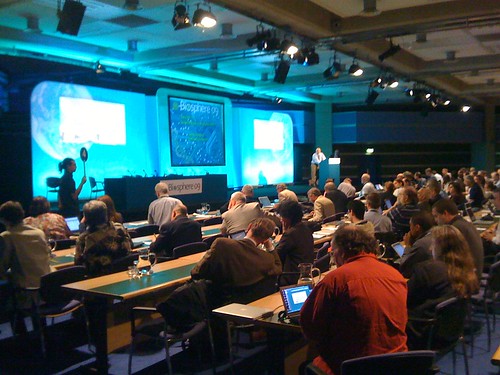
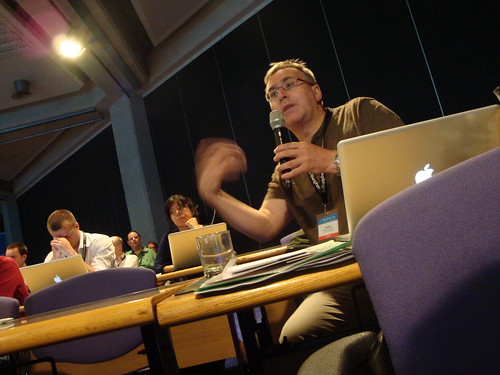
I tried to stir things up a little (almost literally as captured in this photo by Chris Freeland), with a couple of questions, but to not much effect (other than apparently driving to despair the poor chap behind me ).


But enough grumbling. It was great to see lots of people attending the event, the were lots of interesting posters and booths (creating a market for this field may go some way towards providing an incentive to provide better, more reliable services), and my challenge entry won joint first prize, so perhaps I should sit back, enjoy the wine Joel Sachs choose as the prize (many thanks for his efforts in putting the challenge event together), and let others say what they thought of the meeting.

Saturday, May 30, 2009

e-Biosphere 09 Challenge slides

I've put the slides for my e-Biosphere 09 challenge entry on SlideShare.

Not much information on the other entries yet, except for the eBiosphere Citizen Science Challenge, by Joel Sachs and colleagues, which will demonstrate a "global human sensor net". Their plan is to aggregate observations posted on Flickr, Twitter, Spotter, and email. It might be fun to make use of some of this for my own entry (by default already will, because we are both using EOL's Flickr pool).

Wednesday, May 27, 2009

Visualizing the Evolutionary Tree of Life

Over on the EOL blog is a summary of a meeting Visualizing the Evolutionary Tree of Life. This sounds like it was a fun meeting, but part of me is suffering from déjà vu. Our community has tossed this subject around for a while now. I recall Tamara Munzner wowing us with the H3 hyperbolic browser at a meeting at UC Davis in 2000 (part of the original NSF TOL workshops, archived herel) -- the image of Joel Cracraft excitedly running up to the display screen to find various birds is forever etched into my brain. TreeJuxtaposer has been around for a while, to not much effect.

We seem to continue to fail to make much progress on this topic, despite meetings such as the EOL one, great reviews of the topic, fancy 3D visualisation, and Mike Sanderson's way kewl wall of monitors.

Maybe progress was made at the EOL meeting, but I don't get the sense that we're any further forward. It would be interesting to work out why we've struggled to satisfactorily solve this problem.

Tuesday, May 26, 2009

e-Biosphere Challenge: visualising biodiversity digitisation in real time

e-Biosphere '09 kicks off next week, and features the challenge:
Prepare and present a real-time demonstration during the days of the Conference of the capabilities in your community of practice to discover, disseminate, integrate, and explore new biodiversity-related data by:
  • Capturing data in private and public databases;
  • Conducting quality assurance on the data by automated validation and/or peer review;
  • Indexing, linking and/or automatically submitting the new data records to other relevant databases;
  • Integrating the data with other databases and data streams;
  • Making these data available to relevant audiences;
  • Make the data and links to the data widely accessible; and
  • Offering interfaces for users to query or explore the data.


Originally I planned to enter the wiki project I've been working on for a while, but time was running out and the deadline was too ambitious. Hence, I switched to thinking about RSS feeds. The idea was to first create a set of RSS feeds for sources that lack them, which I've been doing over at http://bioguid.info/rss, then integrate these feeds in a useful way. For example, the feeds would include images from Flickr (such as EOL's pool), geotagged sequences from GenBank, the latest papers from Zootaxa, and new names from uBio (I'd hoped to include ION as well, but they've been spectacularly hacked).

After playing with triple stores and SPARQL (incompatible vocabularies and multiple identifiers rather buggers this approach), and visualisations based on Google Maps (building on my swine flu timemap), it dawned on me what I really needed was an eye-catching way of displaying geotagged, timestamped information, just like David Troy's wonderful twittervision and flickrvision.com. In particular, David took the Poly9 Globe and added Twitter and Flickr feeds (see twittervision 3D and flickrvision 3D. So, I took hacked David's code and created this, which you can view at http://bioguid.info/ebio09/www/3d/:


It's a lot easier to simply look at it rather than describe what it does, but here's a quick sketch of what's under the hood.

Firstly, I take RSS feeds, either the raw geoFeed from Flickr, or from http://bioguid.info/rss. The bioGUID feeds include the latest papers in Zootaxa (most new animal species are described in this journal), a modified version of uBio's new names feed, and a feed of the latest, geotagged sequences in GenBank (I'd hoped to use only DNA barcodes, but it turns out rather few barcode sequences are geotagged, and few have the "BARCODE" keyword). The Flickr feeds are simple to handle because they include locality information (including latitude, longitude, and Yahoo Where-on-Earth Identifiers (WOEIDs)). Similarly, the GenBank feed I created has latitude and longitudes (although extracting this isn't always as straightforward as it should be). Other feeds require more processing. The uBio feed already has taxonomic names, but no geotagging, so I use services from Yahoo! GeoPlanet™ to find localities from article titles. For the Zootaxa feed that I created I use uBio's SOAP service to extract taxonomic names, and Yahoo! GeoPlanet™ to extract localities.


I've tried to create a useful display popup. For Zootaxa papers you get a thumbnail of the paper, and where possible an icon of the taxonomic group the paper talks about (the presence of this icon depends on the success of uBio's taxonomic name finding service, the Catalogue of Life having the same name, and my having a suitable icon). The example above shows a paper about copepods. Other papers have a icon for the journal (again, a function of my being able to determine the journal ISSN and having a suitable icon). Flickr images simply display a thumbnail of the image.

What does it all mean? Well, I could say all sorts of things about integration and mash-ups but, dammit, it's pretty. I think it's a fun way to see just what is happening in digital biodiversity. I've deliberately limited the demo to items that came online in the month of May, and I'll be adding items during the conference (June 1-3rd in London). For example, if any more papers appear in Zootaxa, or in the uBio feeds I'll add those. If anybody uploads geotagged photos to EOL's Flickr group, I'll grab those as well. It's still a bit crude, but it shows some of the potential of bringing things together, coupled with a nice visualisation. I welcome any feedback.

Friday, May 22, 2009

Dryad, DOIs, and why data matters more than journal articles


For the last two days I've been participating in a NESCent meeting on Dryad, a "repository of data underlying scientific publications, with an initial focus on evolutionary biology and related fields". The aim of Dryad is to provide a durable home for the kinds of data that don't get captured by existing databases such as GenBank and TreeBASE (for example, the Excel spreadsheets, Word files, and tarballs of data that, if they are lucky, make it on to a journal's web site as supplementary material (like this example). These data have an alarming tendency to disappear (see "Unavailability of online supplementary scientific information from articles published in major journals" doi:10.1096/fj.05-4784lsf).

Perhaps it was because I was participating virtually (via Adobe Connect, which worked very well), but at times I felt seriously out of step with many of the participants. I got the sense that they regard the scientific article as primary, data as secondary, and weren't entirely convinced that data needed to be treated in the same way as a publication. I was arguing that Dryad should assign DOIs to data sets, join CrossRef, and ensure data sets were cited in the same way as papers. For me this is a no brainer -- by making data equivalent to a publication, journals don't need to do anything special, publishers know how to handle DOIs, and will have fewer qualms than handling URLs, which have a nasty tendency to break (see "Going, Going, Gone: Lost Internet References" doi:10.1126/science.1088234).

Furthermore, being part of CrossRef would bring other benefits. Their cited-by linking service enables publishers to display lists of articles that cite a given paper -- imagine being able to do this for data sets. Dryad could display not just the paper associated with publication of the data set, but all subsequent citations. As an author, I'd love to see this. It would enable me to see what others had done with my data, and provide an incentive to submit my data to Dryad (providing incentives to authors to archive data is a big issue, see Mark Costello's recent paper doi:10.1525/bio.2009.59.5.9).

Not everyone saw things this way, and it's often a "reality check" to discover that things one takes for granted are not at all obvious to others (leading to mutual incomprehension). Many editors, understandably, think of the the journal article as primary, and data as something else (some even struggle to see why one would want to cite data). There's also (to my mind) a ridiculous level of concern about whether ISI would index the data. In the age of Google, who cares? Partly these concerns may reflect the diversity of the participants. Some subjects, such as phylogenetics, are built on reuse of previous data, and it's this reuse that makes data citation both important and potentially powerful (for more on this see my papers hdl:10101/npre.2009.3173.1 and doi:10.1093/bib/bbn022). In many ways, the data is more important than the publication. If I look at a phylogenetics paper published, say 5 or more years ago, the methods may be outmoded, the software obsolete (I might not be able to run it on a modern machine), and the results likely to be outdated (additional data and/or taxa changing the tree). So, the paper might be virtually useless, but the data continues to be of value. Furthermore, the great thing about data (especially sequence data) is that it can be used in all sorts of unexpected ways. In disciplines such as phylogenetics, data reuse is very common. In other areas in evolution and ecology, this might not be the case.

It will be clear from this that I buy the idea articulated by Philip Bourne (doi:10.1371/journal.pcbi.0​010034) that there's really no difference between a database and a journal article and that the two are converging (I've argued for a long time that the best thing that could happen to phylogeneics would be if Molecular Phylogenetics and Evolution and TreeBASE were to merge and become one entity). Data submission would equal publication. In the age of Google where data is unreasonably effective (doi:10.1109/mis.2009.36, PDF here), privileging articles at the expense of data strikes me as archaic.

So, whither Dryad? I wish it every success, and I'm sure it will be a great start. There are some very clever people behind it, and it takes a lot of work to bring a community on board. However, I think Dryad's use of Handles is a mistake (they are the obvious choice of identifier given Dryad is based on DSpace), as this presents publishers with another identifier to deal with, and has none of the benefits of DOIs. Indeed, I would go further and say that the use of Handles + DSpace marks Dryad as being basically yet another digital library project, which is fine, but it puts it outside the mainstream of science publishing, and I think that is a strategic mistake. An example of how to do things better is Nature Precedings, which assigns DOIs to manuscripts, reports, and presentations. I think the use of DOIs in this context demonstrated that Nature was serious, and valued these sorts of resource. Personally, I'd argue that Dryad should be more ambitious, and see itself as a publisher, not a repository. In fact, it could think of itself as a journal publisher. Ironically, maybe the editors at the NESCent meeting were well advised to be wary, what they could be witnessing is the formation of a new kind of publication, where data is the article, and the article is data.

Thursday, May 07, 2009

Nomenclators + digitised literature = fail


Continuing with RSS feeds, I've now added wrappers around IPNI that will return for each plant family a list of names added to the IPNI database in the last 30 days. You can see the list at here.

One thing which is a constant source of frustration for me is the disconnect between nomenclators (lists of published names for species) and scientific publishing. The unit of digitisation for a publisher is the scientific article, but nomenclators often cite not the article in which a name was published, but the page on which the name appears.

For example, consider IPNI record 77096979-1 (or, if you prefer LSIDs urn:lsid:ipni.org:names:77096979-1). It is for the begonia Begonia ozotothrix, and the citation is:

Edinburgh J. Bot. 66(1): 105 (-110; figs. 1, 4-5, map). 2009 [Mar 2009]

Very detailed, and great if I have access to a physical library that has the Edinburgh Journal of Botany -- I just find volume 66 on the shelf and turn to page 105. But, I want this on my computer now ("library" - who they?). How do I find this reference on the web? The answer, is not easily. Tools such as OpenURL, which could be used, assume that I know at least the starting page of the article, but IPNI doesn't tell me that. Nor do I have an article title, which might help, but a Google search on "Begonia ozotothrix" finds the article:

TWO NEW SPECIES OF BEGONIA ( BEGONIACEAE) FROM CENTRAL SULAWESI, INDONESIA
D C Thomas, W H Ardi and M Hughes
Edinburgh Journal of Botany 66, 103 (2009)
doi:10.1017/S0960428609005320

Note the DOI! This article exists on the web, so why can't IPNI give me the DOI? They've gone to a lot of trouble to describe the citation in great detail, but adding the DOI brings the record into the 21st century and the web (the DOI is even printed on the article!).

I think nomenclators need to make a concerted effort to integrate with the digital scientific literature, otherwise they will remain digital backwaters that make the implicit assumption that their users have access to libraries such as that at the Royal Botanic Gardens, Edinburgh (pictured).

For recently published articles there's absolutely no reason not to store the DOI. Finding these retrospectively is a pain, but I need these for my RSS feed (and other projects) so one thing I added a while ago to bioGUID's OpenURL resolver is the ability to search for an article given an arbitrary page. For example,

http://bioguid.info/openurl/?genre=article&title=Edinburgh J. Bot.&volume=66&pages=105

will search various sources (such as CrossRef) to find an article that includes page 105. Now, I just have to have a parser that can make sense of IPNI bibliographic citations...

Wednesday, May 06, 2009

Integrating and displaying data using RSS


Although I'd been thinking of getting the wiki project ready for e-Biosphere '09 as a challenge entry, lately I've been playing with RSS has a complementary, but quicker way to achieve some simple integration.

I've been playing with RSS on and off for a while, but what reignited my interest was the swine flu timemap I made last week. The neatest thing about the timemap was how easy it was to make. Just take some RSS that is geotagged and you get the timemap (courtesy of Nick Rabinowitz's wonderful Timemap library).

So, I began to think about taking RSS feeds for, say journals and taxonomic and genomic databases and adding them together and displaying them using tools such as timemap (see here for an earlier mock up of some GenBank data). Two obstacles are in the way. The first is that not every data source of interest provides RSS feeds. To address this I've started to develop wrappers around some sources, the first of which is ZooBank.

The second obstacle is that integration requires shared content (e.g., tags, identifiers, or localities). Some integration will be possible geographically (for example, adding geotagged sequences and images to a map), but this won't work for everything. So, I need to spend some time trying to link stuff together. In the case of Zoobank there's some scope for this, as ZooBank metadata sometimes includes DOIs, which enables us to link to the original publication, as well as bookmarking services such as Connotea. I'm aiming to include these links within the feed, as shown in this snippet (see the <link rel="related"...> element):


<entry>
<title>New Protocetid Whale from the Middle Eocene of Pakistan: Birth on Land, Precocial Development, and Sexual Dimorphism</title>
<link rel="alternate" type="text/html" href="http://zoobank.org/urn:lsid:zoobank.org:pub:8625FB9A-1FC3-43C3-9A99-7A3CDE0DFC9C"/>
<updated>2009-05-06T18:37:34+01:00</updated>
<id>urn:uuid:c8f6be01-2359-1805-8bdb-02f271a95ab4</id>
<content type="html">Gingerich, Philip D., Munir ul-Haq, Wighart von Koenigswald, William J. Sanders, B. Holly Smith & Iyad S. Zalmout<br/><a href="http://dx.doi.org/10.1371/journal.pone.0004366">doi:10.1371/journal.pone.0004366</a></content>
<summary type="html">Gingerich, Philip D., Munir ul-Haq, Wighart von Koenigswald, William J. Sanders, B. Holly Smith & Iyad S. Zalmout<br/><a href="http://dx.doi.org/10.1371/journal.pone.0004366">doi:10.1371/journal.pone.0004366</a></summary>
<link rel="related" type="text/html" href="http://dx.doi.org/10.1371/journal.pone.0004366" title="doi:10.1371/journal.pone.0004366"/>
<link rel="related" type="text/html" href="http://bioguid.info/urn:lsid:zoobank.org:pub:8625FB9A-1FC3-43C3-9A99-7A3CDE0DFC9C" title="urn:lsid:zoobank.org:pub:8625FB9A-1FC3-43C3-9A99-7A3CDE0DFC9C"/>
</entry>


What I'm hoping is that there will be enough links to create something rather like my Elsevier Challenge entry, but with a much more diverse set of sources.