Wednesday, February 22, 2012

Clustering strings

Revisiting an old idea (Clustering taxonomic names) I've added code to cluster strings into sets of similar strings to the phyloinformatics course site.

This service (available at http://iphylo.org/~rpage/phyloinformatics/services/clusterstrings.php) takes a list of strings, one per line, and returns a list of clusters. For example, given the names


Ferrusac 1821
Bonavita 1965
Ferussa 1821
Fer.
Lamarck 1812
Ferussac 1821


the service finds three clusters, displayed here using Google images:


(Note to self, investigate canviz as an alternative for displaying graphviz graphs.)

If you are curious, these strings are taxonomic authorities associated with the name Helicella, and based on this clustering there are three taxonomic names, one of which has three different variations of the author's name.

Why LSIDs suck

I'll keep this short: LSIDs suck because they are so hard to set up that many LSIDs don't actually work. Because of this there seems to be no shame in publishing "fake" LSIDs (LSIDs that look like LSIDs but which don't resolve using the LSID protocol). Hey, it's hard work, so let's just stick them on a web page but not actually make them resolvable. Hence we have an identifier that people don't recognise (most people have no idea what an LSID is) and which we have no expectations that it will actually work. This devalues the identifier to the point where it becomes effectively worthless.

Now consider URLs. If you publish a URL I expect it to work (i.e., I paste it into a web browser and I get something). If it doesn't work then I can conclude that the URL is wrong, or that you are a numpty and can't run a web site (or don't care enough about your content to keep the URL working). At no point am I going to say "gee, it's OK that this URL doesn't resolve because these things are hard work."

Now you might argue that whether your LSID resolves is an even better way for me to assess your technical ability (because it's hard work to do it right). Fair enough, but the fact that even major resources (such as Catalogue of Life) can't get them to work reliably reduces the value of this test (it's a poor predictor of the quality of the resource). Or, perhaps the LSID is a signal that you get this "globally unique identifier thing" and maybe one day will make the LSIDs work. No, it's a signal you don't care enough about identifiers to make them actually work today.

As soon as people decided it's OK to publish LSIDs that don't work, LSIDs were doomed. The most immediate way for me to determine whether you are providing useful information (resolving the identifier) is gone. And with that goes any sense that I can trust LSIDs.

Tuesday, February 21, 2012

Linking GBIF and Genbank

As part of my mantra that it's not about the data, it's all about the links between the data, I've started exploring matching GenBank sequences to GBIF occurrences using the specimen_voucher codes recorded in GenBank sequences. It's quickly becoming apparent that this is not going to be easy. Specimen codes are not unique, are written in all sorts of ways, there are multiple codes for the same specimen (GenBank sequences may be associated with museum catalogue entries, or which field or collector numbers).

So why undertake what is fast looking like a hopeless task? There are several reasons:
  1. GBIF occurrences have a unique URL which we could potentially use as a unique, resolvable identifier for the corresponding specimen.
  2. Linking GenBank to GBIF would make it possible for GBIF to list sequences associated with a specimen, as well as the associated publication, which means we could demonstrate the "impact" of a specimen. In the simplest terms this could be the number of sequences and publications that use data from the specimen, more sophisticated approaches could use PageRank-like measures, see hdl:10101/npre.2008.1760.1.
  3. Having a unique identifier that is shared across different databases makes it easier to combine data from different sources. For example, if a sequence in GenBank lacks geographic coordinates but the voucher specimen in GBIF is georeferenced, we can use that information to locate the sequence in geographic space (and hence build geophylogenies or add spatial indexes to databases such as TreeBASE). Conversely, if the GenBank sequence is georeferenced but the GBIF record isn't we can update the GBIF record and possibly expand the range of the corresponding taxon (this was part of the motivation behind hdl:10101/npre.2009.3173.1.

As an example, below is the GBIF 1° density map for the frog Pristimantis ridens from GBIF, with the phylogeny from Wang et al.Phylogeography of the Pygmy Rain Frog (Pristimantis ridens) across the lowland wet forests of isthmian Central Americahttp://dx.doi.org/10.1016/j.ympev.2008.02.021 layered over it. I created the KML tree from the corresponding tree in TreeBASE using the tool I described earlier. You can grab the KML for the tree here.

Density

As we'd expect, there is a lot of overlap in the two sources of data. If we investigate further, there are records that are in fact based on the same specimen. For example, if we download the GBIF KML file with individual placemarks we see that in the northern part of the range their are 15 GBIF occurrences that map onto the same point as one of the terminal taxa in the tree.

Gbif

One of these 15 GBIF records (http://data.gbif.org/occurrences/244335848) is for specimen USNM 514547, which is the voucher specimen for EU443175. This gives us a link between the record in GBIF and the record in GenBank. It also gives us a URI we can use for the specimen http://data.gbif.org/occurrences/244335848 instead of the unresolvable and potentially ambiguous USNM 514547.

If we view the geophylogeny from a different vantage point we see numerous localities that don't have occurrences in GBIF.

Nogbif

Close inspection reveals that some of the specimens listed in the Wang et al. paper are actually in GBIF, but lack geographic coordinates. For example the OTU "Pristimantis ridens Nusagandi AJC 0211" has the voucher specimen FMNH 257697. This specimen is in GBIF as http://data.gbif.org/occurrences/57919777/, but without coordinates, so it doesn't appear on the GBIF map. However, both the Wang et al. paper and the GenBank record for the sequence from this specimen EU443164 give the latitude and longitude. In this example, GBIF gives us a unique identifier for the specimen, and GenBank provides data on location that GBIF lacks.

Part of GBIFs success is due to the relative ease of integrating data by taxonomic names (despite the problems caused by synonyms, homonyms, misspellings, etc.) or using spatial coordinates (which immediately enables integration with environmental data. But if we want to integrate at deeper levels then specimen records are the glue that connects GBIF (and its contributing data sources) to sequence databases, phylogenies, and the taxonomic literature (via lists of material exampled). This will not be easy, certainly for legacy data that cites ambiguous specimen codes, but I would argue that the potential rewards are great.

Thursday, February 16, 2012

EOL Phylogenetic Tree Challenge

34106 130 130The Encyclopedia of Life have announced the EOL Phylogenetic Tree Challenge. The contest has two purposes:


It provides a testbed for the Evolutionary Informatics community to develop robust methods for producing, serving, and evaluating large, biologically meaningful trees that will be useful both to the research community and to broader audiences.

It enables the Encyclopedia of Life to organise the information it aggregates according to phylogenetic relationships; in other words, it provides a direct pipeline from research results to practical use.


First prize is a trip to iEvoBio 2012, this year in Ottawa, Canada. For more details visit the challenge website. There is also an EOL community devoted to this challenge.

Challenges are great things, especially ones with worthwhile tasks and decent prizes. EOL badly needs a phylogenetic perspective, so this is a welcome development.

But (there's always a but), I can't help feeling that we need something a little more radical. The tree of life isn't a tree. At deep levels it's a forest, and even at shallow levels things are a complicated tangle of gene trees. Sometimes the tree is clear, sometimes not, and some of this is real and some reflects our ignorance.

If you want a simple tree to navigate, then I'd argue that the NCBI tree is a pretty good start, and EOL already has this. What would be really cool is to have a way to navigate that makes it clear that phylogenetic knowledge has a degree of uncertainty, and that the "tree of life" might be better depicted as a set of overlapping trees. The mental image I have is of a collage of trees from different data sets, superimposed over each other, with perhaps an underlying consensus to help navigate. This visualisation could be zoomable, because in some ways the tree of life is fractal. Trees don't stop at species, as the wealth of barcoding and phylogeographic studies show. Given computational constraints (not to mention visualisation issues), I wonder whether there is an effective limit to the size of any one tree in terms of number of taxa. What varies is the taxonomic scope. So we could imagine a backbone tree based on slowly evolving genes, we zoom in and more trees appear, but at lower levels, and finally we hit populations and individuals, trees that may have 100's of samples, but a very narrow scope.

This is all rather poorly articulated, but I can't help wondering whether a phylogenetic classification will end up distorting the very thing we're trying to depict. It also looses connection with the underlying data (and trees), which for me is a huge drawback of existing classifications. There's no sense of why they are the way they are. There's a chance here to bring together ideas that have been kicking around in the phylogenetic community for a couple of decades and rethink how we navigate the "tree of life".

Friday, February 10, 2012

BLAST a sequence and get a tree and a map

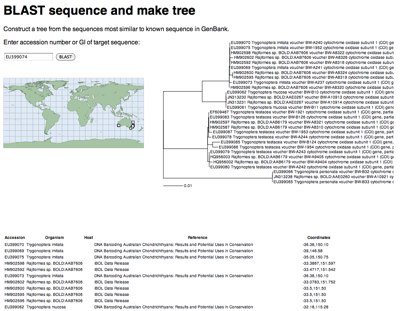
I've updated the BLAST a sequence and get a tree tool described in a previous post to output additional details, such as a list of the sequences used to build the tree and some basic metadata (such as the taxon name, name of any associated host, publication, and geographic coordinates). If the sequences are geotagged, then you will also see a little map showing the localities. As ever, all this relies on SVG, so if you're browser doesn't support that out won't see much.

The example below is for the sequence EU399074, which falls in a cluster of "dark taxa"; in this case, DNA barcode sequences that haven't been properly labelled.

Blastmap

Wednesday, February 08, 2012

Automating the creation of geophylogenies: NEXUS + delimited text = KML

One thing which has always frustrated me about geophylogenies is how tedious they are to create. In theory, they should be pretty straightforward to generate. We take a tree, get point localities for each leaf in the tree, and generate the KML to display on Google Earth. The tedious part is getting the latitude and longitude data in the right format, and linking the leaves in the tree to the locality data.

To help reduce the tedium I've create a tool that tries to automate this as much as possible. The goal is to be able to paste in a NEXUS tree, and a table of localities, and get back a KML tree. Some publishers are making it easier to extract data from articles. For example, if you go to a paper such as http://dx.doi.org/10.1016/j.ympev.2009.07.011 you will see a widget on the right labelled Table download.

Elsevier

If you click on the Find tables button you can download the tables in CSV format. In this case, Table 1 has latitude and longitude data for all the taxa in the tree in TreeBASE study S10103. With some regular expressions we can figure out which column has the latitude and longitude data, and parse values like (10°12′N, 84°09′W) to extract the numerical values for latitude and longitude.

It is also pretty straightforward to be able to read a tree in NEXUS format and extract the taxon names. At this point we have two sets of names (those from the tree and those from the table) which might not be the same (in this case they aren't, we have "Craugastor cf. podiciferus FMNH 257672" and "FMNH 257672"). Matching these names up by hand would be tedious, but as described in Matching names in phylogeny data files we can use maximum weighted bipartite matching to compute an optimal matching between the two sets of labels.

Create KML tree

You can try the Create KML tree tool at http://iphylo.org/~rpage/phyloinformatics/kml/.

To get started, try it with the data below. In step 1 paste in the NEXUS tree, in step 2 paste in the table from the original paper. If all goes as it should, you will see a table displaying the matching, and the KML which you can save and open in Google Earth. If you have the Google Earth Plug-in installed, then you should see the KML displayed on Google Earth in your web browser.


I've tested the tool on only a few examples, so there will be cases where it fails. It also assumes that every taxon in the tree has latitude and longitude values, and that the first column in the table is the taxon name (you'll need to edit the file if this is not the case).

Here is the tree used in the example...


#NEXUS
BEGIN TREES;
TRANSLATE
Tl254954 'Craugastor cf. podiciferus FMNH 257672',
Tl254956 'Craugastor cf. podiciferus FMNH 257653',
Tl254965 'Craugastor cf. podiciferus UCR 16356',
Tl254960 'Craugastor sp. A USNM 563039',
Tl254938 'Craugastor sp. A USNM 563040',
Tl254945 'Craugastor cf. podiciferus UCR 16360',
Tl254928 'Craugastor cf. podiciferus UCR 17439',
Tl254959 'Craugastor cf. podiciferus UCR 17462',
Tl254951 'Craugastor cf. podiciferus FMNH 257596',
Tl254967 'Craugastor sp. A FMNH 257689',
Tl254934 'Craugastor cf. podiciferus UCR 16355',
Tl254964 'Craugastor cf. podiciferus FMNH 257671',
Tl254963 'Craugastor cf. podiciferus UCR 16358',
Tl254952 'Craugastor cf. podiciferus UCR 18062',
Tl254926 'Craugastor cf. podiciferus UCR 17442',
Tl254968 'Craugastor sp. A FMNH 257562',
Tl254939 'Craugastor cf. podiciferus UCR 17441',
Tl254946 'Craugastor cf. podiciferus FMNH 257757',
Tl254942 'Craugastor cf. podiciferus MVZ 149813',
Tl254961 'Craugastor cf. podiciferus FMNH 257595',
Tl254969 'Craugastor cf. podiciferus UCR 17469',
Tl254932 'Craugastor cf. podiciferus MVZ 164825',
Tl254970 'Craugastor sp. A AJC 0891',
Tl254943 'Craugastor cf. podiciferus UCR 16357',
Tl254929 'Craugastor cf. podiciferus FMNH 257673',
Tl254950 'Craugastor cf. podiciferus FMNH 257756',
Tl254944 'Craugastor cf. podiciferus FMNH 257652',
Tl254953 'Craugastor cf. podiciferus UCR 16359',
Tl254931 'Craugastor cf. podiciferus UCR 17443',
Tl254940 'Craugastor stejnegerianus UCR 16332',
Tl254935 'Craugastor underwoodi UCR 16315',
Tl254958 'Craugastor cf. podiciferus UCR 16354',
Tl254966 'Craugastor sp. A AJC 0890',
Tl254949 'Craugastor cf. podiciferus FMNH 257758',
Tl254933 'Craugastor cf. podiciferus UCR 16361',
Tl254962 'Craugastor cf. podiciferus FMNH 257651',
Tl254948 'Craugastor cf. podiciferus FMNH 257670',
Tl254971 'Craugastor cf. podiciferus FMNH 257669',
Tl254936 'Craugastor cf. podiciferus FMNH 257550',
Tl254957 'Craugastor underwoodi USNM 561403',
Tl254947 'Craugastor cf. podiciferus FMNH 257755',
Tl254927 'Craugastor cf. podiciferus UCR 16353',
Tl254925 'Craugastor bransfordii MVUP 1875',
Tl254930 'Craugastor cf. podiciferus UTA A 52449',
Tl254955 'Craugastor tabasarae MVUP 1720',
Tl254941 'Craugastor cf. longirostris FMNH 257678',
Tl254937 'Craugastor cf. longirostris FMNH 257561' ;
TREE 'Fig. 2' = ((Tl254955,(Tl254941,Tl254937)),(((((Tl254954,Tl254942,Tl254933,Tl254948,Tl254971),((Tl254934,Tl254958,Tl254927),((Tl254964,Tl254929),Tl254930))),(((Tl254965,(Tl254963,Tl254943)),(Tl254959,Tl254969),(Tl254951,Tl254961)),((Tl254928,Tl254926,Tl254939,Tl254931),(Tl254952,Tl254932)))),((((Tl254956,Tl254936),Tl254946,Tl254950,(Tl254944,Tl254962),Tl254947),Tl254949),(Tl254945,Tl254953))),((((Tl254960,Tl254938),(Tl254970,Tl254966)),(Tl254967,Tl254968)),((Tl254940,Tl254925),(Tl254935,Tl254957)))));
END;


...and here is the table:


Taxon and institutional vouchera,Locality ID,Collection localityb,Geographic coordinates/approximate location,Elevation (m),GenBank accession number12S,16S,COI,c-myc
1. UTA A-52449,1,"Puntarenas, CR","(10°18′N, 84°48′W)",1520,EF562312,EF562365,None,EF562417
2. MVZ 149813,2,"Puntarenas, CR","(10°18′N, 84°42′W)",1500,EF562319,EF562373,EF562386,EF562430
3. FMNH 257669,1,"Puntarenas, CR","(10°18′N, 84°47′W)",1500,EF562320,EF562372,EF562380,EF562432
4. FMNH 257670,1,"Puntarenas, CR","(10°18′N, 84°47′W)",1500,EF562317,EF562336,EF562376,EF562421
5. FMNH 257671,1,"Puntarenas, CR","(10°18′N, 84°47′W)",1500,EF562314,EF562374,EF562409,None
6. FMNH 257672,1,"Puntarenas, CR","(10°18′N, 84°47′W)",1500,EF562318,None,EF562382,None
7. FMNH 257673,1,"Puntarenas, CR","(10°18′N, 84°47′W)",1500,EF562311,EF562343,EF562392,None
8. UCR 16361,3,"Alejuela, CR","(10°13′ N, 84°22′W)",1930,EF562321,EF562371,EF562375,EF562431
9. UCR 16353,4,"Heredia, CR","(10°12′N, 84°09′W)",1500,EF562313,EF562349,None,EF562420
10. UCR 16354,4,"Heredia, CR","(10°12′N, 84°09′W)",1500,EF562315,EF562363,None,EF562418
11. UCR 16355,4,"Heredia, CR","(10°12′N, 84°09′W)",1500,EF562316,EF562366,None,EF562419
12. UCR 18062,6,"Heredia, CR","(10°10′N, 84°06′W)",1900,EF562302,EF562342,EF562395,None
13. UCR 17439,5,"Heredia, CR","(10°09′N, 84°09′W)",2000,EF562298,EF562341,EF562387,EF562427
14. UCR 17441,5,"Heredia, CR","(10°09′N, 84°09′W)",2000,EF562299,EF562345,EF562388,EF562429
15. UCR 17442,5,"Heredia, CR","(10°09′N, 84°09′W)",2000,EF562300,EF562337,EF562385,EF562422
16. UCR 17443,5,"Heredia, CR","(10°09′N, 84°09′W)",2000,EF562301,EF562340,EF562384,EF562428
17. UCR 17462,5,"Heredia, CR","(10°09′N, 84°09′W)",2000,EF562309,EF562355,EF562406,EF562440
18. UCR 17469,5,"Heredia, CR","(10°09′N, 84°09′W)",2000,EF562310,EF562334,EF562405,EF562414
19. MVZ 164825,7,"Heredia, CR","(10° 05′N, 84° 04′W)",2100,EF562303,EF562346,EF562381,EF562423
20. UCR 16357,8,"San José, CR","(10°02′N, 83°57′W)",1600,EF562306,EF562339,EF562400,EF562433
21. UCR 16358,8,"San José, CR","(10°02′N, 83°57′W)",1600,EF562307,EF562370,EF562412,EF562415
22. UCR 16356,8,"San José, CR","(10°01′N, 83°56′W)",1940,EF562308,EF562329,None,None
23. UCR 16359,10,"San José, CR","(9°26′N, 83°41′W)",1313,EF562297,EF562369,EF562396,None
24. UCR 16360,10,"San José, CR","(9°26′N, 83°41′W)",1313,EF562296,EF562368,None,EF562434
25. FMNH 257595,9,"Cartago, CR","(9°44′N, 83°46′W)",1600,EF562304,EF562338,EF562408,None
26. FMNH 257596,9,"Cartago, CR","(9°44′N, 83°46′W)",1600,EF562305,EF562335,None,EF562416
27. FMNH 257550,11,"Puntarenas, CR","(8°47′N, 82°59′W)",1350,EF562294,EF562330,EF562393,EF562443
28. FMNH 257651,11,"Puntarenas, CR","(8°47′N, 82°59′W)",1350,EF562291,EF562367,EF562402,EF562435
29. FMNH 257652,11,"Puntarenas, CR","(8°47′N, 82°59′W)",1350,EF562288,EF562364,EF562390,None
30. FMNH 257653,11,"Puntarenas, CR","(8°47′N, 82°59′W)",1350,EF562292,EF562354,EF562392,EF562438
31. FMNH 257755,11,"Puntarenas, CR","(8°46′N, 82°59′W)",1410,EF562289,EF562344,EF562379,None
32. FMNH 257756,11,"Puntarenas, CR","(8°46′N, 82°59′W)",1410,EF562290,EF562347,EF562377,EF562413
33. FMNH 257757,11,"Puntarenas, CR","(8°46′N, 82°59′W)",1410,EF562293,EF562352,EF562383,EF562437
34. FMNH 257758,11,"Puntarenas, CR","(8°46′N, 82°59′W)",1410,EF562295,EF562348,EF562397,EF562436
35. USNM 563039,12,"Chiriquí, PA","(8°48′N, 82°24′W)",1663,EF562284,EF562356,EF562389,EF562445
36. USNM 563040,12,"Chiriquí, PA","(8°48′N, 82°24′W)",1663,EF562285,EF562350,EF562391,EF562439
37. AJC 0890,12,"Chiriquí, PA","(8°48′N, 82°24′W)",1663,EF562282,EF562351,EF562398,EF562444
38. MVUP 1880,12,"Chiriquí, PA","(8°48′N, 82°24′W)",1663,EF562283,EF562358,EF562399,EF562442
39. FMNH 257689,12,"Chiriquí, PA","(8°45′N, 82°13′W)",1100,EF562287,EF562353,EF562407,EF562446
40. FMNH 257562,12,"Chiriquí, PA","(8°45′N, 82°13′W)",1100,EF562286,EF562357,EF562410,EF562441
41. USNM 561403,N/A,"Heredia, CR","(10°24′N, 84°03′W)",800,EF562323,EF562361,EF562378,None
42. UCR 16315,N/A,"Alejuela, CR","(10°13′N, 84°35′W)",960,EF562322,EF562362,EF562394,None
43. UCR 16332,N/A,"San José, CR","(9°18′N, 83°46′W)",900,EF562325,EF562360,EF562411,AY211320
44. MVUP 1875 fitzingeri group,N/A,"BDT, PA","(9°24′N, 82°17′W)",50,EF562324,EF562359,None,AY211304
45. MVUP 1720,N/A,"Coclé, PA","(8°40′N, 80°35′W)",800,EF562326,EF562332,EF562401,EF562424
46. FMNH 257561,N/A,"Chiriquí, PA","(8°45′N, 82°13′W)",1100,EF562327,EF562331,None,EF562426
47. FMNH 257678,N/A,"Chiriquí, PA","(8°45′N, 82°13′W)",1100,EF562328,EF562333,EF562404,EF562425

Monday, February 06, 2012

Using Google Refine and taxonomic databases (EOL, NCBI, uBio, WORMS) to clean messy data

RefineGoogle Refine is an elegant tool for data cleaning. One of its most powerful features is the ability to call "Reconciliation Services" to help clean data, for example by matching names to external identifiers. Google Refine comes with the ability to use Freebase reconciliation services, but you can also add external services. Inspired by this I've started to implement services to reconcile taxonomic names.

The services I've implemented so far are:
  • EOL http://iphylo.org/~rpage/phyloinformatics/services/reconciliation_eol.php
  • NCBI taxonomy http://iphylo.org/~rpage/phyloinformatics/services/reconciliation_ncbi.php
  • uBio FindIT http://iphylo.org/~rpage/phyloinformatics/services/reconciliation_ubio.php
  • WORMS http://iphylo.org/~rpage/phyloinformatics/services/reconciliation_worms.php
  • GBIF http://iphylo.org/~rpage/phyloinformatics/services/reconciliation_gbif.php
  • Global Names Index http://iphylo.org/~rpage/phyloinformatics/services/reconciliation_globalnames.php


To use these you need to add the URLs above to Google Refine (see example below). The EOL, NCBI and WORMS do a basic name lookup. The uBio FindIT service extracts a taxonomic name from a string, and can be viewed as a "taxonomic name cleaner".

How to use reconciliation services

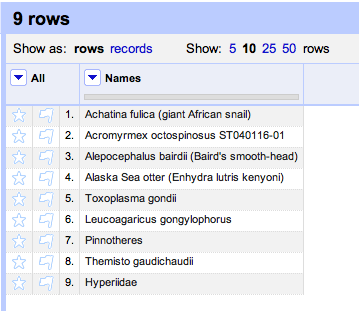
Start a Google Refine session. Save the names below to a text file and open it as a new project.

Names
Achatina fulica (giant African snail)
Acromyrmex octospinosus ST040116-01
Alepocephalus bairdii (Baird's smooth-head)
Alaska Sea otter (Enhydra lutris kenyoni)
Toxoplasma gondii
Leucoagaricus gongylophorus
Pinnotheres
Themisto gaudichaudii
Hyperiidae


You should see something like this:
Refine1

Click on the column header Names and choose Reconcile → Start reconciling.

Refine2

A dialog will popup asking you to select a service.

Refine3

If you've already added a service it will be in the list on the left. If not, click the Add Standard Services... button at the bottom left and paste in the URL (in this case http://iphylo.org/~rpage/phyloinformatics/services/reconciliation_ubio.php).

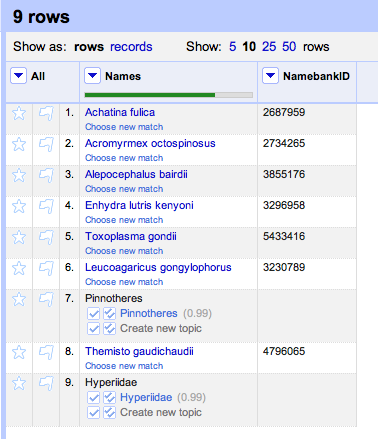
Once the service has loaded click on Start Reconciling. Once it has finished you should see most of the names linked to uBio (click on a name to check this):

Refine4

Sometimes there may be more than one possible match, in which case these will be listed in the cell. Once you have reconciled the data you may want to do something with the reconciliation. For example, if you want to get the ids for the names you've just matched you can create a new column based on the reconciliation. Click on the Names column header and choose Edit column → Add column based on this column.... A dialog box will be displayed:

Refine6

In the box labelled Expression enter cell.recon.match.id and give the column a name (e.g., "NamebankID"). You will now have a column of uBio NamebankIDs for the names:

Refine7

You could also get the names uBio extracted by creating a column based on the values of cell.recon.match.name. To compare this with the original values, click on the Names column header and choose Reconcile → Actions → Clear reconciliation data. Now you can see the original input names, and the string uBio extracted from each name:

Refine8

These are some very simple ideas for using Google Refine with taxonomic name services. Obvious extensions would to use services that provide an "accepted name", or services that support approximate string matching so you could catch spelling mistakes (most of the services I've implemented here have some degree of support for these features).

Development notes
The code for these services is in Github (undocumented as yet, that's on the to do list). I had a few hiccups getting these services to work. There is detailed documentation at http://code.google.com/p/google-refine/wiki/ReconciliationServiceApi, but this seems a little out of step with what actually happens. Based on the documentation I thought Google Refine called a reconciliation service using HTTP GET, but in fact it uses POST. Google Refine always called my reconciliation service using "Multiple Query Mode", which meant supporting this mode wasn't optional. Once these issues were sorted out (turning on the Java console as per David Huynh's tip helped) things work pretty well.

Thursday, February 02, 2012

Browsing TreeBASE using a genome browser-like interface

One of the things I find frustrating about TreeBASE is that there's no easy way to get an overview of what it contains. What is it's taxonomic coverage like? Is it dominated by plants and fungi, or are there lots of animal trees as well? Are the obvious gaps in our phylogenetic knowledge, or do the phylogenies it contains pretty much span the tree of life?

As part of my phyloinformatics course I've put together a simple browser to navigate through TreeBASE. The inspiration comes from genome browsers (e.g., the UCSC Genome Browser) where the genome is treated as a linear set of co-ordinates, and features of the genome are displayed as "tracks".

Hgt genome 596a ac7fe0

For my browser, I've used the order in which nodes appear in the NCBI tree as you go from left to right as the set of co-ordinates (actually, from top to bottom as my browser displays the co-ordinate axis vertically).

Browser

I then place each TreeBASE tree within this classification by taking the TreeBASE → NCBI mapping provided by TreeBASE and finding the "majority rule" taxon for each tree (in a sense, the taxa that summarises what the tree is about). Each tree is represented by a vertical line depicting the span of the corresponding NCBI taxon (corresponding to a "track" in a genome browser). Taking the majority-rule taxon rather than say, the span of the tree, makes it possible to pack the vertical lines tightly together so that they take up less space (the ordering from left to right is determined by the NCBI taxonomy).

If you mouse-over a vertical bar you can see the title of the study that published the tree. If you click on the vertical bar you'll see the tree displayed on the right (if your web browser understands SVG, that is). If you click on the background you will drill down a level in the NCBI classification. To go back up the classification, click on the arrow at the top left of the browser.

This is all very preliminary, but you can take it for a spin at http://iphylo.org/~rpage/phyloinformatics/treebase/.

Below is a short video walking you through some examples.

Monday, January 30, 2012

BLAST a sequence and get a tree

For this weeks sessions of my phyloinformatics course I'm developing some phylogeny tools. The first is a simple AJAX-based BLAST tool. I've always wanted a quick way to see a GenBank sequence in its phylogenetic context, so I've built a simple tool to that takes a GenBank accession number or GI number, submits a BLAST job, retrieves the sequences, aligns them using CLUSTALW, builds a quick and dirty neighbour-joining tree using PAUP*, then displays the tree using SVG (if your browser doesn't support this you won't see the tree). One use for this is to quikcly get a sense of whether an unnamed ("dark") taxon is related to sequences that have been identified.

Nothing fancy, but it was a chance to display the whole process in the browser without opening new windows or refreshing the page. Here's an example for the GenBank sequence FJ559186:


For the technically-minded, the calls to BLAST and the alignment and tree construction tools all use AJAX, and there's a simple Javascript timer to countdown the seconds that the NCBI BLAST web service estimates the BLAST job will take, before we poll NCBI to see if the job has in fact finished. The code is in GitHub.

Thursday, January 26, 2012

Extracting museum specimen codes from text

Quick note about a tool I've cobbled together as part of the phyloinformatics course, which addresses a long standing need I and others have to extract specimen codes from text. I've had this code kicking around for a while (as part of various never-finished data mining projects), but never got around to releasing it, until now. It is very crude (basically a bunch of regular expressions), and there's a lot which could be done to improve it (not least starting with a complete list of museum specimen codes, rather than just those I've come across in, say Zootaxa and BioStor).

You can try the tool at http://iphylo.org/~rpage/phyloinformatics/services/specimenparser.php. Paste in some text and it will try and extract museum codes. The tool tries to handle ranges of specimens (e.g., MHNSM 1808-09), and some of the more common specimen numbering schemes.

Comments welcome. If you are looking for a source of text, papers in Zookeys or Zootaxa are a good place to start (especially papers on vertebrates where specimen numbers are often used). BioStor is also a good source: if you're looking at a paper in BioStor click on the "Text" link to get the OCR text for an article and paste that into the form at . For example, the text for Systematics of the Bufo coccifer complex (Anura: Bufonidae) of Mesoamerica is available at http://biostor.org/reference/97426.text.

The extraction tool can also be called as a web service using POST to get back the results in JSON.

Monday, January 23, 2012

Open course on phyloinformatics

As part of a postgraduate course here at the University of Glasgow I'm teaching five sessions on "phyloinformatics", which I've decided to define broadly enough to encompass most of biodiversity informatics.

Given that this module is being developed on the fly, and will make use of lots of little "toys" I've developed and discussed on this blog, I've decided to put the course notes online, along with the interactive demos and the source code. So, if you want to follow along for the next couple of weeks, here are the links:


Each course page supports comments (see the bottom of the page), so feel free to add comments, or suggestions. The notes are at a crude stage, and will be developed over the duration of the course (2 weeks). I'm also endeavouring to get all the source code for the demonstration apps into GitHub. None of these demos is polished, but they will hopefully provide some ideas for taking them further. There will be iSpecies-like mashups, iPad webapps, classification visualisations, TreeBASE search tools, geophylogenies and other phylogeny viewers.

Thursday, January 19, 2012

EOL iPad web app using jQueryMobile

As part of a course on "phyloinformatics" that I'm about to teach I've been making some visualisations of classifications. Here's one I've put together using jQuery Mobile and the Encyclopedia of Life API. It's pretty limited, but is a simple way to explore EOL using three different classifications. You can view this live at http://iphylo.org/~rpage/phyloinformatics/eoliphone/ (looks best on an iPad or iPhone). Once I've tidied it up I'll put the code online. Meantime here's a quick demo:

Wednesday, January 18, 2012

Yet another reason why we need specimen identifiers, now!

This message appeared on the TAXACOM mailing list:

It is getting more and more necessary for taxonomists to demonstrate
that they are useful and used. This does not only apply to the
individual scientists, but also to institutions with taxonomic
collections, such as museums and herbaria.

In an attempt to live up to that increasing demand for documentation,
the leadership of the Natural History Museum of Denmark has issued an
order to its curatorial staff - The staff members are requested to
document which publications from 2011, written entirely by external
scientists, that in one way or another are based on material in the
collections of the Museum.


Given that most specimens lack resolvable digital identifiers (a theme I've harped on about before, most recently in the context of DNA barcoding), answering this kind of query ends up being a case of searching publications for text strings that contain the acronym of the collection. The sender of the message, Ib Friis, is alarmed at this prospect:

In publications, material from our herbarium at "C" is normally referred
to in text strings of one of the following forms: "(C)", "(C, ", ", C,"
or " C)". But a search in for example Google Scholar or other search
engines result in overflow of thousands and thousands of hits, even
when these text strings are combined with other relevant words such as
"botany", "plants", etc.


In an earlier paper "Biodiversity informatics: the challenge of linking data and the role of shared identifiers" (http://dx.doi.org/10.1093/bib/bbn022) (free preprint available here: hdl:10101/npre.2008.1760.1) I argued that having resolvable identifiers for specimens could enable measures of "citation" to be computed for specimens (and data derived from those specimens). Just as we have citation counts for articles and impact factors for journals, we could have equivalent measures for specimens and collections. These measures may keep administrators happy, for scientists I think the real benefits will be the ability to trace the provenance of some data, and the fate of data they themselves have collected or published.

For things such as publications it is trivial to track their usage. For example, to find the number of times the article "Biodiversity informatics: the challenge of linking data and the role of shared identifiers" has been cited, I simply enter the DOI into Google Scholar, e.g. http://scholar.google.co.uk/scholar?q=10.1093/bib/bbn022. Imagine being able to do the same for specimens?

For this to happen, museum specimens need digital identifiers. If museums are serious about quantifying the impact of their collections, they should make assigning digital identifiers a priority.

Tuesday, January 17, 2012

Mendeley as CiteBank: some ideas

Here are some quick notes on how BHL could use Mendeley as a "CiteBank".

As a repository of bibliographic data

If the goal is to assemble a "bibliography of life" then there are various ways this could be done.

Taxon-specific bibliographies

Create groups that are taxon-specific (or find existing groups in Mendeley. For example, I've created groups for amphibias (Amphibian Species of the World) and reptiles (TIGR/JCVI Reptile Database) based on the Amphibian Species of the World and TIGR/JCVI Reptile Database, respectively. Taxon-specific groups are probably going to be attractive to users, but the quality of bibliographic metadata can be variable. However, a bibliography for a specific taxonomic group that is populated with links to BHL content would be very useful.

Journal-specific bibliographies

This is where I've spent most of my efforts. I've created around 300 groups for various journals (see list below, or go directly to http://dl.dropbox.com/u/639486/groups.html). In some cases I've managed to populate these with the complete set of articles published in that journal, typically harvested from the journal's own web site. Typically the metadata from journal sites is high quality, although one has to be wary of Orwellian metadata.


I use these groups in two ways. The first is as a source of metadata for extracting articles from BHL using BioStor. If you have article-level metadata finding articles in BHL becomes easier, and can be automated so that 1000's can be added in a few minutes.

The second is for the taxon-literature mapping project, where one strategy is to use approximate string mapping to find equivalent citations in Mendeley and the ION database. Ultimately I'd like to link to the Mendeley citations as they tend to be higher quality than those in the original ION database.

BHL could create Mendeley groups for journals it has scanned, and populate those.

As an article-level index to BHL

This is perhaps the most direct way BHL could use Mendeley is as follows:

  1. Create a BHL account.
  2. For each BHL title create a Mendeley group (the name would be the BHL TitleID).
  3. For each item in that title create a folder in the corresponding group (the folder name would be the ItemID).
  4. Within each folder list the articles, book chapters or other component parts. If these aren't available yet, encourage people to add them. Some of these could be pre-populated with content from BioStor.
  5. Harvest the contents of these groups to provide an article-level index to BHL (which for me is the single biggest impediment to using BHL). Previously I've suggested a way to easily add article data to BHL, Mendeley title/item groups and folders might be way to facilitate this process.
PDF storage

Although Mendeley offers PDF storage, this is one feature I'd be less inclined to use. Mendeley's rule for sharing PDFs and making them publicly available are too restrictive (they often don't know whether a PDF can, in fact, be shared). Plus you want tools to visualise, index, and archive PDFs. In effect a big file store with added features. I have some ideas on how this can be implemented (and have a rough working version to support http://iphylo.org/~rpage/itaxon). Alternatively, one could use Internet Archive services.

Summary

As I've often argued, given the success of tools like Mendeley it seems pointless for anyone to try and build yet another online bibliographic database. The trick is to figure out how to leverage what Mendeley provides to support what the taxonomic (and broader biodiversity) community needs.

Tuesday, January 10, 2012

Journals I'd like BHL to scan

I've recently updated my database of links between animal taxonomic names and literature identifiers, which now has over 280,000 names linked to some form of identifier (127,000 of these being DOIs). You can see the current version here:

http://iphylo.org/~rpage/itaxon/

As an experiment I've added a feature to list the number of names for each journal. Based on this list (limited to journals that I've found an ISSN for) here are some journals I'd like to see digitised by the Biodiversity Heritage Library (BHL). Note that by digitised I mean beyond the 1923 cutoff applied to many journals. This will mean negotiating with the journal publishers, but in a number of cases these are scientific societies or institutions, some associated with BHL. Given that major partners in BHL have made post-1923 content available, it would nice to extend this to other key taxonomic journals.

Revue Suisse de Zoologie

Revue Suisse de Zoologie has published nearly 10,000 taxonomic names but has essentially zero digital presence, which is extraordinary. Another Swiss journal, Entomologica Basiliensia is also an obvious candidate.

Revue de Zoologie et de Botanique Africaines

Revue de Zoologie et de Botanique Africaines has published over 5,000 names, and given the interest in providing information resources for Africa (e.g., http://www.mendeley.com/groups/1681811/bhl-africa/) this seems an obvious journal to scan completely.

Bulletin of the British Museum (Natural History) journals and books

The Natural History Museum [formerly British Museum (Natural History)] is a member of BHL so I'd expect it to have better coverage of it's own publications in BHL. There are gaps in journals such as Bulletin of the British Museum (Natural History) Entomology, which means there is a significant chunk of research published by Museum staff that simply doesn't exist digitally. At one point The Natural History Museum renamed the journals and moved them to Cambridge University Press, resulting in further gaps in digitisation. It's interesting that museums that haven't changed the title of their publications (such as the American Museum of Natural History and the Australian Museum) have better digital coverage than the NHM, which has flirted with various title changes in the last few decades. The Museum also published a series of monographs in the 20th century, many of these aren't in BHL.

Memoirs of the Queensland Museum

The Memoirs of the Queensland Museum is an important journal (> 3,000 names) but has only early issues scanned in BHL and recent issues as PDFs on the Museum web site (vulnerable to link rot when the site gets redesigned, as I've discovered to my cost).

Russian journals

Russian journals contain large numbers of taxonomic descriptions, but their digital presence is patchy. Springer has started to publish translations online (e.g., http://dx.doi.org/10.1134/S0013873810050155 in Entomological Review, which is a translation of an article in Zoologicheskii Zhurnal), but much of the Russian literature seems unavailable in digital form. BHL has spread from it's US-UK origins to BHL-Europe, BHL_China, and BHL_Australia, maybe it's time for BHL-Russia?

Summary

There are huge holes in the availability of taxonomic literature (where I equate "availability" with being digitised and online, free or otherwise). But on the other hand I've been pleasantly surprised by just how much taxonomic literature is online. It looks quite feasible to link at least 300,000 animal names to digital publications.

The journals I've highlighted are just a few obvious candidate for scanning. I suspect that as one goes down the list of taxonomic journals the rate of return will decline, to the point where scanning entire journals will be less efficient than scanning targeted articles.


Monday, December 19, 2011

Towards an interactive taxonomic article: displaying an article from ZooKeys

One of the things I keep revisiting is the way we display scientific articles. Apart from Nature's excellent iPhone and iPad apps, most efforts to re-imagine how we display articles are little more than glorified PDF viewers (e.g., the PLoS iPad app).

Part of the challenge is that if we make the article more interactive we immediately confront the problem of how to link to other content. For example, we may have a lovingly crafted ePub view (e.g., Nature's apps), but what happens when the user clicks on a citation to another paper? If the paper is published by the same journal, then potentially it could be viewed using the same viewer, but if not then we are at the mercy of the other publisher. They will have their own ideas of how to display articles, so the simplest fallback is to display the cited article in a web browser view. The problem with this is that it breaks the user experience - the other publisher is unlikely to follow the same conventions for displaying an article and its links. If we are lucky the cited article might be published in an Open Access journal that provides, say, XML based on the NLM DTD standard. Knowing whether an article is Open Access or not is not straightforward, and different journals have their own unique interpretation of the NLM standard.

Then there is the issue of other kinds of content, such as taxonomic names, specimens, DNA sequences, geographic localities, etc. We lack decent services for many of these objects, as a result efforts like PLoS Biodiversity Hub end up being underwhelming collections of reformatted journal articles, rather then innovative integrations of biodiversity knowledge.

With these issues in mind I've started playing with ZooKeys XML, initially looking at ways to display the article beyond the conventional format. Ultimately I'd like to embed the article in a broader web of citations and data. ZooKeys articles are available in PDF, HTML, and XML. The HTML has links to taxon pages, maps, etc., which is nice, but I personally find this a little jarring because it interrupts the reading experience. The ZooKeys web site also surrounds the article with all paraphernalia of a publisher's web site:

Zookeys
As a first experiment, I've taken the XML for article At the lower size limit for tetrapods, two new species of the miniaturized frog genus Paedophryne (Anura, Microhylidae) http://dx.doi.org/10.3897/zookeys.154.1963 and used a XSLT style sheet to reformat the article. I've borrowed some ideas from Nature's apps, such as the font for the title, displaying the abstract in bold, and showing all the figures in the article as thumbnails near the top. I've also added some basic interactivity, which you can see in the video below. Instead of figures being in one place in the article, wherever a figure is mentioned in the article (e.g., "Fig. 1") if you click on the reference to the figure it appears. If the article display a point locality using latitude and longitude, instead of launching a separate browser window with a Google map, click on the locality and the map appears. The idea is that the flow of reading isn't interrupted, figures, maps, and citations all appear in the text.


This demo (which you can see live at http://iphylo.org/~rpage/zookeys) is limited, but most of its functionality comes from simply reformatting XML using XSLT. There's a little bit of jQuery for animation, and I ended up having to write a PHP script to convert verbatim latitude and longitude coordinates to the decimal coordinates expected by Google Maps, but it's all very light weight. It wouldn't take much to add some JSON queries to make the taxon names clickable (e.g., showing a summary of a taxon from EOL). Because ZooKeys uses the NLM DTD for its XML, some of this code could also be applied to other journals, such as PLoS, so we could start to grow a library of linked, interactive taxonomic articles.

Monday, December 12, 2011

Exporting data from Australian Faunal Directory on CouchDB

Quick note to self about exporting data from my Australian Faunal Directory on CouchDB project. To export data from a CouchDB view you can use a list function (see Formatting with Show and List). Following the example on the Kanapes IDE blog, I created the following list function:

{
"_id": "_design/publication",
"_rev": "14-467dee8248e97d874f1141411f536848",
"language": "javascript",
"lists": {
"tsv": "function(head,req) {
var row;
start({
'headers': {
'Content-Type': 'text/tsv'
}
});
while(row = getRow()) {
send(row.value + '\\t' + row.key + '\\n');
}}"
},
"views": {
.
.
.
}
}


I can use this function with the view below, which lists Australian Faunal Directory publications by UUID ("value"), indexed by DOI ("key").

Couch

I can get the tab-delimited dump from http://localhost:5984/afd/_design/publication/_list/tsv/doi. Note that instead of, say, /afd/_design/publication/_view/doi to get the view, we use /afd/_design/publication/_list/tsv/doi to get the tab-delimited dump.

I've created files listing DOIs and BioStor ids for publications in the Australian Faunal Directory. I'll play with lists a bit more, specially as I would like to extract the mapping from the Australian Faunal Directory on CouchDB project and add it to the iTaxon project.

Sunday, December 11, 2011

DNA Barcoding, the Darwin Core Triplet, and failing to learn from past mistakes

Banner05
Given various discussions about identifiers, dark taxa, and DNA barcoding that have been swirling around the last few weeks, there's one notion that is starting to bug me more and more. It's the "Darwin Core triplet", which creates identifiers for voucher specimens in the form <institution-code>:<OPTIONAL collection-code>:<specimen-id>. For example,

MVZ:Herp:246033

is the identifier for specimen 246033 in the Herpetology collection of the Museum of Vertebrate Zoology (see http://arctos.database.museum/guid/MVZ:Herp:246033).

On the face of it this seems a perfectly reasonable idea, and goes some way towards addressing the problem of linking GenBank sequences to vouchers (see, for example, http://dx.doi.org/10.1016/j.ympev.2009.04.016, preprint at PubMed Central). But I'd argue that this is a hack, and one which potentially will create the same sort of mess that citation linking was in before the widespread use of DOIs. In other words, it's a fudge to postpone adopting what we really need, namely persistent resolvable identifiers for specimens.

In many ways the Darwin Core triplet is analogous to an article citation of the form <journal>, <volume>:<starting page>. In order to go from this "triplet" to the digital version of the article we've ended up with OpenURL resolvers, which are basically web services that take this triple and (hopefully) return a link. In practice building OpenURL resolvers gets tricky, not least because you have to deal with ambiguities in the <journal> field. Journal names are often abbreviated, and there are various ways those abbreviations can be constructed. This leads to lists of standard abbreviations of journals and/or tools to map these to standard identifiers for journals, such as ISSNs.

This should sound familiar to anybody dealing with specimens. Databases such as the Registry of Biological Repositories and the Biodiversity Collectuons Index have been created to provide standardised lists of collection abbreviations (such as MVZ = Museum of Vertebrate Zoology). Indeed, one could easily argue that the what we need is an OpenURL for specimens (and I've done exactly that).

As much as there are advantages to OpenURL (nicely articulated in Eric Hellman's post When shall we link?), ultimately this will end in tears. Linking mechanisms that depend on metadata (such as museum acronyms and specimen codes, or journal names) are prone to break as the metadata changes. In the case of journals, publishers can rename entire back catalogues and change the corresponding metadata (see Orwellian metadata: making journals disappear), journals can be renamed, merged, or moved to new publishers. In the same way, museums can be rebranded, specimens moved to new institutions, etc. By using a metadata-based identifier we are storing up a world of hurt for someone in the future. Why don't we look at the publishing industry and learn from them? By having unique, resolvable, widely adopted identifiers (in this case DOIs) scientific publishers have created an infrastructure we now take for granted. I can read a paper online, and follow the citations by clicking on the DOIs. It's seamless and by and large it works.

On could argue that a big advantage of the Darwin Core triplet is that it can identify a specimen even if it doesn't have a web presence (which is another way of saying that maybe it doesn't have a web presence now, but it might in the future). But for me this is the crux of the matter. Why don't these specimens have a web presence? Why is it the case that biodiversity informatics has failed to tackle this? It seems crazy that in the context of digital data (DNA sequences) and digital databases (GenBank) we are constructing unresolvable text strings as identifiers.

But, of course, much of the specimen data we care about is online, in the form of aggregated records hosted by GBIF. It would be technically trivial for GBIF to assign a decent identifier to these (for example, a DOI) and we could complete the link between sequence and specimen. There are ways this could be done such that these identifiers could be passed on to the home institutions if and when they have the infrastructure to do it (see GBIF and Handles: admitting that "distributed" begets "centralized").

But for now, we seem determined to postpone having resolvable identifiers for specimens. The Darwin Core triplet may seem a pragmatic solution to the lack of specimen identifiers, but it seems to me it's simply postponing the day we actually get serious about this problem.


Tuesday, December 06, 2011

Google doesn't like BioStor anymore

According to Google Analytics BioStor has experienced a big drop in traffic since the start of October:

Panda

At one point I'm getting something like 4500 visits a week, now it's just over a thousand a week. I'm guessing this is due to Google's 'Panda' update. I suspect part of the problem is that in terms of text content BioStor is actually pretty thin. For each article there is some metadata and a few links, so it probably looks a little like a link farm. The bulk of the content is in the page images, which of course, Google can't read.

I'd be interested to know of any other sites in the field that have been affected in the same way (or, indeed, sites which have seen no change in their traffic since October).

Monday, December 05, 2011

These are my species - finding the taxonomic names I published using Mendeley

The latest addition to my mapping of taxonomic names to the literature (http://iphylo.org/~rpage/itaxon/) is the ability for authors with Mendeley accounts to find the names they've published. This is an extension of the "I wrote that" tool I developed earlier.

Let's say I want to show the names that a given author has published. I could search by that author's name, but that raises all sorts of issues (see my earlier posts ReaderMeter: what's in a name? and Equivalent author names), especially for this database where I have incomplete citations and in many cases lack author names beyond surname.

Another way to tackle the problem is if I have a list of publications for an author, then all I need to do is match that list to the publications in my taxonomic database. If both lists have identifiers for the publications, such as DOIs, then the task is trivial. But, where do I get these lists?

An obvious source is Mendeley, where people are building lists of their own publications (as well as other publications that they are interested in). For example, my publications are listed at http://www.mendeley.com/profiles/roderic-page/.

But I don't want to have to get these lists myself, I'd much rather that a Mendeley user could go to my taxonomic database, say "I have this Mendeley account, show me the names I've published". One reason I'd like to do this is that if I want people to engage with this project it would be nice to be able to offer an immediate reward, in this case, a place where you can show your contribution to the task of cataloguing life on this planet.

Finding my taxonomic names

If you have a Mendeley account here's what you do:

Go to http://iphylo.org/~rpage/itaxon/. At the top right you will see a "Sign in using Mendeley" link.

M1
Click this and you will be taken to Mendeley where you will be asked if you'd like to allow http://iphylo.org/~rpage/itaxon/ to connect to your account (if you're already logged in to Mendeley then you'll see an Accept button, otherwise Mendeley will ask you to log in).

M2
If you click on Accept then you will be taken back to my site and you should now see your profile name and picture on the top right:

M3

If you click on the Profile link then my site will talk to Mendeley and get a list of your papers and look for them in my database. If it find a paper it outputs the taxonomic names published in that paper. For example, here is my profile:

M4

Listed are the species of bird lice in the genus Dennyus described in a paper on which I was a coauthor (http://dx.doi.org/10.1046/j.1365-3113.1996.d01-13.x).

This list is incomplete as earlier papers of mine on crab and isopod taxonomy aren't listed because these lack identifiers. This is something I need to work on, but for now this seems like a simple way to enable someone to go to the http://iphylo.org/~rpage/itaxon/ mapping between taxonomic names and literature and find the names they've authored.

If you have a Mendeley account, and your list of publications in Mendeley includes papers describing new animal species, go to http://iphylo.org/~rpage/itaxon/ and try it out.


Tuesday, November 29, 2011

Mapping names to literature: closing in on 250,000 names

Following on from my earlier post Linking taxonomic names to literature: beyond digitised 5×3 index cards I've been slowly updating my latest toy:

http://iphylo.org/~rpage/itaxonAlpheus

This site displays a database mapping over 200,000 animal names to the primary literature, using a mix of identifiers (DOIs, Handles, PubMed, URLs) as well as links to freely available PDFs where they are available. Lots still to do as about a third of the 1.5 million names in the database have citations that my code hasn't been able to parse. There are also lots of gaps that need to be filled in, for example missing DOIs or PubMed identifiers, and a lot of the earlier names are linked by "microcitations" to names, and I'll need to handle those (using code from my earlier project Nomenclator Zoologicus meets Biodiversity Heritage Library: linking names directly to literature).

The mapping itself is stored in a database that I'm constantly editing, so this is far from production quality, but I've found it eye-opening just how much literature is available. There is a lot of scope for generating customised lists of papers, for example, primary taxonomic sources for taxa currently on the IUCN Red List, or those taxa which have sequences in GenBank (building on the mapping of NCBI taxa onto Wikipedia). Given that a lot of the relevant literature is in BHL, or available as PDFs, we could do some data mining, such as extracting geographical coordinates, taxonomic names, and citations. And if linked data is your thing, the 110,000 DOIs and nearly 9,000 CiNiii URLs all serve RDF (albeit not without a few problems).

I've set a "goal" of having 250,000 names mapped to the primary literature, at which point the database interface will get some much-needed attention, but for now have a look for your favourite animal and see if it's original description has been digitised.

Towards the bibliography of life

David King et al.'s paper "Towards the bibliography of life" http://dx.doi.org/10.3897/zookeys.150.2167 has just appeared in a special issue of ZooKeys. I've written a number of posts on this topic, so I've a few comments.

King et al. survey some of the issues, but don't really tackle the big issue of how we're going to build this. If we define the "bibliography of life" somewhat narrowly as the list of all papers that have published a scientific name (or a new combination, such as moving a species from one genus to another), then this is a large, but measurable undertaking. According to ION's metrics page, these are the numbers involved (for animals and protozoa):

Total New Names1,510,402
Total New Genera / Subgenera215,242
Total New Species / Subspecies1,192,366
Total Other New Names102,794
Total New Combinations241,296
Total New Synonyms260,544


Even in the worse case scenario of one name per publication (clearly not the case) this is big, but not insurmountable, task.

Publications not taxa
Part of the challenge is figuring out the best way to tackle the problem. In the past, most efforts at building taxonomic bibliographies have focussed on specific taxa, which is natural — the bibliographies are being built by taxonomists and they specialise in particular groups. But I'd argue that this is not the most efficient way to tackle the problem. Because the taxonomic literature is so widely dispersed, after the obvious "low hanging fruit" have been collected, considerable effort must be spent tracking down the harder to find citations. There are few economies of scale in this approach. In contrast, if we focus on publications at, say, the level of journal, then we can build a bibliography much more quickly. Once we've found the source, say, for one article, often we could use that information to harvest many articles from the same source (e.g., write scripts to harvest from a digital repository such as a DSpace server, or a digital library such as Gallica). But if we are focussed on a particular taxon, we will ignore the other articles in that journal ("what do I care about fish, I like turtles").

Put another way, if we imagine a taxa × publication matrix, then we can either go after rows (i.e., a bibliography for a specific taxonomic group), or columns (a list of articles in a specific journal). The article-based approach will be faster, albeit at the cost of finding articles that aren't necessarily relevant to taxonomy. This is why I'm spending what feels like far too much time harvesting article lists and uploading these to Mendeley. It is also one reason BHL has been so successful. They've simply gone after scanning the literature wholesale, rather than focussing on particular taxonomic groups.

TaxapublicationmatrixWikispecies logo enCrowd sourcing and Wikispecies
Crowd sourcing often strikes me as a euphemism for "we can't be bothered doing the tedious stuff, lets get the public to do it for us (plus it will look like we're engaged with the public)." I'm not denying can work, but I suspect it's not a magic bullet. Perhaps the best crowd sourcing is not to try and bring the crowd to a project, but go where the crowd has already gathered. In this case, an obvious crowd is the Wikispecies community. Working with the ION database for my Sherborn presentation, it's clear that the quality of bibliographic data in ION is variable, and rather poor for older references. In contrast, the reference lists on Wikispecies can be very good (e.g., the bibliography for George Boulenger). There are some issues with Wikispecies, notably the lack of a decent bibliographic template (unlike Wikipedia) so parsing references can be *cough* interesting, but there is scope here to use it to improve other databases. Citation matching can be a challenge, but in this case we have citations indexed by taxonomic name (in both ION and Wikispecies), which greatly reduces the scope of possible matches.

Summary
I think building the "bibliography of life" needs a combination of aggressive data gathering, and avoiding building additional tools unless absolutely needed. There are great tools and communities that can already be leveraged (e.g., Mendeley, Wikispecies), let's make use of them.

Thursday, November 24, 2011

BHL needs to engage with publishers (and EOL needs to link to primary literature)

Browsing EOL I stumbled upon the recently described fish Protoanguilla palau, shown below in an image by rairaiken2011:
Palauan Primitive Cave Eel

Two things struck me, the first is that the EOL page for this fish gives absolutely no clue as to where you would to find out more about this fish (apart from an unclickable link to the Wikipedia page http://en.wikipedia.org/wiki/Protoanguilla - seriously, a link that isn't clickable?), despite the fact this fish has been recently described in an Open Access publication ("A 'living fossil eel (Anguilliformes: Protanguillidae, fam. nov.) from an undersea cave in Palau", http://dx.doi.org/10.1098/rspb.2011.1289).

Now that I've got my customary grumble about EOL out of the way, let's look at the article itself. On the first page of the PDF it states:
This article cites 29 articles, 7 of which can be accessed free
http://rspb.royalsocietypublishing.org/content/early/2011/09/16/rspb.2011.1289.full.html#ref-list-1

So 22 of the articles or books cited in this paper are, apparently, not freely available. However, looking at the list of literature cited it becomes obvious that rather more of these citations are available online than we might think. For example, there are articles that are in the Biodiversity Heritage Library (BHL), e.g.


Then there are articles that are available in other digitising projects

  • Hay O. P. 1903 On a collection of Upper Cretaceous fishes from Mount Lebanon, Syria, with descriptions of four new genera and nineteen new species. Bull. Am. Mus. Nat. Hist. N. Y. 19, 395–452. http://hdl.handle.net/2246/1500
  • Nelson G. J. 1966 Gill arches of fishes of the order Anguilliformes. Pac. Sci. 20, 391–408. http://hdl.handle.net/10125/7805

Furthermore, there are articles that aren't necessarily free, but which have been digitised and have DOIs that have been missed by the publisher, such as the Regan paper above, and


So, the Proceedings of the Royal Society has underestimated just how many citations the reader can view online. The problem, of course, is how does a publisher discover these additional citations? Some have been missed because of sloppy bibliographic data. The missing DOIs are probably because the Regan citation lacks a volume number, and the Trewavas paper uses a different volume number to that used by Wiley (who digitised Proc. Zool. Soc. Lond.). But the content in BHL and other digital archives will be missed because finding these is not part of a publisher's normal workflow. Typically citations are matched by using services ultimately provided by CrossRef, and the bulk of BHL content is not in CrossRef.

So it seems there's an opportunity here for someone to provide a service for publishers that adds value to their content in at least three ways:
  1. Add missing DOIs due to problematic citations for older literature
  2. Add links to BHL content
  3. Add links to content in additional digitisation projects, such as journal archives in DSpace respositories

For readers this would enhance their experience (more of the literature becomes accessible to them), and for BHL and the repositories it will drive more readers to those repositories (how many people reading the paper on Protoanguilla palau have even heard of BHL?). I've said most of this before, but I really think there's an opportunity here to provide services to the publishing industry, and we don't seem to be grasping it yet.

Wednesday, November 23, 2011

Wikipedia History Flow tool now in GitHub

Inspired by a comment on my post Visualising edit history of a Wikipedia page, the code I use to make history flow diagrams like the one below is now in GitHub at https://github.com/rdmpage/wikihistoryflow.

Historyflow

There is also a live version at http://iphylo.org/~rpage/wikihistoryflow. If you enter the name of a Wikipedia page the tool will display the edit history with columns representing page versions and individual contributors (people and bots) distinguished by different colours.

This tool will fall over for pages with a lengthy history of edits, and requires a web browser that can support SVG, but it's a fun visualisation, and may inspire someone to do this properly.

Tuesday, November 22, 2011

Apache mod_rewrite and question marks "?"

Quick note to self in case I (inevitably) forget later. If you are using Apache mod_rewrite to make nice, clean URLs, and are also supporting JSONP, you may run into the situation where you have code that wants to append "?callback=xxx" to your URL (e.g., a cross-domain AJAX call in jQuery). Imagine you have a nice clean URL /user/123, which actually corresponds to user.php?id=123. If you append ?callback=xxx to the URL then chances are the code will break, because mod_rewrite will rewrite the URL to something like user.php?id=123?callback=xxx. What you actually want to send to your web server is user.php?id=123&callback=xxx (note the & before "callback"). After much grief trying to figure out how to coerce Apache mod_rewrite into handling this situation I found the answer, of course, on Stack Overflow. If you use the [QSA] flag, Apache will append the additional callback parameter onto the end of the rewritten URL, so JSONP will now work. Once again, Stack Overflow turned a show-stopper into a learning experience.

Friday, November 18, 2011

Adding article-level metadata to BHL

Recently I've been thinking about the best ways to make article-level metadata from BioStor more widely available. For example, for someone visiting the BHL site there is no easy way to find articles, which are the basic unit for much of the scientific literature. How hard would it be to add articles to BHL? In the past I've wanted an all-singing all dancing article-level interface to BHL content (sort of BioStor on steroids), but that's a way off, and ideally would have a broader scope than BHL. So instead I've been thinking of ways to add articles to BHL without requiring a lot of re-engineering of BHL itself.

Looking at other digital archive projects like Gallica and Google Books it strikes me that if the BHL interface to a scanned item had a "Contents" drop down menu then users would be able to go to individual articles very easily. Below is a screen shot of how Gallica does this (see http://gallica.bnf.fr/ark:/12148/bpt6k61331684/f57).

Gallica

There's also a screen shot of something similar in Google Books (see http://books.google.co.uk/books?id=PkvoRnAM6WUC)

Contents

The idea would be that if BioStor had found articles within a scanned item, they would be listed in the contents menu (title, author, starting page), and if the user clicked on the article title then the BHL viewer would jump to that page. If there were no known articles, but the scanned item had a table of contents flagged (e.g., http://www.biodiversitylibrary.org/item/25703) then the menu could function as a button that takes you to that page. If there are no articles or contents, then the menu could be grayed out, or simply not displayed. This way the interface would work for books, monographs, and journal volumes.

Now, admittedly this is not the most elegant interface, and it treats articles as fragments of books rather than individual units, but it would be a start. It would also require minimal effort both on the part of BHL (who need to add the contents button), and myself (it would be easy to create a dump of the article titles indexed by scanned item).

Nature iPhone app clone in GitHub

One thing I'm increasingly conscious of is that I've a lot of demos and toy projects hanging around and the code for most of these isn't readily available. So, I plan to clean these up and put them in GitHub so others can explore the code, and reuse it if they see fit.

First up is the code to create a HTML+Javascript clone of Nature's iPhone app, as described in an earlier post.

photo.PNGphoto.PNG


There's a live version of the clone here here. and the code is now available from GitHub at https://github.com/rdmpage/natureiphone.


Friday, October 28, 2011

Sherborn presentation on Open Taxonomy

Here is my presentation from today's Anchoring Biodiversity Information: From Sherborn to the 21st century and beyond meeting.


All the presentations will be posted online, along with podcasts of the audio. Meantime, presentations by Dave Remsen and Chris Freeland are already online.

Thursday, October 27, 2011

Linking taxonomic names to literature: beyond digitised 5×3 index cards

Pubs
Tomorrow is the Anchoring Biodiversity Information: From Sherborn to the 21st century and beyond meeting. It should be an interesting gathering, albeit overshadowed by the sudden death of Frank Bisby.

I'm giving a talk entitled "Open Taxonomy", in which I argue that most taxonomic databases are little more than digitised collections of 5×3 index cards, where literature is treated as dumb citation strings rather than as resources with digital identifiers. To make the discussion concrete I've created a mapping between the Index to Organism Names (ION) database and a range of bibliographic sources, such as CrossRef (for DOIs), BioStor, JSTOR, etc.

This mapping is online at http://iphylo.org/~rpage/itaxon/.

So far I've managed to link some 200,000 animal names to a literature identifier, and a good fraction of these articles are freely available, either as images in BioStor and Gallica (for I've created a simple viewer) or as PDFs (which are displayed using Google Docs.

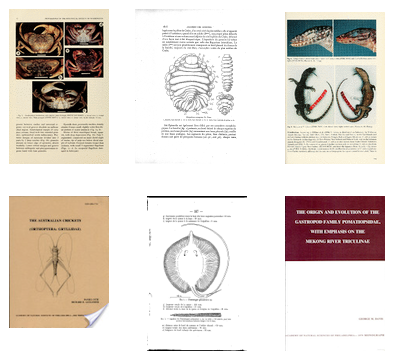
Some examples are:


The site is obviously a work in progress, and there's a lot to be done to the interface, but I hope it conveys the key point: a significant fraction of the primary taxonomic literature is online, and we should be linking to this. The days of digitised 5×3 index cards are past.