Sunday, August 28, 2011

Tree of Life 0.1 - annotating the NCBI taxonomy

Last week I was at the NSF "Assembling, Visualising and Analysing the Tree of Life" Ideas Lab, run by KnowInnovation.com/. It was an interesting experience, essentially a structured week of brainstorming ideas.

One thing I came away with is the feeling that our notions of the "tree of life" are fuzzy, contradictory, and often probably unobtainable. It's tempting to imagine all sorts of wonderful visualisations, and loose sight of building something that is useful. Perhaps it's time instead to think of "Tree of Life version 0.1".

Imagine taking the NCBI taxonomy as a starting point. Yes it's incomplete, and has almost no fossils, but it's freely available and linked to a lot of data. Let's use a Google Maps-like viewer along the lines I explored earlier this year.

Then add annotation "tracks" to the tips. As a first pass these could be taken from the NCBI LinkOut service, such as the NCBI-Wikipedia mapping http://iphylo.org/linkout.

Ncbi 1

The NCBI tree is a classification rather than a phylogeny, so we could add greater phylogenetic content by linking to phylogenetic databases, such as TreeBASE and PhyLoTA. Imagine clicking on a node in the NCBI taxonomy and seeing a display of all the phylogenies centred on that node:

Ncbi 02

Now we have a way to navigate a large tree, view annotations, and display phylogenetic trees. All of this could be done fairly easily. The key is to have services keyed by the NCBI tax_id used to identify nodes on the tree.

Among the next steps would be to add additional "tracks", perhaps based on curated links analogous to the wiki-based NCBI-Wikipedia mapping. For example, very basic habitat data (marine or terrestrial) could be added, or geography, or host relationships (could be based in part on the data already in GenBank).

Given that the NCBI tree continues to grow, subsequent versions could be released as the tree changes. Or we could "fork" the NCBI tree and start to refine it based on phylogenetic information, and add taxa that aren't in the genome databases (these taxa will need consistent identifiers so we can map annotations on to them as well). Perhaps we could use something like Git to manage this tree, and to handle the necessary merging of updated versions of the NCBI tree. People could edit the tree, or indeed fork it and come up with their own.

Logo tmp reasonably smallThere are lots of ways to visualise trees (see TreeVis.net for some great examples), but what I'm after is a tool that is useful, that gives us a sense of what we know and what we don't. I suspect that one of the reasons we've struggled with visualising the tree of life is that there are lots of different notions about what it's for. In this case, I want a tool to navigate data about organisms, one that we can easily add annotations too.


Friday, August 26, 2011

I am not a number...I am an "ideator"

As part of the NSF "Assembling, Visualising and Analysing the Tree of Life" Ideas Lab that I took part in earlier this week I had an assessment of my "problem solving style" carried out using a service called FourSight. I'm hugely sceptical of attempts to classify people (I'm unique, aren't I?), but I took the test and turns out am an "Ideator". FourSight's web site defines an Ideator as one who:

  • Likes to look at the big picture
  • Enjoys toying with ideas and possibilities
  • Likes to stretch his or her imagination
  • Enjoys thinking in more global and abstract terms
  • Takes an intuitive approach to innovation
  • May overlook details

Details schmetails, it's the big picture folks!

Ideators are:

  • Playful
  • Imaginative
  • Social
  • Adaptable
  • Flexible
  • Adventurous
  • Independent

Liking this. OK, how do you care for ideators? We need:

  • Room to be playful
  • Constant stimulation
  • Variety and change
  • The big picture

That's right, leave us alone to think our great thoughts. Result! Then there's this totally superfluous category "Ideators annoy others by...".

  • Drawing attention to themselves
  • Being impatient when others don’t get their ideas
  • Offering ideas that are too off-the-wall
  • Being too abstract
  • Not sticking to one idea

Utter, utter, nonsense. Look at my blog, it's full of ideas that have been developed fully... oh, wait. And, maybe the blog thing is a bit attention seeking, and I guess saying "it sucks" is a tad impatient, and saying to a crowd of taxonomists "haven't we basically found every species bigger than my coffee cup?" is a little off-the-wall.

Good job these psychometric thingies are clearly bogus.

Wednesday, July 13, 2011

Correcting OCR using hOCR in Firefox

Quick post on a little tool I came across, moz-hocr-edit. This Firefox add-on lets you proofread Optical Character Recognition (OCR) output. Given my interest in OCR and the Biodiversity Heritage Library I decided to take it for a spin.

moz-hocr-edit uses the hOCR, which is a format for representing the output of OCR software, and is used by tools such as OCRopus (you can see the public specification for hOCR here). Basically it's a microformat, that is, it's HTML with some additional tags. Given some hOCR, moz-hocr-edit enables you to edit the OCR output line-by-line.

Demo
I've created a simple demo based upon Case 3368 Eatoniella Dall, 1876 and EATONIELLIDAE Ponder, 1965 (Mollusca, Gastropoda): proposed conservation. For the demo to work you will need to use the Firefox web browser with the moz-hocr-edit installed.

  1. Go to http://dl.dropbox.com/u/639486/hocr/80780.html
  2. You will see a simple HTML representation of the OCR text from "Case 3368 Eatoniella Dall, 1876 and EATONIELLIDAE Ponder, 1965 (Mollusca, Gastropoda): proposed conservation". I created this HTML from the original ABBYY FineReader XML from the Internet Archive.
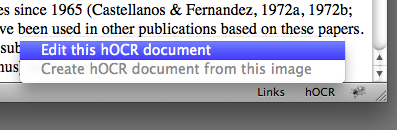
  3. On the bottom right-hand of the Firefox browser window you should see hOCR. Click on it and select "Edit this hOCR document":
    Statusbar
  4. Firefox will open a new tab that will look something like this:
    Screenshot
  5. You can now edit individual lines of text, and see your edits applied to the HTML below.
moz-hocr-edit is a neat little tool. With appropriate web server settings (and, as the tool's author Jim Garrison suggests, autoversioning) it could the basis of a great tool for correcting OCR errors in BHL.

Tuesday, July 12, 2011

Talk @vizbi on phylogeny visualisation

The talks from the 2001 workshop on Visualizing Biological Data (VizBi 2011) are now available on Vimeo. There were some great talks at VizBi, especially the keynotes (the "featured videos" on the Vimeo page for VizBi).

My own (slightly breathless) talk was on phylogeny visualisation, which you can watch below.

Visualization of phylogenetics & phylogeography from Roderic Page on Vimeo.


In the talk I mention that the slides are also on SlideShare, and that is where you'll find URLs for the projects I mention. The URls aren't all that easy to get that way, so here they are:

Saturday, June 11, 2011

Mendeley Hack4Knowledge: towards an "ego wall"

I'm taking a virtual part in Mendeley's Hack4Knowledge event. I'm using this a chance to explore some ideas about building novel interfaces to bibliographic data in Mendeley. One idea is to display a user's entire library in one screen. I think the user interfaces employed by most bibliographic software are too conservative and there some cool things that could be done. For example, see A fluid treemap interface for personal digital libraries (doi:10.1145/1065385.1065512, PDF available from CiteSeer).

One idea I'm playing with is to display all a Mendeley user's papers as a quantum treemap, with thumbnails of the papers and "badges" indicating, for example, how many readers each paper has. The idea is that at a glance you can see all your publications, and which ones are being read the most. You can think of it as an "ego wall" — a quick way to see what others think about your work. Below is part of my library. You can see the full treemap here as an SVG file. Imagine this as an iPad interface to a user's Mendeley library.

Wall

Eventually I'll make this live. I'm doing this yet as the script to create the visualisation is slow due to the multiple requests I need to make to get the necessary information. I have to get the list of a user's papers from Mendeley, then I call the API for each paper to get basic bibliographic details. I have to screen scrape the corresponding paper's web page to get the thumbnail and the paper's UUID, which I can then use to get the readership stats via Mendeley's API via yet another API call. Sigh.

Anyway, this is enough hacking for one day. Hope to spend some more time on this project tomorrow.


Wednesday, June 08, 2011

Adding Solr to BioStor: searching for real

Solr

Prompted by the appearance on the BHL blog of an article about BioStor I've thinking about how to improve what is basically a fairly clunky tool.

One major weakness is searching the collection of nearly 40,000 articles extracted from BHL. Note the word "extracted." BioStor isn't a tool like PubMed or Google Scholar where the goal is to find articles on a topic. Instead it addresses a more specific question, namely whether a given article is contained in an item scanned by BHL. Confusion about this was one reason publication of my paper on BioStor (doi:10.1186/1471-2105-12-187) took so long to pass through the review stage.

However, users (myself included) expect to be able to search for articles. So, it's time to explore ways to make it easier to find articles within the BioStor database. I've junked the previous pretty crappy code I wrote and have started to play with the Solr search engine. I'd experimented with Solr a while ago, but other stuff got in the way. Today I've managed to add it to BioStor and do a preliminary indexing of the articles in BioStor. So far I'm only indexing basic bibliographic metadata, and displaying the first 30 hits, but already it's making it much easier to find interesting stuff in BioStor.

Solr also supports faceted searching (i.e., clustering results by categories such as year, author, journal). I don't so much with this yet, but there's clearly a lot of scope. I could also add taxonomic names, and even the OCR text to Solr, greatly expanding the ability to find articles. But that's for the future. For now, here are some interesting searches:


I wrote that: asserting authorship using the Mendeley API

Inspired by the forthcoming Hack4Knowledge I've put together a service that enables you to assert that you are the author of a paper using the Mendeley API.

If you are impatient, give it a try at:

http://iphylo.org/~rpage/hack4knowledge/iwrotethat/

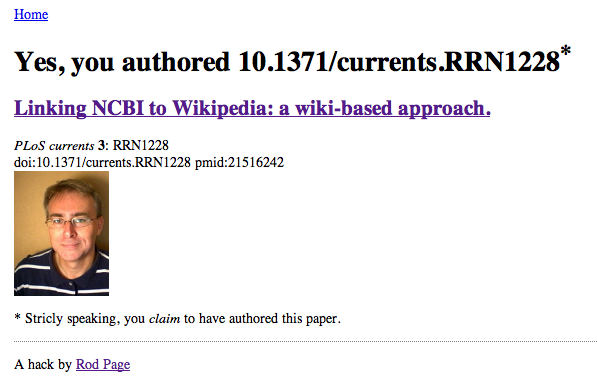
To use it you need a Mendeley account. When you go to I wrote that you will be asked to connect to your Mendeley account. Once you've done that, enter the DOI or PubMed ID of a paper and, if the paper is in your Mendeley library and flagged as a paper you've authored, you should see something like this:

Wrote

The site can be a little sluggish as it needs to go through all of your publications one by one until it finds a match.

Why?
Imagine you have a web database that includes publications, and you want people to join your site as users. If they have publications in your database, you'd like your users to be able to say "I'm the author of those papers" or, more generally, the author you have as "Roderic D. M. Page" is me.

One way to do this would be to enable the users to sign in to your site using Mendeley (see my blog post Mendeley connect). Once they've done that, the user could select a publication and say "that's mine". How do we test this assertion? Well, if the user is indeed the author it is likely that they will have added it to their "My Publications" section in their Mendeley library. So, we can use the Mendeley API to get a list of the author's publications and see whether the publication they claim is, in fact, one of theirs.

The inspiration for this came from tools like Google Analytics, where in order to add the tool to your web site you need to convince Google that you own the site. One way to do this is to add some text supplied by Google to the HTML on for site, on the assumption that only you can do this (because it's your site). In the same way, only you can add papers to your Mendeley library. Of course, I'm assuming that Mendeley users are being trustworthy when they and papers to "My Publications" (i.e., they're not claiming authorship on papers they didn't write).

How?
This hack uses Mendeley's OAuth support (the same technology used by Twitter and Facebook to connect to other sites) to enable you to connect your Mendeley account to the "I wrote that" application (note that my app never sees your account name or password). I use the Mendeley API user authored method to get a list of your publications, and user library document details to retrieve details of each publication. I then compare the DOI or PMID you supplied with each publication, until I find one that matches. If none matches, then I've no evidence you authored that paper.

Moan
No post about the Mendeley API would be complete without a moan about the state of the API. Apart from the fact that there is no function to directly find a publication in your library by DOI or PMID (hence I have to look at them all), there is virtually no support for retrieving any details about the user. For example, I wanted to brighten the web page up a little by adding a picture of the Mendeley user once they've logged in. There is no API function for this, nor a function to retrieve an identifier or URL for the user. Hence, in order to get a picture I screen scrape (yes, screen scrape) the Mendeley web page for the reference to get the URL for the linked author of the paper, then scrape the author's profile page and extract the URL for the image. This is insane. Please, please can we have a better API?

Thursday, June 02, 2011

Would you give me a grant? An experiment in Open Science

I would like to know what you think of a grant proposal I plan to submit to the UK Natural Environment Research Council at the end of the month. The proposal takes the notion of "dark taxa" explored in an earlier blog post and outlines three things I'd like to do:
  1. Quantify the extent of dark taxa (taxa in GenBank that don't have scientific names)
  2. Determine how many dark taxa are genuinely new species (as opposed to taxa that are known to science but simply haven't been labelled with their proper names)
  3. Explore what we can learn about a taxon's biology even if it lacks a scientific name (e.g., the "symbiome")

Given that I discuss most of my ideas on this blog, and deposit preprints in Nature Precedings before the corresponding manuscript is published, it seems a logical extension to make grant proposals open as well. So you view the proposal on Google Docs, and you can add comments, if you wish.


Any feedback or suggestions are welcome. Do you think this is fundable? Have I made a good case for the proposed research? Is it interesting, or is it obvious, or has it already been done? Let me know what you think.

Thursday, May 26, 2011

ZooBank on CouchDB: UUIDs, replication, and embedding the literature in taxonomic databases

ZooBankBannerLast December I released a web site called Australian Faunal Directory on CouchDB, which was part of my ongoing exploration of how to build a simple yet useful database of taxonomic names. In particular, I want to link names directly to the primary taxonomic literature. No longer is it adequate to simply list names, or list names with mangled bibliographic details (I'm looking at you, Catalogue of Life). This is the 21st century, so I expect one click from name to literature, or at the most two (via, say, a DOI). Nothing else will cut it.

CouchbaseThe Australian Faunal Directory (AFD) was an eye opener as it was the first serious use I'd made of CouchDB (now CouchBase). I'd played with replicating and forking data in 2010: Catalogue of Life and CouchDB, but the AFD project was bigger, and also inspired me to use web hooks to make the database editable. Suddenly this stuff started to look easy: no schema, simple web services, and tiny amounts of code.

ZooBank
So then my attention turned to ZooBank, which is "the official registry of Zoological Nomenclature, according to the International Commission on Zoological Nomenclature (ICZN)." ZooBank was proposed by Polaszek et al. (2005) in a short piece in Nature ("A universal register for animal names", doi:10.1038/437477a). By providing a registry of names for animals, ultimately it aims to help avoid embarrassing situations such as the example I recount in my paper on BioStor (doi:10.1186/1471-2105-12-187): a recent paper in Nature published the name Leviathan for an extinct sperm whale with a giant bite (doi:10.1038/nature09067), only for authors to have to publish an erratum with a new name (doi:10.1038/nature09381) when it was discovered that Leviathan had already been used for an extinct mammoth.

ZooBank is developed and run by Rich Pyle, and has some nice features, such as RDF export (via LSIDs), but like most taxonomic databases it doesn't link directly to the literature. Where are the DOIs? Where are links to BHL? Where is the ability to add these links? And why is it almost entirely about fish? (OK, I know the answer to that one).

CouchDB
But the thing which really got me thinking about using CouchDB to create a version of ZooBank was Rich Pyle's vision of having a distributed ZooBank, and his insistence on using ugly UUIDs in ZooBank identifiers (e.g., urn:lsid:zoobank.org:act:6BBEF50E-76B4-42EF-97B1-7029DBCD8257). As much as they are ugly, Rich has always argued that they make distributed systems easy because you don't need a centralised system to assign unique identifiers.

Anybody who has played with CouchDB will know that CouchDB uses UUIDs by default to create identifiers for database documents. It also excels at data synchronisation, and can run on platforms large and small (including mobile such as Android and iOS). This means a database could be updated on an iPhone or iPad without an Internet connection, then the data could be synchronised with other databases. Indeed, I developed this CouchDB clone of ZooBank on my MacBook, then pointed it at CouchDB running on my server and within minutes had an exact copy of the database running on the server. This ease of replication, together with the joy of schema-less design makes CouchDB seem an obvious fit to ZooBank.

Demo
You can see the ZooBank on CouchDB demo here. It's not a complete copy of ZooBank, but has most of it. I reuse the UUIDs issued by ZooBank, so that

http://zoobank.org:80/?uuid=6bbef50e-76b4-42ef-97b1-7029dbcd8257

becomes

http://iphylo.org/~rpage/zoobank/6bbef50e-76b4-42ef-97b1-7029dbcd8257

As usual it's all a bit crude, but has some nice features, such as links to BHL content with a built in article viewer I wrote for the AFD project:

EtheostomaWhat's next?
At present only a fraction of the ZooBank references have external links, I hope to add more in the next few days, using both automatic scripts and the web hook interface. The search interface needs work, and being that ZooBank is about nomenclature and not taxonomy, it might be useful to add a classification (say from the Catalogue of Life) so that users can navigate around the names (and get a sense of how many are *cough* fish).

At present to display a reference I do one of four things:
  1. If reference is in BHL I use my article viewer
  2. If there is a freely available PDF online I display that using Google Docs PDF viewer
  3. If 1 and 2 don't apply, but there is a DOI then I resolve the DOI and display the result in an IFRAME (yuck)
  4. If none of 1-3 apply I display a blank rectangle

There are a couple ways we could improve this. The first is to enhance the display of BHL content by making use of the structure of the source DjVu files. Another is to make use of the XML now being made available by the journal Zookeys (see my blog post, and Pensoft's announcement that ZooKeys is now being archived by PubMed Central, complete with taxonomic markup). There are a lot of ZooKeys articles in ZooBank, so there's a lot of potential for embedding an article viewer that takes Zookeys XML and redisplays it with taxonomic names and references as clickable links that link to other ZooBank content. That way we approach the point where taxonomic literature becomes a first class citizen of a taxonomic database.

What is the best way to measure academic outputs that aren't publications?

My institute is going through various reviews of staff performance and, frankly, I'm feeling somewhat vulnerable given my somewhat unorthodox (at least amongst my colleagues) approach to doing science. I spend way more time writing code, building databases and web sites, and blogging than writing papers and getting grants (although I have been known to do both).

So the issue becomes, how to demonstrate that coding, building websites, and ranting on my blog is a worthwhile thing to do? Now, I'm happy that what I do has value, but my happiness isn't the issue. It's convincing people who want to see papers in high impact journals and bums on seats in labs that there's other ways to generate scientific output, and that output can have value. I'm also concerned that a simplistic view of what constitutes valid outputs will stifle innovation, just at the time when traditional science publishing is undergoing a revolution.

So, I posted a question on Quora:What is the best way to measure academic outputs that aren't publications?, where I wrote:
Usually we assess the quality of academic output using measures based on citations, either directly (how many papers have cited the paper?) or indirectly (is the paper published in a journal like Nature or Science that contains papers that on average get lots of citations, i.e. "impact factor"). But what of other outputs, such as web sites, databases, and software? These outputs often require considerable work, and can be widely used. What is the best way to measure those outputs?


There have been various approaches to measuring the impact of an article other than using citations, such as the number of article downloads, or the number of times an article has been bookmarked on a site such as Mendeley or CiteULike. But what of the coding, the database development, the web sites, and the blog posts. How can I show that these have value?

I guess there are two things here. One is the need to be able to compare across outputs, which is tricky (comparing citations across different disciplines is already hard), the other is the need to be able to compare within broadly similar outputs. Here are some quick thoughts:

Web sites
An obvious approach is to use Google Analytics to harvest information about page views and visitor numbers. The geographic origin of those visitors could be used to make a case for whether the research/data on that site is internationally relevant, although I suspect "internationally relevant" is a somewhat suspect notion. Most academic specialities are narrow, such that the person most interested in your research is likely living in a different country, hence by definition most research will be internationally "relevant".

The advantage of Google Analytics is that it is widely used, hence you could get comparative data and be able to show that your web site is more (or less) used that another site.

Code
The value of code is tricky, but tools like ohloh provide estimates of the effort and expense required to generate code for a project. For example, for my bioGUID code repository (which includes code for bioGUID and BioStor, as well as some third party code) ohloh's estimated cost is 87 person-years and $US 4,784,203. OK, silly numbers, but at least I can compare these with other projects (Drupal, for example, represents 153 years and $US 8,438,417 of investment).


Comparing across output categories will be challenging, especially as there is no obvious equivalent for citation (one reason why if you develop software or a web site it makes good sense to write a paper describing it, worked for me). But perhaps download or article access statistics could provide a way to say "my web site is worth x publications. Note also that I'm not arguing that any of these measures is actually a good thing, just that if I'm going to be measured, and I have some say in how I'm measured, I'd like to suggest something sensible that others might actually buy.

So, please feel free to comment either here or on Quora . I need to put together some notes to make the case that people like me aren't just sitting drinking coffee, playing loud music, and tweeting without, you know, actually making stuff.

Wednesday, May 25, 2011

The top-ten new species described in 2010 and the failure of taxonomy to embrace Open Access publication

Each year the grandly titled International Institute for Species Exploration (IISE) publishes list of the top 10 species described in the previous year. This year's list is reproduced below, to which I've added the links to the original publications (why do people think still it's OK to omit links to the primary literature when all of these articles are online?).

The striking thing is that only 2 of the 10 species were described in Open Access publications (and I use that term loosely as as Arthropod Systematics & Phylogeny PDFs are freely available, but the licensing isn't clear). Sadly much of our knowledge of the planet's diversity is still locked up behind a paywall.

SpeciesReferenceDOI/PDFOpen Access
Caerostris 5Darwin's Bark SpiderKuntner, M. and I. Agnarsson. 2010. Web gigantism in Darwin's bark spider, a new species from Madagascar (Araneidae: Caerostris). The Journal of Arachnology 38(2):346-35610.1636/B09-113.1No
Mycena 2Bioluminescent MushroomDesjardin, D.E., B.A. Perry, D.J. Lodge, C.V. Stevani, and E. Nagasawa. 2010. Luminescent Mycena: new and noteworthy species. Mycologia 102(2):459-47710.3852/09-197No
HalomonasBacteriumSanchez-Porro, C., B. Kaur, H. Mann and A. Ventosa. 2010. Halomonas titanicae sp. nov., a halophilic bacterium isolated from the RMS Titanic. International Journal of Systematic and Evolutionary Microbiology 60(12):2768-277410.1099/ijs.0.020628-0No
VaranusMonitor LizardWelton, L.J., C.D. Siler, D. Bennett, A. Diesmos, M.R. Duya, R. Dugay, E.L.B. Rico, M. van Weerd and R.M. Brown. 2010. A spectacular new Philippine monitor lizard reveals a hidden biogeographic boundary and a novel flagship species for conservation. Biology Letters 6(5):654-65810.1098/rsbl.2010.0119No
GlomeremusPollinating cricketHugel, S., C. Micheneau, J. Fournel, B.H. Warren, A. Gauvin-Bialecki, T. Pailler, M.W. Chase and D. Strasberg. 2010. Glomeremus species from the Mascarene islands (Orthoptera, Gryllacrididae) with the description of the pollinator of an endemic orchid from the island of Réunion. Zootaxa 2545:58-68PDFNo
Philantomba 2DuikerColyn, M., J. Hulselmans, G. Sonet, P. Oudé, J. de Winter, A. Natta, Z.T. Nagy and E. Verheyen. 2010. Discovery of a new duiker species (Bovidae: Cephalophinae) from the Dahomey Gap, West Africa. Zootaxa 2637:1-30PDFNo
TyrannobdellaLeechPhillips, A.J., R. Arauco-Brown, A. Oceguera-Figueroa, G.P. Gomez, M. Beltran, Y.-T. Lai and M.E. Siddall. 2010. Tyrannobdella rex n. gen. n. sp. and the evolutionary origins of mucosal leech infestations. PLoS ONE 5(4):e1005710.1371/journal.pone.0010057Yes
PsathyrellaUnderwater mushroomFrank, J.L., R.A. Coffan and D. Southworth. 2010. Aquatic gilled mushrooms: Psathyrella fruiting in the Rogue River in southern Oregon. Mycologia 102(1):93-10710.3852/07-190No
SaltoblattellaJumping cockroachBohn, H., M. Picker, K.-D. Klass and J. Colville. 2010. A jumping cockroach from South Africa, Saltoblattella montistabularis, gen. nov., spec. nov. (Blattodea: Blattellidae). Arthropod Systematics and Phylogeny 68(1):53-39/td>PDFYes
HalieutichthysPancake BatfishHo, H.-C., P. Chakrabarty and J.S. Sparks. 2010. Review of the Halieutichthys aculeatus species complex (Lophiiformes: Ogcocephalidae), with descriptions of two new species. Journal of Fish Biology 77(4):841-86910.1111/j.1095-8649.2010.02716.xNo

Monday, May 23, 2011

BioStor article published (finally)

LogoMy article describing BioStor — "Extracting scientific articles from a large digital archive: BioStor and the Biodiversity Heritage Library" — has finally seen the light of day in BMC Bioinformatics (doi:10.1186/1471-2105-12-187, the DOI is not working at the moment, give it a little while to go live, meantime you can access the article here).

Getting this article published was more work than I expected. There seems to be an inverse correlation between how important I think the work is and how easy it is to get published — the more straightforward I think the article is the more work it is to convince the referees of its merits. Of course, it may be that my judgement of the article's merits influences how much effort I put into making the manuscript as rigorous and clear as possible. And perhaps having a blog has spoiled me, I really struggle with the notion that it takes months to publish a paper, especially as most of the intellectual debate involved (i.e., the refereeing process) is behind closed doors, compared to the open and immediate nature of commentary on a blog post.

However, despite my frustrations with the referring process, there's no doubt that it did improve the manuscript (you can see the original version at Nature Precedings, hdl:10101/npre.2010.4928.1).

With the publication of this article, and last week's conversation with Anurag Acharya and Darcy Dapra about getting BioStor indexed by Google Scholar, it has been a good few days for BioStor.


Friday, April 15, 2011

BHL, DjVu, and reading the f*cking manual

One of the many biggest challenges I've faced with the BioStor project, apart from dealing with messy metadata, has been handling page images. At present I get these from the Biodiversity Heritage Library. They are big (typically 1 Mb in size), and have the caramel colour of old paper. Nothing fills up a server quicker than thousands of images.

A while ago started playing with ImageMagick to resize the images, making them smaller, as well as ways to remove the background colour, leaving just black text and lines on white background.

Before and after converting BHL image


I think this makes the page image clearer, as well as removing the impression that this is some ancient document, rather than a scientific article. Yes, it's the Biodiversity Heritage Library, but the whole point of the taxonomic literature is that it lasts forever. Why not make it look as fresh as when it was first printed?

Working out how to best remove the background colour takes some effort, and running ImageMagick on every image that's downloaded starts putting a lot of stress on the poor little Mac Mini that powers BioStor.

Then there's the issue of having an iPad viewer for BHL, and making it interactive. So, I started looking at the DjVu files generated by the Internet Archive, and thinking whether it would make more sense to download those and extract images from them, rather than go via the BHL API. I'll need the DjVu files for the text layout anyway (see Towards an interactive DjVu file viewer for the BHL).

I couldn't remember the command to extract images from DjVu, but I did remember that Google is my friend, which led me to this question on Stack Overflow: Using the DjVu tools to for background / foreground seperation?.

OMG! DjVu tools can remove the background? A quick look at the documentation confirmed it. So I did a quick test. The page on the left is the default page image, the page on the right was extracted using ddjvu with the option -mode=foreground.

507.png


Much, much nicer. But why didn't I know this? Why did I waste time playing with ImageMagick when it's a trivial option in a DjVu tool? And why does BHL serve the discoloured page images when it could serve crisp, clean versions?

So, I felt like an idiot. But the other good thing that's come out of this is that I've taken a closer look at the Internet Archive's BHL-related content, and I'm beginning to think that perhaps the more efficient way to build something like BioStor is not through downloading BHL data and using their API, but by going directly to the Internet Archive and downloading the DjVu and associated files. Maybe it's time to rethink everything about how BioStor is built...

Tuesday, April 12, 2011

Dark taxa: GenBank in a post-taxonomic world

How to cite: Page, R. (2011). Dark taxa: GenBank in a post-taxonomic world. https://doi.org/10.59350/xhvv2-xjt24
In an earlier post (Are names really the key to the big new biology?, I questioned Patterson et al.'s assertion in a recent TREE article (doi:10.1016/j.tree.2010.09.004) that names are key to the new biology.

In this post I'm going to revisit this idea by doing a quick analysis of how many species in GenBank have "proper" scientific names, and whether the number of named species has changed over time. My definition of "proper" name is a little loose: anything that had two words, second one starting with a lower case letter, was treated as a proper name. hence, a name like Eptesicus sp. A JLE-2010" is not a proper name, but Eptesicus andersoni is.

Mammals

Since GenBank started, every year has seen some 100-200 mammal species added to the database.


Until around 2003 almost all of these species had proper binomial names, but since then an increasing percentage of species-level taxa haven't been identified to species. In 2010 three-quarters of new tax_ids for mammals weren't identified.

Invertebrates

For "invertebrates" 2010 saw an explosive growth in the number of new taxa sequenced, with nearly 71,000 new taxa added to GenBank.


This coincides with a spectacular drop in the number of properly-named taxa, but even before 2010 the proportion of named invertebrate species in GenBank was in decline: in 2009 just over a half of the species added had binomials.

Bacteria

To put this in perspective, here are the equivalent graphs for bacteria.
Although at the outset most of the bacteria in GenBank had binomial names, pretty quickly the bulk of sequenced bacteria had informal names. In 2010 less than 1% of newly sequenced bacteria had been formerly described.

Dark taxa

For bacteria the graphs are hardly surprising. To get a proper name a bacterium must be cultured, and the vast majority of bacteria haven't been (or can't be) cultured. Hence, microbiologists can gloat at the nomenclatural mess plant and animal taxonomists have to deal with only because microbiologists have a tiny number of names to deal with.

For mammals and invertebrates there's clear a decline in the use of proper names.It would be tempting to suggest that this reflects a decline in the number of taxonomists - there might simply not be enough of them in enough groups to be able to identify and/or describe the taxa being sequenced.

However, if we look at the recent peaks of unnamed animal species, we discover that many have names like Lepidoptera sp. BOLD:AAD7075, indicating that they are DNA Barcodes from the Barcode of Life Data Systems. Of the 62,365 unnamed invertebrates added last year, 54,546 are BOLD sequences that haven't been assigned to a known species. Of the 277 unnamed mammals, 218 are BOLD taxa. Hence, DNA bnacording is flooding Genbank with taxa that lack proper names (and typically are represented by a single DNA bnacode sequence).

There are various ways to interpret these graphs, but for me the message is clear. The bulk of newly added taxa in GenBank are what we might term "dark taxa", that is, taxa that aren't identified to a known species. This doesn't necessarily mean that they are species new to science, we may already have encountered these species before, they may be sitting in museum collections, and have descriptions already published. We simply don't know. As the output from DNA barcoding grows, the number of dark taxa will only increase, and macroscopic biology starts to look a lot like microbiology.


A post-taxonomic world
If we look at the graphs for bacteria, we see that taxonomic names are virtually irrelevant, and yet microbiology seems to be doing fine as a discipline. So, perhaps it's time to think about a post-taxonomic world where taxonomic names, contra Patterson et al., are not that important. We can discover a good deal about organismal biology from GenBank alone (see my post Visualising the symbiome: hosts, parasites, and the Tree of Life for some examples, as well as Rougerie et al. 2010 doi:10.1111/j.1365-294X.2010.04918.x).

This leaves us with two questions:
  1. How much biology can we do without taxonomic names?
  2. If the lack of taxonomic names limits what we can do (and, playing devil's advocate, this is an open question) how can we speed up linking GenBank sequences to names?


I suspect that the answer to (1) is "quite a lot" (especially if we think like microbiologists). Question (2) is ultimately a question about how fast we can link literature, museum collections, sequences, and phylogenies. If progress to date is any indication, we need to rethink how we do this, and in a hurry, because dark taxa are accumulating at an accelerating rate.

How the analyses were done

Although the NCBI makes a dump of its taxonomic database available via FTP (at ftp://ftp.ncbi.nih.gov/pub/taxonomy/), this dump doesn't have dates for when the taxa were added to the database. However, using the Entrez EUtilities we can get the tax_ids that were published within a given date range. For example, to retrieve all the tax_ids added to the database in December 2010, we set the URL parameters &mindate=2010/12/01 and &maxdate=2010-12-31 to form this URL:

http://eutils.ncbi.nlm.nih.gov/entrez/eutils/esearch.fcgi?db=taxonomy&mindate=2010/12/01&maxdate=2010/12/31&retmax=1000000.

I've set &retmax to a big number to ensure I get all the tax_ids for that month (in this case 23511). I then made a local copy of the NCBI database in MySQL ( instructions here) and queried for all species-level taxa in GenBank. I used a rather crude regular expression REGEXP '^[A-Z][a-z]+ [a-z][a-z]+$' to find just those species names that were likely to be proper scientific names (i.e., no "sp.", "aff.", museum or voucher codes, etc.). To group the species into major taxonomic groups I used the division_id.

Results are available in a Google Spreadsheet.

Friday, April 01, 2011

Data matters but do data sets?

Interest in archiving data and data publication is growing, as evidenced by projects such as Dryad, and earlier tools such as TreeBASE. But I can't help wondering whether this is a little misguided. I think the issues are granularity and reuse.

Taking the second issue first, how much re-use do data sets get? I suspect the answer is "not much". I think there are two clear use cases, repeatability of a study, and benchmarks. Repeatability is a worthy goal, but difficult to achieve given the complexity of many analyses and the constant problem of "bit rot" as software becomes harder to run the older it gets. Furthermore, despite the growing availability of cheap cloud computing, it simply may not be feasible to repeat some analyses.

Methodological fields often rely on benchmarks to evaluate new methods, and this is an obvious case where a dataset may get reused ("I ran my new method on your dataset, and my method is the business — yours, not so much").

But I suspect the real issue here is granularity. Take DNA sequences, for example. New studies rarely reuse (or cite) previous data sets, such as a TreeBASE alignment or a GenBank Popset. Instead they cite individual sequences by accession number. I think in part this is because the rate of accumulation of new sequences is so great that any subsequent study would needs to add these new sequences to be taken seriously. Similarly, in taxonomic work the citable data unit is often a single museum specimen, rather than a data set made up of specimens.

To me, citing data sets makes almost as much sense as citing journal volumes - the level of granularity is wrong. Journal volumes are largely arbitrary collections of articles, it's the articles that are the typical unit of citation. Likewise I think sequences will be cited more often than alignments.

It might be argued that there are disciplines where the dataset is the sensible unit, such as an ecological study of a particular species. Such a data set may lack obvious subsets, and hence it makes sense to be cited as a unit. But my expectation here is that such datasets will see limited re-use, for the very reason that they can't be easily partitioned and mashed up. Data sets, such as alignments, are built from smaller, reusable units of data (i.e., sequences) can be recombined, trimmed, or merged, and hence can be readily re-used. Monolithic datasets with largely unique content can't be easily mashed up with other data.

Hence, my suspicion is that many data sets in digital archives will gather digital dust, and anyone submitting a data set in the expectation that it will be cited may turn out to be disappointed.

Mendeley and Web Hooks

Quick, poorly thought out idea. I've argued before that Mendeley seems the obvious tool to build a "bibliography of life." It has pretty much all the features we need: nice editing tools, support for DOIs, PubMed identifiers, social networking, etc.

But there's one thing it lacks. There's not an easy way to transmit updates from Mendeley to another database. There are RSS feeds for groups, such as this one for the "Museum Type Catalogues" group, but that just lists recently added articles. What if I edit an article, say by correcting the authorship, or adding a DOI? How can I get those edits into databases downstream?

One way would be if Mendeley provided RSS feeds for each article, and these feeds would list the edits made to that article. But polling thousands of individual RSS feeds would be a hassle. Perhaps we could have a user-level RSS feed of edits made?

But another way to do this would be with web hooks, which I explored earlier in connection with updating literature within a taxonomic database. The idea is as follows:
  1. I have a taxonomic database that contains literature. It also has a web hook where I can tell the database that a record has been edited elsewhere.
  2. I edit my Mendeley library using the desktop client.
  3. When I've finished all the edits I've made (e.g., DOIs added, etc.), the web hook is automatically called and the taxonomic database notified of the edits.
  4. The taxonomic database processes the edits, and if it accepts them it updates its own records

Several things are needed to make this work. We need to be able to talk about the same record in the taxonomic database and in Mendeley, which means either the database stores the Mendeley identifier, or visa versa, or both. We also need a way to find all the recent edits made in Mendeley. Given that the Mendeley database is stored locally as a SQLite database, one simple hack would be to write a script that was called at a set time, determined which records had been changed (records in the Mendeley SQLite database are timestamped) and send those to the web hook. If we're clever, we may even be able to automate this by calling the script when Mendeley quicks (depending on how scriptable the operating system and application are).

Of course, what would be even better is if the Mendeley application had this feature built in. You supply one or more web hook URLs that Mendeley will call, say after any edits have been synchronised with your Mendeley database in the cloud. More and more I think we need to focus on how we join all these tools and databases together, and web hooks look like being the obvious candidate.

Thursday, March 31, 2011

Paper on NCBI and Wikipedia published in PLoS Currents: Tree of Life

__logo__1.jpg
My paper describing the mapping between NCBI and Wikipedia has been published in PLoS Currents: Tree of Life. You can see the paper here. It's only just gone live, so it's yet to get a PubMed Central number (one of the nice features of PLoS Currents is that the articles get archived in PMC).

Publishing in PLoS Currents: Tree of Life was a pleasant experience. The Google Knol editing environment was easy to use, and the reviewing process quick. It's obviously a new and rather experimental journal, and there are a few things that could be improved. Automatically looking up articles by PubMed identifier is nice, but it would also be great to do this for DOIs as well. Furthermore, the PubMed identifiers aren't displayed as clickable links, which rather defeats the point of having references on the web (I've added DOI links to the articles wherever possible). But, minor grumbles aside, as a way to get an Open Access article published for free, and have it archived in PubMed Central, PLoS Currents is hard to beat. What will be interesting is whether the article receives any comments. This seems to be one area online journals haven't really cracked — providing an environment where people want to engage in discussion.

Monday, March 28, 2011

Linking the NCBI taxonomy to BBC Wildlife Finder


A few weeks ago I spent some time mapping pages from the BBC Wildlife Finder to the equivalent taxa in the NCBI taxonomy. This seemed a useful exercise because the Wildlife Finder pages have some wonderful picture, video, and audio content, as well as other nice features, such as reusing Wikipedia page titles as "slugs" in the BBC page URLs. For example, the Wikipedia page for the Yacare Caiman (Caiman yacare) has the URL http://en.wikipedia.org/wiki/Yacare_Caiman, and the BBC page has the URL http://www.bbc.co.uk/nature/life/Yacare_Caiman. Both share the slug Yacare_Caiman.

After adding these links to iphylo.org/linkout, where you can find them listed on the BBC category page, I've finally uploaded these to the NCBI, so now some 504 NCBI taxon pages have links to high quality multimedia from the BBC.

- Posted using BlogPress from my iPad

Location:Schmiedestraße,Wetter,Germany

Friday, March 25, 2011

Fun things about crustaceans

One side effect of playing with ways to visualise and integrate biology databases is that you stumble across the weird and wonderful stuff that living organisms get up to. My earliest papers were on crustacean taxonomy, so I thought I'd try my latest toy on them.

What lives on crustaceans?

The "symbiome" graph for crustacea shows a range of associations, including marine bacteria (Vibrio), fungi (microsporidians), and other organisms, including other crustacea (crustaceans are at the top of the circle, I'll work on labelling these diagrams a little better).

CrusthostWhat do crustaceans live on?Crustpara

Crustacea (in addition to parasitising other crustacea) parasitise several vertebrates groups, including fish and whales. But they also occur in terrestrial vertebrates. For example, sequence EF583871 is from the pentastomid worm Porocephalus crotali from a dog. When people think of terrestrial crustacea they usually don't think of parasites. There's also a prominent line from crustaceans to what turns out to be corals, representing coral-living barnacles.

It's instructive to compare this with insects, which similarly parasitise vertebrates. The striking difference is the association between insects and flowering plants.

Insect

I guess these really need to be made interactive, so we could click on them and discover more about the association represented by each line in the diagram.

Visualising the symbiome: hosts, parasites, and the Tree of Life

Back in 2006 in a short post entitled "Building the encyclopedia of life" I wrote that GenBank is a potentially rich source of information on host-parasite relationships. Often sequences of parasites will include information on the name of the host (the example I used was sequence AF131710 from the platyhelminth Ligophorus mugilinus, which records the host as the Flathead mullet Mugil cephalus).

I've always wanted to explore this idea a bit more, and have finally made a start, in part inspired by the recent VIZBI 2011 meeting. I've grabbed a large chunk of GenBank, mined the sequences for host records, and created some simple visualisations of what I'm terming (with tongue firmly in cheek) the "symbiome". Jonathan Eisen will not be happy, but I need a word that describes the complete set of hosts, mutualists, symbionts with which an organism is associated, and "symbiome" seems appropriate.

Human symbiome
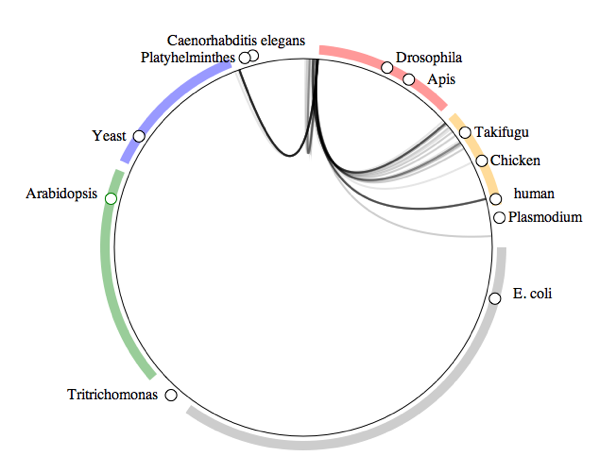
To illustrate the idea, below is the human "symbiome". This diagram shows all the taxa in GenBank arranged in a circle, with lines connecting those organisms that have DNA sequences where humans are recorded as their host.

Human

At a glance, we have a lot of bacteria (the gray bar with E. coli) and fungi (blue bar with Yeast), and a few nematodes and arthropods.

Fig tree symbiome
Next up are organisms collected from fig trees (genus Ficus).

Ficus
Fig trees have wasp pollinators (the dark line landing near the honey bee Apis), as well as nematodes (dark line landing near Caenorhabditis elegans). There are also some associations with fungi and other arthropods.

Which taxa host insects?
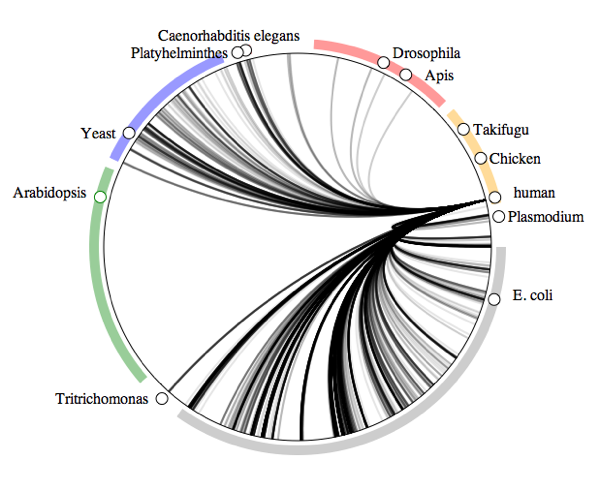
Next up is a plot of all associations involving insects and a host.

Insect
The diagram is dominated by insect-flowering plant interactions, followed by insect-vertebrate associations (most likely bird and mammal lice).

Which taxa are hosted by insects?
We can reverse the question and ask what organisms are hosted by insects:

Insectashost
Lots of associations between insects and fungi, as well as bacteria, and a few other organisms, such as nematodes, and Plasmodium (the organism which causes malaria).

Frog symbiome
Lastly, below is the symbiome of frogs. "Worms" feature prominently, as well as the fungus that causes chytridiomycosis.

FrogHow the visualisation was made

The symbiome visualisations were made as follows. Firstly DNA sequences were downloaded from EMBL and run through a script that extracted as much metadata as possible, including the contents of the host field (where present). I then took the NCBI taxonomy and generated an ordered list of taxa by walking the tree in postorder, which determines where on the circumference of the circle the taxon lies. Pairs of taxa in an association are connected by a quadratic Bezier curve. The illustration was created using SVG.


Next steps
There are several ways this visualisation could be improved. It's based only only a subset of data (I haven't run all of the sequence databases though the parser yet), and the matching of host taxa is based on exact string matching. All manner of weird and wonderful things get entered in the host field, so we'll need some more sophisticated parsing (see "LINNAEUS: A species name identification system for biomedical literature" doi:10.1186/1471-2105-11-85 for a more general discussion of this issue).

The visualisation is fairly crude at this stage. Circle plots like this are fairly simple to create, and pop up in all sorts of situations (e.g., RNA secondary structure methods, which I did some work on years ago). Of course, Circos would be an obvious tool to use to create the visualisations, but the overhead of installing it and learning how to use it meant I took a shortcut and wrote some SVG from scratch.

Although I've focussed on GenBank as a source of data, this visualisation could also be applied to other data. I briefly touched on this in Tag trees: displaying the taxonomy of names in BHL where a page in the Biodiversity Heritage Library contains the names of a flea and it's mammalian hosts. I think these circle plots would be a great way to highlight possible ecological associations mentioned in a text.

Thursday, March 24, 2011

TreeBASE meets NCBI, again

Déjà vu is a scary thing. Four years ago I released a mapping between names in TreeBASE and other databases called TBMap (described here: doi:10.1186/1471-2105-8-158). Today I find myself releasing yet another mapping, as part of my NCBI to Wikipedia project. By embedding the mapping in a wiki, it can be edited, so the kinds of problems I encountered with TbMap, recounted here, here, and here. The mapping in and of itself isn't terribly exciting, but it's the starting point for some things I want to do regarding how to visualise the data in TreeBASE.

Because TreeBASE 2 has issued new identifiers for its taxa (see TreeBASE II makes me pull my hair out), and now contains its own mapping to the NCBI taxonomy, as a first pass I've taken their mapping and added it to http://iphylo.org/linkout. I've also added some obvious mappings that TreeBASE has missed. There are a lot more taxa which could be added, but this is a start.

The TreeBASE taxa that have a mapping each get their own page with a URL of the form http://iphylo.org/linkout/<TreeBase taxon identifier>, e.g. http://iphylo.org/linkout/TB2:Tl257333. This page simply gives the name of the taxon in TreeBASE and the corresponding NCBI taxon id. It uses a Semantic Mediawiki template to generate a statement that the TreeBASE and and NCBI taxa are a "close match". If you go to the corresponding page in the wiki for the NCBI taxon (e.g., http://iphylo.org/linkout/Ncbi:448631) you will see any corresponding TreeBASE taxa listed there. If a mapping is erroneous, we simply need to edit the TreeBASE taxon page in the wiki to fix it. Nice and simple.

At the time of writing the initial mapping is still being loaded (this can take a while). I'll update this post when the uploading has finished.

Sunday, March 20, 2011

VIZBI 2011

broad.jpg
I've spent the last three days at VIZBI, a Workshop on Visualizing Biological Data, held at the Broad Institute in Boston (note that "Broad" rhymes with "Code"). A great conference in a special venue that includes the DNAtrium. Videos of the talks will be online "real soon now", look for the keynotes, which were full of great ideas and visualisations. To get a flavour of the meeting search for the hashtag #vizbi on Twitter (you can also see the tweet stream on the VIZBI home page). All the keynotes were great, but I personally found Tamara Munzer's the most enlightening. She drew on lots of research in visual perception to outline what works and what doesn't when presenting information visually. You can grab a PDF of her presentation here.

One aspect of the meeting which worked really well was the poster presentations. Poster sessions were held during coffee breaks, and after the last talk of the session but before the audience broke for coffee, each author of a poster got 90 seconds to introduce their poster (there were typically around 10 posters per break). This meant the poster authors got a chance to introduce themselves and their work to the workshop audience, and the audience could discover what posters were being displayed. Neat idea.

I gave a presentation on phylogenies, which I've put on slideshare. After explaining that I thought phylogeny visualisation was mostly a solved problem (as evidenced by the large number of tree viewers available), I continued the theme of why I don't think 3D works for phylogeny (except for geophylogenies), made the pitch for building a phylogeny viewer on the iPad, and finished with my recent work on Google Maps-style viewing very large trees.

Friday, March 11, 2011

Geography and genes: zoomable view of frog NCBI classification with linked map

More zoom viewer experiments (see previous post), this time with a linked map that updates as you browse the tree (SVG-capable browser required). As you browse the frog classification the map updates to show the location of georeferenced sequences in GenBank from the taxa in the part of the tree you are looking at. The map is limited to not more than 200 localities, and many frog sequences aren't georeferenced, but it's a fun way to combine classification and geography. You can try it at:

http://iphylo.org/~rpage/deeptree/7.html

or watch the video:

Tuesday, March 08, 2011

The Mendeley API Binary Battle - win $US 10,001

Now we'll bring the awesome. Mendeley have announced The Mendeley API Binary Battle, with a first prize of $US 10,0001, and some very high-profile judges (Juan Enriquez, Tim O'Reilly, James Powell, Werner Vogels, and John Wilbanks). Deadline for submission is August 31st 2011, with the results announced in October.

The criterion for judging are:
  1. How active is your application? We’ll look at your API key usage.

  2. How viral is the app? We’ll look at the number of sign ups on Mendeley and/or your application, and we’ll also have an eye on Twitter.

  3. Does the application increase collaboration and/or transparency? We’ll look at how much your application contributes to making science more open.

  4. How cool is your app? Does it make our jaws drop? Is it the most fun that you can have with your pants on? Is it making use of Facebook, Twitter, etc.?

  5. The Binary Battle is open to apps built previous to this announcement.


Start your engines...

Monday, March 07, 2011

Nomenclator Zoologicus meets Biodiversity Heritage Library: linking names directly to literature

Following on from my previous post on microcitations I've blasted all the citations in Nomenclator Zoologicus through my microcitation service and created a simple web site where these results can be browsed.

The web site is here: http://iphylo.org/~rpage/nz/.

To create it I've taken a file dump of Nomenclator Zoologicus provided by Dave Remsen and run all the citations through the microcitation service, storing the results in a simple database. You can search by genus name, author and year, or publication. The search is pretty crude, and in the case of publications can be a bit hit and miss. Citations in Nomenclator Zoologicus are stored as strings, so I've used some crude rules to try and extract the publication name from the rest of the details (such as page numbering).

To get started, you can look at names published by published by Distant in 1910, which you can see below:

Nz1

If the citation has been found you can click on the icon to view the page in a popup, like this:

Nz2

You can also click on the page number to be taken to that page in BHL.


I've also added some other links, such as to the name in the Index to Organism Names, as well as bibliographic identifiers such as DOIs, Handles, and links to JSTOR and CiNii.

So far only 10% of Nomenclator Zoologicus records have a match in BHL, which is slightly depressing. Browsing through there are some obvious gaps where my parser clearly failed, typically where multiple pages are included in the citation, or the citation has some additional comments. These could be fixed. There are also cases where the OCR text is so mangled that a match has been rejected because the genus name and text were too different.

This has been hastily assembled, but it's one vision of a simple service where we can go from genus name to being able to see the original publication of that name. There are other things we could do with this mapping, such as enabling BHL to tell users that the reference they are looking at is the original source of a particular name, and enabling services that use BHL content (such as EOL and Atlas of Living Australia to flag which reference in BHL is the one that matters in terms of nomenclature.

Thursday, March 03, 2011

Microcitations: linking nomenclators to BHL

One of the challenges of linking databases of taxonomic names to the primary literature is the minimal citation style used by nomenclators (see my earlier post Nomenclators + digitised literature = fail).

For example, consider Nomenclator Zoologicus. Volumes 1-10 of this list of generic names in zoology were digitised in 2004 and put online by uBio (for more details of this project see Taxonomic informatics tools for the electronic Nomenclator Zoologicus, pmid:16501061). In Nomenclator Zoologicus the citation for the genus Abana is:

Ann. Mag. nat. Hist., (8) 2, 72.

The challenge is to link this short citation to the digital version of the corresponding article. I've been sitting on a copy of the digitised Nomenclator Zoologicus kindly provided by Dave Remsen, and I've finally started to look at the problem of mining it for links to databases such as BHL.

You can see the first attempt at http://biostor.org/microcitation.php. This form takes a genus name and the short citation and attempts to locate the corresponding page in BHL. It then checks whether the name is present on that page. Locating a page in a journal can be a challenge given the often rather ropey metadata in BHL, but BioStor uses a combination of fuzzy string matching and crude kludges to find the best match. But a further complication is that OCR errors may mean the taxonomic name we are looking for might not be detected on the page.

For example, if we search for the citation for the genus Aethriscus, Ann. Mag. nat. Hist., (7) 10, 329. we find two candidate pages in the journal Ann. Mag. nat. Hist, but neither contains the string "Aethriscus". However, if we use approximate string matching we find the OCR text for one page has the string "thriscus". This differs by only two characters from "Aethriscus", and so is a possible match (shown in orange).

2.png

Looking at the scanned page we can see the likely source of the problem:
3.png

In the original publication the name Aethriscus was written as Æthriscus. The ligature Æ has been corrupted by the OCR engine, and in Nomenclator Zoologicus the name is written without the ligature, hence the failure to exactly match the name with the text. These are some of the challenges faced when trying to close the circle and link names to literature.

The microcitation parser is still pretty crude, but usable. You can get results in either HTML or JSON, so the task of mapping microcitations to BHL pages can be automated. At present the name matching assumes you are looking at a single word (e.g., a genus), I need to extend it to handle binomials.

BioStor updates on Twitter

BioStor has had a Twitter account @biostor_org for a while, but it's not been active. I finally got around to hooking it up to BioStor, so that now every time an article is added to BioStor, the title of that article and it's URL appears in the @biostor_org Twitter feed.


Activity on this feed will be variable, depending on whether articles are being added manually, or in bulk. But it's a handy way to keep tabs on the growing number of articles being harvested from the Biodiversity Heritage Library.

Tuesday, March 01, 2011

Zooming a large tree, now with thumbnails

Continuing experiments with a zoom viewer for large trees (see previous post), I've now made a demo where the labels are clickable. If the NCBI taxon has an equivalent page in Wikipedia the demo displays and link to that page (and, if present, a thumbnail image). Give it a try at

http://iphylo.org/~rpage/deeptree/3.html

or watch the short video clip below:

Mendeley, OpenURL, BioStor, and BHL

Mendeley has added a feature which makes it easier to use Mendeley with repositories such as BioStor and BHL. As announced in Get Full Text: Mendeley now works with your local library via OpenURL, you can now add OpenURL resolvers to your Mendeley account:
We’ve added a button to the catalog pages that will allow you to get the article from your library right in Mendeley. This feature will link you directly to the full text copy according to your institutional access rights.
Ironically, in the UK access to electronic articles from a University is pretty seamless via the UK Access Management Federation, so I don't need to add an OpenURL resolver to get full text for an article. But this new feature does enable another way to access to articles in my BioStor repository. By adding the BioStor OpenURL to your Mendeley account, you can search for articles from your Mendeley library in BioStor.

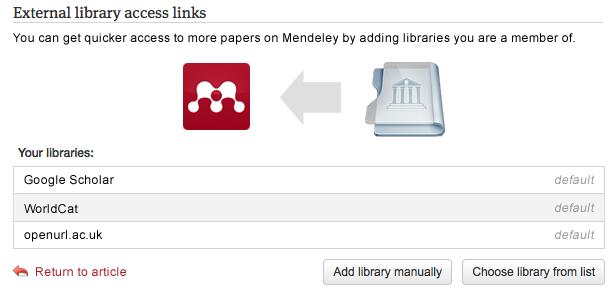
The Mendeley blog post explains how to set up an OpenURL resolver. Go to your Mendeley account and click on the My Account button in the upper right corner of then page, then select Account Details, then the Sharing/Importing tab, or just click here.

openurl_settings.jpg

Click on Add library manually, then enter the name of the resolver (e.g., "BioStor") and the URL http://biostor.org/openurl:

Snapshot 2011-03-01 07-37-20.png

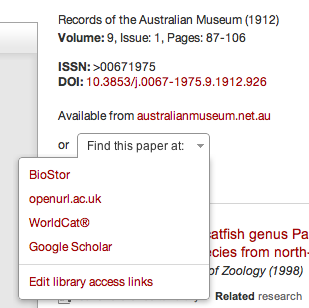
If you view a reference in Mendeley, you will now see something like this:

Snapshot 2011-03-01 07-40-04.png

In addition to the DOI and the URL, this reference now displays a Find this paper at menu. Clicking on it shows the default services, together with any OpenURL resolvers you've added (in this case, BioStor):
Snapshot 2011-03-01 07-42-50.png

You can add multiple resolvers, so we could add the BHL OpenURL resolver http://www.biodiversitylibrary.org/openurl, although finding articles isn't BHL OpenURL resolver's strong point.

Now, what would be very handy is if Mendeley were to complete the circle by providing their own OpenURL resolver, so that people could find articles in Mendeley from metadata such as article title, journal, volume, and starting page. The Mendeley API might be a way to implement this, although its search features lack the granularity needed.