class Voila {
public:
  // Voila
  static const string VOILA = "Voila";
  // will not interfere with embedded tags.
}
Friday, December 19, 2008
Code prettyfier
Test of google-code-prettify:

Thursday, December 18, 2008
Failure
Success is the ability to go from failure to failure without losing your enthusiasm -- Winston ChurchillI learnt today that my Elsevier Challenge entry didn't make the final cut. This wasn't unexpected. In the interests of "open science" (blame Paulo Nuin) here is the feedback I received from the judges:
StrengthsI think this is a pretty fair evaluation of my entry. I was making a case for what could be done, rather than providing a specific bit of kit that could make this happen right now. I think I was also a little guilty of not following the "underpromise but overdeliver" mantra. My original proposal included harvesting phylogenies from images, and that proved too difficult to do in the time available. I don't think having trees would have ultimately changed the result (i.e., not making the cut), but it would have been cool to have them.
Beautiful presentation, lovely website. Page clearly made his case for open access to metadata/full articles in order to allow communities to build the tools they want. The judges would have enjoyed seeing more elements from the original abstract (tree of life). Great contribution so far to the discussion; Page made his point very well.
Weaknesses
Given that no specific tool was proposed, this submission is somewhat out of scope for the competition. Nonetheless, in support of his point, Page could have elaborated on the kinds of open formats and standards for text and data and figures that would support integrated community-wide tool-building. Alternatively, if the framework and the displayed functionalities were to be the submission, there could have been more discussion of how others can integrate their plug-ins and make them cross-referential to the plug-ins of others. The proposal for Linked Data should utilize Semantic Web standards
Elements to Consider for Development
How many, and which types of, information substrates? How much work for a new developer to create a new one, and to make this work? How to incentivize authors to produce the required metadata? Or to make the data formats uniform?
Anyway, time to stomp around the house a bit, and be generally grumpy towards innocent children and pets. Congratulations to the
Tuesday, December 16, 2008
Reading books
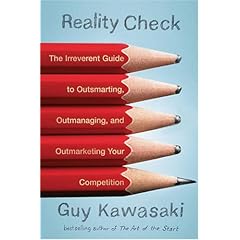 One advantage of flying to the US is the chance to do some reading. At Newark (EWR) I picked up Guy Kawasaki's "Reality Check", which is a fun read. You can get a flavour of the book from this presentation Guy gave in 2006.
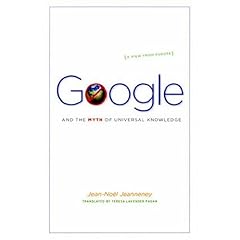 While at MIT for the Elsevier Challenge I was browsing in the MIT book shop and stumbled across "Google and the Myth of Universal Knowledge" by Frenchman Jean-Noël Jeanneney. It's, um, very French. I have some sympathy with his argument, but ultimately it comes across as European whining about American success. And the proposed solution involves that classic European solution -- committees! In many ways it's really a librarian complaing about Google (again), which librarians just need to get over:
OK, I'm not really doing the arguments justice, but I'm getting a little tired of European efforts that are essentially motivated by "well the Americans are doing this, so we need to do something as well."
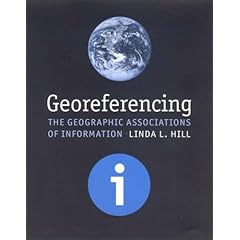
Lastly, I also bought Linda Hill's "Georeferencing: The Geographic Associations of Information", which is a little out of date (what, no Google Maps or Google Earth?), but is nevertheless an interesting read, and has lots of references to georeferencing in biodiversity informatics. Given that my efforts for the challenge in this area where so crude, it's something I need to think about a bit more deeply.
Now, if I can just find my gate...
Elsevier Challenge
Quick post about the Elsevier Challenge, which took place yesterday in the wonderful Stata Center at MIT. It was a great experience. Cool venue, interesting talks, probing questions (having a panel of judges ensured that everybody got feedback/queries). Some talks (like mine) were more aspirational (demos of what could be done), others, such as Sean O'Donoghue's talk on Reflect, and Stephen Wan's on CSBIS (see "In-Browser Summarisation: Generating Elaborative Summaries Biased Towards the Reading Context") were systems that Elsevier could plug in to their existing Science Direct product (and hence are my picks to go forward to the last round).
I was typically blunt in my talk, especially about how useless Science Direct's "2collab" and "Related articles" features were. Rafael Sidi is not unsympathetic to this, and I think despite their status as the Microsoft of publishing (for the XBox crowd, that's a Bad Thing™), the Elsevier people at the meeting were genuinely interested in changing things, and exploring how best to disseminate knowledge. There's hope for them yet! Oh, and special thanks to Anita de Ward and Noelle Gracy for organising the meeting, and the smooth running of the Challenge.

I was typically blunt in my talk, especially about how useless Science Direct's "2collab" and "Related articles" features were. Rafael Sidi is not unsympathetic to this, and I think despite their status as the Microsoft of publishing (for the XBox crowd, that's a Bad Thing™), the Elsevier people at the meeting were genuinely interested in changing things, and exploring how best to disseminate knowledge. There's hope for them yet! Oh, and special thanks to Anita de Ward and Noelle Gracy for organising the meeting, and the smooth running of the Challenge.
Death throes of Cladistics
I'm in the US on UK time, so this is probably a bad idea to write this, but the paper by Malte Ebach et al. ("O Cladistics, Where Art Thou?", doi:10.1111/j.1096-0031.2008.00225.x) in the latest Cladistics just annoys me too much. Rather than the call to arms that the authors intend, I think they've provided one more example of the death throes of cladistics (in the narrow parsimony is all, statistical methods are evil, molecular systematics is phenetics, barcoding is killing taxonomy sense).
In some ways all this saddens me. I was an undergraduate student around the time of the heyday of the New York school, thought Systematics and Biogeography: Cladistics and Vicariance was a great (if flawed) book (and I still do), and did my first post doc with Gary Nelson at the AMNH. It was a great time to be a student. Phylogenetic trees were appearing in all sorts of places, and systematists were tackling big topics such as biogeography, diversification, coevolution, and development. There was a sense of ambition, and excitement. Yet now it seems that Cladistics has become a venue for reactionary rants by people unable to break out of the comforting (but ultimately crippling) coherence of the hard-core cladist's world view.
Associations, such as the Willi Hennig society, and journals, such as Cladistics, were erected in order to tackle the growing problem of pheneticists, purveyors of overall similarity, clustering and divergence rates. Rather than challenge molecular systematists and their numerical taxonomic methods, we take part. Where is our integrity?Gosh, maybe people realised that molecular data are useful, that molecular data benefit from statistical analysis, and that divergence rates (and times) were of great biological interest? Fancy that!
What happened to the Cladistic Revolution? Today, students appear to have no knowledge of that Revolution. They graduate as students did so before the Revolution, with a sound knowledge of phenetics, ancestor worship and a healthy dose of molecular genetics. What happened to taxonomy and cladistics?I suspect the real drivers in the "Revolution" were: the development methods that could be implemented in computer software (I include parsimony in this); computer hardware that was becoming cheaper and more powerful; and, the growth of molecular data (i.e., data that was easily digitised). I don't mean to imply that everything was technologically driven, but I suspect it was a combination of a desire to infer evolutionary trees coupled with plausible means of doing so that drove the "revolution", rather than any great conceptual framework.
Such matters as the Phylocode, DNA taxonomy and barcoding, for example, have risen to prominence despite criticism of their many flaws and illogical conclusions. The attempts of these applied technologies to derail almost 250 years of scholarship are barely even questioned by our own peers with only a few taking a stand (e.g., Will and Rubinoff, 2004; Wheeler, 2005).Barcoding is happening, get over it. There are technical issues with its ability to identify "species", but to object to it on ideological grounds (as papers published in Cladistics tend to do) is ultimately futile. If the authors dealt with bacteria they wouldn't bat an eyelid. Besides, I suspect that the ability to identify organisms, or discover clusters of similar sequences will be among the least interesting applications of barcoding. There will be a wealth of standardised, geotagged data from across life around the planet. People not blinkered by ideology will do interesting things with these data.
Barcoding is understood as a ‘‘solution’’ (to what, one might ask?), systematics journals are infested with phenetics and population genetics (cladistics has vanished), both, seemingly, directing the course and future of taxonomy. Where are the scholars?Personally I use the term "phenetics" as a litmus test. If anybody says that a method is "phenetic" then I pretty much switch off. Almost always, if somebody uses this term they simply don't understand what they are talking about. If you describe a method as "phenetic" then that tells me that you either don't understand the method, or you're too lazy to try and understand it.
In some ways all this saddens me. I was an undergraduate student around the time of the heyday of the New York school, thought Systematics and Biogeography: Cladistics and Vicariance was a great (if flawed) book (and I still do), and did my first post doc with Gary Nelson at the AMNH. It was a great time to be a student. Phylogenetic trees were appearing in all sorts of places, and systematists were tackling big topics such as biogeography, diversification, coevolution, and development. There was a sense of ambition, and excitement. Yet now it seems that Cladistics has become a venue for reactionary rants by people unable to break out of the comforting (but ultimately crippling) coherence of the hard-core cladist's world view.
Saturday, December 13, 2008
EOL hyperbole
The latest post on the EOL blog (Biodiversity in a rapidly changing world) really, really annoys me. It claims that
Nope, I suggest it demonstrates just how limited EOL is. If I view the page for the red lionfish I get an out of date map from GBIF that shows a very limited distribution, and doesn't show the introductions in Florida and the Bahamas (I have to wade through text to find reference to the Florida introduction, and the page doesn't mention the Bahamas!). The blog entry states that
Well, the GBIF map is old (a more recent map is available from GBIF itself), the bibliography omits key references such as "Biological invasion of the Indo-Pacific lionfish Pterois volitans along the Atlantic coast of North America" (useful reading for a "science-based decision", one would think). Most of this information I got from Wikipedia, GBIF, and Google Scholar via an iSpecies search.
In other words, EOL in it's present state is serving limited, out of date information. The gap between hype and delivery shows no sign of narrowing. How can this help "science-based decision making"? Surely there will come a point when people will tire of breathless statements about how EOL will be useful, and they will start to ask "where's the beef?"
The case of the red lionfish exemplfies how EOL can provide information for science-based decision making. Red lionfish are native to coral reef ecosystems in the Indo-Pacific. Yet, probably due to human release of the fish from aquariums, a large population has found itself in the waters near the Bahamas.
Nope, I suggest it demonstrates just how limited EOL is. If I view the page for the red lionfish I get an out of date map from GBIF that shows a very limited distribution, and doesn't show the introductions in Florida and the Bahamas (I have to wade through text to find reference to the Florida introduction, and the page doesn't mention the Bahamas!). The blog entry states that
In this senerio[sic], EOL and its data partners provide up to date information about the lionfish, or pterois[sic] volitans, in a species page.
Well, the GBIF map is old (a more recent map is available from GBIF itself), the bibliography omits key references such as "Biological invasion of the Indo-Pacific lionfish Pterois volitans along the Atlantic coast of North America" (useful reading for a "science-based decision", one would think). Most of this information I got from Wikipedia, GBIF, and Google Scholar via an iSpecies search.
In other words, EOL in it's present state is serving limited, out of date information. The gap between hype and delivery shows no sign of narrowing. How can this help "science-based decision making"? Surely there will come a point when people will tire of breathless statements about how EOL will be useful, and they will start to ask "where's the beef?"
Thursday, December 11, 2008
Tuesday, December 09, 2008
Stack Overflow

Quick note to say how much I like the programmers' Q & A site Stack Overflow. I've only asked two questions, but the responses have been rapid and useful.

I found out about Stack Overflow by listening to the Stack Overflow podcast episodes on IT Conversations (which carry a lot of other podcasts as well).
For a wannabe geek, these podcasts are a great source of ideas.
Table lens view of data matrix
Among the many weaknesses of my challenge demo is the way it simply dumps out a list of sequences (see comments on the demo. I decided to take a look at table lens after reading BiblioViz: a system for visualizing bibliography information -- see also Rao and Card's 1994 paper (doi:10.1145/191666.191776, there is a free PDF on Ramono Rao's web site), and DateLens (another product of the University of Maryland's Human -Computer Interaction Lab, who also gave us treemaps). I've hacked together some crude Javascript and CSS, taking some suggestions on Stack Overflow as a starting point (seems to work in Safari and Firefox, doesn't in IE6).
The idea is to display a table in a fixed space. As you mouse over a cell, the contents of the cell, and the relevant row and column labels become visible. This enables you to get an overview of the full table, but still see individual items:

It's easier to show than explain. For example, take a look at The amphibian tree of life, or watch this short screencast:
There are some things to fix. Firstly, I group all sequences by NCBI taxon and gene "features". If there's more than one sequence for the same gene and taxon, I just show one of them (an obvious solution is to add a popup menu if there's more than one sequence). Secondly, the gene "names" are extracted from GenBank feature tables, and will include synonyms and duplicates (for example, a sequence may have a gene feature "RAG-1" and a CDS feature "recombination activating protein 1"). I've stored all of these as not every sequence is consistently labelled, so excluding one class of feature may loose all labels from a sequence. At some point it would be useful to cluster gene names (a task for another day).
The idea is to display a table in a fixed space. As you mouse over a cell, the contents of the cell, and the relevant row and column labels become visible. This enables you to get an overview of the full table, but still see individual items:

It's easier to show than explain. For example, take a look at The amphibian tree of life, or watch this short screencast:
There are some things to fix. Firstly, I group all sequences by NCBI taxon and gene "features". If there's more than one sequence for the same gene and taxon, I just show one of them (an obvious solution is to add a popup menu if there's more than one sequence). Secondly, the gene "names" are extracted from GenBank feature tables, and will include synonyms and duplicates (for example, a sequence may have a gene feature "RAG-1" and a CDS feature "recombination activating protein 1"). I've stored all of these as not every sequence is consistently labelled, so excluding one class of feature may loose all labels from a sequence. At some point it would be useful to cluster gene names (a task for another day).
Friday, November 28, 2008
Challenge entry
I've submitted my entry for the Elsevier Grand Challenge. The paper describing the entry is available from Nature Precedings (doi:10.1038/npre.2008.2579.1). The web site demo is at http://iphylo.org/~rpage/challenge/www/. I'm now officially knackered.
Wednesday, November 26, 2008
Sequencing Carmen Electra

One byproduct of playing with the Challenge Demo is that I come across some rather surprising results. For example, the rather staidly titled "Cryptic speciation and paraphyly in the cosmopolitan bryozoan Electra pilosa—Impact of the Tethys closing on species evolution" (doi:10.1016/j.ympev.2007.07.016) starts to look a whole lot more interesting given the taxon treemap (right).
The girl is Carmen Electra, which is understandable given the Yahoo image search was for "Electra" (a genus of bryozoan). However, what are the wild men (and women) doing at the top? Turns out this is the result of searching for the genus Homo. But why, you ask, does a paper on bryozoans have human sequences? Well, looks like the table in the paper has incorrect GenBank accession numbers. The sequences AJ711044-50 should, I'm guessing, be AJ971044-50.
Ironically, although it was Carmen Electra's photo that initially made me wonder what was going on, it's really the hairy folks above her image that signal something is wrong. I've come across at least one other example of a paper citing an incorrect sequences, so it might be time to automate this checking. Or, what is probably going to be more fun, looking at treemaps for obviously wrong images and trying to figure out why.
Challenge Demo online
I've put the my Elsevier Challenge demo online. I'm still loading data into it, so it will grow over the next day or so. There's also the small matter of writing a paper on what's under the hood of the demo. Feel free to leave comments on the demo home page.

For some example of what the project does, take a look at Mitochondrial paraphyly in a polymorphic poison frog species (Dendrobatidae; D. pumilio), then compare it to the same publication in Science Direct (doi:10.1016/j.ympev.2007.06.010).

For some example of what the project does, take a look at Mitochondrial paraphyly in a polymorphic poison frog species (Dendrobatidae; D. pumilio), then compare it to the same publication in Science Direct (doi:10.1016/j.ympev.2007.06.010).
Monday, November 24, 2008
What is a study about? Treemaps of taxa

One of the things I've struggled with most in putting together a web site for the challenge is how to summarise that taxonomic content of a study. Initially I was playing with showing a subtree of the NCBI taxonomy, highlighting the taxa in the study. But this assumes the user is familiar with the scientific names of most of life. I really wanted something that tells you "at a glance" what the study is about.
I've settled (for now, at least) on using a treemap of images of the taxa in the study. I've played with treemaps before, and have never been totally convinced of their utility. However, in this context I think they work well. For each paper I extract the taxonomic names (via the Genbank sequences linked to the paper), group them into genera, and then construct a treemap where the size of each cell is proportional to the number of species in each genus. Then I harvest images from Flickr and/or Yahoo's image search APIs and display a thumbnail with a link to the image source.

I'm hoping that these treemaps will give the user an almost instant sense of what the study is about, even if it's only "it's about plants". The treemap above is for Frost et al.'s The amphibian tree of life (doi:10.1206/0003-0090(2006)297[0001:TATOL]2.0.CO;2), the one to the right is for Johnson and Weese's "Geographic distribution, morphological and molecular characterization, and relationships of Lathrocasis tenerrima (Polemoniaceae)".
Note that the more taxa a study includes the smaller and more numerous the cells (see below). This may obscure some images, but gives the user the sense that the study includes a lot of taxa. The image search isn't perfect, but I think it works well enough for my purposes.

Saturday, November 22, 2008
Elsevier Grand Challenge Video
Elsevier have released this video about the challenge, featuring a few of the contestants. I couldn't get my act together in time to send anything useful, and having seen the 16 gigabytes song (full version here), I'm glad I didn't -- there's just no way I could compete with Michael Greenacre and Trevor Hastie.
Thursday, November 20, 2008
OpenRef and bioGUID
One of the judges for the Elsevier Article 2.0 Contest is Andrew Perry, whose blog has some posts on Noel O'Boyle's OpenRef idea (see DOI or DOH? Proposal for a RESTful unique identifier for papers). Andrew discusses some implementations he has come up with, and compares OpenRef with OpenURL. This prompted me to add OpenRef-style identifiers to bioGUID's OpenURL resolver.
Basically, OpenRef is a human-readable identifier for an article, based on concatenating the journal name, year of publication, volume number, and starting page, for example:
openref://BMC Bioinformatics/2007/8/487
The equivalent OpenURL link would be
http://bioguid.info/openurl/?genre=article &title=BMC%20Bioinformatics &date=2007 &volume=8 &spage=487
Andrew notes:
I've done this for my resolver. One limitation of OpenRef is that there are many different ways to write a journal's name, so you can't determine whether two OpenRef's refer to the same journal by simply string matching (as you can with a DOI, for example -- if the DOI's are different the article is different). For example I might write BMC Bioinformatics and you might write BMC Bioinf.. One way around tis is to have unique identifiers for journals, which of course is the approach Robert Cameron advocated with Universal Serial Item Names and JACC's. The obvious candidate for journal identifier is the ISSN. I guess the problem here is that it's easier to use the journal name rather than require the user to know the ISSN. OpenRefs are certainly easier to write. Hence, I think they are great as a simple way for people to construct a resolvable URL for an artcle, but not so great as an identifier.
Basically, OpenRef is a human-readable identifier for an article, based on concatenating the journal name, year of publication, volume number, and starting page, for example:
openref://BMC Bioinformatics/2007/8/487
The equivalent OpenURL link would be
http://bioguid.info/openurl/?genre=article &title=BMC%20Bioinformatics &date=2007 &volume=8 &spage=487
Andrew notes:
A key cosmetic (and philosophical) difference between OpenURL and OpenRef/ResolveRef URLs is that OpenURL uses HTTP GET fields, eg ?title=bla&issn=12345, while OpenRef/ResolveRef uses the URL path itself eg, somejournalname/2008/4/1996. It’s a bit like one scheme was designed in the age of CGI scripts, while the other was designed for web applications capable of more RESTful behaviour. In my mind OpenURL is more versatile but much uglier, while OpenRef is cleaner and simpler but can only reference journal articles.Of course, it is straightforward to add openref-style URLs to an OpenURL resolver by using URL rewriting, for example:
RewriteRule ^openref/(.*)/([0-9]{4})(.*)/(.*)
openurl.php?title=$1&date=$2&volume=$3&spage=$4&genre=article [NC,L]
I've done this for my resolver. One limitation of OpenRef is that there are many different ways to write a journal's name, so you can't determine whether two OpenRef's refer to the same journal by simply string matching (as you can with a DOI, for example -- if the DOI's are different the article is different). For example I might write BMC Bioinformatics and you might write BMC Bioinf.. One way around tis is to have unique identifiers for journals, which of course is the approach Robert Cameron advocated with Universal Serial Item Names and JACC's. The obvious candidate for journal identifier is the ISSN. I guess the problem here is that it's easier to use the journal name rather than require the user to know the ISSN. OpenRefs are certainly easier to write. Hence, I think they are great as a simple way for people to construct a resolvable URL for an artcle, but not so great as an identifier.
Elsevier Article 2.0 Contest
Chris Freeland's tweet alterted me to the Elsevier Article 2.0 Contest:
The site provides some sample applications (written in XQuery), which you can play with by going to the list of journals that are included in the challenge and clicking down through volume and issue until you get to individual articles.
Elsevier Labs is inviting creative individuals who have wanted the opportunity to view and work with journal article content on the web to enter the Elsevier Article 2.0 Contest. Each contestant will be provided online access to approximately 7,500 full-text XML articles from Elsevier journals, including the associated images, and the Elsevier Article 2.0 API to develop a unique yet useful web-based journal article rendering application. What if you were the publisher? Show us your preference!Elsevier are clearly looking for ideas (they also have their Grand Challenge), and there's been some interesting commentary on the Article 2.0 contest.
The site provides some sample applications (written in XQuery), which you can play with by going to the list of journals that are included in the challenge and clicking down through volume and issue until you get to individual articles.
Saturday, November 15, 2008
EOL on CBS
Watch CBS Videos Online
CBS News Sunday Morning Segment on the EOL. All fun stuff (Paddy skewering the interviewer who fails to recognise an echidna), but still long on promises and short on actual product.
Monday, November 10, 2008
Rewriting DOIs
One problem with my cunning plan to use Mediawiki REDIRECTs to handle DOIs is that some DOIs, such as those that BioOne serves based on SICIs contain square brackets, [ ], which conflicts with wiki syntax. For example, doi:10.1206/0003-0090(2006)297[0001:TATOL]2.0.CO;2 I want to enable users to enter a raw DOI, so I've been playing with a simple URL rewrite in Appache httd.conf, namely:
RewriteRule ^/wiki/doi:(.*)\[(.*)\](.*)$ /w/index.php?title=Doi:$1-$2-$3 [NC,R]
This rewrites the [ and ] in the original DOI, then forces a new HTTP request (hence the [NC,R] at the end of the line). This keeps Mediawiki happy, at the cost of the REDIRECT page having a DOI that looks a slightly different from the original. However, it means the user can enter the original DOI in the URL, and not have to manually edit it.
RewriteRule ^/wiki/doi:(.*)\[(.*)\](.*)$ /w/index.php?title=Doi:$1-$2-$3 [NC,R]
This rewrites the [ and ] in the original DOI, then forces a new HTTP request (hence the [NC,R] at the end of the line). This keeps Mediawiki happy, at the cost of the REDIRECT page having a DOI that looks a slightly different from the original. However, it means the user can enter the original DOI in the URL, and not have to manually edit it.
From bibliographic coupling to data coupling
Bibliographic coupling is a term coined by Kessler (doi:10.1002/asi.5090140103) in 1963 as a measure of similarity between documents. If two documents, A and B, cite a third, C, then A and B are coupled.
I'm interested in extending this to data, such as DNA sequences and specimens. In part this is because within the challenge dataset I'm finding cases where authors cite data, but not the paper publishing the data. For example, a paper may list all the DNA sequences in uses (thus citing the original data), but not the paper providing the data.
To make this concrete, the paper "Towards a phylogenetic framework for the evolution of shakes, rattles, and rolls in Myiarchus tyrant-flycatchers (Aves: Passeriformes: Tyrannidae)" doi:10.1016/S1055-7903(03)00259-8 lists the sequences used, but does not cite the source of three of these (which is the Science paper "Nonequilibrium Diversity Dynamics of the Lesser Antillean Avifauna" (doi:10.1126/science.1065005). As a result, if I was reading "Nonequilibrium Diversity Dynamics of the Lesser Antillean Avifauna" and wanted to learn who had cited it I would miss the fact that paper "Towards a phylogenetic framework for the evolution of shakes, rattles, and rolls..." had used the data (and hence, in effect, "cited" the paper). In some cases, data citation may be more relevant than bibliographic citation because it relates to people using the data, which seems a more significant action than simply reading the paper.
Note that I'm not interested in the issue of credit as such. In the above example, the authors of the Science paper are also coauthors of the "shakes, rattles, and rolls" paper, and hence show commendable restrain in not citing themselves. I'm interested in the fate of the data. Who has used it? What have they done with it? Has anybody challenged the data (for example, suggesting a sequence was misindentified)? These are the things that a true "web of data" could tell us.
I'm interested in extending this to data, such as DNA sequences and specimens. In part this is because within the challenge dataset I'm finding cases where authors cite data, but not the paper publishing the data. For example, a paper may list all the DNA sequences in uses (thus citing the original data), but not the paper providing the data.
To make this concrete, the paper "Towards a phylogenetic framework for the evolution of shakes, rattles, and rolls in Myiarchus tyrant-flycatchers (Aves: Passeriformes: Tyrannidae)" doi:10.1016/S1055-7903(03)00259-8 lists the sequences used, but does not cite the source of three of these (which is the Science paper "Nonequilibrium Diversity Dynamics of the Lesser Antillean Avifauna" (doi:10.1126/science.1065005). As a result, if I was reading "Nonequilibrium Diversity Dynamics of the Lesser Antillean Avifauna" and wanted to learn who had cited it I would miss the fact that paper "Towards a phylogenetic framework for the evolution of shakes, rattles, and rolls..." had used the data (and hence, in effect, "cited" the paper). In some cases, data citation may be more relevant than bibliographic citation because it relates to people using the data, which seems a more significant action than simply reading the paper.
Note that I'm not interested in the issue of credit as such. In the above example, the authors of the Science paper are also coauthors of the "shakes, rattles, and rolls" paper, and hence show commendable restrain in not citing themselves. I'm interested in the fate of the data. Who has used it? What have they done with it? Has anybody challenged the data (for example, suggesting a sequence was misindentified)? These are the things that a true "web of data" could tell us.
Wednesday, November 05, 2008
Defrosting the Digital Library
Duncan Hull alerted me to his paper "Defrosting the Digital Library: Bibliographic Tools for the Next Generation Web" (PloS Computational Biology, doi:10.1371/journal.pcbi.1000204). Here's the abstract:
Many scientists now manage the bulk of their bibliographic information electronically, thereby organizing their publications and citation material from digital libraries. However, a library has been described as “thought in cold storage,” and unfortunately many digital libraries can be cold, impersonal, isolated, and inaccessible places. In this Review, we discuss the current chilly state of digital libraries for the computational biologist, including PubMed, IEEE Xplore, the ACM digital library, ISI Web of Knowledge, Scopus, Citeseer, arXiv, DBLP, and Google Scholar. We illustrate the current process of using these libraries with a typical workflow, and highlight problems with managing data and metadata using URIs. We then examine a range of new applications such as Zotero, Mendeley, Mekentosj Papers, MyNCBI, CiteULike, Connotea, and HubMed that exploit the Web to make these digital libraries more personal, sociable, integrated, and accessible places. We conclude with how these applications may begin to help achieve a digital defrost, and discuss some of the issues that will help or hinder this in terms of making libraries on the Web warmer places in the future, becoming resources that are considerably more useful to both humans and machines.
It's an interesting read, and it also <shamless plug>cites my bioGUID project</shamless plug>.
[Image from dave 7]
Subscribe to:
Posts (Atom)