Wednesday, November 29, 2006

Homonyms and uBio's data model (yet more on names)

As part of the TreeBASE name mapping exercise, I've come across some interesting names, such as "Diplura". This is a homonym, meaning that more than one taxon has this name. This can complicate life somewhat.


In TreeBASE, the taxon Diplura is a spider genus (TreeBASE taxon T4182), part of the study by Fredrick Coyle (hdl:2246/1665).

NCBI has "Diplura" (Taxonomy ID (29997), but this is the insect class (or order, depdnign on what classification you use). NCBI mistakenly links "Diplura" in NCBI to "Diplura" in TreeBASE, but links correctly to the insect record in ITIS (Taxonomic Serial No:99228).

To make matters worse, there is also an algal genus Diplura, which ITIS also has (Taxonomic Serial No:10873).

The problem comes when we look up this name in uBio. The name Diplura is listed as appearing in several classifications, including NCBI, ITIS, etc., as well as its occurrence as a butterfly name (Diplura Ranbur, 1866). However, in the metadata for this name there is the tag <ubio:taxonomicGroup>Phaeophyceae</ubio:taxonomicGroup> (the Phaeophyceae are algae). Clearly, a name that is used by a spider, an insect, and an alga (never mind a butterfly) can't be assigned to a single taxonomic group. Perhaps one solution would be have multiple instance of the <ubio:taxonomicGroup> tag, one for each major taxonomic group the name came from.

My motivation in all this is to start thinking about taxonomic names as simple "tags", with a view to using some of the vocabularies for taxonomies and "folksonomies" geing developed elsewhere, such as SKOS Core. Under this approach, I'd need GUIDs for name strings, independent of their usage. uBio pretty much does this, but for the <ubio:taxonomicGroup> tag.

Friday, November 24, 2006

Demise of Phyloinformatics.org


As noted on the Society of Systematic Biology (SSB) web site, the journal Phyloinformatics has disappeared. It only published eight papers, but this still represents lost effort, and some of the papers are highly relevant to issues I'm interested in. Luckily, with the help of the Internet Archive's "wayback machine", and a PDF sent by Paul Sereno, I've put all the PDFs on the SSB web site. You can get them here.

Friday, November 17, 2006

More on names (and frogs)

Molecular Phylogenetics and Evolution carries two articles debating the application of names to trees, which reflects tensions between two codes of nomenclatures (ICZN and Phylocode). Alain Dubois (doi:10.1016/j.ympev.2006.06.007 and
David Hillis (doi:10.1016/j.ympev.2006.08.001) present rather different views. The paper that brought things to a head is Hillis and Wilcox (2005) "Phylogeny of the New World true frogs (Rana)" (doi:10.1016/j.ympev.2004.10.007, TreeBASE S1186). I've not had time to digest this (it's Friday evening, after all), but I think it's interesting to see to what extent the systems can coexist (which is what Hillis seems to argue, if only as a transitional stage), or whether they are simply incompatible.

Tuesday, November 14, 2006

Synonomy and kinds of name


Just wanted to write this example down before I loose it. Browsing Bill Piel's trees in Google Earth, and was looking at Lee et al.'s paper (doi:10.1111/j.1365-294X.2005.02707.x) on Physalaemus pustulosus. Searching in iSpecies.org lead to records in GenBank, whereupon I stumble on the fact that in GenBank it is Engystomops pustulosus (Taxonomy ID: 76066). Following up the reference on the NCBI taxonomy page, I find a
PDF of the paper freely available (although only a URL for an identifier). Browsing the GenBank records (e.g., DQ337249), I find Ron et al. (10.1016/j.ympev.2005.11.022). Among other things, this paper refines the genus Engystomops:


Engystomops, Jiménez de la Espada 1872 (converted clade name). Definition: clade stemming from the most recent common ancestor of E. petersi Jiménez de la Espada 1872, and E. pustulatus (Shreve, 1941).


Then paddling off to HerpNET I query for "Engystomops pustulosus" and get one record, whereas for "Physalaemus pustulosus" I get lots of records (although the geographic range doesn't include all the localities in doi:10.1111/j.1365-294X.2005.02707.x.

My point? Well, don't really have one, except that again we are clicking around different web sites to get a complete picture of what is going on, important data are attached to different names for the same animal, and the nature of those names themselves may vary (for example, Nascimento et al. define Engystomops as a set with a type species (E. petersi), whereas Ron et al. (10.1016/j.ympev.2005.11.022) define Engystomops as a least common ancestor of two taxa on a tree. All of this makes integration a challenge, to say the least.

Monday, November 06, 2006

The politics and practice of accessibility in systematics


Stumbled across New Infrastructures for Knowledge Production: Understanding E-science while writing about TAXACOM on the iSpecies blog.
The book is edited by Christine Hine, who has an article entitled The politics and practice of accessibility in systematics, which I think will be part of Past, Present & Future of Research in the Information Society. The final paragraph of this article is intriguing:
There are some messages here for an open access movement that places belief in the ability of digital solutions to realise access to information. The experience of systematics suggests that too great a focus on the movement, and too much emphasis on the ability of particular technologies to realise a desired effect can be counter productive. A belief in the inevitability of digital solutions can sideline consideration of potential users and transform it into a simple belief that they will come. From this perspective open access looks like a low cost technical fix to issues of inequality, and of course nothing is that simple. However, we can expect that within the “open access movement” a wide diversity of initiatives may proliferate, and these will make sense to those most directly involved in a variety of ways which cross and blur the distinction between providers and users of information. There will be a need to remain open to non-digital solutions, and to respect the capacity of practitioners to craft their own appropriate technologies, even whilst we celebrate the ability of grand visions of open access to inspire, stimulate and offer a way of making sense of diverse experience.

Sunday, October 15, 2006

Mac Spoof: Upgrading

Really should be doing some work, but nearly wet myself when I saw this...

Friday, September 22, 2006

PygmyBrowse demo

I've now put a simple demo of the PygmyBrowse tree browser up here. It's a simple toy just to demo the idea.

Wednesday, September 20, 2006

PygmyBrowse


I've previously bemoaned the lack of a decent way to display and navigate through phylogenies. Ryen White, a graduate of Glasgow's Computer Science department and now at Microsoft Research is coauthor of of cool paper on viewing large trees in small spaces. PygmyBrowse: a small screen tree browser (doi:10.1145/1125451.1125562) describes an elegant approach to browsing a hierarchy that strikes me as being potentially very useful for navigating taxonomic classifications. It should be a cinch to implement this using AJAX (I'll let you know if I manage to do this before getting distracted by other things).

Tuesday, August 29, 2006

Collaborative data matrices using EditGrid


EditGrid is an online collaborative spreadsheet tool that I stumbled across via Ogle Earth. It strikes me thjat this could be a way to create phylogenetic data sets collaboratively.


As a quick test I grabbed the Vertebrates example file that comes with MacClade, exported the NEXUS file as a table, opened it in Excel, then uploaded the Excel file to EditGrid. You can see the results here.


The spreadsheet is a natural metaphor for phylogenetic data, although in this application is is likely to be better suited to morphological data where a team of people are assembling a matrix from various sources.

The developers of EditGrid have a blog whioch converys their own sense of excitement about this project.

Tuesday, August 08, 2006

Connotea and TreeBASE


One of my (forever) ongoing projects is to map taxon names in TreeBASE to names in external databases (such as uBio) as a way of checking that the names are correct, adding the ability to handle synonyms, and hierarchical queries (see my earlier post for more details).

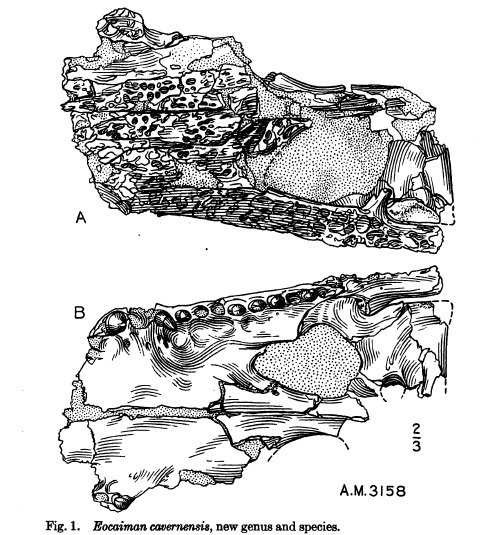
Now, many names in TreeBASE aren't in any of the major name databases (fossils seem particularly poorly supported), which means hunting on Google for the name. In some cases I come across the name and the original reference for the name, which means I can document that the name is correct. For example, TreeBASE taxon T8737 is Eocaiman cavernensis, which doesn't occur in any of the name sources I use (uBio, ITIS, NCBI, IPNI, etc.). It's a fossil crocodilian, described by George Gaylord Simpson in 1933.


The original description in American Museum Novitates is online (hdl:2246/2050), courtesy of the AMNH's DSpace server. So, how do I link the name and the publication -- without me creating a new database to do this? Well, Connotea to the rescue. I add Simpson's paper to Connotea, tagged with the TreeBASE TaxonID T8737, and viola, the information is stored.

Now, to make use of this we need to do a little bit more, such as have a triple store that contains both the TreeBASE names and the Connotea record, but given that Connotea serves RSS 1.0 (i.e., RDF), this is easy.

What I like about this is:

  1. I don't have to do much work

  2. The publication information is stored where others can see it and make use of it (i.e., if my experiments with these ideas fall by the wayside, the data still remain).


Now, back to the tedious task of mapping...

Wednesday, July 12, 2006

Small Pieces Loosely Joined


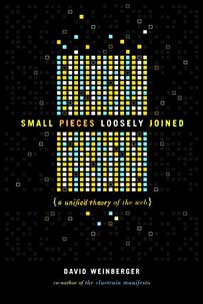
Just finished reading Small Pieces Loosely Joined. It's a fabulous essay on the nature of the Web. The more I read it the more it confirms my fear that most people talking about biological taxonomy and biodiversity on the Web simply don't "get" the Web. Adopting the Web successfully will require a willingness to accept error, ambiguity, and downplaying "expertise" and "authority". It will be interesting to see what happens.

Wednesday, June 28, 2006

TreeBASE rocks


I gave a talk today ("Dude, where's my tree?") at the Evolution 2006 meeting at Stony Brook. It was intended as a somewhat tongue-in-check overview of some issues concerning TreeBASE, and broader areas of biodiversity informatics, making use of ants as an example (see my SemAnt project).
Michael Donoghue took me aside after the talk and made some interesting points. He was a little tired — understandably — of hearing that "TreeBASE sucks" (e.g., my CIPRES talk), and felt that my constantly saying this was counter productive. It could also lead to people not putting their data in TreeBASE because they'd heard that it "sucks".
There is an element of social responsibility here, I guess. I resolutely avoid politics. I don't mean this in a pejorative sense, it's just that I don't have the temperament or skill for it, unlike Michael himself (Lee Belbin is another person in this area who strikes me as a very skilled manager).
Now, my talk was intended to be fun, and I was taking the piss out of myself as much as anything. I also think the things we criticise are the things we value the most. But that said, let be make it clear that TreeBASE is very important. As editor of Systematic Biology I've made authors submit data to it. I have a lot of respect for the work Michael, Bill Piel, and Mike Sanderson put into TreeBASE. If you have phylogenetic data — submit it to TreeBASE. It's the best we have. It's just that, well, as a community, we could do better.

Taxonomic names, metadata, and the Semantic Web

My paper "Taxonomic names, metadata, and the Semantic Web" has appeared in Biodiversity Informatics.


Life Science Identifiers (LSIDs) offer an attractive solution to the problem of globally unique identifiers for digital objects in biology. However, I suggest that in the context of taxonomic names, the most compelling benefit of adopting these identifiers comes from the metadata associated with each LSID. By using existing vocabularies wherever possible, and using a simple vocabulary for taxonomy-specific concepts we can quickly capture the essential information about a taxonomic name in the Resource Description Framework (RDF) format. This opens up the prospect of using technologies developed for the Semantic Web to add ``taxonomic intelligence" to biodiversity databases. This essay explores some of these ideas in the context of providing a taxonomic framework for the phylogenetic database TreeBASE.

Saturday, May 27, 2006

More on trees and Google Earth


Well, turns out Bill's not the only one putting trees on Google Earth. Declan Butler pointed me to Ogle Earth, where there is a teaser of some work on guiology.

Currently playing in iTunes: Crazy In Love by Beyoncé

Avian flu, phylogeny, and Google Earth

The penny just dropped (duh!).
Having mentioned Bill Piel's very cool visualisation of phylogenies on Google Earth

what about the other cool use of Google Earth in biology, namely Declan Butler's displays of the march of avian flu?

Instead of standard diagrams like this one from the Ruben Donis' paper in Emerging Infections Diseases:

why not take phylogenies for avian flu virus and add them to the data Declan is displaying? This could be a potentially compelling graphic, and a test of whether phylogenies add useful information to our understanding of what is going on.

Friday, May 26, 2006

TreeBASE meets Google Earth


Bill Piel has created a cool tool for creating KMZ files of phylogenies for Google Earth. From the web site:

One of the components of the CIPRES project is the development of TreeBASE II — a robust, scalable, and versatile re-design and re-engineering of TreeBASE. As part of this project, we are exploring other ways of browsing and visualizing trees. Google Earth is a fantastic 3-D browser for exploring geographic resources and has the potential to be a useful and fun tool for delivering biological information with a geographic component.


Google Earth (available for Windows and Mac OS X) is opening up all sorts of possibilities for biodiversity informatics (ants being one of the first examples). What is cool about Bill's work is that it departs from simple locality records.

As always, after pausing to say "wow", there are all sorts of things that one could think of adding. For example, some trees are clearer than others, due to how well the geography and trees match. I wonder if this could be used as a measure of how well geography "explains" the tree. For example, simple vicariance or serial dispersal would have few cross-overs, a history of dispersal (or an old pattern with extinction, or if geography has changed) might be messier. Perhaps there is a metric that could be developed for this. It strikes me as similar in spirit to trees for tandem duplications -- there's a nice spatial (albeit it linear) order in a tree if the sequences are tandem duplications.

If the trees had dated nodes (i.e., were "chronograms"), presumably this could be used to compute node heights, so you'd be able to have chronograms. Sort of a reverse onion, the layers getting older as you go out. People could then see whether biogeographic patterns were of a similar age. This adds a spatial dimension to chronograms (see an earlier post on the analogy between genome browsers and chronograms).

As an aside, and because I was once a panbiogeography enthusiast, why haven't panbiogeographers leap on Google Earth as a tool to display "tracks"? If ever there was an opportunity to drag that movement out of the doldrums, this is it.

Wednesday, May 24, 2006

Open Access taxonomy


Pyramica boltoni
Originally uploaded by Roderic Page.
Fussing around with ants, I stumbled across this paper (doi:10.1653/0015-4040(2006)89[1:PBANSO]2.0.CO;2) (if the DOI doesn't work, try this link), which describes a new species, Pyramica boltoni. This paper is Open Access, so the question arises, how do I get it into a triple store? I could add the metadata about the paper (it would be nice to do this automatically via Connotea and the DOI, but some BioOne DOIs aren't "live" yet), but what about things like the pictures?
For fun, I grabbed Fig. 1, uploaded it into iPhoto, then exported it to Flickr using the FlickrExport plugin.
Flickr has an API, hence the image (and the associated tags) could be retrieved automatically. Hence, anybody with Connotea and Flickr accounts could contribute to a triple store.

Sunday, May 21, 2006

Towards the ToL database - some visions


So, when I started this blog I promised to write something about phyloinformatics, and the goal of a phylogenetic database. I've been playing around with various ideas, some of which have made it online, but most remain buried on various hard drives until they get written up to the state they are useable.

There are also numerous distractions, and detours along the way, such as MyPHPBib, Taxonomic Search Engine, and LSIDs, oh and iSpecies, which got me into trouble with Google, then there is a certain journal, and a certain person (but let's not go there...).

My point (and I do have one), is that maybe it's time to rethink some cherished ideas. Basically, my original goal of creating a phylogenetic database involved massive annotation, disambiguation of taxonomic names, and linking to global identifiers for taxonomic names, sequences, images, and publications. This is the project outlined at the start of this blog.

I still believe this would be worthwhile, and I've a lot of the work done for TreeBASE (e.g., mapping TreeBASE names to external databases, BLASTing sequences in ttreeBASE to get accession numbers, etc.). This is a lot of work, and I wonder about scalability and involvement. In other words, can it cope with the amount of data and trees we generate, and how do we get people to contribute. So, here are a few different (not necessarily exclusive approaches).

Curation
Use TreeBASE as a seed and continue to grow that database, adding extensive annotations and cross links. Time consuming, but potentially very powerful, especially is data is dumped into a triple store and cool ways to query it are developed.

Googolise everything
Use Google to crawl for NEXUS files (e.g., "#nexus" "begin data" format dna), extract them and put them into a database. Use string matching and BLAST to figure out what the files are about.

Phylogeny news
Monitor NCBI and journal RSS feeds, when new sequences or papers appear, extract popsets, use or build alignments, compute trees quickly and wack into a database. Interface is something like Postgenomic (maybe using the same clustering algorithms to link related stories), or even cooler, newsmap


Connotea style

Inspired by projects like Connotea, perhaps the trick is to mobilise the community by lowering the barrier to entry. Instead of aiming for a carefully curated database, what if people could upload the basics (some sort of identifier for the paper, such as a DOI or a PubMed id, and one or more trees in Newick format). I think this is what Wayne Maddison was suggesting when we chatted at the CIPRES (see my earlier post about that meeting) -- if Wayne didn't suggest this, then my apologies. The idea would be that people could upload the bare minimum, but be able to annotate, comment, link, etc. Behind the scenes we have scripts to look up whatever identifiers we have and extract relevant metadata.

Saturday, May 20, 2006

Taxonomic Search Engine back online

My Taxonomic Search Engine is back online (mostly). This tool to search multiple databases for scientific names was another casualty of hacking. Having been developed under PHP 4, it needed some work to play nice with PHP 5. The changes were minor, and mainly concerned changes in code involving XPath and XSLT. I've commited these changes to SourceForge. I've not got the Species 2000 service back up (this needs local data to be restored), and the LSIDs are broken due to problems with IBM's LSID perl stack on my Fedora Core 4 machine (sigh).

Wednesday, May 17, 2006

AntBase and Web 2.0 business value

Dion Hinchcliffe has a piece entitled Creating real business value with Web 2.0 which lists AntBase.org (I think he actually means AntWeb) as an example of a non-commercial Web 2.0 service that demonstrates "scalable marshalling of underutilized data resources," and shows:


...how a scientific community turned massive taxonomy resources otherwise mouldering away in basements as lost specimens into a thriving online database of information that can be shared by all. Understanding the success and importance of both of these points to intriguing and largely unexploited possibilities that I predict will become more common and widespread in the near future.


The article comes with this graphic:


See also Dion's Thinking in Web 2.0: Sixteen ways (via Danny Ayers).