Wednesday, April 17, 2013

Reconciling author names using Open Refine and VIAF

RefineIn an earlier post I discussed using Open Refine (formerly Google Refine) to clean and reconcile taxon names. I've added an additional service that can be used to reconcile author names that uses the Virtual International Authority File (VIAF) API. Using this service we can match authors to VIAF identifiers (you may have noticed these appearing on people's pages in Wikipedia, e.g. Mary J. Rathbun's Wikipedia page lists her VIAF as 61796012).

To use the service follow the instructions in the earlier post but add the service:

http://iphylo.org/~rpage/phyloinformatics/services/reconciliation_viaf.php

This service is fairly crude, in particular, I make no attempt to score the matches that VIAR returns because this would require parsing and normalising author names. This could be added if needed. If you want some exmaple names to try, here are some taxonomists:


George A Boulenger
G A Boulenger
Wilhelm Michaelsen
W Michaelsen
Colin Campbell Sanborn
Suzanne Hand
Philip Hershkovitz
Yehudah Leopold Werner
W B Spencer
Norman Platnick

Tuesday, April 16, 2013

A decadal view of biodiversity informatics: challenges and priorities

LogoBMC Ecology has published Alex Hardisty and Dave Roberts' white paper on biodiversity informatics:

Hardisty, A., & Roberts, D. (2013). A decadal view of biodiversity informatics: challenges and priorities. BMC Ecology, 13(1), 16. doi:10.1186/1472-6785-13-16

Here are their 12 recommendations (with some comments of my own):

  1. Open Data, should be normal practice and should embody the principles of being accessible, assessable, intelligible and usable.

    Seems obvious, but data providers are often reluctant to open "their" data up for reuse.
  2. Data encoding should allow analysis across multiple scales, e.g. from nanometers to planet-wide and from fractions of a second to millions of years, and such encoding schemes need to be developed. Individual data sets will have application over a small fraction of these scales, but the encoding schema needs to facilitate the integration of various data sets in a single analytical structure.

    No I don't know what this means either, but I'm guessing that it's relevant if we want to attempt this: doi:10.1038/493295a
  3. Infrastructure projects should devote significant resources to market the service they develop, specifically to attract users from outside the project-funded community, and ideally in significant numbers. To make such an investment effective, projects should release their service early and update often, in response to user feedback.

    Put simply, make something that is both useful and easy to use. Simples.
  4. Build a complete list of currently used taxon names with a statement of their interrelationships (e.g. this is a spelling variation; this is a synonym; etc.). This is a much simpler challenge than building a list of valid names, and an essential pre-requisite.

    One of the simplest tasks, first tackled successfully by uBio, now moribund. The Global Names project seems stalled, intent on drowning in acronym soup (GNA,GNI,GNUB, GNITE).
  5. Attach a Persistent Identifier (PID) to every resource so that they can be linked to one another. Part of the PID should be a common syntactic structure, such as ‘DOI: ...’ so that any instance can be simply found in a free-text search.

    DOIs have won the identifier wars, and everything citable (publications, figures, datasets) is acquiring one. The mistake to avoid is forgetting that identifiers need services built on top of them (see http://labs.crossref.org/ for some DOI-related tools). The core service we need is reverse lookup: given this thing (publication, specimen, etc.) what is its identifier?
  6. Implement a system of author identifiers so that the individual contributing a resource can be identified. This, in combination with the PID (above), will allow the computation of the impact of any contribution and the provenance of any resource.

    This is a solved problem, assuming ORCID continues to gain momentum. For past authors VIAF has identifiers (which are being incorporated into Wikipedia).
  7. Make use of trusted third-party authentication measures so that users can easily work with multiple resources without having to log into each one separately.

    Again, a solved problem. People routinely use third parties such as Google and Facebook for this purpose.
  8. Build a repository for classifications (classification bank) that will allow, in combination with the list of taxonomic names, automatic construction of taxonomies to close gaps in coverage.

    Let's not, let's focus on the only two classifications that actually matter because they are linked to data, namely GBIF and NCBI. If we want one classification to coalesce around make it GBIF (NCBI will grow anyway).
  9. Develop a single portal for currently accepted names - one of the priority requirements for most users.

    Yup, still haven't got this, we clearly didn't get the memo about point 3.
  10. Standards and tools are needed to structure data into a linked format by using the potential of vocabularies and ontologies for all biodiversity facets, including: taxonomy, environmental factors, ecosystem functioning and services, and data streams like DNA (up to genomics).

    The most successful vocabulary we've come up with (Darwin Core) is essentially an agreed way to label columns in Excel spreadsheets. I've argued elsewhere that focussing on vocabularies and ontologies distracts from the real prerequisite for linking stuff together, namely reusable identifiers (see 5). No point developing labels for links if you don't have the links.
  11. Mechanisms to evaluate data quality and fitness-for-purpose are required.

    Our data is inaccurate and full of holes, and we lack decent tools for visualising and fixing this (hence my interest in putting the GBIF classification into GitHub).
  12. A next-generation infrastructure is needed to manage ever-increasing amounts of observational data.

    Not our problem, see doi:10.1038/nature11875 (by which I mean lots of people need massive storage, so it will be solved)

Food for thought. I suspect we will see the gaggle of biodiversity informatics projects will seek to align themselves with some of these goals, carving up the territory. Sadly, we have yet to find a way to coalesce critical mass around tackling these challenges. It's a cliché, but I can't help thinking "what would Google do?" or, more, precisely, "what would a Google of biodiversity look like?"

Thursday, April 11, 2013

BioNames update - taxon concepts

Quick notes on "taxon concepts". In order to navigate through taxon names I plan to have at least one taxonomic classification in BioNames. GBIF makes the most sense at this stage.

Taxonconcept
The model I'm adopting is that the classification is a graph where nodes have the id used by the external database (in this case GBIF). Each node has one or more names attached, and where possible the names are linked to the original description. Where we have synonyms it would be nice to link the synonymy to publication(s) that proposed that relationship.

Wednesday, April 10, 2013

Time to put taxonomy into GitHub

Donald Hobern drew my attention to nice the way iNaturalist displays taxonomic splits:

Inaturalist
In this example, observations identified as Rhipidura fuliginosa are being split into Rhipidura fuliginosa and Rhipidura albiscapa. This immediately reminds me of the idea which keeps circulating around, namely using version control tools to manage taxonomic classification. Some years ago David Shorthouse proposed managing taxonomic classifications using version control, see Taxonomic Consensus as Software Creation. I discussed this in Taxonomy on a hard disk, and Pierre Lindenbaum has an interesting post on treating the NCBI taxonomy as a file system A FUSE-based filesystem reproducing the NCBI Taxonomy hierarchy.

The idea is that a taxonomy, such as the GBIF backbone taxonomy, could be placed in GitHub where people could clone it, annotated, correct, edit, or otherwise mess with it, then GBIF could pull in those edits and release an updated, cleaner taxonomy. If software version control seems a bit esoteric, it's worth noting that use of GitHub is rapidly becoming much more mainstream in science, and not just for software development. People are using it to store versions of data analysis (e.g., https://github.com/dwinter/Fungal-Foray) and collaboratively write manuscripts (e.g., https://github.com/weecology/data-sharing-paper). The journal eLIFE is depositing articles there (e.g., https://github.com/elifesciences/elife-articles). In addition to all the infrastructure GitHub provides (the ability to identify who did what and when, to roll back changes, to fork classifications, etc.) there is also the attraction of not creating yet more software, but simply editing a classification by moving folders around on your local filesystem. The idea seems irresistible…

Sunday, April 07, 2013

DNA QR Codes


Came across this paper recently:

Liu, C., Shi, L., Xu, X., Li, H., Xing, H., Liang, D., Jiang, K., et al. (2012). DNA Barcode Goes Two-Dimensions: DNA QR Code Web Server. (R. DeSalle, Ed.)PLoS ONE, 7(5), e35146. doi:10.1371/journal.pone.0035146

Despite QR Codes being uncool, there's something appealing about the idea of compressing a DNA barcode sequence into a small image. Imagine having a specimen label with a QR Code, pointing a smart phone at the label using an app that converts the QR Code to a sequence, sends it to BLAST and returns a phylogeny that includes DNA from that specimen (perhaps using a service like http://iphylo.org/~rpage/phyloinformatics/blast).

Thursday, April 04, 2013

Notes on font size

I'm working on displaying OCR text from BHL using SVG, and these are just some quick notes on font size. Specifically how SVG font size corresponds to the size of letters, and how you work out what point size was used to print text on a BHL page.

SVG font-size corresponds to the EM square of the font. Hence, if I specify a font-size of 100px then text looks like this (you'll need need a browser that supports SVG to see this):


The yellow box is the EM square (in this example 100px by 100px). The height of the letter "M" is set by the properties of the font which in this case is Times-Roman which has a capheight of 662. This value (and others) are defined in the font description file (Adobe-Core35_AFMs-314.tar.gz).

Below is a diagram showing attributes of Times Roman with respect to the 1000 x 1000 EM square:


Couple of things to note. The first is that the height of a digital font is not given by simply adding the capheight and descender, the height of the font is the EM square. If you know the capheight and the font metrics you can compute the size of the EM square (for Times Roman capheight / 0.662 gives you the EM square). Hence it is possible to fairly accurately reproduce printed text in SVG. I had hopes that I could then go on to infer the actual point size used on the printed page (being able to say "this is 10pt" seemed more elegant than this font is "x pixels"). Turns out that "point size" is a terribly elusive concept, see Point Size and the Em Square: Not What People Think. I've clearly lots to learn about typography. BHL would be a gold mine for anyone interested in the development of type faces and printing technology over time.

Tuesday, March 26, 2013

Towards DOIs for Biodiversity Heritage Library articles

The new look Biodiversity Heritage Library includes articles extracted from BioStor, which is a step forwards in making the "legacy" biodiversity literature more accessible. But we still have some way to go. In particular the articles lack the obvious decoration of a modern article, the DOI. Consequently these articles still live in a twilight zone where they are cited in the literature but not linked to. DOIs are becoming more common for taxonomic articles. Zookeys has them, and now Zootaxa has adopted them (and will be applying them retrospectively to thousands of already published articles). Major archives of back issues digitised by Taylor and Francis, and Wiley, for example, also have DOIs.

One obstacle to assigning CrossRef DOIs to articles in BHL is the convention that DOIs are typically managed by the publisher of the journal. But in a number of cases the publisher may no longer exist, the journal may no longer be published, or the publisher may lack the commercial resources to support DOIs. In these cases perhaps BHL could adopt the role of publisher?

Another approach is that adopted by a number of other digital archives, whereby the archive assigns DOIs to articles, but these DOIs are registered not through CrossRef but with another DOI registration agency, such as DataCite. For example the Swiss Electronic Academic Library Service (SEALS) archive assigns DOIs to individual articles, such as http://dx.doi.org/10.5169/seals-88913.

There are some limitations to not using CrossRef DOIs, in particular, you don't get the full benefits of their metadata-based services such as getting metadata from a DOI, discovering DOIs from metadata, or citation linking. But all is not lost. Some services support both CrossRef and DataCite DOIs, such as http://crosscite.org/citeproc. For example, for the DOI 10.5169/seals-88913 we get some basic formatting:

Perret, Jean-Luc. (1961). Etudes herpétologiques africaines III. Société Neuchâteloise des Sciences Naturelles. doi:10.5169/seals-88913

This still leaves us lacking some services, such as finding DOIs for articles cited in a manuscript. However this is a service we can provide, and will have to anyway if we want to find all the digitised literature available (e.g., archives such as SEALS as well as numerous instances of DSpace). My preference would be for CrossRef DOIs, but if that proves problematics we can still get much of the functionality we need using other DOI providers.

Wednesday, March 20, 2013

BioNames update - matching taxon names to classifications

On eof the things BioNames will need to do is match taxon names to classifications. For example, if I want to display a taxonomic hierarchy for the user to browse through the names, then I need a map between the taxon names that I've collected and one or more classifications. The approach I'm taking is to match strings, wherever possible using both the name and taxon authority. In many cases this is straightforward, especially if there is only one taxon with a name. But often we have cases where the same name has been used more than once for different taxa. For example, here is what ION has for the name "Nystactes".
Nystactes Bohlke2735131
Nystactes2787598
Nystactes Gloger 18274888093
Nystactes Kaup 18294888094


If I want to map these names to GBIF then these are corresponding taxa with the name "Nystactes":
Nystactes Böhlke, 19572403398
Nystactes Gloger, 18272475109
Nystactes Kaup, 18293239722


Clearly the names are almost identical, but there are enough little differences (presence or absence of comma, "o" versus "ö") to make things interesting. To make the mapping I construct a bipartite graph where the nodes are taxon names, divided into two sets based on which database they came from. I then connect the nodes of the graph by edges, weighted by how similar the names are. For example, here is the graph for "Nystactes" (displayed using Google images:


I then compute the maximum weighted bipartite matching using a C++ program I wrote. This matching corresponds to the solid lines in the graph above.

In this way we can make a sensible guess as to how names in the two databases relate to one another.

Tuesday, March 19, 2013

BioNames update - API documentation

D4844ff2657d813d00fbd0741e8377a4
One of the fun things about developing web sites is learning new tricks, tools, and techniques. Typically I hack away on my MacBook, and when something seems vaguely usable I stick it on a web server. For BioNames things need to be a little more formalised, especially as I'm collaborating with another developer (Ryan Schenk). Ryan is focussing on the front end, I'm working on the data (harvesting, cleaning, storing).

In most projects I've worked on the code to talk to the database and the code to display results have been the same, it was ugly but it got things. For this project these two aspects have to be much more cleaning separated so that Ryan and I can work independently. One way to do this is to have a well-defined API that Ryan can develop against. This means I can hide the sometimes messy details of how to communicate with the data, and Ryan doesn't need to worry about how to get access to the data.

Nice idea, but to be workable it requires that the API is documented (if it's just me then the documentation is in my head). Documentation is a pain, and it is easy for it to get out of sync with the code such that what the docs say an API does and what it actually does are two separate things (sound familiar?). What would be great is a tool that enables you to write the API documentation, and make that "live" so that the API output can be tested against. In other words, a tool like apiary.io.

Apiary.io is free, very slick, and comes with GitHUb integration. I've started to document the BioNames API at http://docs.bionames.apiary.io/. These documents are "live" in that you can try out the API and get live results from the BioNames database.

I'm sure this is all old news to real software developers (as opposed to people like me who know just enough to get themselves into trouble), but it's quite liberating to start with the API first before worrying about what the web site will look like.

Monday, March 18, 2013

New look Biodiversity Heritage Library launched


The new look Biodiversity Heritage Library has just launched. It's a complete refresh of the old site, based on the Biodiversity Heritage Library–Australia site. If you want an overview of what's new, BHL have published a guide to the new look site. Congrats to involved in the relaunch.

One of the new features draws on the work I've been doing on BioStor. The new BHL interface adds the notion of "parts" of an item, which you can see under the "Table of Contents" tab. For example, the scanned volume 109 of the Proceedings of the Entomological Society of Washington now displays a list of articles within that volume:

Newbhl
This means you can now jump to individual articles. Before you had to scroll through the scan, or click through page numbers until you found what you were after. The screenshot above shows the article "Three new species of chewing lice (Phthiraptera: Ischnocera: Philopteridae) from australian parrots (Psittaciformes: Psittacidae)". The details of this article have been extracted from BioStor, where this article appears as http://biostor.org/reference/55323. You can go directly to this article in BHL using the link http://www.biodiversitylibrary.org/part/69723. As an aside, I've chosen this article because it helps demonstrate that BHL has modern content as well as pre-1923 literature, and this article names a louse, Neopsittaconirmus vincesmithi after a former student of mine, Vince Smith. You're nobody in this field unless you've had a louse named after you ;)

BioStor has over 90,000 articles, but this is a tiny fraction of the articles contained in BHL content, so there's a long way to go until the entire archive is indexed to article level. There will also be errors in the article metadata derived from BioStor. If we invoke Linus's Law ("given enough eyeballs, all bugs are shallow") then having this content in BHL should help expose those errors more rapidly.

As always, I have a few niggles about the site, but I'll save those for another time. For noe, I'm happy to celebrate an extraordinary, open access archive of over 40 million pages. BHL represents one of the few truly indispensable biodiversity resources online.

Friday, March 15, 2013

BioNames ideas - automatically finding synonyms from the literature

One of the biggest pains (and self-inflicted wounds) in taxonomy is synonymy, the existence of multiple names for the same taxon. A common cause of synonymy is moving species to different genera in order to have their name reflect their classification. The consequence of this is any attempt to search the literature for basic biological data runs into the problem that observations published at different times by different researchers (e.g., taxonomists, ecologists, parasitologists) may use different names for the same taxon.

Existing taxonomic databases often have lists of synonyms, but these are incomplete, and typically don't provide any evidence why two names are synonyms.

Reading literature extracted form the Biodiversity Heritage Library I'm struck by how often I come across papers such as taxonomic revisions, museum catalogues, and checklists, that list two names as synonyms. Wouldn't it be great if we could mine these to automatically build lists of synonyms?

One quick and dirty way to do this is look for sets of names that have the same species name but different generic names, e.g.

  • Atlantoxerus getulus
  • Sciurus getulus
  • Xerus getulus

If such names appear on the same page (i.e., in close proximity) there's a reasonable chance they are synonyms. So, one of the features I'm building in BioNames is an index of names like this. Hence, if we are displaying a page for the name Atlantoxerus getulus that page could also display Sciurus getulus and Xerus getulus as possible synonyms.

There's a lot more that could be done with this sort of approach. For example, this approach only works if the the species name remains unchanged. To improve it we'd need to do things like handle changes to the ending of a species name to agree with the gender of the genus, and cases where the taxa are demoted to subspecies (or promoted to species).

If we were even clever we'd attempt to parse synonymy lists to extract even more synonyms (for an example see Huber and Klump (PDF available here):

Huber, R., & Klump, J. (2009). Charting taxonomic knowledge through ontologies and ranking algorithms. Computers & Geosciences, 35(4), 862–868. doi:10.1016/j.cageo.2008.02.016

Then there's the broader topic of looking at co-occurrence of taxonomic names in general. As I noted a while ago there are examples of pages in BHL that lists taxonomically unrelated taxa that are ecologically closely associated (e.g., hosts and parasites). Hence we could imagine automatically building host-parasite databases by mining the literature. Initially we could simply display lists of names that co-occur frequently. Ideally we'd filter out "accidental" co-occurrences, such as indexes or tables of contents, but there seems to be a lot of potential in automating the extraction of basic information from the taxonomic literature.

BioNames: yet another taxonomic database

Yet another taxonomic database, this time I can't blame anyone else because I'm the one building it (with some help, as I'll explain below).

BioNames was my entry in EOL's Computable Data Challenge (you can see the proposal here: http://dx.doi.org/10.6084/m9.figshare.92091). In that proposal I outlined my goal:
BioNames aims to create a biodiversity “dashboard” where at a glance we can see a summary of the taxonomic and phylogenetic information we have for a given taxon, and that information is seamlessly linked together in one place. It combines classifications from EOL with animal taxonomic names from ION, and bibliographic data from multiple sources including BHL, CrossRef, and Mendeley. The goal is to create a database where the user can drill down from a taxonomic name to see the original description, track the fate of that name through successive revisions, and see other related literature. Publications that are freely available will displayed in situ. If the taxon has been sequenced, the user can see one or more phylogenetic trees for those sequences, where each sequence is in turn linked to the publication that made those sequences available. For a biologist the site provides a quick answer to the basic question “what is this taxon?”, coupled with with graphical displays of the relevant bibliographic and genomic information.

The bulk of the funding from EOL is going into interface work by Ryan Schenk (@ryanschenk), author of synynyms among other cool things. EOL's Chief Scientist Cyndy Parr (@cydparr) is providing adult supervision ("Chief Scientist", why can't I have a title like that?).

Development of BioNames is taking place in the open as much as we can, so there are some places you can see things unfold:


I've lots of terrible code scattered around which I am in the process of organising into something usable, which I'll then post on GitHub. Working with Ryan is forcing me to be a lot more thoughtful about coding this project, which is a good thing. Currently I'm focussing on building an API that will support the kinds of things we want to do. I'm hoping to make this public shortly.

The original proposal was a tad ambitious (no, really). Most of what I hope to do exists in one form or another, but making it robust and usable is a whole other matter.

As the project takes shape I hope to post updates here. If you have any suggestions feel free to make them. The current target is to have this "out the door" by the end of May.

Wednesday, March 13, 2013

In defence of OpenURL: making bibliographic metadata hackable

This is not a post I'd thought I'd write, because OpenURL is an awful spec. But last week I ended up in vigorous debate on Twitter after I posted what I thought was a casual remark:


This ended up being a marathon thread about OpenURL, accessibility, bibliographic metadata, and more. It spilled over onto a previous blog post (Tight versus loose coupling) where Ed Summers and I debated the merits of Context Object in Span (COinS).

This debate still nags at me because I think there's an underlying assumption that people making bibliographic web sites know what's best for their users.

Ed wrote:

I prefer to encourage publishers to use HTML's metadata facilities using the <meta> tag and microdata/RDFa, and build actually useful tools that do something useful with it, like Zotero or Mendeley have done.

That's fine, I like embedded metadata, both as a consumer and as a provider (I provide Google Scholar-compatible metadata in BioStor). What I object to is the idea that this is all we need to do. Embedded metadata is great if you want to make individual articles visible to search engines:
Metadata1
Tools like Google (or bibliographic managers like Mendeley and Zotero) can "read" the web page, extract structured data, and do something with that. Nice for search engines, nice for repositories (metadata becomes part of their search engine optimisation strategy).

But this isn't the only thing a user might want to do. I often find myself confronted with a list of articles on a web site (e.g., a bibliography on a topic, a list of references cited in a paper, the results of a bibliographic search) and those references have no links. Often those links may not have existed when original web page was published, but may exist now. I'd like a tool that helped me find those links.

If a web site doesn't provide the functionality you need then, luckily, you are not entirely at the mercy of the people who made the decisions about what you can and can't do. Tools like Greasemonkey pioneered the idea that we can hack a web page to make it more useful. I see COinS as an example of this approach. If the web page doesn't provide links, but has embedded COinS then I can use those to create OpenURL links to try and locate those references. I am no longer bound by the limitations of the web page itself.

Metadata2
This strikes me as very powerful, and I use COinS a lot where they are available. For example, CrossRef's excellent search engine supports COinS, which means I can find a reference using that tool, then use the embedded COinS to see whether there is a version of that article digitised by the Biodiversity Heritage Library. This enables me to do stuff that CrossRef itself hasn't anticipated, and that makes their search engine much more valuable to me. In a way this is ironic because CrossRef is predicated on the idea that there is one definitive link to a reference, the DOI.

So, what I found frustrating about the conversation with Ed was that it seemed to me that his insistence on following certain standards was at the expense of functionality that I found useful. If the client is the search engine, or the repository, then COinS do indeed seem to offer little apart from God-awful HTML messing up the page. But if you include the user and accept that users may want to do stuff that you don't (indeed can't) anticipate then COinS are useful. This is the "genius of and", why not support both approaches?

Now, COinS are not the only way to implement what I want to do, we could imagine other ways to do this. But to support the functionality that they offer we need a way to encode metadata in a web page, a way to extract that metadata and form a query URL, and a set of services that know what to do with that URL. OpenURL and COinS provide all of this right now and work. I'd be all for alternative tools that did this more simply than the Byzantine syntax of OpenURL, but in the absence of such tools I stick by my original tweet:

If you publish bibliographic data and don't use COinS you are doing it wrong

Bibliographic metadata pollution

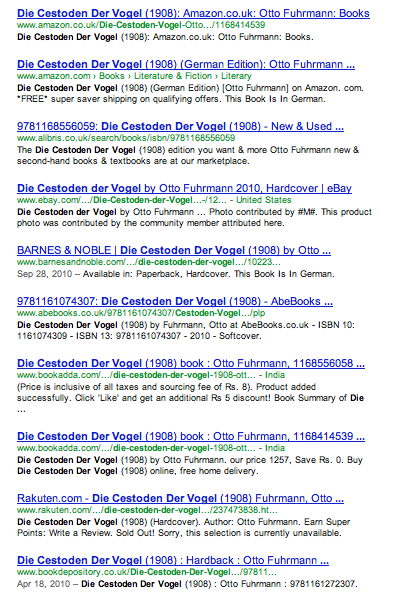
I spend a lot of time searching the web for bibliographic metadata and links to digitised versions of publications. Sometimes I search Google and get nothing, sometimes I get the article I'm after, but often I get something like this:

Google

If I search for Die cestoden der Vogel in Google I get masses of hits for the same thing from multiple sources (e.g., Google Books, Amazon, other booksellers, etc.). For this query we can happily click through pages and pages of results that are all, in some sense, the same thing. Sometimes I get the similar results when searching for an article, multiple hits from sites with metadata on that article, but few, if any with an actual link to the article itself.

One byproduct of putting bibliographic metadata on the web is that we are starting to pollute web space with repetitions of the same (or closely similar) metadata. This makes searching for definitive metadata difficult, never mind actually finding the content itself. In some cases we can use tools such as Google Scholar, which clusters multiple versions of the same reference, but Google Scholar is often poor for the kind of literature I am after (e.g., older taxonomic publications).

As Alan Ruttenberg (@alanruttenbergpoints out, books would seem to be a case where Google could extend its knowledge graph and cluster the books together (using ISBNs, title matching, etc.). But meantime if you think simply pumping out bibliographic metadata is a good thing, spare a thought for those of us trying to wade through the metadata soup looking for the "good stuff".

Friday, March 08, 2013

On Names Attribution, Rights, and Licensing of taxonomic names

Few things have annoyed be as much as the following post on TAXACOM:

The Global Names project will host a workshop to explore options and to make recommendations as to issues that relate to Attribution, Rights and Licensing of names and compilations of names. The aim of the workshop is a report that clarifies if and how we share names.

We seek submissions from all interested parties - nomenclaturalists, taxonomists, aggregators, and users of names. Let us know what (you think) intellectual property rights apply or what rights should be associated with names and compilations of names. How can those who compile names get useful attribution for names, and what responsibilities do they have to ensure that information is authoritative. If there are rights, what kind of licensing is appropriate.

Contributions can be submitted http://names-attribution-rights-and-licensing.wikia.com/wiki/Main_Page, where you will find more information about this event.

I'm trying to work out why this seemingly innocuous post made me so mad. I think this is because I think this fundamentally framing the question the wrong way. Surely the goal is to have a list of names that is global in scope, well documented, and freely usable by all without restriction? Surely we want open and free access to fundamental biodiversity data? In which case, can we please stop having meetings and get on with making this so?

If you frame the discussion as one of "Attribution, Rights and Licensing of names and compilations of names" then you've already lost sight of the prize. You've focussed on the presumed "rights" of name compilers instead.

I would argue that names compilations are somewhat overvalued. They are basically lists of names, sometimes (all to rarely) with some degree of provenance (e.g., a citation to the original use of the name). As I've documented before (e.g., More fictional taxa and the myth of the expert taxonomic database and Fictional taxa) entirely fictional can end up in taxonomic databases with alarming ease. So any claims that these are expert-curated lists should be taken with a pinch of salt.

Furthermore, it is increasingly easy to automate building these lists, given that we have tools for finding names in text, and an ever expanding volume of digitised text becoming available. Indeed, in an ideal world where all taxonomic literature was digitised much of the rationale for taxonomic name databases would disappear (in the same way that library card catalogues are irrelevant in the age of Google). We are fast approaching the point where we can do better than experts. To give just one example, in a recent BHL interview with Gary Poore it was stated that:

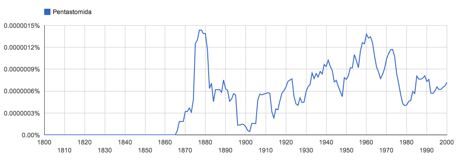
For example, the name widely used name Pentastomida itself was widely attributed to Diesing, 1836, but the word did not appear in the literature until 1905.


A quick check of Google Ngrams shows this to be simply false:

Pentastomida

I don't need taxonomic expertise to see this, I simply need decent text indexing. So, if you have a list of names, you have something that it will soon be largely possible to recreate using automated methods (i.e., text mining). With a little sophistication we could mine the literature for further details, such as synonymy, etc. Annotation and clarification of a few "edge cases" where things get tricky will always be needed, but if you want to argue that your lists deserves "Attribution, Rights and Licensing" then you fail to realise that your list is going to be increasing easy to recreate simply by crawling the web.

It seems to me that most taxonomic databases are little more than digitised 5x3 index cards, and lack any details on the provenance of the names they contain. They often don't have links to the primary literature, and if they do cite that literature they typically do so in a way that makes it hard to find the actual publication. I once gave a talk which included the slide below showing taxonomic databases as being "in the way" between taxonomists and users of taxonomic information:

Users

In the old days building taxonomic databases required expertise and access to obscure, hard to find, physical literature. A catalogue of names was a way to summarise that information (since we couldn't share access). Now we are in an age where more and more primary taxonomic information is available to all, which removes most of the rationale for taxonomic databases. Users can go directly to taxonomic information themselves, which mean they can get the "good stuff", and maybe even cite it (giving us provenance and credit, which I regard as basically the same thing). In many ways taxonomic databases are transitional phenomena (like phone directories, remember those), and one could argue are now in the way of the taxonomists' Holy Grail, getting their work cited.

Lastly, any discussion of "Attribution, Rights and Licensing of names and compilations of names" reflects one of the great self inflicted wounds of biodiversity informatics, namely the reluctance to freely share data. As we speak terrabytes of genomics data are whizzing around the planet, people are downloading entire copies of GenBank and creating new databases. All of this without people fussing over "Attribution, Rights and Licensing." It's time for taxonomic databases to get over themselves and focus on making biodiversity data as accessible and available as genomics data.

Friday, March 01, 2013

Why the ICZN is in trouble

There are many reasons why the International Commission on Zoological Nomenclature (ICZN) is in trouble, but fundamentally I think it's because of situation illustrated by following diagram.

ICZN
Based on an analysis of the Index of Organism Names (ION) database that I'm currently working on, there are around 3.8 million animal names (I define "animal" loosely, the ICZN covers a number of eukaryote groups), of which around 1.5 million are "original combinations", that is, the name as originally published. The other 2 million plus names are synonyms, spelling variations, etc.

Of these 3.8 million names the ICZN itself can say very little. It has placed some 12,600 names (around 0.3% of the total) on its Official Lists and Indexes (which is where it records decisions on nomenclature), and its new register of names, ZooBank, has less than 100,000 names (i.e., less than 3% of all animal names).

The ICZN doesn't have a comprehensive database of animal names, so it can't answer the most basic questions one might have about names (e.g., "is this a name?", "can I use this name, or has somebody already used it?", "what other names have people used for this taxon?", "where was this name originally published?", "can I see the original description?", "who first said these two names are synonyms?", and so on). The ICZN has no answer to these questions. In the absence of these services, it is reduced to making decisions about a tiny fraction of the names that are in use (and there is no database of these decisions). It is no wonder that it is in such trouble.

Friday, February 22, 2013

The end of names? ICZN in financial crisis

Science carries a news piece on the perilous state of the International Commission on Zoological Nomenclature (on Twitter as @ZooNom):

Pennisi, E. (2013). International Arbiter of Animal Names Faces Financial Woes. Science, 339(6122), 897–897. doi:10.1126/science.339.6122.897 (paywall)

Elizabeth Pennisi's article states:

A rose by any other name might still smell as sweet, but an animal with two scientific monikers can wreak havoc for researchers trying to study it. Since 1895, the International Commission on Zoological Nomenclature (ICZN) has helped ensure animal names are unique and long-lasting, with a panel of volunteer commissioners who maintain naming rules and resolve conflicts when they arise. But the U.K.-based charitable trust that supports all this is slated to run out of money before the year's end—and that could spell trouble. "If the trust ceases to exist it will be very difficult for the commissioners to do their work," says Michael Dixon, chair of the trust's board and director of the Natural History Museum in London. If ICZN disappeared "it would be something akin to anarchy in animal naming."

The sums of money are not huge:

The nonprofit organization that formed in 1947 to raise funds and administer the ICZN code and the journal—the International Trust for Zoological Nomenclature—has weathered other crises. But net income from its journal is only about $47,000 a year, and the trust's annual expenses now top $155,000. So reserves are about to be exhausted, Dixon says.

A few weeks ago, he sent an e-mail plea to directors of natural history museums around the world for emergency relief. In it, he proposed establishing a committee that would come up with a new financial model for the troubled organization. "This is not unlike GenBank," the database of genome sequences that receives government support, Coddington says. "It's the same distributed goods [situation], that everyone needs and nobody wants to pay for."

...

Dixon estimates the trust needs $78,000 or more to make it through the year. No single organization may be able to fund it long-term, but a network of 10 or 20 institutions might be able to kick in enough to sustain it, he says.

Maybe it's time for the ICZN to start a Jimmy Wales-style appeal, or take taxonomy to KickStarter.

Thursday, February 21, 2013

Why are botanists locking away their data in JSTOR Plant Science?

Goet008353Somehow I get the feeling that botanists haven't got the "open data" religion. Not only is the list of plant names list behind a really bad license, but the Global Plants Initiative (GPI) hides its type images behind a JSTOR Plant Sciences paywall. Why is botany determined to keep its data under wraps?

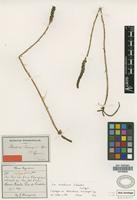
For example, the first specimen on the JSTOR site is the GOET008353, the isotype of Aa achalensis Schltr.. You can see a thumbnail of the specimen (shown on the right), but if you want the full image you need to have a subscription, otherwise you see this message:

The resource you are attempting to access is part of JSTOR Plant Science. JSTOR Plant Science is currently being offered free of charge for all JSTOR participants and not for profit institutions. To learn more about JSTOR Plant Science, please contact plants@jstor.org.


So, without a subscription you don't get to see this in high resolution (the JSTOR site features a higher resolution image and associated viewer):

Resolver

Why would herbariums hand over this imagery? I complained about this on Facebook and Chuck Miller responded that the original herbaria retain control over the images, so they aren't locked away. However, I then when to the herbarium that has this specimen (the Type Database of Herbarium Göttingen (GOET) and search for this specimen I eventually find it listed as 4966. There is no image!

So, the only place I can see this image is on JSTOR, for which I need a subscription. I'm also puzzled by the fact that JSTOR refers to this as "GOET008353", whereas the original herbarium refers to it as "4966". GBIF also has this specimen, which it refers to as GOET GOET-Typen 4966. The GOET008353 is a barcode given to types as part of the GPI digitisation programme. Unfortunately, neither the originating herbarium nor GBIF seems to know about this.

In summary, we have three databases with data on this specimen, each with a different specimen identifier, none of which link to each other, and the available imagery is behind a paywall.

Clearly botany hasn't gotten the memo about open data...

Thursday, February 14, 2013

Rate of description of new animal species and *that* Taxatoy graph

As part of the discussion on whether legacy biodiversity literature matters a graph from the following paper came up:

Sarkar, I., Schenk, R., & Norton, C. N. (2008). Exploring historical trends using taxonomic name metadata. BMC Evolutionary Biology, 8(1), 144. doi:10.1186/1471-2148-8-144


So, why is the Sarkar et al. graph bogus? Here is their graph (Fig. 3) for animals:

Taxatoy

This is the number of new animal species described each year, estimated by parsing taxonomic names and extracting the date in the taxonomic authority. There are two prominent "spikes" which are worrying. Sarkar et al. discuss the peak in 1994:

For example, the analyzed data indicate that a significant portion of the 1994 peak is due to an increase in descriptions of the family Cerambycidae, a large group of beetles.


So, 1994 was a bumper year for describing new species of Cerambycidae? Not quite. Taxatoy is based on names in uBio, and I have a local copy of most of these names. The Cerambycidae names contain lots of duplicate names that differ only in taxon authority. For example, searching the name Ancylocera macrotela on uBio finds:


Ancylocera macrotela
Ancylocera macrotela Aurivillius, 1912
Ancylocera macrotela BATES Henry Walter, 1880
Ancylocera macrotela Bates, 1880
Ancylocera macrotela Bates, 1885
Ancylocera macrotela Blackwelder, 1946
Ancylocera macrotela Chemsak & Linsley, 1970
Ancylocera macrotela Chemsak, 1963
Ancylocera macrotela Chemsak, 1964
Ancylocera macrotela Chemsak, Linsley & Mankins, 1980
Ancylocera macrotela Chemsak, Linsley & Noguera, 1992
Ancylocera macrotela Lameere, 1883
Ancylocera macrotela Maes & al., 1994
Ancylocera macrotela Monné & Giesbert, 1994
Ancylocera macrotela Monné, 1994
Ancylocera macrotela Noguera & Chemsak, 1996
Ancylocera macrotela Viana, 1971


These names are chresonyms. The original name is Ancylocera macrotela Bates, 1880 (you can see first publication of this name in BHL), the rest are subsequent citations of that name (gotta love taxonomy...).

Why the spike in 1994? I suspect that this is due to the publication in 1994 of "Checklist of the Cerambycidae and Disteniidae (Coleoptera) of the Western Hemisphere" by Miguel A Monné and Edmund F Giesbert. At least 8552 names from that checklist seem to have ended up in uBio, all with the date "1994". So the spike is an artefact. Similarly, the other peak (1912) corresponds to the publication of a checklist by Per Olof Christopher Aurivillius, which contributes over 3000 names.

One reason I was suspicious of the Taxatoy graph is that it doesn't look anything like the equivalent graph from the Index of Organism Names. After a bit of fussing I've grabbed data from the ION site, and from Taxatoy's Google Code repository and created the following chart:

Taxatoy version2

The data for this chart is on figshare http://dx.doi.org/10.6084/m9.figshare.156862. ION is an index of all new animal names, based on Zoological Record. I place more confidence in its data than data derived from uBio, but it clearly ION has its own issues (such as the gap after 1850, and the uneven sampling of the early years of taxonomy). The key point is that arguments on the temporal distribution of taxonomic descriptions (and the value of legacy literature) need to be aware that the data used is in pretty poor shape.

Update 2013-02-23
Jose Antonio Gonzalez Oreja pointed out in an email that the values for ION that I used were a little higher than those that appear on the ION web site. My script for retrieving those values hadn't quite worked. I've uploaded the corrected data to Figshare http://dx.doi.org/10.6084/m9.figshare.156862, updated the diagram above, and put the web calls I used to fetch the data on GitHub https://gist.github.com/rdmpage/5019153. The story doesn't change, but it helps to have the correct data.

Does the legacy biodiversity literature matter?

I've just come back from a pro-iBiosphere Workshop at Leiden where the role of "legacy literature" became the subject of some discussion. This continued on Twitter as Ross Mounce (@rmounce) and I went back and forth:
Ross was wondering whether we should invest much effort in extracting information from legacy literature, suggesting that this literature was of most interest to taxonomists, whereas other biologists will be more likely to find what they want from ever growing recent literature. I was arguing that because many taxa are poorly studied, the chances that you will find data on your organism in the recent literature is likely to be low, unless you study an economically or medically important taxon, or a model organism (many of which fit first categories). My view is based on papers such as Bob May's 1988 paper:
MAY, R. M. (1988). How Many Species Are There on Earth? Science, 241(4872), 1441-1449. doi:10.1126/science.241.4872.1441
In table 3 May lists the average number of papers per species in the period 1978-1987 across various taxonomic groups. Mammals averaged 1.8 papers per species, beetles averaged 0.01. This means that if you study a beetle species you have a 1/100 chance (on average) of finding a paper on your species in any given year (assuming all beetles are equal, which is clearly false). At this point perhaps we should define "legacy literature". In many ways the issue is not so much the age of the literature, but whether the literature was "born digital", that is, whether from it's authoring to publication the document has been in digital form, so the output is in a format (e.g., HTML, XML, or PDF that contains the document text) from which we can readily extract and mine the text. In contrast, documents that have been digitised from a physical medium (e.g., scans of pages) are less tractable because the text has to be extracted by OCR, and error-prone process. Given these errors is the effort worth it. At this point I should say that BHL is not using the best OCR technology available (my own experience suggests that ABBYY Online is much better), and our community is not making use of research on automating OCR correction). But the question is worth asking. In an effort to answer it, I've done a quick analysis of the PanTHERIA database:
Jones, K. E., Bielby, J., Cardillo, M., Fritz, S. A., O Dell, J., Orme, C. D. L., & Purvis, A. (2009). PanTHERIA: a species-level database of life history, ecology, and geography of extant and recently extinct mammals. (W. K. Michener, Ed.)Ecology, 90(9), 2648-2648. doi:10.1890/08-1494.1
PanTHERIA is a database assembled by Kate Jones (@ProfKateJones) and colleagues for comparative biologists (not taxonomists), and collects fundamental biological data about the best studied animal group on the planet (see May's paper above). In the metadata for the database there is a list of the 3143 publications they consulted to populate the database. Below is a table showing the distribution of the year in which these publications appeared:

Decade startingPublications
18401
18601
18901
190010
19104
192014
193048
194061
1950114
1960295
1970527
1980865
19901019
2000183
Pantheria The bulk of the papers came from the second half of the 20th century, and many of these are "legacy" in the sense that they are in archives like JSTOR, and hence the PDFs are based on scanned images and OCR. The oldest papers are from the 19th century, which is legacy by anyone's definition. My interpretation of this data is that even for a well-studied group such as mammals, the basic organismal-level data sought by comparative biologists is in the "legacy" literature. My suspicion is that if we attempt to build PanTHERIA-style databases for other, less well-studied taxa, the data (if it exists at all) will be found not in the modern literature (where the focus has long since moved on from the organism to genomics and system biology) but in the corpus of taxonomic and ecological literature that are being scanned and stored in digital archives.

Update
I've put the articles cited as data sources by the PanTHERIA database in a Mendeley group.