Showing posts sorted by relevance for query bhl. Sort by date Show all posts

Friday, April 11, 2025

Future interfaces for the Biodiversity Heritage Library

On Wednesday this week (April 9th, 2025) I gave a talk entitled “Future interface(s) for BHL” (the slides are on FigShare) at BHL Day 2025. My goal was to introduce “BHL-Light”, an exploration of an alternative interface to the Biodiversity Heritage Library (BHL). As some readers may already know, BHL is coming to a crossroads, and so this presentation felt a bit more urgent than my usual “here’s yet another web site I made”.

BHL-Light

BHL-Light is my attempt to explore other ways of navigating BHL. The current interface is somewhat dated, and I wanted to start from scratch and see what might be possible to create, even for someone with my somewhat limited skills. BHL-Light has only a very small subset of BHL’s content, I’m putting scalability issues to one side so that I can have some fun.

The tech (TL;DR BHL was not harmed in the making of this)

Under the hood, BHL-Light stores BHL metadata, OCR text, and layout information as JSON documents in CouchDB (one of my favourite databases for exploring new ideas).

BHL serves its images from Internet Archive, which is not always available. BHL recently uploaded images to AWS, but the images there are not currently viewable on the web. So I ended up creating my own image server. I used Hetzner’s S3-compatible object storage for the image files, added imgproxy to resize images as needed, and finally put all this behind a Cloudflare CDN to speed up image delivery (and reduce traffic to the S3 store, which becomes a real consideration when one is paying for all of this).

To view BHL content (e.g., books, journal volumes) I wrote my own viewer, modelled loosely on Google Books. I expressly wanted to avoid IIIF because I find IIIF viewers a terrible way to view documents, and for me BHL is all about the text.

The web site itself is a few PHP scripts to glue everything together, and I’ve tried to avoid using Javascript unless absolutely necessary. HTML + CSS is really powerful these days, so you can do a lot without resorting to Javascript.

Tour

In building BHL-Light I’ve wanted a simple interface to concentrate on displaying content as much as possible. I also wanted a cleaner interface, one that is responsive (AKA "mobile friendly").

BHL has some extraordinary content. It has works both old and new.

Text

The viewer I built makes it easy to scroll through an item, and also makes text selectable (something you currently can’t do in BHL. This means you can interact with text in the browser, such as using Google Chrome to translate part of the text.

It also opens up the possibility of annotation using Hypothes.is.

Geotagging and maps

I also demonstrated pages that had been geotagged. These tags can be extracted and used to create an interactive map.

I still haven’t decided on the best way to interact with the map. For example, should we use the map to search for content geographically, or should we search for content and display those results on a map, or both? I ran out of time to resolve this, so for now if you click on the map you see a H3 hexagon that encloses where you click. The idea is that then the page would display BHL content within that area. Other idea ideas include something like Frankenplace or JournalMap.

Document layout

For me one of the most exciting areas for the future is adding document layout information to BHL content, such that not only can we identify articles, but figures, tables, references, etc. In this way BHL could finally offer something akin to what Plazi can deliver: structured text about species. This has seemed a challenging task, but recent AI developments have been a game changer. In particular, Datalab have released powerful and simple-to-use tools that do a very good job of retrieving document structure from scanned pages. I have started to use this on BHL content and display the results on BHL-Light. For example, Datalab makes it almost trivial to identify and extract figures from scanned pages. Below is a comparsion of document layout for a page as inferred from a born-digital PDF by Plazi, and the same page in BHL where it is simply an image, but Datalab's methods have inferred which bits are text, figures, captions, etc.

One unexpected consequence of building my own image server (see above) is that the task of displaying figures by cropping page images becomes almost trivial. This idea was inspired in part by Smits et al.’s approach of cropping Internet Archive images.

What’s next?

There is much to do. BHL-Light is missing many features. It doesn’t make it easy to find content such as articles found by BioStor, the project I started over a decade ago to find articles in BHL. Search is rudimentary at best, and I haven’t tackled taxonomic names yet (but have ideas for this).

For me BHL-Light is a fun way to explore BHL, and its development has made me even more aware of all the work done to create the current and maintain the BHL portal. Apart from being a play thing for me, I am curious as to whether BHL-Light might be a way to have “BHL-mini” portals, rather like GBIF hosted portals. In this way, we could have views of BHL focused on a particular taxon, institution, person, etc., or localised by language and/or country. Perhaps we could de-extinct past projects such as BHL-Europe?

References

Page, R.D. Extracting scientific articles from a large digital archive: BioStor and the Biodiversity Heritage Library. BMC Bioinformatics 12, 187 (2011). https://doi.org/10.1186/1471-2105-12-187

Page, Roderic (2025). Future interface(s) for BHL. figshare. Presentation. https://doi.org/10.6084/m9.figshare.28777868.v1

Smits, T., Warner, B., Fyfe, P., & Lee, B. C. G. (2025). A Fully-Searchable Multimodal Dataset of the Illustrated London News, 1842–1890. Journal of Open Humanities Data, 11(1), 10. https://doi.org/10.5334/johd.284

Written with StackEdit.

Wednesday, April 16, 2014

Breaking the Biodiversity Heritage Library

The Biodiversity Heritage Library (BHL) has recently introduced a feature that I strongly dislike. The post describing this feature (Inspiring discovery through free access to biodiversity knowledge... states:

Now BHL is expanding the data model for its portal to be able to accommodate references to content in other well-known repositories. This is highly beneficial to end users as it allows them to search for articles, alongside books and journals, within a single search interface instead of having to search each of these siloes separately.

What this means is that, whereas in the past a search in BHL would only turn up content actually in BHL, now that search may return results from other sources. What's not to like? Well, for me this breaks the fundamental BHL experience that I've come to rely on, namely:

If I find something in BHL I can read it there and then

With the new feature, the search results may include links to other sources. Sometimes these are useful, but sometimes they are anything but. Once you start including external links in your search results, you have limited control over what those links point to. For example, if I search BHL for the journal Revista Chilena de Historia Natural I get two hits. Cool! So I click on one hit and I can read a fairly limited set of scanned volumes in BHL, if I click on the other hit I'm taken to a page at the Digital Library of the Real Jardín Botánico of Madrid. This is a great resource, but the experience is a little jarring. Worse, for this journal the Real Jardín Botánico doesn't actually have any content, instead the "View Book" link takes me to SciElo in Chile, where I can see a list of recent volumes of this journal.

In this case, BHL is basically a link farm that doesn't give me direct access to content, but instead sends me on a series of hops around the Internet until I find something (and I could have gotten there more quickly via Google).

What is wrong with this?


There are two reasons I dislike what BHL have done. The first is that it breaks the experience of search then read within a consistent user interface. Now I am presented with different reading experiences, or, indeed, no reading at all, just links to where I might find something to read.

More subtlety, it undermines a nice feature of BHL, namely searching by taxonomic names. The content BHL has scanned has also been indexed by taxonomic name, so often I find what I'm looking for not by using bibliographic details (journal name, volume, etc.), which are often a bit messy, but by searching on a name. External content has not been indexed by name, so it can't be found in this way. Whereas before, if I search by name I would be reasonably confident that if BHL had something on that name I could find it (barring OCR errors), now BHL may well have what I looking for (in an external source) but can't show me that because it hasn't been indexed.

From my perpsective, the things I've come to rely on have been broken by this new feature (and I haven't even begun to talk about how this breaks things I rely on to harvest BHL for article metadata, which I then put into BioStor, which in turn gets fed back into BHL).

What should BHL have done?


To be clear, I'm not arguing against BHL being "able to accommodate references to content in other well-known repositories". Indeed, I'd wish they'd go further and incorporate content from BHL-Europe, whose portal is, frankly, a mess. Rather, my argument is that they should not have done this within the existing BHL portal. Doing so dilutes the fundamental experience of that portal ("if I find it I can read it").

Here's what I would do instead:
  1. Keep the current BHL portal as it was, with only content actually scanned and indexed by BHL.
  2. Create a new site that indexes all relevant content (e.g., BHL, BHL-Europe, and other repositories.
  3. Model this new portal on something like CrossRef's wonderful metadata search. That is, throw all the metadata into a NoSQL database, add a decent search engine, and provide users with a simple, fast tool.
  4. The portal should clearly distinguish hits that are to BHL content (e.g. by showing thumbnails) and hits that are to external links (and please filter links to links!).
  5. Add taxonomic names to the index (you have these for BHL content, adding them for external content is pretty easy).
  6. Even more useful, start indexing full text content, maybe starting at articles ("parts"). At the moment Google is doing a better job of indexing BHL content (indirectly via indexing Internet Archive) than BHL does.

Creating a new tool would also give BHL the freedom to explore some new approaches without annoying users like me who have come to rely on the currently portal working in a certain way. Otherwise BHL risks "feature creep", however well motivated.

Tuesday, July 02, 2024

A future for the Biodiversity Heritage Library

How to cite: Page, R. (2024). A future for the Biodiversity Heritage Library https://doi.org/10.59350/n3dkt-6xd05

Following the 2024 BHL meeting, and the departure of Martin Kalfatovic and the uncertainty the departure of such a pivitol person brings, perhaps it’s time to think about the future of BHL. Below I sketch some thoughts, which are hazy at best. I should say at the outset that I think BHL is an extraordinary project. My goal is to think about ways to enhance its utility and impact.

Three facets

I think BHL, in common with other projects such as GBIF, has three main facets: providers, users, and developers. These communities have different needs, and what works for one community need not work for the others.

Providers

Any project that mobilises data depends on people and organisations that have that data being willing to share it. That community needs a rationale for sharing, tools to share, and a means to demonstrate the value of sharing. The few BHL meetings I’ve been to have been dominated by libraries (it is a library project, after all). BHL meetings typically feature a tour of physical libraries where we gaze at ancient books, many of which are now accessible via the BHL website. There is value in being a member of a club that shares similar goals (making biodiversity literature accessible to a wider audience). From my perspective, a lot of BHL effort and infrastructure is focussed on libraries and library-related tasks. This is natural given its origins, but this means other aspects have been neglected.

Users (readers and more)

BHL users are likely diverse, and range from people like me who want the “hard core” technical literature (e.g., species descriptions) to people who revel in the wealth of imagery available in BHL (AKA “the pretty”) (see the BHL Flickr pages).

The current BHL portal provides a way for people to browse the scanned content, but feels designed primarily for librarians. It is organised by title and scanned volumes, hence it is driven by bibliographic metadata. For a long time, it didn’t support the notion of an “article”, which is why I ended up building BioStor to extract and display individual articles (the unit most academics work with). BHL is now actively adding articles and minting DOIs for articles, which helps embed its content in the wider scholarly landscape. To date these new DOI have been cited 56,000 times.

But the current BHL interface is not ideal for viewing articles. We need something simpler and cleaner, and more like the experience offered by modern journal websites.

Developers and data wranglers

I’m lumping developers and data wranglers together, even though these people may have different goals, they share the desire to get past the web interface to the underlying data. BHL has some great APIs that I and others make extensive use of. But this is different from providing a clean interface to the data. BHL has a wealth of information linked to taxonomic names, people, places, and more. Taxonomic indexing by Global Names has made BHL content much more findable, but there is huge scope for indexing on other features. For example, BioStor extracts latitude and longitude pairs from BHL text. These are shown on the map below, indicating the scope for geographic search in BHL.

What’s next?

I think there’s a case to be made to provide three separate interfaces to BHL.

The first would be for the providers (e.g., libraries), which includes all the behind the scenes infrastructure to do with cataloging, etc., and would also include the current portal. The existing BHL interface is important both to show the complete corpus, and also as a place for serendipitous discovery.

The second interface would be for readers. The obvious candidate here is Open Journal Systems (OJS) which powers many journal sites, including Zootaxa, by far the largest taxonomic journal. Indeed I would argue that BHL should adopt OJS and offer it as a service to existing biodiversity journals that may be struggling to manage their existing publishing. Taxonomic publishing has a very long tail of small journals, as the figure below shows (taken from DNA barcoding and taxonomy: dark taxa and dark texts).

This long tail is often hosted on all manner of custom web sites including Word Press blogs, none of which are ideal. There is an opportunity here for BHL to offer hosting as a, for example, an affordable service, using the same OJS infrastructure it would use to display BHL articles.

The final interface would be a data portal. The goal here is to enable people to retrieve data in ways that they find useful, for example by taxon, geographic location, etc. In an ideal world this might be a knowledge graph, but the gap between what knowledge graphs promise and what they deliver is still significant. As a first pass, probably the way forward is to define a series of simple data objects in JSON, load these into Elasticsearch and provide an API on top. This is essentially what GBIF does, where the data is in Darwin Core and the queries are searches over that data. This same infrastructure could also power searches over the articles in OJS, so that users could easily find the content they want.

This is all pretty arm-wavy at this point, but I think BHL needs to be more outwards facing than it currently is, and needs to think how best to serve the biodiversity community (many of which are already huge fans of BHL), as well as think of ways to enhance its long term sustainability.

Written with StackEdit.

Wednesday, December 24, 2014

I'm worried about the Biodiversity Heritage Library (BHL)

BHL Small LogoOne of my guilty pleasures on a Sunday morning is browsing new content on the Biodiversity Heritage Library (BHL). Indeed, so addicted am I to this that I have an IFTTT.com feed set to forward the BHL RSS feed to my iPhone (via the Pushover app. So, when I wake most Sunday mornings I have a red badge on Pushover announcing fresh BHL content for me to browse, and potentially add to BioStor.

But lately, there has been less and less content that is suitable for BioStor, and this reflects two trends that bother me. The first, which I've blogged about before, is that an increasing amount of BHL content is not hosted by BHL itself. Instead, BHL has links to external providers. For the reasons I've given earlier, I find this to be a jarring user experience, and it greatly reduces the utility of BHL (for example, this external content is not taxonomically searchable).

The other trend that worries me is that recently BHL content has been dominated by a single provider, namely the U.S. Department of Agriculture. To give you a sense of how dominant the USDA now is, below is a chart of the contribution of different sources to BHL over time.

Chart annotated

I built this chart by querying the BHL API and extracting data on each item in BHL (source code and raw data available on github). Unfortunately the API doesn't return information on what each item was scanned, but because the identifier for each item (its ItemID) is an increasing integer, if we order the items by their integer ID then we order them by the date they were added. I've binned the data into units of 1000 (in other words, every item with an ItemID < 1000 is in bin 0, ItemIDs 1000 to 1999 are in bin 1, and so on). The chart shows the top 20 contributors to BHL, with the Smithsonian as the number one contributor.

The chart shows a number of interesting patterns, but there are a couple I want to highlight. The first is the noticeable spikes representing the addition of externally hosted material (from the American Museum of Natural History Library and the Biblioteca Digital del Real Jardin Botanico de Madrid). The second is the recent dominance of content from the USDA.

Now, to be fair, I must acknowledge that I have my own bias as to what BHL content is most valuable. My own focus is on the taxonomic literature, especially original descriptions, but also taxonomic revisions (useful for automatically extracting synonyms). Discovering these in BHL is what motivated me to build BioStor, and then BioNames, the later being a database that aims to link every animal taxon name to its original description. BioNames would be much poorer if it wasn't for BioStor (and hence BHL).

If, however, your interest is agriculture in the United States, then the USDA content is obviously a potential goldmine of information on topics such as past crop use, pricing policies, etc. But this a topic that is both taxonomically narrow (economically important organisms are a tiny fraction of biodiversity), and, by definition, geographically narrow.

To be clear, I don't have any problem with BHL having USDA content as such, it's a tremendous resource. But I worry that lately BHL has been pretty much all USDA content. There is still a huge amount of literature that has yet to be scanned. I'd like to see BHL actively going after major museums and libraries that have yet to contribute. I especially want to see more post-1923 content. BHL has managed to get post-1923 content from some of its contributors, it needs a lot more. On obvious target is those institutions that signed the Bouchout Declaration. If you've signed up to providing "free and open use of digital resources about biodiversity", then let's see something tangible from that - open up your libraries and your publications, scan them, and make them part of BHL. I'm especially looking at European institutions who (with some notable exceptions) really should be doing a lot better.

It's possible that the current dominance of USDA content is a temporary phenomenon. Looking at the chart above, BHL acquires content in a fairly episodic manner, suggesting that it is largely at the mercy of what its contributors can provide, and when they can do so. Maybe in a few months there will be a bunch of content that is taxonomically and geographically rich, and I will be spending weekends furiously harvesting that content for BioStor. But until then, my Sundays are not nearly as much fun as they used to be.

Tuesday, September 13, 2011

More BHL app ideas

Hero rosellasFollowing on from my previous post on BHL apps and a Twitter discussion in which I appealed for a "sexier" interface for BHL (to which @elywreplied that is what BHL Australia were trying to do), here are some further thoughts on improving BHL's web interface.
Build a new interface
A fun project would be to create a BHL website clone using just the BHL API. This would give you the freedom to explore interface ideas without having to persuade BHL to change its site. In a sense, the app would be provide the persuasion.

Third party annotations
It would be nice if the BHL web site made use of third party annotations. For example, BHL itself is extracting some of the best images and putting them on Flickr. How about if you go to the page for an item in BHL and you see a summary of the images from that item in Flickr? At a glance you can see whether the item has some interesting content. For example, if you go to http://biodiversitylibrary.org/item/109846 you see this:

N2 w1150

which gives you no idea that it contains images like this:

n24_w1150Tables of contents
Another source of annotations is my own BioStor project, which finds articles in scanned volumes in BHL. If you are looking at an item in BHL it would be nice to see a list of articles that have been found in that item, perhaps displayed in a drop down menu as a table of contents. This would help provide a way to navigate through the volume.

Who links to BHL?
When I suggested third party annotations on Twitter @stho002chimed in asking about Wikispecies, Species-ID, ZooBank, etc. These resources are different, in that they aren't repurposing BHL content but are linking to it. It woud be great if a BHL page for an item could display reverse links (i.e., the pages in those external databases that link to that BHL item).

Implementing reverse links (essential citation linking) can be tricky, but two ways to do it might be:
  1. Use BHL web server logs to find and extract referrals from those projects
  2. Perhaps more elegantly, encourage external databases to link to BHL content using an OpenURL which includes the URL of the originating page. OpenURL can be messy, but especially in Mediawiki-based projects such as Wikispecies and Species-ID it would be straightforward to make a template that generated the correct syntax. In this way BHL could harvest the inbound links and display them on the item page.


Friday, March 19, 2010

Where next for BHL?

You can't just ask customers what they want and then try to give that to them. By the time you get it built, they'll want something new. - Steve Jobs

It's Friday, so time for either a folly or a rant. BHL have put another user survey into the field http://www.surveymonkey.com/s/BHLsurvey. I loathe user surveys. They don't ask the questions I would ask, then when you see the results, often the most interesting suggestions are ignored (see the Evaluation of the User Requirement Survey Oct-Nov 2009). And we've been here before, with EDIT (see this TAXACOM message about the moribund Virtual Taxonomic Library). Why go to the trouble of asking users if you aren't going to deliver?

I suspect surveys exist not to genuinely help figure out what to do, but as an internal organisational tool to convince programmers what needs to be done, especially in large, multinational consortia where the programmers might be in a different institution, and don't have any particular vested interest in the project (if they did, they wouldn't need user surveys, they'd be too busy making stuff to change the world).

So, what should BHL be doing? There's lots of things to do, but for me the core challenges are findability and linkage. BHL needs to make its content more findable, both in terms of bibliographic metadata and search terms (e.g., taxa, geographic places). It also needs to be much more strongly linked, both internally (e.g., cross referencing between articles where one BHL article cites another BHL article), and externally (to the non-BHL literature, for example, and to nomenclators), and the external links need to be reciprocal (BHL should link to nomenclators, and nomenclators should point back to BHL).

There are immediate benefits from improved linkage. Users could navigate within BHL content by citation links, for example, in the same way we can in the recent literature. If BHL cleaned up its metadata and had a robust article-level OpenURL resolver it could offer services to publishers to add additional links to their content, driving traffic to BHL itself. Better findability leads to better links.

One major impediment to improving things is the quality of the OCR text extracted from BHL scans. There have been various automated attempts to extract metadata from OCR scans (e.g., "A metadata generation system for scanned scientific volumes" doi:10.1145/1378889.1378918), but these have met with mixed success. There's a lot of scope for improving this, but I suspect a series of grad student theses on this topic may not be the way forward (grad students rarely go all the way and develop something that can be deployed). Which leaves crowd sourcing. Given the tools already available for correcting Internet Archive-derived book scans (e.g., Wikisource discussed in an earlier post), it seems to me the logical next move for BHL is to dump all their content into a Wikisource-style environment, polish the tools and interface a bit, and encourage the community to have at it. Forming and nurturing that community will be a challenge, but providing BHL can demonstrate some clear benefits (e.g., generating clean pages with new taxon names, annotated illustrations, OpenURL tools for publishers to use), then I think the task isn't insurmountable. It just needs some creativity (e.g., why not engage EOL users who land on BHL content to go one step further and clean it up, or link with Wikipedia and Wikispecies to attract users interested in actively contributing?).

I doubt any of this will be in any user survey...

Tuesday, July 17, 2012

Building a BHL Africa: BHL in a box

Was going to post this as a comment on the BHL blog but they use Blogger's native comment system, which is horrible, and it refused to accept my comment (yes, yes, I'm sure it did that on grounds of taste). I read the recent post Building a BHL Africa and couldn't believe my eyes when I read the following:

the "BHL in a Box" concept was highly desired. This would entail creating interactive CDs of BHL content for distribution in areas where internet access is unreliable or unavailable.
CDs! Really? Surely this is crazy!?. You want to use an obsolete technology that require additional obsolete technology to ship BHL around Africa? Why not ship relevant parts of BHL on iPads? Lots more storage space than CDs, built-in interactivity (obviously need to write an app, but could use HTML + Javascript as a starting point), long battery life, portable, comes with 3G support if needed. I'll be the first to admit that my knowledge of Africa is about zero, but given that mobile devices are common, mobile networks are fairly well developed, and tablets are making inroads (see iPad has become a big factor in African business) surely "BHL mobile" is the way to go to provide "BHL in a box", not CDs.

Why not develop an app that stores BHL content on a device like an iPad, then distribute those? Support updating the content over the network so the user isn't stuck with content they no longer need. In effect, something like Amazon's Kindle app or iBooks would do the trick. You'd need to compress BHL content to keep the size down (the images BHL currently displays on its web site could be made a lot smaller) but this is doable. Indeed, the BHL Africa could be an ideal motivation to move BHL to platforms such as phones and tablets, where at the moment users have to struggle with a website that makes no concessions to those devices.

Postscript
Of course, it doesn't have to be the iPad as such. Imagine if BHL published books and articles on Amazon, then used Kindle to deliver content physically (i.e., ship Kindles), and anyone else could access it directly from Amazon using their Kindle (or Kindle app on iPad).

Thursday, May 26, 2016

Thoughts on Wikipedia, Wikidata, and the Biodiversity Heritage Library

Given that Wikipedia, Wikidata, and the Biodiversity Heritage Library (BHL) all share the goal of making information free, open, and accessible, there seems to be a lot of potential for useful collaboration. Below I sketch out some ideas.

BHL as a source of references for Wikipedia

Wikipedia likes to have sources cited to support claims in its articles. BHL has a lot of articles that could be cited by Wikipedia articles. By adding these links, Wikipedia users get access to further details on the topic of interest. BHL also benefits from greater visibility resulting from visits from Wikipedia readers.

In the short term BHL could search Wikipedia for articles that could benefit from links to BHL (see below). In the long term as more and more BHL articles get DOIs this will become redundant as Wikipedia authors will discover articles via CrossRef.

There are various ways to search Wikipedia to get a sense of what links could be added. For example, you can search the Wikipedia API for pages that link to a particular web domain (see https://www.mediawiki.org/wiki/API:Lists/All#Exturlusage). Here's a search for articles linking to biostor.org https://en.wikipedia.org/w/api.php?action=query&list=exturlusage&euquery=biostor.org&eulimit=20.

A quick inspection suggests that many of these links could be improved (for example, some have outdated links to PDFs and not to the article), so we can locate Wikipedia articles that could be edited. It is likely that Wikipedia articles that have one link to BHL or BioStor may have other citations that could be linked.

Wikipedia as a source of content

One of the big challenges facing BHL is extracting articles from its content. My own BioStor is one approach to tackling this problem. BioStor takes citation details for articles and attempts to locate them in BHL - the limiting factor is access to good-quality citation data. Wikipedia is potentially an untapped source of citation data. Each page that uses the "Cite" template could be mined for citations, which in turn could be used to locate articles. Wikipedia pages using the Cite template can be found via the API, e.g. https://en.wikipedia.org/w/api.php?action=query&list=embeddedin&eititle=Template:Cite&eilimit=20&format=json. Alternatively, we could mine particular types of pages (e.g., those on taxa or taxonomists), or mine Wikispecies (which doesn't use the same citation formatting as Wikipedia).

Wikidata as a data store

If Wikidata aims to be a repository of all structured data relevant to Wikipedia, then this includes bibliographic citations (see WikiCite 2016 ), hence many articles in BHL will end up in Wikidata. This has some interesting implications, because Wikidata can model data with more fidelity than many other sources of bibliographic information. For example, it supports multiple languages as well as multiple representations of the sample language - the journal Acta Herpetologica Sinica https://www.wikidata.org/wiki/Q24159308 in Wikidata has not only the Chinese title (兩棲爬行動物學報) but the pinyin transliteration "Liangqi baxing dongwu yanjiu". Rather than attempt to replicate a community-editable database, Wikidata could be the place to manage article and journal-related metadata.

Disambiguating people

As we move from "strings to things" we need to associate names for things with identifiers for those things. I've touched on this already in Possible project: mapping authors to Wikipedia entries using lists of published works. Ideally each author in BHL would be associated with a globally unique identifier, such as ORCID or ISNI. Contributors to Wikipedia and Wikidata have been collecting these for individuals with Wikipedia articles. If those Wikipedia pages have links to BHL content then we can semi-automate the process of linking people to identifiers.

Caveats

There are a couple of potential "gotchas" concerning Wikipedia and BHL. The licenses used for content are different, BHL is typically CC-BY-NC whereas Wikipedia is CC-BY. The "non commercial" restriction used by BHL is a deal-breaker for sharing content such as page images with Wikicommons.

Wikipedia and Wikidata are communities, and I've often found this makes it challenging to find out how to get things done. Who do you contact to make a decsioon about some new feature you'd like to add? It's not at all obvious (unless you're a part of that community). Existing communities with accepted practices can be resistant to change, or may not be convinced that what you'd like to do is a benefit. For example, I think it would be great to have a Wikipedia page for each journal. Not everyone agrees with this, and one can expend a lot of energy debating the pros and cons. The last time I got seriously engaged with Wikipedia I ended up getting so frustrated I went off in a huff and built my own wiki. This is where a "Wikipedian in residence" might be helpful.

Wednesday, September 30, 2009

Visualising the Biodiversity Heritage Library as a Timeline

bhlstrip.pngOne thing about the Encyclopedia of Life which bugs me no end is the awful way it displays the bibliography generated from the Biodiversity Heritage Library (BHL). The image on the right shows the bibliography for the frog Hyla rivularis Taylor, 1952. It's one long, alphabetical list of pages. How can a user make sense of this? It's even more annoying because the BHL is one of the cornerstones of EOL, and one could argue that BHL content is one of the few thing pages EOL offer that distinguishes them from cheap and cheerful mashups such as iSpecies. Can't we do something a little better?

BHL has an API (documented here), so I decided to experiment. As I mentioned in an earlier post (Biodiversity Heritage Library, Google books, and metadata quality), a key piece of metadata about a bibliographic reference is its date. This is especially so for the taxonomic literature, where the earliest reference that contains a name may (depending on how complete BHL scanning is) be the first description of that name. So, it would be nice to order the BHL bibliography by date. Turns out it's possible to get dates from quite a few BHL items, providing one fusses with regular expressions long enough.

So, in principle we could sort BHL content by dates. But, we could go one better and visualise them. As an experiment, I've put together a demo that uses the SIMILE Timeline widget to display the BHL bibliography for a taxon. Here's a screenshot of the bibliography for Hyla rivularis:
bhltimeline.png


You can generate others at http://bioguid.info/bhl/. The demo has been thrown together in haste, but here's what it does:
  1. Takes a taxon name and tries to find it in uBio. This gives us the NamebankID BHL needs
  2. Calls the BHL API and retrieves the bibliography for the NamebankID found in step 1
  3. Parses the BHL result, trying to extract dates (often the dates are ranges, e.g. 1950-1955)
  4. The previous step generates a JSON document which can be displayed by Timeline

If you click on an item you get a list of pages, clicking on any those takes to you to the page in BHL. Items that have a range of dates are displayed as horizontal lines, items with a well-defined date are shown as points. Note that my code for working out the date of an item will probably fail on some items, and some items don't have any dates at all. Hence, not every item in BHL will appear in the timeline.

It would be nice to embellish the results a little (for example, group pages into articles, refine the dates, etc.) but I think this goes a little way to demonstrating what can be done. We could also add articles obtained from other sources (e.g., Google Scholar, PubMed) to the same display, providing an overview of published knowledge about a taxon.

Monday, August 10, 2015

Demo of full-text indexing of BHL using CouchDB hosted by Cloudant

One of the limitations of the Biodiversity Heritage Library (BHL) is that, unlike say Google Books, its search functions are limited to searching metadata (e.g., book and article titles) and taxonomic names. It doesn't support full-text search, by which I mean you can't just type in the name of a locality, specimen code, or a phrase and expect to get back much in the way of results. In fact, in many cases when I Google a phrase that occurs in BHL content I'm more likely to find that phrase in content from the Internet Archive, and then it's a matter of following the links to the equivalent item in BHL.

So, as an experiment I've created a live demo of what full-text search in BHL could look like. I've done this using the same infrastructure the new BioStor is built on, namely CouchDB hosted by Cloudant. Using BHL's API I've grabbed some volumes of the British Ornithological Club's Bulletin and put them into CouchDB (BHL's API serves up JSON, so this is pretty straightforward to do). I've added the OCR text for each page, and asked Cloudant to index that. This means that we can now search on a phrase in BHL (in the British Ornithological Club's Bulletin) and get a result.

I've made a quick and dirty demo of this approach and you can see it in the "Labs" section on BioStor, so you can try it here. You should see something like this:

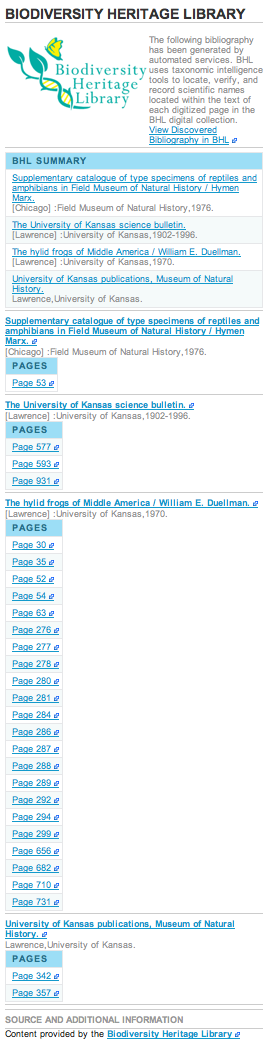
Bhl couchdb The page image only appears if you click on the blue labels for the page. None of this is robust or optimised, but it is a workable proof-of-concept of how fill-text search could work.
What could we do with this? Well, all sorts of searches are no possible. We can search for museum specimen codes, such as 1900.2.27.13. This specimen is in GBIF (see http://bionames.org/~rpage/material-examined/www/?code=BMNH%201900.2.27.13) so we could imagine starting to link specimens to the scientific literature about that specimen. We can also search for locations (such as Mt. Albert Edward), or common names (such as crocodile).

Note that I've not completed uploading all the page text and XML. Once I do I'll have a better idea of how scalable this approach is. But the idea of having full-text search across all of BHL (or, at least the core taxonomic journals) is tantalising.

Technical details

Initially I simply displayed a list of the pages that matched the search term, together with a fragment of text with the search term highlighted. Cloudant's version of CouchDB provides these highlights, and a "group_field" that enabled me to group together pages from the same BHL "item" (roughly corresponding to a volume of a journal).

This was a nice start, but I really wanted to display the hits on the actual BHL page. To do this I grabbed the DjVu XML for each BHL page for British Ornithological Club's Bulletin, and used a XSLT style-sheet that renders the OCR text on top of the page image. You can't see the text because it I set the colour of the text to "rgba(0, 0, 0, 0)" (see http://stackoverflow.com/a/10835846) and set the "overflow" style to "hidden". But the text is there, which means you can select with the mouse and copy and paste it. This still leaves the problem of highlighting the text that matches the search term. I originally wrote the code for this to handle species names, which comprise two words. So, each DIV in the HTML has a "data-one-word" and "data-two-words" attribute set, which contains the first (and forst plus second) word in the search term, respectively. I then use a JQuery selector to set the CSS of each DIV that has a "data-one-word" or "data-two-words" attribute that matches the search term(s). Obviously, this is terribly crude, and doesn't do well if you've more than two word sin your search query.

As an added feature, I use CSS to convert the BHL page scan to a black-and-white image (works in Webkit-based browsers).

Tuesday, March 27, 2012

BHL and GBIF as biomedical databases

When I think of the Biodiversity Heritage Library (BHL) or GBIF I tend to think of taxonomy and biodiversity. Folk wisdom has it that BHL is full of old books, mostly pre-1923. Great for finding old taxonomic names, or nice artwork, but not exactly "modern" biology. GBIF is mainly about displaying organism distributions based on museum specimens, the primary data of taxonomic research. Again, great stuff, but aren't museums simply full of dead stuff that people have collected and forgotten about?

But BHL has a lot more post-1923 content than I suspect most people realise (several museum or society journals have 21st century issues in BHL's archives, for example). Continuing the theme of linking BHL and GBIF content, as part of a forthcoming project on taxonomic names (to be made available "real soon now") I stumbled across this 1976 paper in BHL (now in BioStor):

Monograph on "Lithoglyphopsis" aperta, the snail host of Mekong River Schistosomiasis by Davis et al..

Malacologia157576inst 0263

This paper has been indexed in PubMed (PMID:948206, but as far as I'm aware, BHL (and BioStor) has the only digital copy of this paper. (As a side note, wouldn't it be great if PubMed could link to BHL content?).

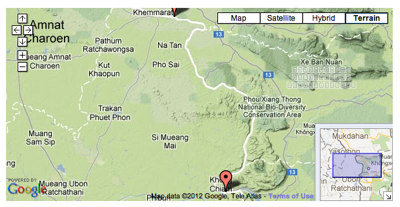
The article page in BioStor shows a map derived from the OCR text, showing a two localities:

Mekong

Below the map are the specimen codes I've automatically extracted from the OCR text, linked to the corresponding records in GBIF, which are georeferenced (e.g., ANSP Malacology 330925).

If we joined these things up just a little more, we could do some useful things. For example, what if a researcher searching in PubMed for schistosomiasis in South East Asia could find the Davis et al. paper, and then go to BHL or BioStor to read it? What if a researcher looking at gastropod distributions in the Mekong River in the GBIF portal could see that BHL had publications on diseases associated with these organisms (as well as their taxonomy and biology). We could also traverse the link from GBIF to BHL to PubMed and provide a direct route from distribution maps to biomedical literature.

It seems there's scope for trying to connect BHL, GBIF, and PubMed, and that BHL and GBIF may have important roles to play in providing access to basic information about organisms that have a serious impact on human populations.

Thursday, July 23, 2015

Purposeful Games and the Biodiversity Heritage Library

0a5c989ef8f5b9523b2119808a9f15ab

These are some quick thoughts on the games on the BHL site, part of the Purposeful Gaming and BHL Project. As mentioned on Twitter, I had a quick play of the Beanstalk game and got bored pretty quickly. I should stress that I'm not a gamer (although my family includes at least one very serious gamer, and a lot of casual players). Personally, if I'm going to spend a large amount of time with a computer I want to be creating something, so gaming seems like a big time sink. Hence, I may not be the best person to review the BHL games. Anyhow...

It seems to me that there are a couple of ways games like this might work:

  1. You want to complete the game so you can do something you really want to do. This is the essence of solving CAPTCHAs, I'll solve your stupid puzzle so that I can buy my tickets.
  2. The game itself is engaging, and what you are asked to do is a natural part of the game's world. When you swipe candy, bits of candy may explode, or fall down (this is a good thing, apparently), or when you pull back a slingshot and release the bird, you get to break stuff).

The BHL games are trying to get you to do one activity (type in the text shown in a fragment of a BHL book) and this means, say, a tree grows bigger. To me this feels like a huge disconnect (cf. point 2 above), there is no connection between what I'm doing and the outcome.

Worse, BHL is an amazing corpus of text and images, and this is almost entirely hidden from me. If I see a cool looking word, or some old typeface, there's no way for me to dig deeper (what text did that come from?, what does that phrase mean?). I get no sense of where the words come from, or whether I'm doing anything actually useful. For things like ReCAPTCHA (where you helped OCR books) this doesn't matter because I don't care about the books, I want my tickets. But for BHL I do care (and BHL should want at least some of the players to care as well).

So, remembering that I'm not a gamer, here are some quick ideas for games.

Find that species

One reason BHL is so useful is it contains original taxonomic descriptions. Sometimes the OCR is too poor for the name to extracted from the description. Imagine a game where the player has a list of species (with cute pictures) and is told to go find them in the text. Imagine that we have a pretty good idea where they are (from bibliographic data we could, for example, know the page the name should occur on), the player hunts for the word on the page, and when they find it and mark it. BHL then gets corrected text and confirmation that the name occurs on that page. Players could select taxa (e.g., birds, turtles, mosses) that they like.

Find lat/longs

BHL text is full of lat/long pairs, often the OCR is not quite good enough to extract them. Imagine that we can process BHL to find things that look like lat/long pairs. Imsgine that we can read enough of the text to get a sense of where in the world the text refers to. Now, have a game where we pick a spot on a map and find things related to that spot. Say we get presented with OCR text that may refer to that locality, we fix it, and the map starts get populated. A bit like Yelp and Four Square, we could imagine badges for the most articles found about a place.

Find the letter/font

There are lots of cool symbols and fonts in BHL, someone might be interested collecting these. Simple things might be diphthongs such as æ. Older BHL texts are full of these, often misinterpreted. Other examples are male and female symbols. Perhaps we could have a game where we try and guess what symbol the OCR text actually matches - in other words, show the OCR text first, player tries to guess actual symbol, then the image appears, and then player types in actual symbol. Goal is to get good at predicting OCR errors.

Games like this would really benefit if the player could see (say, on the side) the complete text. Imagine that you correct a word, then you see it comes from a gorgeous plate of a bird. Imagine you could then correct any of the there words on that page.

Word eaters

Imagine the layer is presented with a page with text and, a bit like Minecraft's monsters, things appear which start to "eat" the words. You need to check as many words as possible before the text is eaten. Perhaps structure things in such a way that checked words form a barrier to the word-eating creatures and buy you some time, or like Minecraft, fixing a bad OCR word blasts a radius free of the word eaters. As an option (again, like Minecraft) turn off the eaters and just correct the words at your leisure.

Countdown

Based on the UK game show, present a set of random letters (as images), player makes longest word they can, then check against dictionary, this tells you what letters they think the images represent.

Falling words

Have page fragments fall from the top of the screen, and have a key word displayed (say, "sternum", or enable player to type a word in) then display images of words whose OCR text resembles this (in other words, have a bunch of OCR text indexed using methods that allow for errors). As the word images fall, the player taps on an image that matches the word and they are collected. Maybe add features such as a timeline to show when the word was used (i.e., the date of the BHL text), give the meaning of the word, lightly chide players who enter words like "f**k" (that'd be me), etc.

Summary

Like comedy, I imagine that designing games is really, really hard. But the best games I've seen create a world that the player is immersed in and which makes sense within the rules of that world. Regardless of whether these ideas are any good, my concern is that the BHL games seem completely divorced from context, and the game play bears no relation to outcomes in the game.

Tuesday, January 17, 2012

Mendeley as CiteBank: some ideas

Here are some quick notes on how BHL could use Mendeley as a "CiteBank".

As a repository of bibliographic data

If the goal is to assemble a "bibliography of life" then there are various ways this could be done.

Taxon-specific bibliographies

Create groups that are taxon-specific (or find existing groups in Mendeley. For example, I've created groups for amphibias (Amphibian Species of the World) and reptiles (TIGR/JCVI Reptile Database) based on the Amphibian Species of the World and TIGR/JCVI Reptile Database, respectively. Taxon-specific groups are probably going to be attractive to users, but the quality of bibliographic metadata can be variable. However, a bibliography for a specific taxonomic group that is populated with links to BHL content would be very useful.

Journal-specific bibliographies

This is where I've spent most of my efforts. I've created around 300 groups for various journals (see list below, or go directly to http://dl.dropbox.com/u/639486/groups.html). In some cases I've managed to populate these with the complete set of articles published in that journal, typically harvested from the journal's own web site. Typically the metadata from journal sites is high quality, although one has to be wary of Orwellian metadata.


I use these groups in two ways. The first is as a source of metadata for extracting articles from BHL using BioStor. If you have article-level metadata finding articles in BHL becomes easier, and can be automated so that 1000's can be added in a few minutes.

The second is for the taxon-literature mapping project, where one strategy is to use approximate string mapping to find equivalent citations in Mendeley and the ION database. Ultimately I'd like to link to the Mendeley citations as they tend to be higher quality than those in the original ION database.

BHL could create Mendeley groups for journals it has scanned, and populate those.

As an article-level index to BHL

This is perhaps the most direct way BHL could use Mendeley is as follows:

  1. Create a BHL account.
  2. For each BHL title create a Mendeley group (the name would be the BHL TitleID).
  3. For each item in that title create a folder in the corresponding group (the folder name would be the ItemID).
  4. Within each folder list the articles, book chapters or other component parts. If these aren't available yet, encourage people to add them. Some of these could be pre-populated with content from BioStor.
  5. Harvest the contents of these groups to provide an article-level index to BHL (which for me is the single biggest impediment to using BHL). Previously I've suggested a way to easily add article data to BHL, Mendeley title/item groups and folders might be way to facilitate this process.
PDF storage

Although Mendeley offers PDF storage, this is one feature I'd be less inclined to use. Mendeley's rule for sharing PDFs and making them publicly available are too restrictive (they often don't know whether a PDF can, in fact, be shared). Plus you want tools to visualise, index, and archive PDFs. In effect a big file store with added features. I have some ideas on how this can be implemented (and have a rough working version to support http://iphylo.org/~rpage/itaxon). Alternatively, one could use Internet Archive services.

Summary

As I've often argued, given the success of tools like Mendeley it seems pointless for anyone to try and build yet another online bibliographic database. The trick is to figure out how to leverage what Mendeley provides to support what the taxonomic (and broader biodiversity) community needs.

Saturday, September 19, 2009

Biodiversity Heritage Library, Google books, and metadata quality

I've been playing recently with the Biodiversity Heritage Library (BHL), and am starting to get a sense for the complexities (and limitations) of the metadata BHL stores about publications. The more I look at BHL the more I think the resource is (a) wonderfully useful and (b) hampered by some dodgy metadata.

The BHL data model has three kinds of entities, "Titles", "Items", and "Pages". Pages are individual pages in an item, where an item which corresponds to a physical object that has been scanned (such as a book or a bound volume of a journal). A title may comprise a single item, such as book, or many items, such as volumes of a journal. Most of the metadata BHL has relates to physical items (books and bound volume issues), as opposed to article-level metadata, which is basically absent (see But where are the articles?).

bhl_model.png


This model reflects the sources of the BHL metadata (library catalogues) and the mode of operation (bulk scanning of bound volumes). But it can make working out dates of somewhat challenging.

To give an example, I did a search on the frog name Hyla rivularis Taylor, 1952 (NameBankID 27357), currently known as Isthmohyla rivularis. I wanted to find the original description of this frog. A BHL search returns 34 pages containing the name Hyla rivularis, distributed over 5 titles (a title in BHL may be a book, or a journal). Given that the name was published in 1952, it would be nice if I could sort these results by date, and then look at items from 1952. Unfortunately I can't. BHL has limited information on dates, especially at the level I would need to find a document published in 1952.

For the five titles returned in the search, I have dates for four of them, albeit two are ranges (University of Kansas publications, Museum of Natural History, 1946-1971, and The University of Kansas science bulletin, 1902-1996). At the level of individual items, only item 25858 (University of Kansas publications, Museum of Natural History) has dates (1961-1966). If I look at the VolumeInfo field for an item (you can get this from the database dump, or using the JSON web service) I sometimes get strings like this "v.35:pt.1 (1952)". This item (25857) is the one I'm after, but the date is buried in the VolumeInfo string. So, the information I need is there, but it's going to need some parsing.

84203b53fc75bd5bbc7f6a62fe8500f1.jpeg

Another issue is that of duplicates. Searching for publications on Rana grahamii, I found items 41040 and 45847. Although one item is treated as a book, and the other as a volume of the journal Records of the Indian Museum, these are the same thing. Having duplicates is a complication, but it might also be useful for quality control and testing (for example, do taxon name extraction algorithms return the same names from OCR text from both copies?). Nor is having duplicate copies and/or identifiers unique to BHL. The Records of the Indian Museum has a series-level identifier (ISSN 0537-0744), and this article ("A monograph of the South Asian, Papuan, Melanesian and Australian frogs of the genus Rana") also as the ISBN 8121104327.

There are parallels with Google books scanning project, which has been the subject of criticism on several fronts, including the quality of the metadata they have for each book. Geoff Nunberg has an entertaining post entitled Google Books: A Metadata Train Wreck which lists many examples of errors. This blog post also contains a detailed response from Jon Orwant of Google books. In essence, Google books is riddled with metadata errors (such as books on the Internet with publication dates predating the birth of their authors), but most of these errors have come from library catalogues (not unexpected given the scale of the task), not Google.

What could BHL do about its metadata? One thing is crowdsourcing. BHL does a little of this already, for example capturing user-provided metadata when PDFs are created, but I wonder if we could do more. For example, imagine dumping metadata for all 39,000 items into a semantic wiki and inviting people to edit and annotate the metadata. This could be extended to adding article boundaries (i.e., identifying which page corresponds to the start of an article). There is also considerable scope for trying to find article boundaries using existing metadata from bibliographies assembled by individual scientists.

But we should watch closely what Google does with its book project. Eric Hellman has argued that, far from creating the metadata mess, Google is ideally positioned to sort it out. He writes:
What if Google, with pseudo-monopoly funding and the smartest engineers anywhere, manages to figure out new ways to separate the bird shit from the valuable metadata in thousands of metadata feeds, thereby revolutionizing the library world without even intending to do so?

Tuesday, January 10, 2012

Journals I'd like BHL to scan

I've recently updated my database of links between animal taxonomic names and literature identifiers, which now has over 280,000 names linked to some form of identifier (127,000 of these being DOIs). You can see the current version here:

http://iphylo.org/~rpage/itaxon/

As an experiment I've added a feature to list the number of names for each journal. Based on this list (limited to journals that I've found an ISSN for) here are some journals I'd like to see digitised by the Biodiversity Heritage Library (BHL). Note that by digitised I mean beyond the 1923 cutoff applied to many journals. This will mean negotiating with the journal publishers, but in a number of cases these are scientific societies or institutions, some associated with BHL. Given that major partners in BHL have made post-1923 content available, it would nice to extend this to other key taxonomic journals.

Revue Suisse de Zoologie

Revue Suisse de Zoologie has published nearly 10,000 taxonomic names but has essentially zero digital presence, which is extraordinary. Another Swiss journal, Entomologica Basiliensia is also an obvious candidate.

Revue de Zoologie et de Botanique Africaines

Revue de Zoologie et de Botanique Africaines has published over 5,000 names, and given the interest in providing information resources for Africa (e.g., http://www.mendeley.com/groups/1681811/bhl-africa/) this seems an obvious journal to scan completely.

Bulletin of the British Museum (Natural History) journals and books

The Natural History Museum [formerly British Museum (Natural History)] is a member of BHL so I'd expect it to have better coverage of it's own publications in BHL. There are gaps in journals such as Bulletin of the British Museum (Natural History) Entomology, which means there is a significant chunk of research published by Museum staff that simply doesn't exist digitally. At one point The Natural History Museum renamed the journals and moved them to Cambridge University Press, resulting in further gaps in digitisation. It's interesting that museums that haven't changed the title of their publications (such as the American Museum of Natural History and the Australian Museum) have better digital coverage than the NHM, which has flirted with various title changes in the last few decades. The Museum also published a series of monographs in the 20th century, many of these aren't in BHL.

Memoirs of the Queensland Museum

The Memoirs of the Queensland Museum is an important journal (> 3,000 names) but has only early issues scanned in BHL and recent issues as PDFs on the Museum web site (vulnerable to link rot when the site gets redesigned, as I've discovered to my cost).

Russian journals

Russian journals contain large numbers of taxonomic descriptions, but their digital presence is patchy. Springer has started to publish translations online (e.g., http://dx.doi.org/10.1134/S0013873810050155 in Entomological Review, which is a translation of an article in Zoologicheskii Zhurnal), but much of the Russian literature seems unavailable in digital form. BHL has spread from it's US-UK origins to BHL-Europe, BHL_China, and BHL_Australia, maybe it's time for BHL-Russia?

Summary

There are huge holes in the availability of taxonomic literature (where I equate "availability" with being digitised and online, free or otherwise). But on the other hand I've been pleasantly surprised by just how much taxonomic literature is online. It looks quite feasible to link at least 300,000 animal names to digital publications.

The journals I've highlighted are just a few obvious candidate for scanning. I suspect that as one goes down the list of taxonomic journals the rate of return will decline, to the point where scanning entire journals will be less efficient than scanning targeted articles.


Wednesday, December 08, 2010

First thoughts on CiteBank and BHL-Europe

This week saw the release of two tools from the Biodiversity Heritage Library, CiteBank and the BHL-Europe portal. Both have actually been quietly around for a while, but were only publicly announced last week.

In developing a new tool there are several questions to ask. Does something already exist that meets my needs? If it doesn't exist, can I build it using an existing framework, or do I need to start from scratch? As a developer it's awfully tempting sometimes to build something from scratch (I'm certainly guilty of this). Sometimes a more sensible approach is to build on something that already exists, particularly if what you are building upon is well supported. This is one of the attractions of Drupal, which underlies CiteBank and Scratchpads. In my own work I've used Semantic Mediawiki to support editable, versioned databases, rather than roll my own. Perhaps the more difficult question for a developer is whether they need to build anything at all. What if there are tools already out there that, if not exacty what you want, are close enough (or most likely will be by the time you finish your own tool).

CiteBank
bhlsquare_reasonably_small.png
CiteBank is an open access platform to aggregate citations for biodiversity publications and deliver access to biodiversity related articles. CiteBank aggregates links to content from digital libraries, publishers, and other bibliographic systems in order to provide a single point of access to the world’s biodiversity literature, including content created by its community of users. CiteBank is a project of the Biodiversity Heritage Library (BHL).

I have two reactions to CiteBank. Firstly, Drupal's bibliographic tools really suck, and secondly, why do we need this? As I've argued earlier (see Mendeley, BHL, and the "Bibliography of Life"), I can't see the rationale for having CiteBank separate from an existing bibliographic database such as Mendeley or Zotero. These tools are more mature, better supported, and address user needs beyond simply building lists of papers (e.g., citing papers when writing manuscripts).

For me, one of BHL's goals should be integrating the literature they have scanned into mainstream scientific literature, which means finding articles, assigning DOIs, and becoming in effect a digital publishing platform (like BioOne or JSTOR). Getting to this point will require managing and cleaning metadata for many thousands of articles and books. It seems to me that you want to gather this metadata from as many sources as possible, and expose it to as many eyes (and algorithms) as possible to help tidy it up. I think this is a clear case of it being better to use an existing tool (such as Mendeley), rather than build a new one. If a good fraction of the world's taxonomists shared their person bibliographies on Mendeley we'd pretty much have the world's taxonomic literature in one place, without really trying.

BHL-Europe
logo.jpg
It's early days for BHL-Europe, and they've taken the "lets use an existing framework" approach, basing the BHL-Europe portal on DISMARC, the later being a EU-funded project to "encourage and support the interoperability of music related data".

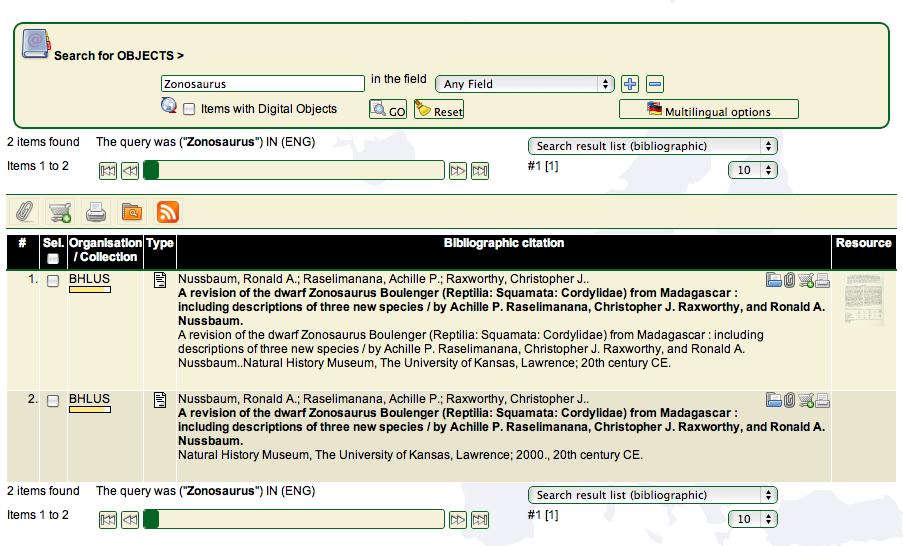
BHL-Europe is the kind of web site only its developers could love. It's spectacularly ugly, and a classic example of what digital libraries came up with while Google was quietly eating their lunch. Here's the web site showing search results for "Zonosaurus":

bhleu.png


Yuck! Why do these things have to be so ugly?. DISMARC was designed to store metadata about digital objects, specifically music. Look at commercial music interfaces such as iTunes, Spotify, and Last.fm. Or even academic projects such as mSpace.

To be useful BHL-Europe really needs to provide an interface that reflects what its users care about, for example taxonomic names, classification, and geography. It can't treat scientific literature as a bunch of lifeless metadata objects (but then again, DISMARC managed to do this for music).

Where next?
CiteBank and BHL-Europe seem further additions to the worthy but ultimately deeply unsatisfying attempts to improve access biodiversity literature. To date our field has failed to get to grips with aggregating metadata (outside of the library setting), creating social networks around that aggregation, and providing intuitive interfaces that enable users to search and browse productively. These are big challenges. I'd like to see the resources that we have put to better use, rather than being used to build tools where suitable alternatives already exist (CiteBank), or used to shoe horn data into generic tools that are unspeakably ugly (BHL-Europe portal) and not fit for purpose. Let's not reinvent the wheel, and let's not try and convince ourselves that squares make perfectly good wheels.

Wednesday, September 05, 2012

BHL is duplicating DOIs because it doesn't know about articles

Quick note that as much as I like that the Biodiversity Heritage Library is using DOIs, they are generating them for publications that already have them (or are acquiring them from other sources). For example, here are the two DOIs for the same article (formatted using the DOI Citation Formatter), one from BHL and one from the Smithsonian:

Springer, V. G. (1982). Pacific Plate biogeography, with special reference to shorefishes / Victor G. Springer. Smithsonian Institution. doi:10.5962/bhl.title.37141
Springer, V. G. (1982). Pacific Plate biogeography, with special reference to shorefishes. Smithsonian Contributions to Zoology, (367), 1–182. doi:10.5479/si.00810282.367


The BHL DOI resolves to a page in BHL, the other DOI resolves to the a page in the Smithsonian Digital Repository (this article also has the handle hdl:10088/5222).

Now this is a problem, because DOIs are meant to be unique: one article, one DOI. I've encountered duplicates elsewhere, but in these cases one should be an alias of the other. In the example above, the DOIs resolve to different locations. If you are just after the content this isn't a huge problem, but if, say, you were using the DOI to uniquely identify the publication (say, in a database) you have a problem: which DOI to choose? If you and I choose differently then we will make statements about the same article but be unaware of that sameness.

Much of this problem arises because BHL has no concept of articles. Most articles are likely to reside within scanned volumes of a journal, but some articles (e.g., monographs) may be treated a single title by BHL, and each BHL title now gets a DOI.

I know that handling articles is on BHL's radar, but it because it hasn't tackled it yet we are going to have cases where BHL DOIs duplicate existing DOIs. In these cases, BHL may have to make their DOI an alias of the other DOI.

Tuesday, March 23, 2010

BHL Tech Report

Chris Freeland tweeted about the presentation he gave to a recent BHL meeting, the slides for which are reproduced below:


It makes interesting viewing. From my own (highly biased) perspective slide 10 is especially interesting, in that BioStor, my tool for locating articles in BHL is the 8th largest source of traffic for BHL - 2.46% of visitors to BHL come via BioStor. By way of comparison, the largest single referrer for the same period is Tropics (11.14%), with EOL third at 6.45% and Wikipedia fourth at 5.56%. Obviously this is a small sample, but it is vaguely encouraging. It is nice to see Wikipedia being a significant source of links. EOL has dropped significantly from being the largest referrer (22.51%) in 2008-2009 to third (6.45%) for 2010 to date. In one sense this may reflect BHL achieving greater visibility independently of EOL. I also wonder whether it might reflect the unsatisfactory way EOL displays BHL results? If the BHL results were grouped (for example, by article), then I suspect they may provide more enticing links for EOL users to click on (especially, for example, if the articles were flagged by whether they included the original description of a taxon). It would be fun to know what EOL users actually do (e.g., what fraction of EOL visitors to a given page click on BHL links?).

Wednesday, September 07, 2011

Suggested apps for BHL's Life and Literature Code Challenge


Since I won't be able to be at the Biodiversity Heritage Library's Life and Literature meeting I thought I'd share some ideas for their Life and Literature Code Challenge. The deadline is pretty close (October 17) so having ideas now isn't terribly helpful I admit. That aside, here are some thoughts inspired by the challenge. In part this post has been inspired by the Results of the PLoS and Mendeley "Call for Apps", where PLoS and Mendeley asked for people (not necessarily developers) to suggest the kind of apps they'd like to see. As an aside, one thing conspicuous by it's absence is a prize for winning the challenge. PLoS and Mendeley have a "API Binary Battle" with a prize of $US 10,001, which seems more likely to inspire people to take part.

Visual search engine
I suspect that many BHL users are looking for illustrations (exemplified by the images being gathered in BHL's Flickr group). One way to search for images would be to search within the OCR text for figure and plate captions, such as "Fig. 1". Indexing these captions by taxonomic name would provide a simple image search tool. For modern publications most figures are on the same page as the caption, but for older publications with illustrations as plates, the caption and corresponding image may be separated (e.g., on facing pages), so the search results might need to show pages around the page containing the caption. As an aside, it's a pity the Flickr images only link to the BHL item and not the BHL page. If they did the later, and the images were tagged with what they depict, you could great a visual search engine using the Flickr API (of course, this might be just the way to implement the visual search engine — harvest images, tags with PageID and taxon names, upload to Flickr).

Mobile interface
The BHL web site doesn't look great on an iPhone. It makes no concessions to the mobile device, and there are some weird things such as the way the list of pages is rendered. A number of mainstream science publishers are exploring mobile versions of their web sites, for example Taylor and Francis have a jQuery Mobile powered interface for mobile users. I've explored iPad interfaces to scientific articles in previous posts. BHL content posses some challenges, but is fundamentally the same as viewing PDFs — you have fixed pages that you may want to zoom.

OCR correction
There is a lot of scope for cleaning up the OCR text in BHL. Part of the trick would be to have a simple use interface for people to contribute to this task. In an earlier post I discussed a Firefox hOCR add-on that provides a nice way to do this. Take this as a starting point, add a way to save the cleaned up text, and you'd be well on the way to making a useful tool.

Taxon name timeline
Despite the shiny new interface, the Encyclopedia of Life still displays BHL literature in the same clunky way I described in an earlier blog post. It would great to have a timeline of the usage of a name, especially if you could compare the usage of different names (such as synonyms). In many ways this is the BHL equivalent Google Books Ngram viewer.

These are just a few hastily put together thoughts. If you have any other ideas or suggestions, feel free to add them as comments below.

- Posted using BlogPress from my iPad