Thursday, August 02, 2012

Google Knowledge Graph using data from BBC and Wikipedia

Google's Knowledge Graph can enhance search results by display some structured information about a hit in your list of results. It's available in the US (i.e., you need to use www.google.com, although I have seen it occasionally appear for google.co.uk.

Fruitbat
Here is what Google displays for Eidolon helvum (the straw-coloured fruit bat). You get a snippet of text from Wikipedia, and also a map from the BBC Nature Wildlife site. Wikipedia is a well-known source of structured data (in that you can mine the infoboxes for information). The BBC site has some embedded RDFa and structured HTML, and you can also get RDF (just append ".rdf" to the URL, i.e., http://www.bbc.co.uk/nature/life/Straw-coloured_Fruit_Bat.rdf). There doesn't seem to be anything in the RDF about the distribution map, so presumably Google are extracting that information from the HTML.

It would be interesting to think about what other biodiversity data providers, such as GBIF and EOL could do to get their data incorporated into Google's Knowledge Graph, and eventually into these search result snippets.

Tuesday, July 24, 2012

Dear GBIF, please stop changing occurrenceIDs!

If we are ever going to link biodiversity data together we need to have some way of ensuring persistent links between digital records. This isn't going to happen unless people take persistent identifiers seriously.

I've been trying to link specimen codes in publications to GBIF, with some success, so imagine my horror when it started to fall apart. For example, I recent added this paper to BioStor:

A remarkable new asterophryine microhylid frog from the mountains of New Guinea. Memoirs of The Queensland Museum 37: 281-286 (1994) http://biostor.org/reference/105389

This paper describes a new frog (i>Asterophrys leucopus) from New Guinea, and BioStor has extracted the specimen code QM J58650 (where "QM" is the abbreviation for Queensland Museum), which according to the local copy of GBIF data that I have, corresponds to http://data.gbif.org/occurrences/363089399/. Unfortunately, if you click on that link GBIF denies all knowledge (you get bounced to the search page). After a bit of digging I discover that specimen is now in GBIF as http://data.gbif.org/occurrences/478001337/. At some point GBIF has updated its data and the old occurrenceID for QM J58650 (363089399) has been deleted. Noooo!

Looking at the old record I have there is an additional identifier:
urn:catalog:QM: Herpetology:J58650

This is a URN, and it's (a) unresolvable and (b) invalid as it contains a space. This is why URNs are useless. There's no expectation they will be resolvable hence there's no incentive to make sure they are correct. It's as much use as writing software code but not bothering to run it (because surely it will work, no?).

The GBIF record http://data.gbif.org/occurrences/478001337/ contains a UUID as an alternative identifier:
bc58ce6b-3cc3-459a-9f5b-4a70a026afbe

If you Google this you discover a record in the Atlas of Living Australia http://biocache.ala.org.au/occurrences/bc58ce6b-3cc3-459a-9f5b-4a70a026afbe, which also lists the URN from the now deleted GBIF record http://data.gbif.org/occurrences/363089399/.

I'm guessing that at some point the OZCAM data provided to GBIF was updated and instead of updating data for existing occurrenceIDs the old ones were deleted and new ones created (possibly because OZCAM switched from URNs to UUIDs as alternative identifiers). Whatever the reason, I will now need to get a new copy of GBIF occurrence data and repeat the linking process. Sigh.

If we are ever going to deliver on the promise of linking biodiversity data together we need to take identifiers seriously. Meantime I need to think about mechanisms to handle links that disappear on a whim.

Monday, July 23, 2012

Microbiome as climate, macrobiome as weather, and a global model of biodiversity

Lp attenboroughHalf-baked idea time. Thinking about projects such as the Earth Microbiome Project and Genomic Observatories, the recent GBIC2012 meeting (I'm still digesting that meeting), and mulling over the book A Vast Machine I keep thinking about the possible parallels between climate science and biodiversity science.

One metaphor from "A Vast Machine" is the difference between "global data" and "making data global". Getting data from around the world ("global data") is one challenge, but then comes making that data global:
building complete, coherent, and consistent global data sets from incomplete, inconsistent, and heterogeneous datasources

The focus of GBIF's data portal is global data, bringing together specimen records and observations from all around the world. This is global data, but one could argue that it's not yet ready to be used for most applications. For example, GBIF doesn't give you the geographic distribution of a given species, merely where it's been recorded from (based on that subset of records that have been digitised). That's a very important start, but if we had for each species an estimated distribution based on museum records, observations, published maps, together with habitat modelling, then we'd be closer to a dataset that we could use to tackle key questions about the distribution of biodiversity.

EMP green smallBut if we continue with the theme that microbiology is the dark matter of biology, and if we look at projects like the Earth Microbiome Project, then we could argue that focussing on eukaryote, particularly macro-eukaryote such as plants, fungi, and animals, may be a mistake. To use a crude analogy, perhaps we have been focussing on the big phenomena (equivalent to thunder storms, flash floods, tornados, etc.) rather than the underlying drivers (equivalent to climatic processes such as those captured in global climate models). Certainly, any attempt to model the biosphere is going to have to include the microbiome, and indeed perhaps the microbiome would be enough to have a working model of the biosphere?

I'm simply waving my arms around here (no, really?), but it's worth thinking about whether the macroecology that conservation and biodiversity focusses on is actually the important thing to consider if you want to model fundamental biological processes. Might macro-organisms be like the weather, and the microbiome is like the climate. As humans we notice the weather, because it is at a scale that affects us directly. But if the weather is a (not entirely predictable) consequence of the climate, what is the equivalent of global climate model for biodiversity?

Friday, July 20, 2012

Figshare and F1000 integrate data into publication: could TreeBASE do the same?

Spiralsticker reasonably smallQuick thoughts on the recent announcement by figshare and F1000 about the new journals being launched on the F1000 Research site. The articles being published have data sets embedded as figshare widgets in the body of the text, instead of being, say, a static table. For example, the article:

Oliver, G. (2012). Considerations for clinical read alignment and mutational profiling using next-generation sequencing. F1000 Research. doi:10.3410/f1000research.1-2.v1
has a widget that looks like this:

Widget
You can interact with this widget to view the data. Because the data are in figshare those data are independently citable, e.g. the dataset "Simulated Illumina BRCA1 reads in FASTQ format" has a DOI http://dx.doi.org/10.6084/m9.figshare.92338.

Now, wouldn't it be cool if TreeBASE did something similar? Imagine if uploading trees to TreeBASE were easy, and that you didn't have to have published yet, you just wanted to store the trees and make them citable. Imagine if TreeBASE had a nice tree viewer (no, not a Java applet, a nice viewer that uses SVG, for exmaple). Imagine if you could embed that tree viewer as a widget when you published your results. It's a win all round. People have an incentive to upload trees (nice viewer, place to store them, and others can cite the trees because they'd have DOIs). TreeBASE builds its database a lot more quickly (make it dead easy to upload tree), and then as more publishers adopt this style of publishing TreeBASE is well placed to provide nice visualisations of phylogenies pre-packaged, interactive, and citable. And let's not stop there, how about a nice alignment viewer? Perhaps this is the something currently rather moribund PLoS Currents Tree of Life could think about supporting?

Tuesday, July 17, 2012

Building a BHL Africa: BHL in a box

Was going to post this as a comment on the BHL blog but they use Blogger's native comment system, which is horrible, and it refused to accept my comment (yes, yes, I'm sure it did that on grounds of taste). I read the recent post Building a BHL Africa and couldn't believe my eyes when I read the following:

the "BHL in a Box" concept was highly desired. This would entail creating interactive CDs of BHL content for distribution in areas where internet access is unreliable or unavailable.
CDs! Really? Surely this is crazy!?. You want to use an obsolete technology that require additional obsolete technology to ship BHL around Africa? Why not ship relevant parts of BHL on iPads? Lots more storage space than CDs, built-in interactivity (obviously need to write an app, but could use HTML + Javascript as a starting point), long battery life, portable, comes with 3G support if needed. I'll be the first to admit that my knowledge of Africa is about zero, but given that mobile devices are common, mobile networks are fairly well developed, and tablets are making inroads (see iPad has become a big factor in African business) surely "BHL mobile" is the way to go to provide "BHL in a box", not CDs.

Why not develop an app that stores BHL content on a device like an iPad, then distribute those? Support updating the content over the network so the user isn't stuck with content they no longer need. In effect, something like Amazon's Kindle app or iBooks would do the trick. You'd need to compress BHL content to keep the size down (the images BHL currently displays on its web site could be made a lot smaller) but this is doable. Indeed, the BHL Africa could be an ideal motivation to move BHL to platforms such as phones and tablets, where at the moment users have to struggle with a website that makes no concessions to those devices.

Postscript
Of course, it doesn't have to be the iPad as such. Imagine if BHL published books and articles on Amazon, then used Kindle to deliver content physically (i.e., ship Kindles), and anyone else could access it directly from Amazon using their Kindle (or Kindle app on iPad).

Friday, July 13, 2012

Sometimes the mess taxonomy creates drives me nuts

Playing with some sequence data I found numerous Plasmodium sequences from the following paper:

Werner, E. B. ., Taylor, W. R., & Holder, A. A. (1998). A Plasmodium chabaudi protein contains a repetitive region with a predicted spectrin-like structure1Note: Nucleotide sequence data reported in this paper are available in the EMBL, GenBank™ and DDJB databases under the accession number U43145.1. Molecular and Biochemical Parasitology, 94(2), 185–196. doi:10.1016/S0166-6851(98)00067-X

These sequences (e.g., U43145) give the host as Thamnomys rutilans. You'd think it would be fairly easy to learn more about this animal, given that it hosts a relative of the cause of malaria in humans, and indeed there are a number of biomedical papers that come up in Google, e.g.:

Landau, I., & Chabaud, A. (1994). Advances in Parasitology (Vol. 33, pp. 49–90). Elsevier BV. doi:10.1016/S0065-308X(08)60411-X
Killick-Kendrick, R. (1968). Malaria parasites of Thamnomys rutilans (Rodentia, Muridae) in Nigeria. Bull World Health Organ. 1968; 38(5): 822–824. PMC2554675

Google also tells me that Thamnomys rutilans is an African rodent (e.g., 6.1.6. Rodent malaria, but NCBI has no sequences for "Thamnomys rutilans", and GBIF has no data on its distribution. If I search Mammal Species of the World I get (literally) "nothing found ...".

So, this is an African rodent, host to Plasmodium, and we know nothing about it? A bit of Googling, a trip to Wikipedia and Google Books reveals that Thamnomys rutilans is a synonym of Grammomys rutilans, but it is now called Grammomys poensis because the original name (Mus rutilans Peters 1876) is a junior synonym homonym of Mus rutilans Olfers, 1818 (simples). You can see the original description of Mus rutilans Peters 1876 in BioStor http://biostor.org/reference/105261 (this took some tracking down, but that's another story):

4ca1a4521753bde9a091661c7694f8ae

The original description of Mus rutilans Olfers, 1818 is given by The description of a new species of South American hocicudo, or long-nose mouse, genus Oxymycterus (Sigmodontinae, Muroidea), with a critical review of the generic content as:

Olfers, I. 1818. Bemerkungen zu Illiger's Ueberblick der Saugethiere nach ihrer Betheilung über die Welttheile rüchsichtlich der Südamerikanischen Arten (Species). In Eschwege, W. L., ed., Journal von Brasilien, Weimar, 15(2): 192-237.

This reference doesn't seem to be online.

The upshot of all this information about the host of Plasmodium chabaudi is hidden behind taxonomic name changes, and databases that one might expect to help simply don't. If names are the glue that link biodiversity data together then we need to get a lot better at making basic information about name changes accessible, otherwise we are creating islands of disconnected data.

Thursday, July 12, 2012

Dimly lit taxa - guest post by Bob Mesibov

The following is a first for iPhylo, a guest post by Bob Mesibov. Bob

Rod Page introduced 'dark taxa' here on iPhylo in April 2011. He wrote:

The bulk of newly added taxa in GenBank are what we might term "dark taxa", that is, taxa that aren't identified to a known species. This doesn't necessarily mean that they are species new to science, we may already have encountered these species before, they may be sitting in museum collections, and have descriptions already published. We simply don't know. As the output from DNA barcoding grows, the number of dark taxa will only increase, and macroscopic biology starts to look a lot like microbiology.

Rod suggested that 'quite a lot' of biology can be done without taxonomic names. For the dark taxa in GenBank, that might well mean doing biology without organisms – a surprising thought if you're a whole-organism biologist.

Non-taxonomists may be surprised to learn that a lot of taxonomy is also done, in fact, without taxonomic names. Not only is there a 'dark taxa' gap between putative species identified genetically and Linnaean species described by specialists, there's a 'dimly lit taxa' gap between the diversity taxonomists have already discovered, and the diversity they've named.

Dimly lit taxa range from genera and species given code names by a specialist or a group of collaborators, and listed by those codes in publications and databases, to potential type specimens once seen and long remembered by a specialist who plans to work them up in future, time and workload permitting.

In that phrase 'time and workload permitting' is a large part of the explanation for dimly lit taxa. Over the past month I created 71 species of this kind myself. Each has been code-named, diagnostically imaged, databased and placed in code-labelled bottles on museum shelves. The relevant museums have been given digital copies of the images and data.

The 71 are 'species-in-waiting'. They aren't formally named and described, but specialists like myself can refer to the images and data for identifying new specimens, building morphological and biogeographical hypotheses, and widening awareness of diversity in the group to which the 71 belong.

'Time and workload permitting'. Many of the 71 are poor-quality or fragmented museum specimens from which important morphological data, let alone sequences, cannot be obtained. Fresh specimens are needed, and fieldwork is neither quick nor easy. In my special corner of zoology, as in most such corners in zoology and botany, the widespread and abundant species are all, or nearly all, named. The unnamed rump consists of a huge diversity of geographically restricted and uncommon species. There are more than 71 in that group of mine; those are just the rare species I know about, so far.

'Time and workload permitting'. A non-taxonomist might ask, 'Why don't you just name and describe the 71 briefly, so that the names are at least available, and the gap between what's known and what's named is narrowed?' The answer is simple: inadequate descriptions are the bane of taxonomy. There are hundreds of species in my special group that were named and inadequately described long ago, and which wind up on checklists of names as 'nomen dubium' and 'incertae sedis'. Clearing up the mysteries means locating the types (which hopefully still exist) and studying them. That slow and tedious study would better have been done by the first describer.

Cybertaxonomic tools can help bring dimly lit taxa into full light, but not much. The rate-limiting steps in lighting up taxa are in the minds and lives of human taxonomists coping with the huge and bewilderingly complex diversity of life. It's not the tools used after the observing and thinking is done, it's the observing and thinking.

In their article 'Ramping up biodiversity discovery via online quantum contributions' (http://dx.doi.org/10.1016/j.tree.2011.10.010), Maddison et al. argue that the pace of naming and description can be increased if information about what I've called dimly lit taxa is publicly posted, piece by piece, 'publish as you go', on the Internet. In my case, I would upload images and data for my 71 'species-in-waiting' to suitable sites and make them freely available.

Excited by these discoveries, amateurs and professionals would rush to search for fresh specimens. Specialists would drop whatever else they were doing, borrow the existing specimens of the 71 from their repositories and do careful inventories of the morphological features I haven't documented. Aroused from their humdrum phylogenetic analyses of other organisms, molecular phylogeny labs would apply for extra funding to work on my 71 dimly lit taxa. In no time at all, a proud team of amateurs and specialists would be publishing the results of their collaboration, with 71 names and descriptions.

Shortly afterwards, flocks of pigs would slowly circle the 71 type localities, flapping their wings in unison.

Memo to Maddison et al. and other would-be reformers: the rate of taxonomic discovery and documentation is very largely constrained by the supply of taxonomists. You want more names, find more namers.

Wednesday, July 11, 2012

Citations, Social Media & Science

Quick note that Morgan Jackson (@BioInFocus) has written nice blog post Citations, Social Media & Science inspired by the fact that the following paper:

Kwong, S., Srivathsan, A., & Meier, R. (2012). An update on DNA barcoding: low species coverage and numerous unidentified sequences. Cladistics, no–no. doi:10.1111/j.1096-0031.2012.00408.x

cites my "Dark taxa" in the body of the text but not in the list of literature cited. This prompted some discussion of DOIs and blog posts on Twitter:


Read Morgan's post for more on this topic. While I personally would prefer to see my blog posts properly cited in papers like doi:10.1111/j.1096-0031.2012.00408.x, I suspect the authors did what they could given current conventions (blogs lack DOIs, are treated differently from papers, and many publishers cite URLs in the text, not the list of references cited). If we can provide DOIs (ideally from CrossRef so we become part of the regular citation network), suitable archiving, and — most importantly — content that people consider worthy of citation then perhaps this practice will change.

Friday, July 06, 2012

Post GBIC2012 thoughts

I'm back from Copenhagen and GBIC2012. The meeting spanned three fairly intense days (with the days immediately before and after also working days for some of us), and was run by a group of facilitators lead by Natasha Walker, who were described us as "an interesting (and delightfully brainy, if sometimes scatty) group of academics, researchers, museum managers and people close to policy...". I've attempted to capture tweets about the meeting using Storify.

There will be a document (perhaps several) based on the meeting, but until then here are a few quick thoughts. Note that the comments below are my own and you shouldn't read into this anything about what directions the GBIC document(s) will actually take.

Microbiology rocks


Highlight of the first day was Robert J. Robbin's talk which urged the audience to consider that life was mostly microbial, that the the things most people in the room cared about were actually merely a few twigs on the tree of life, that the tree of life didn't actually exist anyway, and many of the concepts that made sense for multicellular organisms simply didn't apply in the microbial world. Basically it was a homage to Carl Woese (see also Pace et al. 2012 doi:10.1073/pnas.1109716109) and a wake up call to biodiversity informaticians to stop viewing the world through multicellular eyes. (You can find all the keynotes from the first day here).

F1 large
From Pace, N. R. (1997). A Molecular View of Microbial Diversity and the Biosphere. Science, 276(5313), 734–740. doi:10.1126/science.276.5313.734

Sequences rule


The future of a lot of biodiversity science belongs to sequences, from simple DNA barcoding as a tool for species discovery and identification, metabarcoding as a tool for community analysis, to comparisons of metabolic pathways and beyond. The challenge for classical biodiversity informatics is how to engage with this, and to what extent we should try and map between, say sequences and classical taxa, or whether it might make more sense (gasp) to abandon the taxonomic legacy and move on. Perhaps are more nuanced response is that the point of connection between sequences and classical biodiversity data is unlikely to be at the level of taxonomic names (which are mostly tags for collections of things that look similar) but at the level of specimens and observations.

Ontologies considered harmful


This is my own particular hobby horse. Often the call would come "we need an ontology", to which I respond read Ontology is Overrated: Categories, Links, and Tags. I have several problems with ontologies. The first is that they are too easy to make and distract from the real problem. From my perspective a big challenge is linking data together, that is going from

a

to

b

Let's leave aside what "A" and "B" are (I suspect it matters less than people think), once we have the link then we can can start to do stuff. From my perspective, what ontologies give us is basically this:

c

So now we know the "type" of the link (e.g., "is a part of", "cites approvingly", etc.). I'm not arguing that this isn't useful to have, but if you don't have the network of links then typing the links becomes an idle exercise.

To give an example, the web itself can be modelled as simply nodes connected by links, ignoring the nature of the links between the web pages. The importance of those links can be inferred later from properties of the network. To a first approximation this is how Google works, it doesn't ask what the links "mean" it simply investigates the connections to determine how important each web page is. In the same way, we build citation networks without bothering to ask the nature of the citation (yes I know there are ontologies for citations, but anyone willing to bet how widely they'll be adopted?).

My second complaint is that building ontologies is easy, "easy" in the sense that get a bunch of people together, they squabble for a long time about terminology, and out comes an ontology. Maybe, if you're lucky, someone will adopt it. The cost of making ontologies, and indeed of adopting them is relatively low (although it might not seem like it at the time). The cost of linking data is, I'd argue, higher, because it requires that you trust someone else's identifiers to the extent that you use them for things you care about deeply. Consider the citation network that is emerging from the widespread adoption of DOIs by the publishing industry. Once people trust that the endpoints of the links will survive, then the network starts to grow. But without that trust, that leap of faith, there's no network (unless you have enough resources to build the whole thing internally yourself, which is what happened with the closed citation network owned by Thomson Reuters). It's much easier to silo the data using unique identifiers than it is to link to other data (it's a variant of the "not invented here" syndrome).

Lastly, ontologies can have short lives. They reflect a certain world view that can become out of date, or supplanted if the relationships between things that the ontology cares about can be computed using other data. For example, biological taxonomy is a huge ontology that is rapidly being supplanted by phylogenetic trees computed from sequence (and other) data (compare the classification used by flagship biodiversity projects like GBIF and EOL with the Pace tree of life shown above). Who needs an ontology when you can infer the actual relationships? Likewise, once you have GPS the value of a geographic ontology (say of place names) starts to decline. I can compute if I'm on a mountain simply by knowing where I am.

I'm not saying ontologies are always bad (they're not), nor that they can't be cool (they can be), I'm just suggesting that they aren't the first thing you need. And they certainly aren't a prerequisite for linking stuff together.

Google flu trends


Perhaps the most interesting idea that emerged was the notion of intelligently detecting changes in biodiversity (which is the kind of thing a lot of people want to know) in the way analogous to Google.org's Flu Trends uses flu-related search terms to predict flu outbreaks:

Ginsberg, J., Mohebbi, M. H., Patel, R. S., Brammer, L., Smolinski, M. S., & Brilliant, L. (2008). Detecting influenza epidemics using search engine query data. Nature, 457(7232), 1012–1014. doi:10.1038/nature07634

Could we do something like this for biodiversity data? For various reasons this suggestion become known at GBIC2012 as the "Heidorn paradigm".

Thinking globally


One challenge for a meeting like GBIC 2012 is scope. There's so much cool stuff to think about. From my perspective, a useful filter is to ask "what will happen anyway?" In other words, there is a lot of stuff (for example the growth of metabarcoding) that will happen regardless of anything the biodiversity informatics community does. People will make taxon-specific ontologies for organismal traits, digitise collections, assess biodiversity, etc. without necessarily requiring an entity like GBIF. The key question is "what won't happen at a global scale unless GBIF (or some other entity) gets involved?"

A Vast Machine

51OttqQDcVL SL500 AA300Lastly, in one session Tom Moritz mentioned a book that he felt we could learn from (A Vast Machine: Computer Models, Climate Data, and the Politics of Global Warming). The book recounts the history of climatology and its slow transition to a truly global science. I've started to read it, and it's fascinating to see the interplay between early visions of the future, and the technology (typically driven by military or large-scale commercial interests) that made possible the realisation of those visions. This is one reason why predicting the future is such a futile activity, the things that have the biggest effect come from unexpected sources, and effect things in ways it's hard to anticipate. On a final note, it took about a minute from the time from the time Tom mentioned the book to the time I had a copy from Amazon in the Kindle app on my iPad. Oh that accessing biodiversity data were that simple.

Sunday, July 01, 2012

Using orthographic projections to map organism distributions

For a current project I'm currently working I show organism distributions using data from GBIF, and I display that data on a map that uses the equirectangular projection. I've recently started to create a series of base maps using the GBIF colour scheme, which is simple but effective:

  • #666698 for the sea
  • #003333 for the land
  • #006600 for borders
  • yellow for localities


The distribution map is created by overlaying points on a bitmap background using SVG (see SVG specimen maps from SPARQL results for details). SVG is ideally suited to this because you can take the points, plot them in the x,y plane (where x is longitude and y is latitude) then use SVG transformations to move them to the proper place on the map.

For the base maps themselves I've also started to use SVG, partly because it's possible to edit them with a text editor (for example if you want to change the colours). I then use Inkscape to export the SVG to a PNG to use on the web site.

Gbif360x180

One thing that has bothered me about the equirectangular projection is that, although it is familiar and easy to work with, it gives a distorted view of the world:


This is particularly evident for organisms that have a circumpolar distribution. For example, Kerguelen's petrel Aphrodroma has a distribution that looks like this using the equirectangular projection:

A1

This long, thin distribution looks rather different if we display it on a polar projection:
A2

Likewise, classic Gondwanic distributions such as that of Gripopterygidae become clearer on a polar projection.

g

Computing the polar coordinates for a set of localities is straightforward (see for example this page) and using SVG to lay out the points also helps, because it's trivial to rotate them so that they match the orientation of the map. Ultimately it would be nice to have an embedded, rotatable 3D globe (like the Google Earth plugin, or a Javascript+SVG approach like this). But for now I think it's nice to have the option of using different projections available to help display distributions more faithfully.

The bitmap maps and their SVG sources are available on github.

Friday, June 29, 2012

Planet management, GBIF, and the future of biodiversity informatics

Earth russia large verge medium landscape

Next week I'm in Copenhagen for GBIC, the Global Biodiversity Informatics Conference. The goal of the conference is to:
...convene expertise in the fields of biodiversity informatics, genomics, earth observation, natural history collections, biodiversity research and policy needed to set such collaboration in motion.

The collaboration referred to is the agreement to mobilise data and informatics capability to met the Aichi Biodiversity Targets.

I confess I have mixed feelings about the upcoming meeting. There will be something like 100 people attending the conference, with backgrounds ranging from pure science to intergovernmental policy. It promises to be interesting, but whether a clear vision of the future of biodiversity informatics will emerge is another matter.

GBIC is part of the process of "planet management", a phrase that's been around for a while, but I only came across in the Bowker's essay "Biodiversity Datadiversity"1:

Bowker, G. C. (2000). Biodiversity Datadiversity. Social Studies of Science, 30(5), 643–683. doi:10.1177/030631200030005001

Bowker's essay is well worth a read, not least for the choice quotes such as:

Each particular discipline associated with biodiversity has its own incompletely articulated series of objects. These objects each enfold an organizational history and subtend a particular temporality or spatiality. They frequently are incompletely articulated with other objects, temporalities and spatialities — often legacy versions, when drawing on non-proximate disciplines. If one wants to produce a consistent, long-term database of biodiversity-relevant information the world over, all this sounds like an unholy mess. At the very least it suggests that global panopticons are not the way to go in biodiversity data. (p. 675, emphasis added)

and
I have not, in general, questioned the mania to name which is rife in the circles whose work I have described. There is no absolutely compelling connection between the observation that many of the world’s species are dying and the attempt to catalogue the world before they do. If your house is on fire, you do not necessarily stop to inventory the contents before diving out the window. However, as Jack Goody (1977) and others have observed, list-keeping is at the heart of our body politic. It is also, by extension, at the heart of our scientific strategies. Right or wrong, it is what we do. (p. 676, emphasis added)

Given that I'm a fan of the notion of a "global panopticon", and spend a lot of time fussing with lists of names, I find Bowker's views refreshing. Meantime, roll on GBIC2012.


1. Bowker cites Elichirigoity as a source of the term "planet management":

Fernando Elichirigoity (1999), Planet Management: Limits to Growth,
Computer Simulations, and the Emergence of Global Spaces (Evanston, IL: Northwestern
University Press). ISBN 0810115875 (Google Books oP3wVnKpGDkC).

From the limited Google preview, and the review by Edwards, this looks like an interesting book:

Edwards, P. (2000). Book Review:Planet Management: Limits to Growth, Computer Simulation, and the Emergence of Global Spaces Fernando Elichirigoity. Isis, 91(4), 828. doi:10.1086/385020 (PDF here)

Thursday, June 28, 2012

Where is the "crowd" in crowdsourcing? Mapping EOL Flickr photos

In any discussion of data gathering or data cleaning the term "crowdsourcing" inevitably comes up. A example where this approach has been successful is the Encyclopedia of Life's Flickr pool, where Flickr users upload images that are harvested by EOL.

Given that many Flickr photos are taken with cameras that have built-in GPS (such as the iPhone, the most common camera on Flickr) we could potentially use the Flickr photos not only as a source of images of living things, but to supplement existing distributional data. For example, Flickr has enough data to fairly accurately construct outlines of countries, cities, and neighbourhoods, see The Shape of Alpha, so what about organismal distribution?

This question is part of a Masters project by Jonathan McLatchie here at Glasgow, comparing distributions of taxa in GBIF with those based on Flickr photos. As part of that project the question arose "where are the Flickr photos being taken?" If most of the photos are being taken in the developed world, then there are at least two problems. The first is the obvious bias against organisms that live elsewhere (i.e., typically many photos won't be taken in those regions where you'd actually like to get more data). Secondly, the presence of zoos, wildlife parks, and botanical gardens means you are likely to get images of organisms well outside their natural range.

Jonathan suggested a "heatmap" of the Flickr photos would help, so to create this I wrote a script to grab metadata for the photos from the Encyclopedia of Life's Flickr pool, extract latitude and longitude, and draw the resulting locations on a map. I aggregated the points into 1°×1° squares, and generated a GBIF-style map of the photos:

Screenshot

Lots of photos from North America, Europe, and Australasia, as one might expect. Coverage of the rest of the globe is somewhat patchy. I guess the key question to ask is extent the "crowd" (Flickr users in this case) is essentially replicating the sampling biases already in projects like GBIF that are aggregating data from museum collections (most of which are in the developed world).

The PHP code to fetch the photo data and create the map is available in github. You'll need a Flickr API key to run the script. The github repository has an SVG version of the map (with a bitmap background). A bitmap copy of the map is available on FigShare http://dx.doi.org/10.6084/m9.figshare.92668.

Wednesday, June 27, 2012

UUIDs

Just for future reference:

Monday, June 25, 2012

More fictional taxa and the myth of the expert taxonomic database

I know I'm starting to sound like a broken record, but the more I look, the more taxonomic databases seem to be full of garbage. Databases such as the Catalogue of life, which states that it is a "quality-assured checklist" have records that are patently wrong. Here's yet another example.

If you search for the genus Raymondia in the Catalogue of Life you get multiple occurrences of the same species names, e.g.:


Both of these are listed as "provisionally accepted names", supplied by WTaxa: Electronic Catalogue of Weevil names (Curculionoidea). Clearly we can't have two species with the same name, so what's happening?

Firstly, Hustache, A., 1930 is:

Hustache A (1930) Curculionidae Gallo-Rhénans. Annales de la Société entomologique de France 99: 81-272. http://gallica.bnf.fr/ark:/12148/bpt6k6112240j/f3

On p. 246 Hustache refers to Raymondionymus fossor Aubé, 1864 (see below).

F168 highres

So, Raymondionymus fossor Hustache, A., 1930 is not a new species but simply the citation of a previously published one (it's a chresonym). Hustache cites the author of the name as Aubé, 1864, and you can see the original description by Aubé in BioStor (Description de six espèces nouvelles de Coléoptères d'Europe dont deux appartenant a deux genres nouveaux et aveugles, http://biostor.org/reference/104589). So, if the taxonomic authority should be Aubé, 1864, what about Raymondionymus fossor Ganglebauer, L., 1906? Again, if we track down the original publication (Revision der Blindrüsslergattungen Alaocyba und Raymondionymus, http://biostor.org/reference/104591) it's simply Ganglebauer citing (on p. 142) Aubé's paper, not describing a new species.

Note that the nomenclature of this weevil species is further complicated because Aubé originally described the species as Raymondia fossor, but Raymondia was already in use for a fly (see Über eine neue Fliegengattung: Raymondia, aus der Familie der Coriaceen, nebst Beschreibung zweier Arten derselben, http://biostor.org/reference/104588). To resolve this homonymy Wollaston proposed the name Raymondionymus:

Wollaston, T. V. (1873). XVIII. On the Genera of the Cossonidae. Transactions of the Royal Entomological Society of London, 21(4), 427–652. doi:10.1111/j.1365-2311.1873.tb00645.xhttp://biostor.org/reference/51301

So, we have a bit of a mess. Unfortunately this mess percolates up through other databases, for example EOL has three different pages for Raymondionymus fossor.

For me the lesson here is that relying on acquiring data from "trusted" sources, curated by "experts" is simply not a tenable strategy for building lists of taxa. If names are essential bits of biodiversity infrastructure upon which we hang other data, then these lists need to be cleaned, which means exposing them to scrutiny, and providing an easy means for errors to be flagged and corrected. Trust is something that is earned, not asserted, and it's time taxonomic databases stop claiming to be authoritative simply because they rely on expert sources. Expertise is no guarantee that you won't make errors.

For me this is one of the key reasons projects like BHL are so important. As more and more of the original literature becomes available, we lessen our reliance on "expertise". We can start to see for ourselves. In other words, "Nullius in verba" ("take nobody's word for it").

Tuesday, June 19, 2012

70,000 articles extracted from the Biodiversity Heritage Library

Biostor shadowJust noticed that BioStor now has just over 70,000 articles extracted from the Biodiversity Heritage Library. This number is a little "soft" as there are some duplicates in the database that I need to clean out, but it's a nice sounding number. Each article has full text available, and in most cases reasonably complete metadata.

Most of the articles in BioStor have been added using semi-automated methods, but there's been rather more manual entry than I'd like to admit. One task that does have to be done manually is attaching plates to papers. This is largely an issue for older publications, where printing text and figures required different processes, resulting in text and figures often being widely separated in the publication. Technology evolved, and the more recent literature doesn't have this problem.

Future plans include adding the ability to download the articles as searchable PDFs, and to support OCR correction, amongst other things. BioStor also underpins some of my other projects, such as the EOL Challenge entry, which as of now has around 80,000 animal names linked to their original description in BioStor (and some 300,000 in total linked to some form of digital identifier). One day I may also manage to get the article locations into BHL itself, so that when you browse a scanned item in BHL you can quickly find individual articles. Oh, and it would be cool to have all this on the iPad...

Monday, June 18, 2012

BHL and text-mining: some ideas

Some quick notes on possibilities for text-mining BHL (in rough order of priority). Any text-mining would have to be robust to OCR errors. I've created a group of OCR-related papers on Mendeley:

OCR - Optical Character Recognition is a group in Computer and Information Science on Mendeley.

Improve finding taxonomic names in text in face of OCR errors

There is some published research on OCR errors that could be used to develop a tool to improve our ability to index OCR text. The outcome would be improved search in BHL (and other archives). I've touched on some of these issues earlier). One approach that looks interesting is using anagram hashing (see Reynaert, 2008), which may be a cheap way to support approximate string matching in OCR text.

Reynaert, M. (2008). Non-interactive OCR Post-correction for Giga-Scale Digitization Projects. Lecture Notes in Computer Science, 4919:617-630. doi:10.1007/978-3-540-78135-6_53 (PDF here).


Recognition and extraction of literature cited

Given an article extract all the references it cites. There's a fair amount of literature on automated citation extraction, but again we need to do this in the face of OCR errors, and enormous variability in citation styles. The outputs could help build citation indexes, and also serve as data for the "bibliography of life". The citations could also be used to help locate further articles in BHL (e.g., using BioStor's OpenURL resolver).


Improved extraction of named entities (e.g., museum specimen codes) and localities (e.g., latitude and longitudes, place names)

This would enable better geographic searches, and help start to link literature to museum specimen databases.

Automated recognition of articles within scanned volumes

My own approach to finding articles has focussed on finding articles based on citation metadata, e.g. based on article title, journal, volume, and pagination, find corresponding article in BHL:

Page, R. D. (2011). Extracting scientific articles from a large digital archive: BioStor and the Biodiversity Heritage Library. BMC Bioinformatics, 12(1), 187. doi:10.1186/1471-2105-12-187

An alternative is to infer articles from just the scanned pages. There has been some limited work on this in the context of BHL:

Lu, X., Kahle, B., Wang, J. Z., & Giles, C. L. (2008). A metadata generation system for scanned scientific volumes. Proceedings of the 8th ACM/IEEE-CS joint conference on Digital libraries - JCDL ’08 (p. 167). Association for Computing Machinery (ACM).
doi:10.1145/1378889.1378918 (PDF here)

The NLM has some cool stuff on automatically labelling the parts of a document, see Automated Labeling in Document Images and Ground truth data for document image analysis. See also Distance Measures for Layout-Based Document Image Retrieval.

Other links
Should also note that there's a relevant question on StackOverflow about OCR correction, which has links to tools like OCRspell:

Taghva, K., & Stofsky, E. (2001). OCRSpell: an interactive spelling correction system for OCR errors in text. International Journal on Document Analysis and Recognition, 3(3), 125–137. doi:10.1007/PL00013558

Code is on github.

Fictional taxa

Anyone who works with taxonomic databases is aware of the fact that they have errors. Some taxonomic databases are restricted in scope to a particular taxon in which one or more people have expertise, these then get aggregated into larger databases, which may in turn be aggregated by databases whose scope is global. One consequence of this is that errors in one database can be propagated through many other databases.

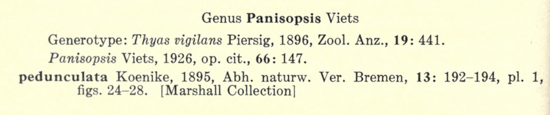
As an example (for reasons I can't remember), I came across the name "Panisopus" (in the water mote family Thyasidae) but was struggling to find any mention of the taxonomic literature associated with this name. If you Google Panisopus the first two pages are full of search results from ITIS, EOL, GBIF, ZipCodeZoo, all listing several species in the genus, and sometimes taxonomic authorities, but no links to the primary literature. If you search BHL for Panisopus you get nothing, nothing at all. It's as if the name didn't exist.

Turns out, that's exactly the point. The name doesn't exist, other than in the various databases that have consumed other databases and recycled this fictional taxon. After some Googling of author's names it became clear that "Panisopus" is probably a misspelling of "Panisopsis", which according to ION was published in:

Viets, K. (1926) Eine nomenklatorische Aenderung im Hydracarinen-Genus Thyas C. L. Koch. Zool Anz Leipzig, 66: 145--148

I can't verify this because this article is not available online. But to give one example, ITIS lists the name "Panisopus pedunculata Keonike, 1895" (TSN 83185). This name should be, as far as I can tell, Panisopsis pedunculata (Koenike, 1895), based on Mitchell, 1954 (http://biostor.org/reference/104266, http://dx.doi.org/10.5962/bhl.title.3110) who on page 36 states:

Mitchell

Note that Panisopsis pedunculata was originally described in a different genus (Koenike 1895 preceeds the publication of the genus name by Viets in 1926). We can locate Koenike's original publication "Nordamerikanische Hydrachniden" in BHL, which I've added to BioStor http://biostor.org/reference/104265, and the original description appears on p. 192 as Thyas pedunculata (note that ITIS misspells the author's name Koenike [o and e transposed], as well as omitting the parentheses around the name).

What I find a little alarming (if not surprising) is that the entirely fictional genus "Panisopus" its accompanying species have ended up in numerous taxonomic databases, and these databases consistently appear in the top Google searches for this name. The good news is that it's becoming increasingly easy to discover these errors, in part because more and more taxonomic literature is coming online, making it possible for users to investigate matters for themselves, rather than rely on unsupported statements in taxonomic databases. I'm continually amazed by how little evidence most taxonomic databases provide for any of the assertions that they make. If a database includes a name, I want some evidence that the name is "real". Show me the publication, or at least give me a citation that I can follow up. I can't take these databases on blind faith, because demonstrably they are replete with errors. Ironically, one measure of success in the Internet age is being in the top 10 hits for a Google search. Now, if the top ten hits are all taxonomic databases I get very, very nervous. It's a good sign the name only exists in those databases.

Friday, June 15, 2012

BHL to PDF workflow

Just some random thoughts on creating searchable PDFs for article extracted from BHL.

Workflow

Thursday, June 14, 2012

Taxonomy and the nine billion names of God

In Arthur C. Clarke's short story The Nine Billion Names of God Tibetan monks hire two programmers to help them generate all the the possible names of God. The monks believe that the purpose of the Universe is to generate those names, once that goal is achieved the Universe will end. As the understandably skeptical programmers leave having completed their task, they look up into the sky and notice that "overhead, without any fuss, the stars were going out."

Leaving aside the delicious irony that arises if we recast this story with the monks replaced by taxonomists, much of our work with taxonomic names seems to be enumerating endless permutations of the same names. Part of the problem is the way some databases store and provide access to names.


The simplest way to represent a taxonomic name is to just have the name (the "canonical name"), without additional bits such as the taxonomic authority. In my view, any taxonomic database that serves names should provide the canonical name. I'm not arguing that they shouldn't provide taxonomic authority information (ideally separately, but could also be as part of a canonical name + authority string), I just want them to also provide just the canonical name. For some reason this seems to upset people (e.g., this thread on the TDWG mailing lists), so let me explain why I think this matters.

Most people use taxonomic names without the authority (just Google a taxonomic name with and without it's authority and compare the number of hits). So, if your goal is to be of service to your users, make sure you provide the canonical name.

Then there is the issue of integrating data from different sources. The more parts to the name the more scope there is for ambiguity. For example, my first ever publication was a description of a new species of peacrab, Pinnotheres atrinicola, published in:

Page, R. D. M. (1983). Description of a new species of Pinnotheres , and redescription of P. novaezelandiae (Brachyura: Pinnotheridae) . New Zealand Journal of Zoology, 10(2), 151–162. doi:10.1080/03014223.1983.10423904

If we look for this name in ION we discover three records:

Pinnotheres atrinacolaurn:lsid:organismnames.com:name:1192320
Pinnotheres atrinicolaurn:lsid:organismnames.com:name:371872
Pinnotheres atrinicola Page 1983urn:lsid:organismnames.com:name:371873


Two are duplicates of "Pinnotheres atrinicola", with and without the authority, one is a misspelling ("Pinnotheres atrinacola"). Given just the name we already see that it's easy for people to get the spelling wrong and generate lexical variants.

If we now add the authority we get more potential for variation. ION write the authority as "Page 1983" (no comma), but other databases such as WoRMS write it as Page, 1983 (with comma). So we now have two variations of the name, and two for the authority, so 4 possible strings if we include both name and authority. This combinatorial explosion means that we can rapidly generate lots of strings that are fundamentally the same.

I'm not arguing that taxonomic authorities aren't useful, and I want them wherever they are known, but insisting that databases serve name + authority to the exclusion of just the canonical name is a recipe for disaster. One could argue that users can parse the string into name and authority components, but that's a headache (just take a look at taxon-name-processing for details). Why make users go through hoops to get basic information?

Another reason I'm wary of taxonomic authority strings is that people don't always understand the conventions. For example, in my previous post I used the following example for names that differed in authority string:

  • Demansia torquata Günther 1862
  • Demansia torquata (Günther, 1862)

The use of parentheses seems a small difference, but (a) it means the strings are different, and (b) the presence or absence of parentheses changes the meaning of the authority. In this example, Demansia torquata Günther 1862 means that Günther is the original author of the name Demansia torquata, and so if I search Günther's publications from 1862 for "Demansia torquata" I will find that name. Demansia torquata (Günther, 1862), on the other hand, means that Günther originally described this species in 1862, but he placed it in a different genus, so my search for "Demansia torquata" in 1862 is likely to be fruitless. So, if the authority is actually (Günther, 1862) but a database tells me it's Günther, 1862 I'd be wasting my time looking for the name in 1862.

As it turns out, this snake was originally described as Diemansia torquata (see "On new species of snakes in the collection of the British Museum" http://biostor.org/reference/50221). The genus name Diemansia differs from Demansia, hence (Günther, 1862) should be correct, but it looks like Diemansia and Demansia are just some of the variations of the same snake genus (see for example http://biodiversitylibrary.org/page/22393791). *Sigh*

Variation in taxonomic authority extends beyond parentheses. In a post on clustering strings I used examples of taxonomic authorities for the genus Helicella:

Ferrusac 1821
Bonavita 1965
Ferussa 1821
Fer.
Lamarck 1812
Ferussac 1821

There are six different strings here which correspond to three different authorities. In this example the name Helicella is a homonym (same name used for different taxa) so having the taxonomic authority can help decide which name is actually meant, but people can't seem to agree on how to spell the authority names, and in other cases they might not agree on dates of publication, hence we get variations such as those above. Even when authorities are useful, they come at a cost. And that's not even considering chresonyms where the authority isn't the original author, but instead is a form of citation of the use of a name.

All of this variation is a cause of ambiguity, and when we combine permutations of taxonomic names and taxonomic authorities, things start to get messy. Indeed, I'd argue that projects such as the Global Names Index (GNI) are essentially doing what Arthur C. Clarke's monks were doing, trying to capture near endless permutations of the same names. Given this, it seems crazy not to try and keep things as simple as possible. In the vast majority of cases I want the name, I don't want the rest of the cruff attached to it. Taxonomic authorities are really just proxies for citation, so lets focus on getting that information linked to names, and stop making life difficult for users.

Wednesday, June 13, 2012

Visualising differences between classifications using cluster maps

As part of a project to build a tool to navigate through taxonomic names and classifications I've become interested in quick ways to compare classifications. For example, EOL has multiple classifications for the same taxon, and I'd like to quickly discover what the similarities and differences are.

One promising approach is to use "cluster maps", a technique described by Fluit et al. (see Aduna Cluster Map for an implementation):

Fluit, C., Sabou, M., & Harmelen, F. (2006). Visualizing the Semantic Web. (V. Geroimenko & C. Chen, Eds.) (pp. 45–58). Springer Science + Business Media. doi:10.1007/1-84628-290-X_3 (see also http://www.cs.vu.nl/~frankh/abstracts/VSW05.html)

Cluster map details

Cluster maps can be thought of as fancy Venn Diagrams, in that they can be used to depict the overlap between sets of objects. The diagram is a graph with two kinds of nodes. One represents categories (in the example above, file formats and search terms), the other represents sets of objects that occur in one or more categories (in the example above, these are files that match the search terms "rdf" and "aperture").

I've cobbled together a crude version of cluster maps. For a given taxon (e.g., a genus) I list all the immediate sub-taxa (e.g., species) in each classification in EOL, and then find the sets of sub-taxa that are shared across the classification sources (e.g., ITIS, NCBI, etc.) and those that are unique to one source. I then create the cluster map using Graphviz. Inspired by the hexagonal packing used by Aduna, I've done something similar to display the taxa in each set. Adding these to the output of Graphviz required a little fussing with. First I get Graphviz to output the graph in SVG, then I load the SVG into a program that locates each node in the graph and inserts SVG for the packed circles (given that SVG is XML this is fairly straightforward).

As an example, consider the genus Demansia (http://eol.org/pages/34967/overview). EOL reports four classifications for this genus. Below is a cluster map for this genus:

34967

This diagram show that, for example, the Catalogue of Life (CoL) and Reptile databases share 4 names, these databases share three other names with ITIS. All databases have names unique to themselves, one database (NCBI) is completely disconnected from the other three databases.

One important caveat here is that I'm mapping the scientific names as returned by EOL, and in many cases these contain the taxonomic authority. This is a major headache, prompting this outburst:


If we clean the names by removing the taxonomic authority the clusters overlap rather more:
Demansia
Now we see that only ITIS and the Reptile Database have unique names. This is one reason why I get stroppy when taxonomists start saying databases shouldn't have to supply cleaned "canonical" names. If the names have authorities then I have to clean them, because in many cases the authorities (while useful to know) are inconsistent across databases. For example:

  • Demansia olivacea GRAY 1842 versus Demansia olivacea (Gray, 1842)
  • Demansia torquata GÜNTHER 1862 versus Demansia torquata (Günther, 1862)

Taxonomic authorities are frequently misspelt, and people seem confused about when to use parentheses or not. Databases should spare the user some pain and provide clean names (and authority strings separately where they have them).

The visualisation is still incomplete (I need to make it interactive), but it shows promise. The names that are unique to one database are usually worth investigating. In some cases they are names other databases regard as synonyms, in other cases they represent spelling variations. The goal of this visualisation is to highlight the names that the user might want to investigate further.