Rants, raves (and occasionally considered opinions) on phyloinformatics, taxonomy, and biodiversity informatics. For more ranty and less considered opinions, see my Twitter feed. ISSN 2051-8188. Written content on this site is licensed under a Creative Commons Attribution 4.0 International license.
Time for a Friday folly. I've made a clunky screencast showing an example of linking biodiversity data together, using bioGUID as the universal wrapper around various data sources. I started with GenBank sequence EF013683, added another, EF013555, then explored some links (specimen, publication, taxon, journal), using the OpenLink RDF Browser:
The demo is a bit clunky, partly because the linked data browser is generic. What we really need is a browser that is tailored to displaying the kind of data we're interested, and hides the gory details under the hood. But the goal is to show that, once everything we care about has a resolvable URI that provides data in a consistent form, and we re-use identifiers, then we can glue stuff together with relative ease. In principle we can simply crawl this web of data (you can append other DOIs, ISSNs, and Genbank accession numbers to http://bioguid.info and get RDF to your heart's content).
None of this is particularly new, we've had RDF in biodiversity informatics for at least five years, there are various linked data-style projects, such as GeoSpecies and the first iteration of bioGUID, and some people (such as Roger Hyam) have been pushing HTTP URIs + RDF for a while, but we seem remarkably unable to get traction on this. Notably, no major biodiversity provider provides RDF (by major I mean GenBank or GBIF size). We make diagrams like the one I drew for GBIF last year, we make the case that linking is a Good Thing™, and yet nothing much happens. This suggests that the idea is still not be presented in a compelling enough fashion. Certainly, clunky demos like the one above probably won't help much. Linked Data clients are generally pretty awful things to use. I think we're going to need some compelling applications that really grab people's attention.
Nobody uses LSIDs except the biodiversity informatics crowd, have we missed something?
LSIDs don't play nice with the Linked Data/Semantic Web world, which is much bigger than us
If we adopt HTTP URIs, will this send the wrong message to data providers (LSIDs imply a commitment to persistence, URLs don't)
The community has invested a lot in LSIDs, it's too late to change course now
There are other issues as well, in many ways much harder, namely how to ensure adoption and long term persistence of whatever identifier technology the techies agree on.
I've been twittering (@rdmpage) about some of this, and Pierre Lindenbaum blogged about my earlier paper on testing LSIDs (doi:10.1186/1751-0473-3-2), so I decided to return to one of the original goals of my bioGUID project, namely providing a tool to resolve existing identifiers in a consistent way (see the now moribund bioGUID blog, I now blog about bioGUID here on iPhylo). One of the goals of bioGUID was to take an identifier and return RDF. I also had an underlying triple store that was populated with this RDF. After a hardware crash I took the opportunity to rebuild bioGUID from scratch, focussing on OpenURL access to literature. Now, I'm looking at LSIDs again.
The standard response to the concern that the rest of the world has gone down the HTTP URI route is to say that we can stick a HTTP proxy on the front of the LSID (e.g., http://lsid.tdwg.org/urn:lsid:indexfungorum.org:names:21364) and play ball with the Linked Data crowd, who are rapidly linking diverse data sets together: However, sticking a HTTP proxy on an LSID isn't enough. As outlined in the document Cool URIs for the Semantic Web, we need a way of distinguishing between a HTTP URI that identifies real-world objects or concepts (such as a person or a car), and documents describing those things (put another way, if I put a HTTP URI for Angelina Jolie into a web browser, I expect to get a document describing her, not Ms Jolie herself) . One solution (and the one that is gaining traction) is to use 303 redirects to make this explicit: A client resolving a URI for a thing will get a 303 status code, telling them that the URI identifies an object. They can get the appropriate representation via content negotiation (a web browser wants HTML, a linked data browser wants RDF).
Data URIs. So, in order to get LSIDs to play ball with Linked Data we need a HTTP proxy that supports 303 redirects (as Roger Hyam pointed out). I've implemented a simple one as part of bioGUID. If you append a LSID to http://bioguid.info/ you get a HTTP URI that passes the Vapour Linked Data validator tests. For example, http://bioguid.info/urn:lsid:indexfungorum.org:names:21364 resolves to a web page in a browser, but clients that ask for RDF will get that. You can see the steps involved in resolving this Cool URI here. Vapour provides a nice graphical overview of the process:
The TDWG LSID proxy doesn't validate, so this is something that should be addressed.
In addition to resolving LSIDs, my service stores the resulting RDF in a triple store using ARC, and you can query this triple store using a SPARQL interface that makes use of Danny Ayers' Javascript SPARQL editor. I've a serious case of déjà vu as I've implemented this feature several times before using 3store3 (usually after much fun getting it to work). I got bored with triple stores as the bigger problem seemed to be the errors in the metadata I was harvesting, which seriously limited my ability to link different objects together (but that's another story).
I started this blog with the goal of documenting my own efforts to make a database of evolutionary trees, based on ideas sketched in hdl:10.1038/npre.2007.1028.1. I've felt that the major task is link phylogenies to other information, such as taxon names, specimens, localities, images, publications, etc. That is, to embed trees in a broader context. Discovering how to engage with that broader context led to a bunch of experiments, toys, and diversions:
iSpecies, a toy to aggregate information on a species.
Semant, experiments with RDF and triple stores (AKA the Semantic Web).
bioGUID, an attempt to make identifiers resolvable, with an increasing focus on developing an OpenURL resolver for biodiversity literature.
iSpecies and bioGUID are still operational, but the ant work fell victim to server crashes, and a growing frustration with the limitations of triple stores. Blogs for all three projects document their histories: iSpecies, Semant, and bioGUID. In a sense, these blogs document the steps along the way to iPhylo.
Based on this experience, I started again with what I've previously referred to as a database of everything. The first public demo is online at iphylo.org/~rpage/demo1. It's very crude, but may give a sense of what I'm trying to do.
The goal of iPhylo is to treat biodiversity objects as equal citizens. Each object has a unique identifier, associated metadata, and is linked to other objects (for example, a specimen is linked to sequences, sequences are linked to publications, etc.). By following the links it is possible to generate new views on existing information, such as a map for study that doesn't have any maps. For example, below is a map generated for Brady et al. (doi:10.1073/pnas.0605858103), based on links between sequences and specimens (if you can't see the map you need a SVG-capable web browser, such as Safari 3 or Firefox 2).
Ironically there are no phylogenies yet. At this stage I'm trying to link the bits together.
How does it work? More on this later. Briefly, iPhylo uses a entity-attribute-value model database to store objects and their relationships. Like bioGUID, iPhylo relies on a suite of web services (most external, some I've developed locally) to locate and resolve identifiers. iPhylo resolves identifiers for PubMed records, GenBank sequences, museum specimens, publications, etc. and adds the associated metadata to a local database. Wherever possible it resolves any links in the metadata (e.g., if a GenBank record mentions a specimen, iPhylo will try and retrieve information on that specimen). When you view an object in iPhylo, these links are displayed. iPhylo will also try and convert bibliographic records to identifiers (such as DOIs) if no identifiers are provided, and also extracts georeferences for specimens and sequences, either from original records or by using a georeferencing service. Taxonomic names are resolved using uBio, and are treated as "tags."
At present iPhylo is being populated by various scripts, there is no facility for users to add data. This is something I will add in the future.
Getting the data One of the biggest challenges is getting data (or, to be more precise, figuring out how to harvest available data). iPhylo builds on code for bioGUID. I've also been exploring bulk harvesting data sources. Sometimes this is easy. Many sequences in Genbank are linked to records in PubMed, so if you know the Pubmed id for a paper, you can harvest the sequences. For example, even though the Bulletin of the American Museum of Natural History isn't indexed in PubMed, it is possible to retrieve all the sequences GenBank records as being from papers published in the Bulletin. You can retrieve this list in XML form by clicking here.
Why?
There are all sorts of things which could be done with this. For example, by linking objects together we can also track the provenance of data, and ultimately build "citation networks" of specimens, sequences, etc. For background see my paper on "Biodiversity informatics: the challenge of linking data and the role of shared identifiers" (doi:10.1093/bib/bbn022, preprint at hdl:10101/npre.2008.1760.1).
As mentioned above, we can generate maps even if the original study didn't include one (by following the links). Given that we can geotag studies, this opens up the possibility to query studies spatially. For example, this study on bats and this study on rodents deal with taxa with very similar distributions. A spatial query could find these easily. Imagine interested in, say, Madagascar, and being able to find phylogenetic studies , even if the title and abstract of the paper don't mention Madagascar by name.
There also potential to clean data. One of the first studies I uploaded is Grant et al.'s study of dart-poison frogs. The map for this study shows a outlying point in California:
This point is MVZ 199828, which is a specimen of the salamander Aneides flavipunctatus. In GenBank, MVZ 199828 is listed as the voucher for seven sequences from the frog Mannophryne trinitatis. Oops. A quick iSpecies search, and a click on the GBIF map reveals that there is a specimen MVZ 199838 of Mannophryne trinitatis. i suspect that this is the true voucher for these sequences, and the GenBank records contain a typo.
Future This is all still very, very crude. The demo is slow, the queries aren't particularly clever, and I've probably gone overboard on using Javascript to populate the web pages. The real value isn't in the web pages, but the links between the data objects. This is my main focus -- extracting and adding links. For now the data is displayed but you can't edit it. However, this is coming. Very basic RDF and RSS feeds are available for each object, and fans of microformats will find some goodies, and sociologists of science may find some of the coauthorship graphs intriguing
What follows are some random thoughts as I try and sort out what things I want to focus on in the coming days/weeks. If you don't want to see some wallowing and general procrastination, look away now.
I see four main strands in what I've been up to in the last year or so:
Mashups iSpecies is my now aging tool for mashing up data from diverse sources, such as Wikipedia, NCBI, GBIF, Yahoo, and Google Scholar. I tweak it every so often (mainly to deal with Google Scholar forever mucking around with their HTML). The big limitation of iSpecies is that it doesn't make it's results reusable (i.e., you can't write a script to call iSpecies and return data). However, it's still the place I go to to quickly find out about a taxon.
The other mashups I've been playing with focus on taking standardised RSS feeds (provided by bioGUID, see above) and mashing them up, sometimes with a nice front end (e.g., my e-Biosphere 09 challenge entry).
Wiki I've invested a huge amount of effort in learning how wikis (especially Mediawiki and its semantic extensions) work, documented in earlier posts. I created a wiki of taxonomic names as a sandbox to explore some of these ideas.
I've come to the conclusion that for basic taxonomic and biological information, the only sensible strategy for our community is to use (and contribute to) Wikipedia. I'm struggling to see any justification for continuing with a proliferation of taxonomic databases. After e-Biosphere 09 the game's up, people have started to notice that we've an excess of databases (see Claire Thomas in Science, "Biodiversity Databases Spread, Prompting Unification Call", doi:10.1126/science.324_1632).
Phyloinformatics In truth I've not been doing much on this, apart from releasing tvwidget (code available from Google Code), and playing with a mapping of TreeBASE studies to bibliographic identifiers (available as a featured download from here). I've played with tvwidget in Mediawiki, and it seems to work quite well.
Where now? So, where now? Here are some thoughts:
I will continue to hack bioGUID (it's now consuming RSS feeds from journals, as well as Zotero). Everything I do pretty much depends on the services bioGUID provides
iSpecies really needs a big overhaul to serve data in a form that can be built upon. But this requires decisions on what that format should be, so this isn't likely to happen soon. But I think the future of mashup work is to use RDF and triple stores (providing that some degree of editing is possible). I think a tool linking together different data sources (along the lines of my ill-fated Elsevier Challenge entry) has enormous potential.
I'm exploring Wikipedia and Wikispecies. I'm tempted to do a quantitative analysis of Wikipedia's classification. I think there needs to be some serious analysis of Wikipedia if people are going to use it as a major taxonomic resource.
If I focus on Wikipedia (i.e., using an existing wiki rather than try to create my own), then that leaves me wondering what all the playing with iTaxon was for. Well, actually I think the original goal of this blog (way back in December 2005) is ideally suited to a wiki. Pretty much all the elements are in place to dump a copy of TreeBASE into a wiki and open up the editing of links to literature and taxonomic names. I think this is going to handily beat my previous efforts (TbMap, doi:10.1186/1471-2105-8-158), especially as errors will be easy to fix.
So, food for thought. Now, I just need to focus a little and get down to actually doing the work.
I'm not sure who said it first, but there's a librarianly spin on the old Perl paradigm I think I heard at code4libcon or Access in the past year: instead of "making simple things simple, and complex things possible," we librarians and those of us librarians who write standards tend, in writing our standards, to "make complex things possible, and make simple things complex." That approach just won't cut it anymore. -Dan Chudnov, Rethinking OpenURL
Time to bring some threads together. I've been working on a tool to parse references and find existing identifiers. The tool is at http://bioguid.info/references (for more on my bioGUID project see the blog). Basically, you paste in one or more references, and it tries to figure out what they are, using ParaTools and CrossRef's OpenURL resolver. For example, if you paste in this reference:
Vogel, B. R. 2004. A review of the spider genera Pardosa and Acantholycosa (Araneae, Lycosidae) of the 48 contiguous United States. J. Arachnol. 32: 55-108.
OK, but what if there is no DOI? Every issue of the Journal of Arachnology is online, but only issues from 2000 onwards have DOIs (hosted by my favourite DOI breaker, BioOne). How do I link to the other articles? One way is using OpenURL. What I've done is add an OpenURL service to bioGUID. If you send it a DOI, it simply redirects you to dx.doi.org to reoslve it. But I've started to expand it to handle papers that I know have no DOI. First up is the Journal of Arachnology. I used SiteSucker to pull all the HTML files listing the PDFs from the journal's web site. Then I ran a Perl script that read each HTML file and pulled out the links. There weren't terribly consistent, there are at least five or six different ways the links are written, but they are consistent enough to parse. What is especially nice is that the URLs include information on volume and starting page number, which greatly simplifies my task. So, this gives me list of over 1000 papers, each with a URL, and for each paper I have the journal, year, volume, and starting page. These four things are enough for me to uniquely identify the article. I then store all this information in a MySQL database, and when a user clicks on the OpenURL link in the list of results from the reference parser, if the journal is the Journal of Arachnology, you go straight to the PDF. Here's one to try.
Yeah, but what else can we do with this? Well, for one thing, you can use the bioGUID OpenURL service in Connotea. On the Advanced settings page you can set an OpenURL resolver. BY default I use CrossRef, but if you put "http://bioguid.info/openurl.php" as the Resolver URL, you will be able get full text for the Journal of Arachnology (providing that you've entered sufficient bibliographic details when saving the reference).
But I think the next step is to have a GUID for each paper, and in the absence of a DOI I'm a favour of SICI's (see my del.icio.us bookmarks for some background). For example, the paper above has the SICI 0161-8202(1988)16<47>2.0.CO;2-0. If this was a resolvable identifier, then we would have unique, stable identifiers for Journal of Arachnology papers that resolve to PDFs. Anybody making links between, say a scientific name and when it was published (e.g., catalogue of Life) could use the SICI as the GUID for the publication.
I need to play more with SICIs (and when I get the chance I'll write a post about that the different bits of a SICI mean), but for now before I forget I'll note that while writing code to generate SICIs for Journal of Arachnology I found a bug in the Perl module Algorithm-CheckDigits-0.44 that I use to compute the checksum for a SICI (the final character in the SICI). The checksum is based on a sum of the characters in the SICI modulo 37, but the code barfs if the sum is exactly divisible by 37 (i.e., the remainder is zero).
Prepare and present a real-time demonstration during the days of the Conference of the capabilities in your community of practice to discover, disseminate, integrate, and explore new biodiversity-related data by:
Capturing data in private and public databases;
Conducting quality assurance on the data by automated validation and/or peer review;
Indexing, linking and/or automatically submitting the new data records to other relevant databases;
Integrating the data with other databases and data streams;
Making these data available to relevant audiences;
Make the data and links to the data widely accessible; and
Offering interfaces for users to query or explore the data.
Originally I planned to enter the wiki project I've been working on for a while, but time was running out and the deadline was too ambitious. Hence, I switched to thinking about RSS feeds. The idea was to first create a set of RSS feeds for sources that lack them, which I've been doing over at http://bioguid.info/rss, then integrate these feeds in a useful way. For example, the feeds would include images from Flickr (such as EOL's pool), geotagged sequences from GenBank, the latest papers from Zootaxa, and new names from uBio (I'd hoped to include ION as well, but they've been spectacularly hacked).
After playing with triple stores and SPARQL (incompatible vocabularies and multiple identifiers rather buggers this approach), and visualisations based on Google Maps (building on my swine flu timemap), it dawned on me what I really needed was an eye-catching way of displaying geotagged, timestamped information, just like David Troy's wonderful twittervision and flickrvision.com. In particular, David took the Poly9 Globe and added Twitter and Flickr feeds (see twittervision 3D and flickrvision 3D. So, I took hacked David's code and created this, which you can view at http://bioguid.info/ebio09/www/3d/:
It's a lot easier to simply look at it rather than describe what it does, but here's a quick sketch of what's under the hood.
Firstly, I take RSS feeds, either the raw geoFeed from Flickr, or from http://bioguid.info/rss. The bioGUID feeds include the latest papers in Zootaxa (most new animal species are described in this journal), a modified version of uBio's new names feed, and a feed of the latest, geotagged sequences in GenBank (I'd hoped to use only DNA barcodes, but it turns out rather few barcode sequences are geotagged, and few have the "BARCODE" keyword). The Flickr feeds are simple to handle because they include locality information (including latitude, longitude, and Yahoo Where-on-Earth Identifiers (WOEIDs)). Similarly, the GenBank feed I created has latitude and longitudes (although extracting this isn't always as straightforward as it should be). Other feeds require more processing. The uBio feed already has taxonomic names, but no geotagging, so I use services from Yahoo! GeoPlanet™ to find localities from article titles. For the Zootaxa feed that I created I use uBio's SOAP service to extract taxonomic names, and Yahoo! GeoPlanet™ to extract localities.
I've tried to create a useful display popup. For Zootaxa papers you get a thumbnail of the paper, and where possible an icon of the taxonomic group the paper talks about (the presence of this icon depends on the success of uBio's taxonomic name finding service, the Catalogue of Life having the same name, and my having a suitable icon). The example above shows a paper about copepods. Other papers have a icon for the journal (again, a function of my being able to determine the journal ISSN and having a suitable icon). Flickr images simply display a thumbnail of the image.
What does it all mean? Well, I could say all sorts of things about integration and mash-ups but, dammit, it's pretty. I think it's a fun way to see just what is happening in digital biodiversity. I've deliberately limited the demo to items that came online in the month of May, and I'll be adding items during the conference (June 1-3rd in London). For example, if any more papers appear in Zootaxa, or in the uBio feeds I'll add those. If anybody uploads geotagged photos to EOL's Flickr group, I'll grab those as well. It's still a bit crude, but it shows some of the potential of bringing things together, coupled with a nice visualisation. I welcome any feedback.
Continuing the Friday folly theme, below is a screencast of a linked data browser that uses the same ideas as last week's screencast, but uses a custom browser I've written to display the results in a more user-friendly way.
Nothing like a little hubris first thing Monday morning...
After various experiments, such as a triple store for ants (documented on the Semant blog) and bioGUID (documented on the bioGUID blog), I'm starting from scratch and working on a "database of everything". Put another way, I'm working on a database that aggregates metadata about specimens, sequences, literature, images, taxonomic names, etc. But beyond "merely" aggregating data I'm really interested in linking the data. Here are some design decisions I've made so far.
The first is that the database structure used to store metadata uses the Entity–Attribute–Value (EAV) model (for some background see the papers I've bookmarked on Connotea with the tag entity–attribute–value). This tends to send traditional database managers into fits, but for my purposes (storing objects of different kinds with frequently sparse metadata) it seems a natural choice. It's a little bit like a triple store, but I find triple stores frustrating when creating a database. Given the often low quality of the incoming data a lot of post-processing may be needed. Having the data easily accessible makes this task easier -- I view triple stores as "read only" databases. The data I store will be made available as RDF, so users could still use Semantic Web tools to analyse it.
Each object stored in the database gets an identifier based on a md5 hash of one of it's GUIDs (e.g., PubMed identifier, DOI, URL), a technique used by del.icio.us and Connotea (for example, the md5 hash of "http://dx.doi.org/10.2196/jmir.5.4.e27" is d00cf429c001c3c7ae4f2d730718dcc8, hence the Connotea URI for this article is http://www.connotea.org/article/d00cf429c001c3c7ae4f2d730718dcc8). The URIs for the objects in my database will also use these md5 hashes. The original GUIDs (such as DOIs, etc.) are stored within the database.
Much of the programming for this project involves retrieving metadata associated with an identifier. Taking the code I wrote for bioGUID as a starting point, I've added a lot of code to try and clean up the metadata (fixing dates, extracting latitude and longitudes and such like, see Metacrap), but also to extract additional identifiers from text. The database is fundamentally about these links between objects. Typically I write a client for a service that returns metadata for an identifier (typically in XML), transform it to JSON, then post process it.
Another decision is that names of genes and taxa are treated as tags, postponing any decision about what the names actually refer to, as well as whether two or more tags refer to the same thing. The expectation is that much of this can be worked out after the fact (in much the same way as I did for the TbMap project).
The database is being populated in two ways, spidering and bulk upload. Spidering involves taking an identifier, finding any linked identifiers, and resolving those. For example, a PubMed identifier may link to a set of nucleotide sequences, many of which may link to a specimen code. Bulk upload involves harvesting large numbers of records and adding them to the database.
The initial focus is on adding records related to TreeBASE, with a view to creating an annotated version of that database such that a user could ask questions like "find me all phylogenies in TreeBASE that include taxa from Australia."
The HTML isn't much to look at, the real goodness is the JSON (obtained by appending "&display=json" to the OpenURL request, or ".json" to the short form, e.g. http://bioguid.info/genbank/DQ502033.json).
The resolver gets the sequence form NCBI, does a little post processing, then displays the result. Postprocesisng includes parsing the latitude and longitude coordinates (something of a mess in GenBank, see my earlier metacrap rant), extracting specimen codes, adding bibliographic GUIDs (such as DOIs, Handles, or URLs), finding uBio namebankID's for hosts, etc. Note that some records have a key called "taxonomic_group". This is to provide clues for resolving museum specimens -- often the DiGIR provider needs to know what kind of taxon you are searching for.
The aim is to have a simple service that returns somewhat cleaned up GenBank records that I (and others) can play with.
For fun I quickly programmed a little tool for bioGUID that makes use of Connotea's web api. When an article is displayed, the page loads a Javascript script that makes a call to a simple web service that looks up a reference in Connotea and displays a tag cloud if the reference is found. For example, the paper announcing Zoobank (doi:10.1038/437477a) looks like this:
The reference has been bookmarked by 6 people, using 15 tags, some more popular than others. The tags and users are linked to Connotea.
This service is can be accessed at http://bioguid.info/services/connotea.php?uri=<doi here>, for example http://bioguid.info/services/connotea.php?uri=doi:10.1038/437477a. By default it returns JSON (you can also set the name of the callback function by add a &callback= parameter), but you can get HTML by adding &format=html. The HTML is also included in the JSON result, if you want to quickly display something, rather than roll your own.
Basically the service takes the DOI you supply, converts it to an MD5 hash, then looks it up in Connotea. There were a few little "gotcha's", such as the fact that the Connotea user may have bookmarked "doi:10.1038/43747" or the proxied version "http://dx.doi.org/10.1038/43747", and these have different MD5 hashes. My service tries both variations and merges the results.
Basically, OpenRef is a human-readable identifier for an article, based on concatenating the journal name, year of publication, volume number, and starting page, for example:
A key cosmetic (and philosophical) difference between OpenURL and OpenRef/ResolveRef URLs is that OpenURL uses HTTP GET fields, eg ?title=bla&issn=12345, while OpenRef/ResolveRef uses the URL path itself eg, somejournalname/2008/4/1996. It’s a bit like one scheme was designed in the age of CGI scripts, while the other was designed for web applications capable of more RESTful behaviour. In my mind OpenURL is more versatile but much uglier, while OpenRef is cleaner and simpler but can only reference journal articles.
Of course, it is straightforward to add openref-style URLs to an OpenURL resolver by using URL rewriting, for example:
I've done this for my resolver. One limitation of OpenRef is that there are many different ways to write a journal's name, so you can't determine whether two OpenRef's refer to the same journal by simply string matching (as you can with a DOI, for example -- if the DOI's are different the article is different). For example I might write BMC Bioinformatics and you might write BMC Bioinf.. One way around tis is to have unique identifiers for journals, which of course is the approach Robert Cameron advocated with Universal Serial Item Names and JACC's. The obvious candidate for journal identifier is the ISSN. I guess the problem here is that it's easier to use the journal name rather than require the user to know the ISSN. OpenRefs are certainly easier to write. Hence, I think they are great as a simple way for people to construct a resolvable URL for an artcle, but not so great as an identifier.
Finally submitted (two days late) a manuscript for the BMC Bioinformatics Special Issue on Biodiversity Informatics organised by Neil Sarkar and sponsored by EOL and CBOL. The manuscript, entitled "bioGUID: resolving, discovering, and minting identifiers for biodiversity informatics" describes my bioGUID project. If you are interested made pre-print available at Nature Precedings (hdl:10101/npre.2009.3079.1).
I'm in the midst of rebuilding iSpecies (my mash-up of Wikipedia, NCBI, GBIF, Yahoo, and Google search results) with the aim of outputting the results in RDF. The goal is to convert iSpecies from a pretty crude "on-the-fly" mash-up to a triple store where results are cached and can be queried in interesting ways. Why? Partly because I think such a triple store is an obvious way to underpin a "biodiversity hub" of the kind envisaged by PLoS (see my earlier post).
As ever, once one embarks down the RDF route (and I've been here before), one hits all the classic stumbling blocks, such as "what URI do I use for a thing?", and "what vocabulary do I use to express relationships between things?". For example, I'd like to represent the geographic distribution of a taxon as depicted on a GBIF map. How do I describe this in a RDF document?
To make this concrete, take one of my favourite animals, the New Zealand mud crab Helice crassa. Here's the GBIF map for this taxon:
(or http://bit.ly/cuTFW9, if you prefer). Now, there's no way I'm using this URL! Plus, the URL identifies an image, not the distribution.
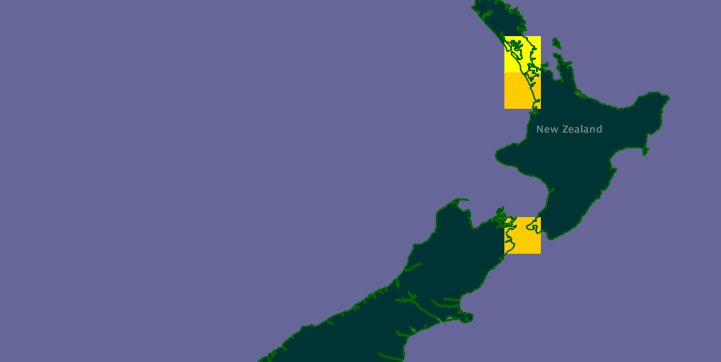
But, if we look at the map we see that it is made of 1° × 1° squares. If each of those had a URI then I could simply list those squares as the distribution of the crab. This seems straightforward as GBIF has a service that provides these squares. For example, the URL http://data.gbif.org/species/17462693 (where 17462693 corresponds to Helice crassa) returns:
These are the 1° × 1° squares for which there are records of Helice crassa. Now, what I'd like to do is have a URI for each square, and I'd like to do this without reinventing the wheel. I've come across a URI space for points of the globe (the WGS 84 Geographic Point URI Space"), but not one for polygons. Then it dawned on me that perhaps c-squares, developed by Tony Rees at the CSIRO in Australia, would do the trick1. To quote Tony:
C-squares is a system for storage, querying, display, and exchange of "spatial data" locations and extents in a simple, text-based, human- and machine- readable format. It uses numbered (coded) squares on the earth's surface measured in degrees (or fractions of degrees) of latitude and longitude as fundamental units of spatial information, which can then be quoted as single squares (similar to a "global postcode") in which one or more data points are located, or be built up into strings of codes to represent a wide variety of shapes and sizes of spatial data "footprints".
C-squares appeal partly (and this says nothing good about me) because they have a slightly Byzantine syntax. However, they are short, and quite easy to calculate. I'll let the reader find out the gory details. To give an example, my home town, Auckland, has latitude -36.84, longitude 174.74, which corresponds to the 1° × 1° c-square with the code 3317:364.
Now, all I need to do is convert c-squares into URIs. If you append the c-square to http://bioguid.info/csquare:, like this, http://bioguid.info/csquare:3317:364, you get a linked data-friendly URI for the c-square. In a web browser you get a simple web page like this:
Now, I can refer to each square by it's own URI. This will also enable me to query a triple store by c-square (e.g., what other taxa occur within this 1° × 1° square?).
Tony Rees had emailed me about this in response to a tweet about URIs for co-ordinates, but it took me a while to realise how useful c-square notation could be.
My institute is going through various reviews of staff performance and, frankly, I'm feeling somewhat vulnerable given my somewhat unorthodox (at least amongst my colleagues) approach to doing science. I spend way more time writing code, building databases and web sites, and blogging than writing papers and getting grants (although I have been known to do both).
So the issue becomes, how to demonstrate that coding, building websites, and ranting on my blog is a worthwhile thing to do? Now, I'm happy that what I do has value, but my happiness isn't the issue. It's convincing people who want to see papers in high impact journals and bums on seats in labs that there's other ways to generate scientific output, and that output can have value. I'm also concerned that a simplistic view of what constitutes valid outputs will stifle innovation, just at the time when traditional science publishing is undergoing a revolution.
Usually we assess the quality of academic output using measures based on citations, either directly (how many papers have cited the paper?) or indirectly (is the paper published in a journal like Nature or Science that contains papers that on average get lots of citations, i.e. "impact factor"). But what of other outputs, such as web sites, databases, and software? These outputs often require considerable work, and can be widely used. What is the best way to measure those outputs?
There have been various approaches to measuring the impact of an article other than using citations, such as the number of article downloads, or the number of times an article has been bookmarked on a site such as Mendeley or CiteULike. But what of the coding, the database development, the web sites, and the blog posts. How can I show that these have value?
I guess there are two things here. One is the need to be able to compare across outputs, which is tricky (comparing citations across different disciplines is already hard), the other is the need to be able to compare within broadly similar outputs. Here are some quick thoughts:
Web sites An obvious approach is to use Google Analytics to harvest information about page views and visitor numbers. The geographic origin of those visitors could be used to make a case for whether the research/data on that site is internationally relevant, although I suspect "internationally relevant" is a somewhat suspect notion. Most academic specialities are narrow, such that the person most interested in your research is likely living in a different country, hence by definition most research will be internationally "relevant".
The advantage of Google Analytics is that it is widely used, hence you could get comparative data and be able to show that your web site is more (or less) used that another site.
Code The value of code is tricky, but tools like ohloh provide estimates of the effort and expense required to generate code for a project. For example, for my bioGUID code repository (which includes code for bioGUID and BioStor, as well as some third party code) ohloh's estimated cost is 87 person-years and $US 4,784,203. OK, silly numbers, but at least I can compare these with other projects (Drupal, for example, represents 153 years and $US 8,438,417 of investment).
Comparing across output categories will be challenging, especially as there is no obvious equivalent for citation (one reason why if you develop software or a web site it makes good sense to write a paper describing it, worked for me). But perhaps download or article access statistics could provide a way to say "my web site is worth x publications. Note also that I'm not arguing that any of these measures is actually a good thing, just that if I'm going to be measured, and I have some say in how I'm measured, I'd like to suggest something sensible that others might actually buy.
So, please feel free to comment either here or on Quora . I need to put together some notes to make the case that people like me aren't just sitting drinking coffee, playing loud music, and tweeting without, you know, actually making stuff.
Lately I've been returning to playing with RDF and triple stores. This is a serious case of déjà vu, as two blogs I've now abandoned will testify (bioGUID and SemAnt). Basically, a combination of frustration with the tools, data cleaning, and the lack of identifiers got in the way of making much progress. I gave up on triple stores for a while, rolling my own Entity–Attribute–Value (EAV) database, which I used for the Elsevier Challenge (EAV databases are essentially key-value databases, CouchDB being a well-known example).
Now, I'm revisiting triple stores and SPARQL, partly because Linked Data is gaining momentum, and partly because we now have a few LSID providers, and some decent vocabularies from TDWG. Having created a LSID resolver that plays nicely with Linked Data (it also does the same thing for DOIs), it's time to dust off SPARQL and see what can be done.
One reason there's interest in having GUIDs and standard vocabularies is so that we can link different sources of information together. But more than just linking, we should be able to compute across these links and learn new things, or at least add annotations from one database to another.
To make this concrete, take the NCBI taxon 101855 , Lulworthia uniseptata. If we visit the NCBI page we see links to other resources, such as Index Fungorum record 105488, which tells us that Lulworthia uniseptata was published in Trans. Mycol. Soc. Japan 25(4): 382 (1984), and that the current name is Lulwoana uniseptata, which was published in Mycol. Res. 109(5): 562 (2005).
Wouldn't it be nice to be able to automatically link these things together? And wouldn't it be nice to have identifiers for the literature, rather than only human-readable text strings? Using bioGUID, we can discover that Mycol. Res. 109(5): 562 (2005) has the DOI doi:10.1017/S0953756205002716 -- I haven't found Trans. Mycol. Soc. Japan 25(4): 382 (1984) online anywhere.
What I'd like to do is link this to the NCBI taxon, so that I can display this additional knowledge in one place (i.e., there is an additional name for this fungus, and where it is published). To do this, I need the NCBI taxonomy in RDF. Turns out that everyone and their dog has been generating RDF versions of the NCBI taxonomy, including Uniport (source of the diagram above). The problem is, each effort creates their own project-specific vocabulary. For example , here is the record for NCBI taxon 101855 in Uniprot RDF (http://www.uniprot.org/taxonomy/101855):
Uniprot has it's own vocabulary, http://purl.uniprot.org/core/. So, what I'd like to do is create a version of the NCBI taxonomy using TDWG's TaxonConcept vocabulary, so that it becomes straightforward to link NCBI to name databases such as Index Fungorum, IPNI, Zoobank, and ION that are serving taxon names.
One reason for storing metadata in Zotero is so that these reference are made available through the bioGUID OpenURL resolver. This is achieved by regularly harvesting the RSS feed for my Zotero account, and adding items in that feed to the bioGUID database of articles. This makes Zotero highly attractive, as I don't have to write a graphical user interface to create bibliographic records. BHL have their own citation editor in the works ("CiteBank"), based on the ubiquitous Drupal, but I wonder whether Zotero is the better bet -- it has a bunch of nice features, including being able to sync local copies across multiple machines, and store local copies of PDFs (synced using WebDAV).
For fun I've created a Zotero group called Biodiversity Heritage Library which will list articles that I've extracted from BHL. At some point I may investigate automating this process of extracting articles (using existing blbiliographic metadata mapped to BHL page numbers), but for now there a mere 27 manually acquired items listed in the BHL group.
One problem I've encountered in building a bibliographic database is the different ways author names are written. For example, for papers I've authored my name may be written as "Roderic D. M. Page" or "R. D. M. Page". Googling about this problem I came across Dror Feitelson's paper On identifying name equivalences in digital libraries. Feitelson addresses the issue of matching first names:
The services provided by digital libraries can be much improved by correctly identifying variants of the same name. For example, this will allow for better retrieval of all the works by a certain author. We focus on variants caused by abbreviations of first names, and show that significant achievements are possible by simple lexical analysis and comparison of names. This is done in two steps: first a pairwise matching of names is performed, and then these are used to find cliques of equivalent names. However, these steps can each be performed in a variety of ways. We therefore conduct an experimental analysis using two real datasets to find which approaches actually work well in practice. Interestingly, this depends on the size of the repository, as larger repositories may have many more similar names.
Feitelson's solution is to construct a graph of similarity between first names, then find weighted cliques grouping equivalent names. For example, given the first names "Ace D. E.", "A. D.", "Abe F. G.", "Abe Bob C.", "A. B. C.", and "Abe B", we create the graph below where the edges are weighted by similarity between the names: In this example, the names "Abe Bob C", "A B C", and "Abe B" are equivalent, as are "Ace D E" and "A D", leaving "Abe F G" by itself.
I've implemented Feitelson's weighted clique algorithm in a PHP script that calls a C++ program that does the clique analysis. Results can be returned in HTML or JSON. You can try the service at http://bioguid.info/services/. You can also call the service directly by a HTTP POST request to the URL http://bioguid.info/services/equivalent.php with these parameters:
Parameter
Value
Description
names
string
List of first names, separated by end of line (\n) character
I've added a service to bioGUID that takes a PDF and attempts to extract latitude and longitude data from the PDF, returning those co-ordinates in either a Google Earth KML file, or in JSON format. This is one of a bunch of services that I'm adding to bioGUID to support some of the data mining that I'm doing.
Then try this one to get the KML file, and open it in Google Earth. The service uses a bunch of regular expressions to try and extract latitude and longitude pairs from the text (needless to say, there are nearly as many different ways to write a latitude and longitude as there are authors).
The ultimate aim is to assemble a bunch of Open Access PDFs (say, from Zootaxa), run them through this service, then display the result on Google Earth. Think of it as a geography of taxonomy.
Oh, and the irony of me criticising GBIF for displaying poor quality data, then adding to this by providing a service to extract yet more co-ordinates of possibly doubtful validity has not entirely escaped me...
As part of the slow rebuild of bioguid.info, and as part of the Challenge, I've started making an OpenURL resolver for specimens. Partly this is just a wrapper around DiGIR providers, but it's also a response to the lack of GUIDs for specimens. In the same way that I think OpenURL for papers only really makes sense in a world without GUIDs for literature (DOIs pretty much take care of that), given the lack of specimen GUIDs we are left to resolve specimens based on metadata.
For example, the holotype of Pseudacris fouquettei (shown in photo by Suzanne L. Collins, original here) is TNHC 63583. In a digital world, I want the paper describing this taxon, and the specimen(s) assigned to it to be a click away. In this spirit, here is an OpenURL link for the specimen: http://bioguid.info/openurl/?genre=specimen &institutionCode=TNHC &collectionCode=Herps &catalogNumber=63583. Click on this link and you get a page with some very basic information on the specimen. If you want more, append "&display=json" to the URL to get a JSON response.
So, armed with this, TNHC 63583 becomes resolvable, and joining the pieces becomes a little easier.
After some fussing and hair pulling I've constructed a demo of linking a journal to the Biodiversity Heritage Library and displaying the results in Zotero (see my earlier post for rationale).
After some searching I managed to retrieve metadata for several hundred article from the Bulletin of Zoological Nomenclature. Using a local copy of the BHL metadata, I wrote a script that looked up each article in BHL and found the URL of the first page in the article. I then created a Zotero group for this journal and uploaded the linked references.
You can browse the group, and if you belong to Zotero you can join the group and get a local copy of the references (which you can edit and correct, the harvesting won't be perfect).
I've also added these references to my bioGUID OpenURL resolver, making it easy to find a given article. For example, the OpenURL link http://bioguid.info/openurl/?genre=article&issn=0007-5167&volume=51&spage=7 displays a page for the article "Doris grandiflora Rapp, 1827 (currently Dendrodoris grandiflora; Mollusca, Gastropoda): proposed conservation of the specific name", together with a link to the article in BHL.




 One thing I find myself doing (probably more often than I should) is adding a reference to


